Pool Covers & Blankets: Types, Costs & What's Worth Buying
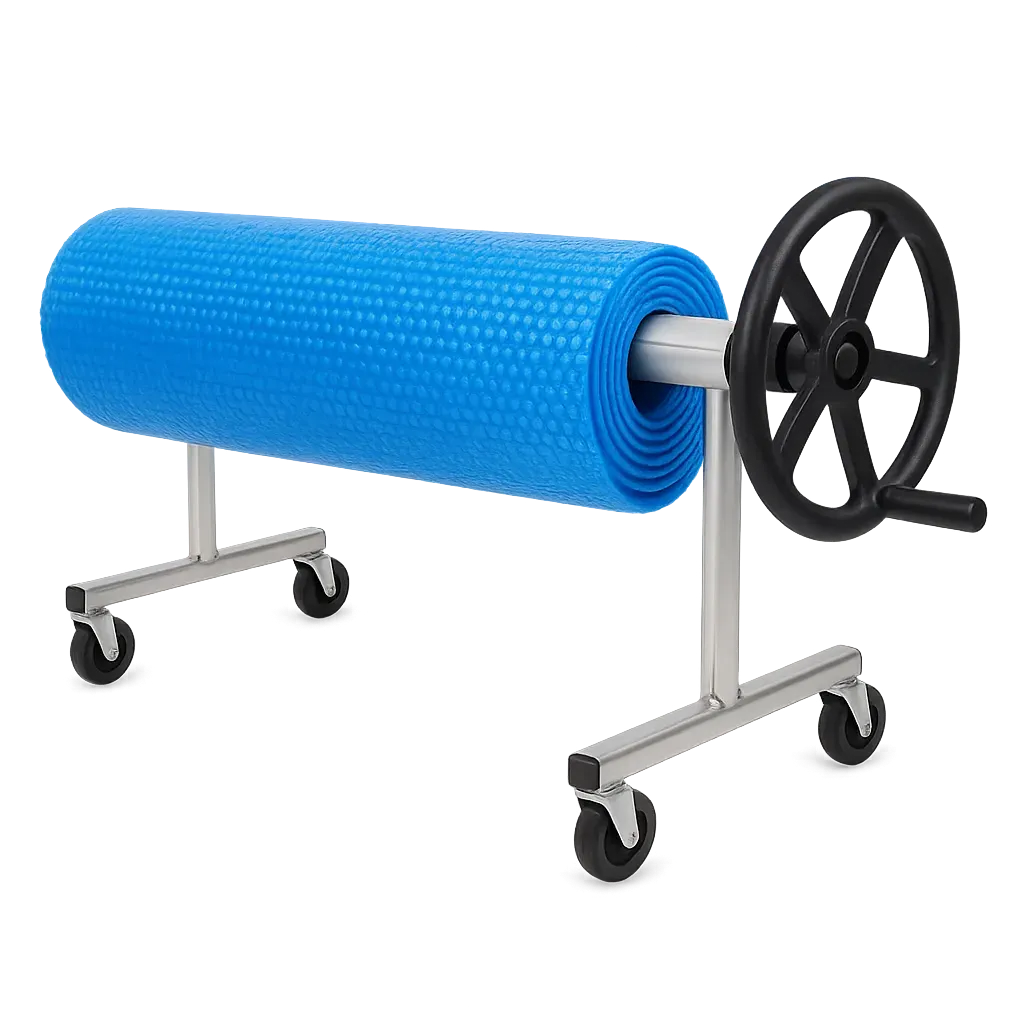
A pool cover is the least glamorous thing you can buy for a pool and comfortably the best value. It halves your biggest heat loss, keeps leaves out of the skimmer, slashes evaporation through a Queensland summer, and pays for itself faster than any other pool accessory. Here's how the options compare, what they cost, and why we fit a blanket and roller sized to the exact pool model at handover.
Why covers matter more than people think
Most of a pool's heat loss — typically around 70% — happens at the surface, and the biggest culprit is evaporation. In South East Queensland an uncovered family-sized pool can lose tens of thousands of litres a year to evaporation — estimates commonly land around 30,000–50,000 litres, depending on wind, water temperature and sun exposure. That's water you pay for, at a temperature you paid to reach, carrying chemicals you also paid for. A cover attacks all three costs at once:
- Heat: cuts overnight heat loss dramatically — figures of up to 50% are typical — which roughly halves what your heat pump works against. If you're heating, a cover isn't optional; see our pool heating cost guide.
- Water: reduces evaporation by well over 90% while the cover is on.
- Chemicals: less UV hitting the water means chlorine lasts longer; less debris means less filtering, less vacuuming and shorter pump run times.
Against a $50,000+ asset, a couple of thousand dollars of cover hardware is the cheapest running-cost improvement you'll ever make. Our pool maintenance guide covers the rest of the low-effort ownership picture.
The main types of pool cover
Solar bubble blankets ($300–$900 off the shelf)
The familiar blue bubble-wrap sheet. It floats on the surface, traps heat, blocks evaporation, and adds a little free solar gain on sunny days. Cheap, effective, and by far the most common choice. Quality varies enormously — thickness is measured in microns, and a 400–500 micron blanket will outlast and outperform the thin 200-micron sheets sold at discount retailers. The other catch is handling, which is why you want a roller.
Thermal blankets
A step up from the standard bubble blanket: thicker foam-core or high-micron material designed primarily to hold heat in rather than add solar gain. If you're running a heat pump through autumn and winter, a thermal blanket is the better partner — it insulates better overnight, which is exactly when a heated pool loses most of its warmth.
Blanket rollers ($300–$800 off the shelf)
A roller turns "wrestle a wet 8-metre sheet" into a 30-second wind-up, which is the difference between a cover that gets used and one that lives in the garage. Wall-mounted, freestanding mobile and low-profile options exist to suit tight surrounds — more on choosing one below.
Slatted and automatic covers ($5,000–$20,000+)
Rigid slats or a motorised vinyl cover that deploys at the push of a button, some strong enough to walk on. Superb insulation and the cleanest look, at many times the price. Worth considering for high-end builds and busy owners; overkill for most family pools.
Leaf and winter covers ($200–$600)
Mesh covers stretched over the pool for the off-season or leaf-drop months. They don't insulate meaningfully but keep the water clean for a cheap winter shutdown.
Do solar pool blankets actually work?
Yes — and it's simple physics, not marketing. The bubbles trap a layer of air against the water surface, insulating against overnight heat loss, while the translucent material lets sunlight through to warm the water by day. A solar blanket alone typically holds a SEQ pool 4–8°C warmer through spring and autumn — often enough to stretch the swimming season by a month or more at each end without any heater.
Which way up do the bubbles go? Bubbles face down, in contact with the water. The air pockets do the insulating, and the flat side faces the sky. Fitted upside down, the blanket still blocks some evaporation but insulates poorly and wears out faster — it's the single most common installation mistake we see.
A few practical rules that make a big difference:
- Keep it on whenever the pool isn't in use, especially overnight — that's when the heat walks out.
- Take it fully off before swimming. Never swim under or around a partially covered pool.
- Trim it to the pool's shape so it sits edge-to-edge. Gaps around the perimeter leak heat and moisture — one reason a blanket cut to your exact pool model beats a generic rectangle.
Sized-to-model Daisy blanket and roller packages
Rather than sending you to a retailer with a tape measure, we supply Daisy thermal blankets — Australian-made and the best-known name in the category — pre-cut to the exact shape of your Aqua Technics pool model, paired with a quality roller and fitted at handover. Packages run from $2,190 to $3,140 installed depending on pool size, and because it's part of the build there's nothing to measure, trim or assemble yourself.
- 3mm Daisy Thermal Blanket in Foam Blue with Stainless Steel Roller — $2,190 supplied & installed, suits pools 3–6.5 m (10 models)
- 3mm Daisy Thermal Blanket — $2,540 supplied & installed, suits pools 6–8.3 m (14 models)
- 3mm Daisy Thermal Blanket in Foam Blue with Stainless Steel Roller — $2,840 supplied & installed, suits pools 8–9 m (5 models)
- 3mm Daisy Thermal Blanket in Foam Blue with Stainless Steel Roller — $3,140 supplied & installed, suits pools up to 11 m (1 models)
Live pricing from our quoting system, sized to each pool model in the range.
Every blanket is matched to the shell it's going on — a Terrace 3 plunge pool needs a very different cover to an 11-metre Kensington — so the fit is edge-to-edge and the roller suits the surrounds. Like everything in our all-inclusive pricing, the number you see is the installed price, not a starting point.
Choosing a roller
The blanket does the thermal work; the roller decides whether the blanket actually gets used. Options worth knowing:
- Freestanding mobile rollers — the default choice. Wheeled ends let you roll the unit away from the pool edge when entertaining.
- Wall or fence-mounted rollers — good for narrow side-of-pool areas where a freestanding unit would block the path.
- Under-bench and hidden rollers — the blanket disappears under a seat or into a cavity; a popular pick where the pool area doubles as an entertaining space.
Whichever style you choose, order the roller with a UV over-cover. Queensland sun degrades a rolled-up blanket from the top down, and the over-cover roughly doubles its life for a small extra cost.
Do you need a pool cover in winter?
In South East Queensland, yes — winter is arguably when a cover earns its keep most. Most SEQ pools aren't drained or shut down for winter; the water just goes quiet for a few months. A cover over that period means:
- Less cleaning: autumn leaf-drop stays out of the water instead of rotting on the floor and staining surfaces.
- Lower chemical use: cold, covered water with low UV exposure needs far less chlorine.
- A warmer start to spring: a covered pool holds more warmth through winter, so it costs less to bring back to swimming temperature.
If you heat your pool for year-round swimming, the maths gets stronger again: a heat pump working under a thermal blanket typically runs for far fewer hours than one fighting an open water surface. Pool, heat pump and blanket together is the standard year-round-swimming package we quote across Brisbane, the Gold Coast and the Sunshine Coast.
Looking after your cover
A solar blanket lives a hard life — chlorinated water below, Queensland UV above — but a few habits stretch it well past the average:
- Store it on the roller, under its UV over-cover, whenever it's off the pool. Never leave a blanket bunched up on hot pavers; trapped heat can warp and delaminate the bubbles.
- Watch your chlorine levels. Very high chlorine (after shock dosing, for instance) accelerates bubble breakdown — leave the blanket off for a day after shocking the pool.
- Hose it off occasionally to shift dust, leaf tannin and sunscreen residue.
- Replace it when bubbles start shedding. Disintegrating bubbles end up in your filter, and a bald blanket insulates poorly. Expect roughly 3–7 years from a quality blanket in SEQ conditions, longer with good storage habits.
What about safety?
No standard pool cover is a child-safety device, and none replaces compliant fencing. In Queensland, any pool deeper than 300mm needs building approval and a compliant barrier — 1200mm minimum fence height, gaps under 100mm, a 900mm non-climb zone and self-closing gates — and the pool must be on the QLD pool register. That applies regardless of any cover, including walk-on slatted systems. Our QLD pool fencing guide covers the rules in detail.
Our recommendation for most pools
A quality Daisy thermal blanket plus a roller, fitted at handover. It's a modest add-on against the cost of the pool, and it improves the running cost of everything else — heating, chemicals, cleaning — from day one. If you're adding a heat pump, treat the blanket as part of the heating system, not an accessory: the two together cost less to run than the heat pump alone. Want the numbers for your yard? Book a free site visit and we'll quote the pool, heating and cover as one installed price.
FAQs
How much does a pool cover cost in Australia?
Off-the-shelf solar bubble blankets run $300–$900 depending on pool size and thickness, plus $300–$800 for a roller. Our Daisy thermal blanket and roller packages, pre-cut to the pool model and fitted at handover, run $2,190–$3,140 installed. Automatic slatted systems start around $5,000 and can exceed $20,000.
Do pool covers really keep the pool warmer?
Yes — a blanket typically holds the pool 4–8°C warmer than an uncovered pool through spring and autumn, and cuts heat-pump running costs dramatically by stopping overnight losses.
Should the bubbles on a solar pool cover face up or down?
Down — the bubbles sit in contact with the water, and the flat side faces the sky. The trapped air pockets do the insulating. A blanket fitted bubbles-up still blocks some evaporation, but it insulates poorly and the bubbles degrade faster in direct sun.
Can you swim with a solar blanket on?
No — covers must come fully off before swimming. This is another reason the roller matters: covers that are easy to remove actually get removed (and put back on).
Do I need to cover my pool in winter in Queensland?
It's not compulsory, but it's the cheapest way to winter a pool: a cover keeps leaf-drop out, cuts chemical use while the pool sits idle, and holds warmth so the pool costs less to bring back up to temperature in spring. If you heat year-round, a thermal blanket is close to essential.
How long do solar pool blankets last?
Typically 3–7 years in Queensland sun, depending on thickness (higher-micron blankets last longer) and whether it's stored on a roller with a UV over-cover between uses.
Does a pool cover replace a pool fence?
No. Queensland law requires a compliant barrier around any pool deeper than 300mm regardless of what cover it has — including walk-on slatted covers. A cover manages heat, water and debris; only fencing manages safety.