Pool Heating Costs Australia: Heat Pump vs Solar vs Gas
Installed pool heat pump prices from $4,100 to $10,600 in South East Queensland, plus what heat pump, solar and gas cost to run across a swim season.
Technically reviewed by Caleb Druhan, General Manager (QBCC licence 15087383) on
Published · Updated
Direct answer
Pool heating costs in Australia come in two parts: what the heater costs installed, and what it costs to run each season. A pool heat pump costs $4,100 installed for a 9kW unit and $10,600 installed for a 24kW unit in South East Queensland. Running a covered 7m fibreglass pool held at 28°C in Brisbane costs $600 to $1,200 a year with a heat pump. Solar pool heating costs $150 to $400 a year, and a gas pool heater run continuously costs $2,000 to $4,000 or more. The cheapest setup to run is solar pool heating under a thermal pool blanket, which stops delivering heat at night, under heavy cloud and through winter. The cheapest setup that heats year round is a heat pump under a blanket, and the blanket takes more off the bill than any other single purchase.
Can a fibreglass pool be heated?
A fibreglass pool can be heated, and three heating systems do it: solar pool heating, an electric heat pump, and a gas pool heater. Each one is plumbed into the circulation line that already serves the pool. Water leaves through the skimmer, passes the pump and the filter, runs through the heater, and returns to the pool warmer than it left. The fibreglass pool shell is never cut, drilled or modified to take heat, so fitting a heater changes nothing about how long a fibreglass pool lasts. The same three systems suit a one-piece moulded shell and a poured concrete pool alike.
Heating earns its place in South East Queensland by lengthening the swim season. With no heating, the swim season here runs roughly November to March. Boss Pool Heating reports Brisbane pool water typically falling to between 15°C and 19°C from May through to September. Heating is what buys back April, May, September and October, and a heat pump under a blanket buys back winter as well.
Which type of pool heater suits a fibreglass pool?
An electric heat pump suits most South East Queensland fibreglass pools, because it works at night and in overcast weather and holds a set pool temperature year round. Solar pool heating is the cheapest of the three to run and stops delivering heat in winter. A gas pool heater is the fastest to heat and the dearest of the three to run.
| System | Upfront | Running cost | Season it delivers |
|---|---|---|---|
| Pool heat pump | $4,100 installed (9kW) to $10,600 installed (24kW) | $600–$1,200 a year, covered 7m pool at 28°C | Year round, day or night, in overcast weather |
| Solar pool heating | Site-quoted: collector area, roof orientation and shading set the price | $150–$400 a year, booster pump power only | September to April, daylight hours, sun-dependent |
| Gas pool heater | Site-quoted: depends on a gas line reaching the equipment pad | $2,000–$4,000+ a year run continuously, or $10–$25 per swim session on demand | Any day of the year, within hours |
A pool heat pump moves heat rather than making it. A fan draws outside air across a coil, refrigerant absorbs the warmth, and a heat exchanger moves it into the water as it circulates through the filtration system. One unit of electricity delivers several units of heat. That ratio is the coefficient of performance (COP), and the published figures disagree. Palatial Pools puts pool heat pumps at COP 4.0 to 6.0, falling to 2.5 to 3.5 in winter air. Supreme Heating and Madimack quote COP 10 to 20 for full-inverter units, peak readings taken in warm air rather than seasonal averages. Size and cost a heat pump on the lower, seasonal numbers.
A correctly sized heat pump lifts the water 0.5°C to 1°C an hour while it runs. A 30,000L pool goes from 18°C to 28°C in one to two days of daytime running, then only holds it. AES puts the 28°C target on an average 32 cubic metre pool at 4 to 12 hours on gas, 12 to 48 hours on an electric heat pump, and 24 to 96 hours on solar.
A heat pump extracts more heat per kilowatt hour from warm air, so pool automation schedules the run for the middle of the day and the same heat costs less power than it does overnight.
Heat pump size follows the pool's water volume. Four sizes cover the range we install.
| Heat pump | Pool it suits | Volume |
|---|---|---|
| 9kW | Plunge pools to 5m | roughly 10,000–20,000L |
| 13kW | 6m to 7m pools | roughly 25,000–35,000L |
| 19kW | 7.5m to 8.5m pools | roughly 35,000–45,000L |
| 24kW | 9m and above, family pools | roughly 45,000L and above |
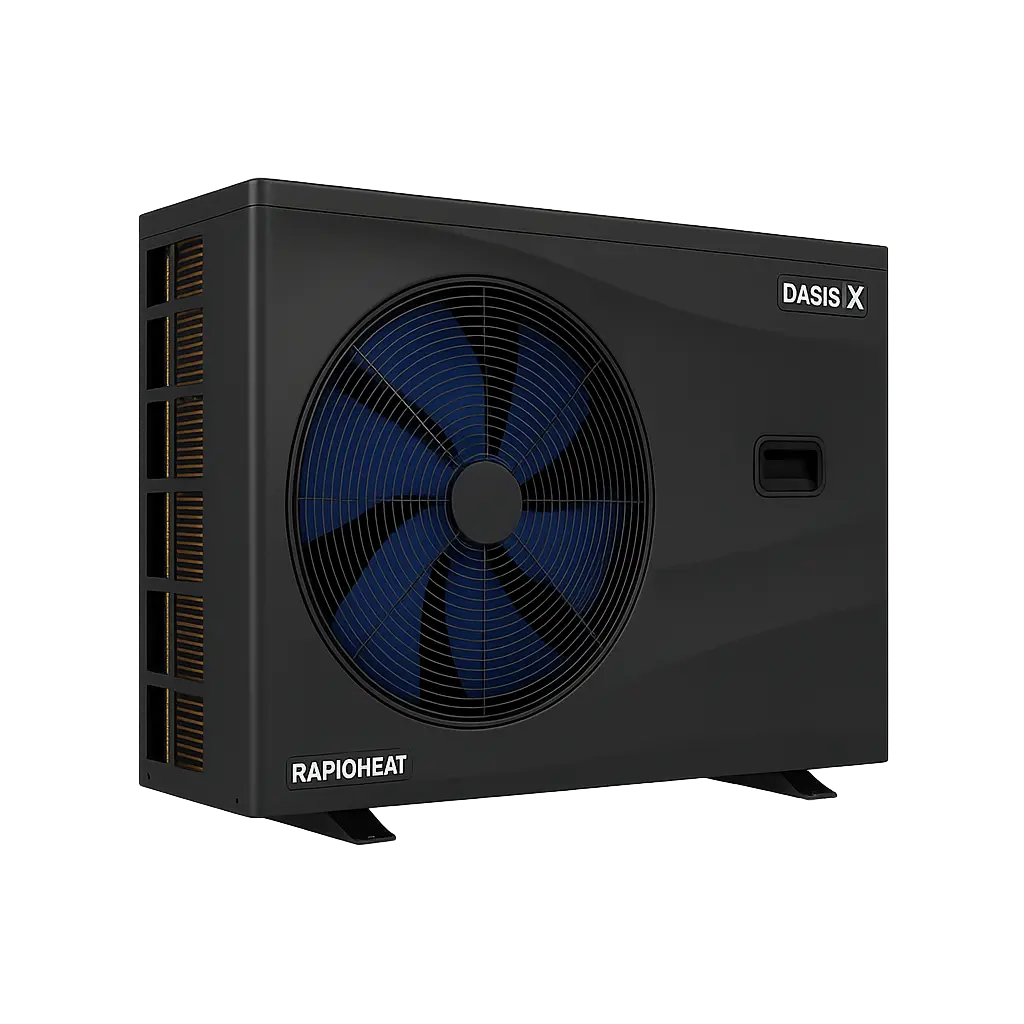
We install 250+ fibreglass pools a year across South East Queensland, and the units we fit are Sunlover Oasis heat pumps. Heating is on most of our quotes, so these are the prices we fit at rather than survey averages.
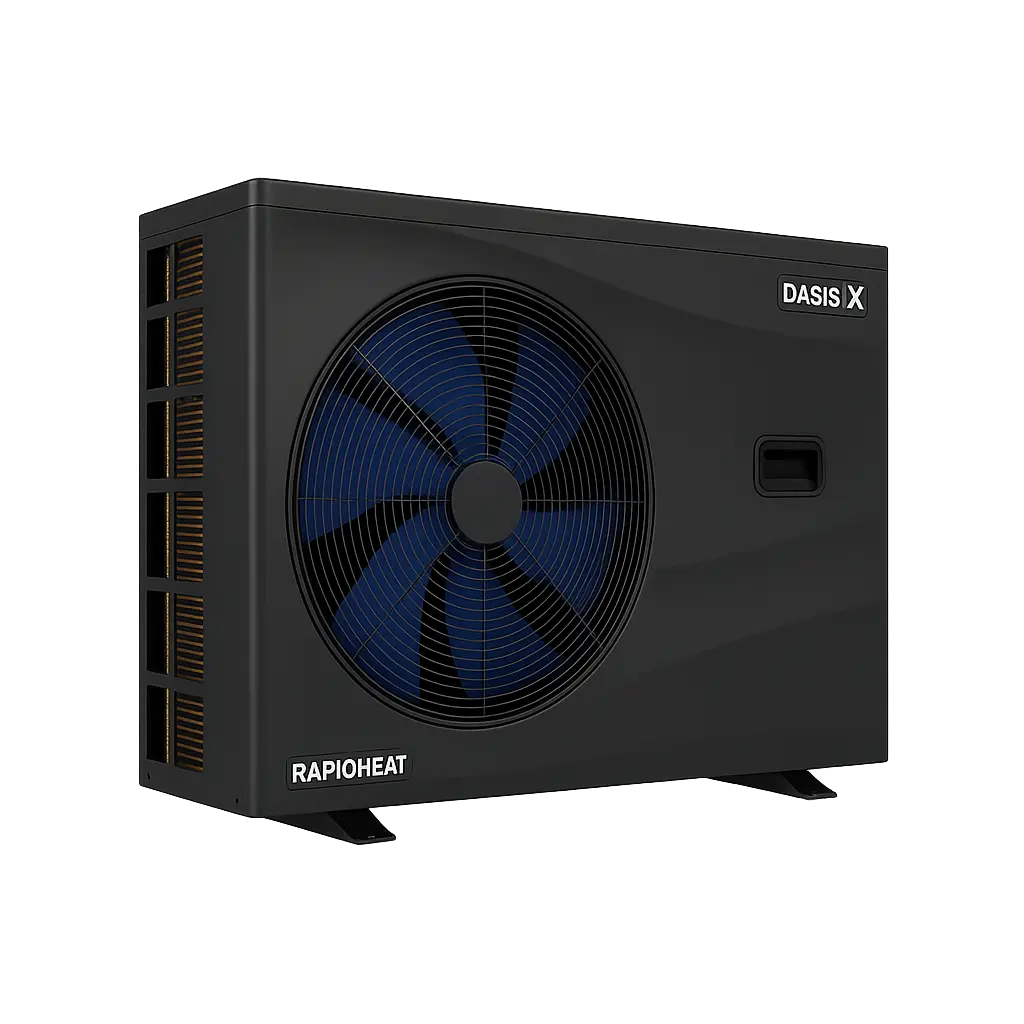
Sunlover Oasis 9kW
$4,125 supplied & installed
Sunlover Oasis 13kW
$5,220 supplied & installed
Sunlover Oasis 19kW
$7,150 supplied & installed
Sunlover Oasis 24kW
$10,550 supplied & installed
Live pricing from our quoting system — the same numbers you'd see on an MFP Easy proposal.
Solar pool heating circulates pool water through collectors on the roof and returns it warmed. The only power it draws goes to a booster pump, which is why solar runs on $150 to $400 a year. Its upfront price is site-quoted: collector area, roof orientation and shading decide both the price and whether the roof can carry enough collector at all. We install the heat pumps and thermal blankets ourselves, and solar collectors and gas lines come from specialist suppliers.
Boss Pool Heating reports that solar extends the Brisbane swim season by three to four months, taking a typical pool to eight or nine swimmable months a year. AES puts solar's extension at a few weeks on the beginning and end of summer, stated nationally rather than for Brisbane. The two published figures are far apart and neither has been tested against the other.
A gas pool heater burns gas to heat water on demand, and it waits for neither sun nor warm air. A pool swum a few weekends a year costs $10 to $25 per swim session heated on demand, against $2,000 to $4,000 or more a year run continuously.
An electric element heater is the fourth option. A resistance element turns one unit of electricity into one unit of heat, where a heat pump moves roughly five, so an element costs about five times as much for the same warmth.
Does a fibreglass pool hold heat better than a concrete one?
A fibreglass pool shell holds heat better than a concrete pool shell, and no measured figure for the difference has been published, so treat it as a small advantage on the running cost rather than a line in the budget. A pool shell in our range is a moulded laminate that arrives in one piece and is craned in, and it sits in backfilled sand. A concrete pool shell is a poured mass in direct contact with the ground.
There is no published percentage, no degrees-per-hour gap and no dollar saving attributed to the shell material, which is worth knowing before a sales conversation puts a number on it.
What the shell does not change is the heater. A 6m to 7m pool holding roughly 25,000 to 35,000L takes a 13kW heat pump whether the shell is fibreglass or concrete, because heat pump sizing follows litres. Without a heater, a fibreglass pool in Brisbane still tracks the weather down through winter.
What does it cost to heat a fibreglass pool?
Heating a covered 7m fibreglass pool in Brisbane held at 28°C costs $600 to $1,200 a year with a heat pump. Solar pool heating costs $150 to $400 a year in booster pump power, across its September to April season. A gas pool heater run continuously costs $2,000 to $4,000 or more a year.
A heat pump's bill is not flat across the year. On a covered 7m pool:
- Summer, December to February. Close to nothing; the pool holds temperature on its own.
- Shoulder, September to November and March to May. $50 to $120 a month.
- Winter, June to August. $150 to $250 a month, for a pool swum right through.
Working out a heat pump month takes three numbers: the kilowatts the unit draws, the hours it runs and the power price. A 13kW heat pump running at COP 5 draws 2.6kW. Four hours of running is 10.4kWh. At $0.30/kWh that is $3.12 a day, or about $95 a month. In June and July the same pool needs 6 to 8 hours a day: 15.6 to 20.8kWh, or $140 to $190 a month. The winter band for a covered 7m pool swum right through is $150 to $250 a month. A smaller pool costs less to hold: a 9kW heat pump at COP 5 draws 1.8kW, so 3 hours a day costs about $1.60 at the same electricity rate.
Published Australian figures cost a larger pool than a 7m fibreglass pool. Finder costs a 50,000L pool over a six-month season at a flat 33c/kWh, and puts solar heating at $16 to $40 a month, electric heat pumps at $50 to $170 a month, and gas heating at $100 to $250 a month. Thermo Pools puts a heat pump on a 50,000-litre South East Queensland pool at $250 to $800 a year, solar at $50 to $100 a year, and gas as the dearest at $1,200 to $3,500 or more a year.
Finder and Thermo Pools agree on the order and disagree on solar. Finder's $16 to $40 a month and Thermo Pools' $50 to $100 a year are not the same cost, and Palatial Pools publishes $0 for solar on a 50,000-litre Melbourne pool. The sources disagree about whether the pool pump's own electricity belongs in a solar figure. Pool size is the other gap: all three cost a 50,000L pool, where a 6m to 7m fibreglass pool holds roughly 25,000 to 35,000L.
Most South East Queensland families settle between 26°C and 29°C, and 27°C to 28°C is what we recommend. Each extra degree adds roughly 10% to 15% to the running cost. Finder puts the penalty higher, reporting that pushing the dial up a degree or two can raise heating costs by 30%, comparing 26°C with 28°C.
A pool cover is the biggest single lever on a heating bill. An uncovered pool loses heat overnight, and the heat pump puts it back the next morning. Best Pool Supplies puts the reduction in heat loss from a cover at 50% to 70% and Solarwise puts it at 75%, so the published Australian span is roughly 50% to 75%. Those running costs assume a covered pool; uncovered, a heat pump runs longer for the same water temperature. We install Daisy thermal blankets with rollers, sized to the pool model. A blanket that comes off and goes back on in thirty seconds gets used; one you drag and fold ends up in the shed.
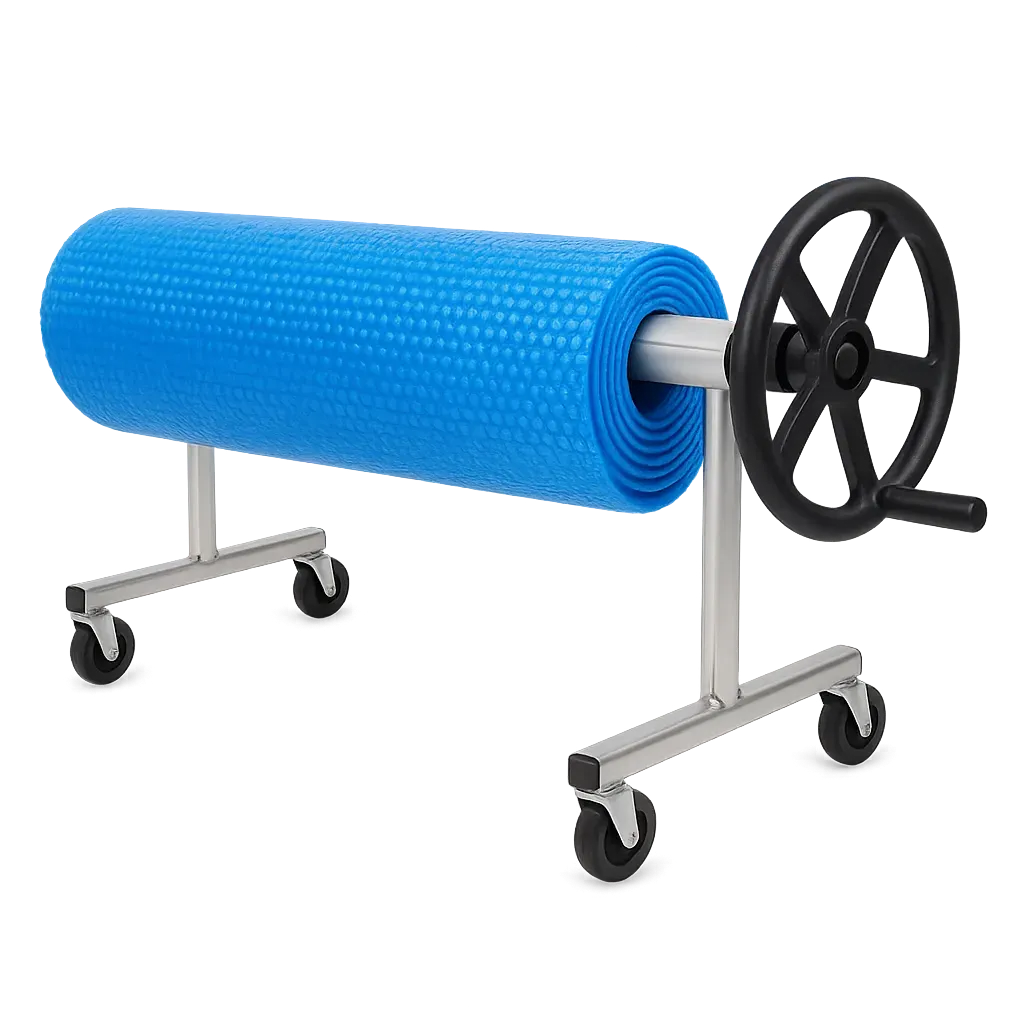
3mm Daisy Thermal Blanket with Stainless Steel Roller
$2,190 supplied & installed
3mm Daisy Thermal Blanket with Stainless Steel Roller
$2,540 supplied & installed
3mm Daisy Thermal Blanket with Stainless Steel Roller
$2,840 supplied & installed
3mm Daisy Thermal Blanket with Stainless Steel Roller
$3,140 supplied & installed
Live pricing from our quoting system, sized to each pool model in the range.
“Buy the blanket first. It's the cheapest item on the list and it cuts heat loss by more than half. Up here in Brisbane a 9kW heat pump plus a blanket will hold 27 to 28 degrees through winter without the power bill getting stupid. I run those numbers with customers every week and the blanket wins every time.”

Heating is one line on a bigger number, and what a heated fibreglass pool costs installed depends on the shell you pick and the site it goes into.
| Pool size | Length | Depth | Installed from |
|---|---|---|---|
| 3m to 4m | 1.45m level | $45,847 | |
| 4m to 5.5m | 1.0m to 1.78m | $45,613 | |
| 6m to 7m | 1.0m to 1.88m | $54,443 | |
| 7.2m to 8m | 0.98m to 1.96m | $60,374 | |
| 8.5m to 11m | 1.0m to 2.0m | $72,535 |
Live all-inclusive installed pricing for standard site conditions in South East Queensland — updated straight from our quoting system.
Can a heater be added to an existing fibreglass pool?
A heat pump can be added to an existing fibreglass pool, because it tees into the return line after the filter rather than into the shell.
Three site checks decide how straightforward the job is:
- Pipework at the equipment pad. Exposed pipework is the simple case: the heat pump goes in line after the filter on a short pipe run. Buried pipework has to be excavated and re-plumbed before the unit can be connected.
- Air space around the unit. A heat pump takes heat out of the air it draws in and blows that air back out colder. Boxed into a tight alcove or pushed hard against a fence, it draws its own cold exhaust back in and its output falls. It needs clear air at the intake and the discharge to hold its rated output.
- Switchboard capacity. The larger units need a dedicated circuit run back to the switchboard.
A thermal pool blanket retrofits to any pool at any time, with nothing to plumb and nothing to wire. Solar pool heating retrofits only where the roof has the area and the orientation to carry enough collector. A gas pool heater retrofits only where a gas line reaches the equipment pad.
FAQs
What is the most cost-effective way to heat a pool in Australia?
Solar pool heating under a thermal pool blanket is the cheapest way to heat a pool in Australia, at $150 to $400 a year in booster pump power on a covered 7m pool in Brisbane. It only delivers heat in daylight, roughly September to April, and nothing through winter. If you want the pool warm year round, an electric heat pump under a blanket is the cheapest system that can do it, at $600 to $1,200 a year on a covered 7m pool in Brisbane. A gas pool heater is the dearest of the three systems to run.
What's cheaper to run to heat a pool?
Solar pool heating is cheaper to run than a heat pump, and a heat pump is cheaper to run than a gas pool heater. On a covered 7m fibreglass pool in Brisbane, solar costs $150 to $400 a year in booster pump power, a heat pump costs $600 to $1,200 a year, and a gas pool heater run continuously costs $2,000 to $4,000 or more. Solar only delivers heat in daylight, roughly September to April, so the cheapest system to run is not the one that heats year round.
How expensive is it to heat a swimming pool?
Heating a covered 7m fibreglass pool with a 13kW heat pump costs about $95 a month at four hours of running a day. That $95 comes off three numbers: at COP 5 the unit draws 2.6kW, four hours is 10.4kWh, and 10.4kWh at $0.30/kWh is $3.12 a day. In June and July the same pool needs 6 to 8 hours a day, and a pool swum right through winter costs $150 to $250 a month. Across a full year, with the pool covered, that is $600 to $1,200.
Are swimming pool heat pumps worth it?
A pool heat pump is worth it if you want to swim outside roughly November to March, which is the unheated swim season in South East Queensland. It costs $4,100 installed for a 9kW unit up to $10,600 for a 24kW unit, and $600 to $1,200 a year to run a covered 7m pool at 28°C. If you only ever swim in summer, a thermal pool blanket on its own is the better buy, with nothing to run.
What are the disadvantages of heated pools?
The main disadvantage of a heated pool is its running cost, and the thermostat setting moves it: each extra degree adds roughly 10% to 15%. A heat pump also slows in cold air. Palatial Pools puts pool heat pump COP at 4.0 to 6.0, falling to 2.5 to 3.5 in winter, so the coldest weeks are the dearest ones to heat. A heat pump needs clear air around it and a dedicated circuit on the larger units. An uncovered heated pool loses heat all night, so it runs longer for the same water temperature.