Concrete vs Fibreglass Round Pools: Cost & Upkeep
Concrete cylinder or certified round fibreglass shell? Install time, surface, crane weight, chemistry and installed cost compared for round plunge pools in Queensland.
Published · Updated
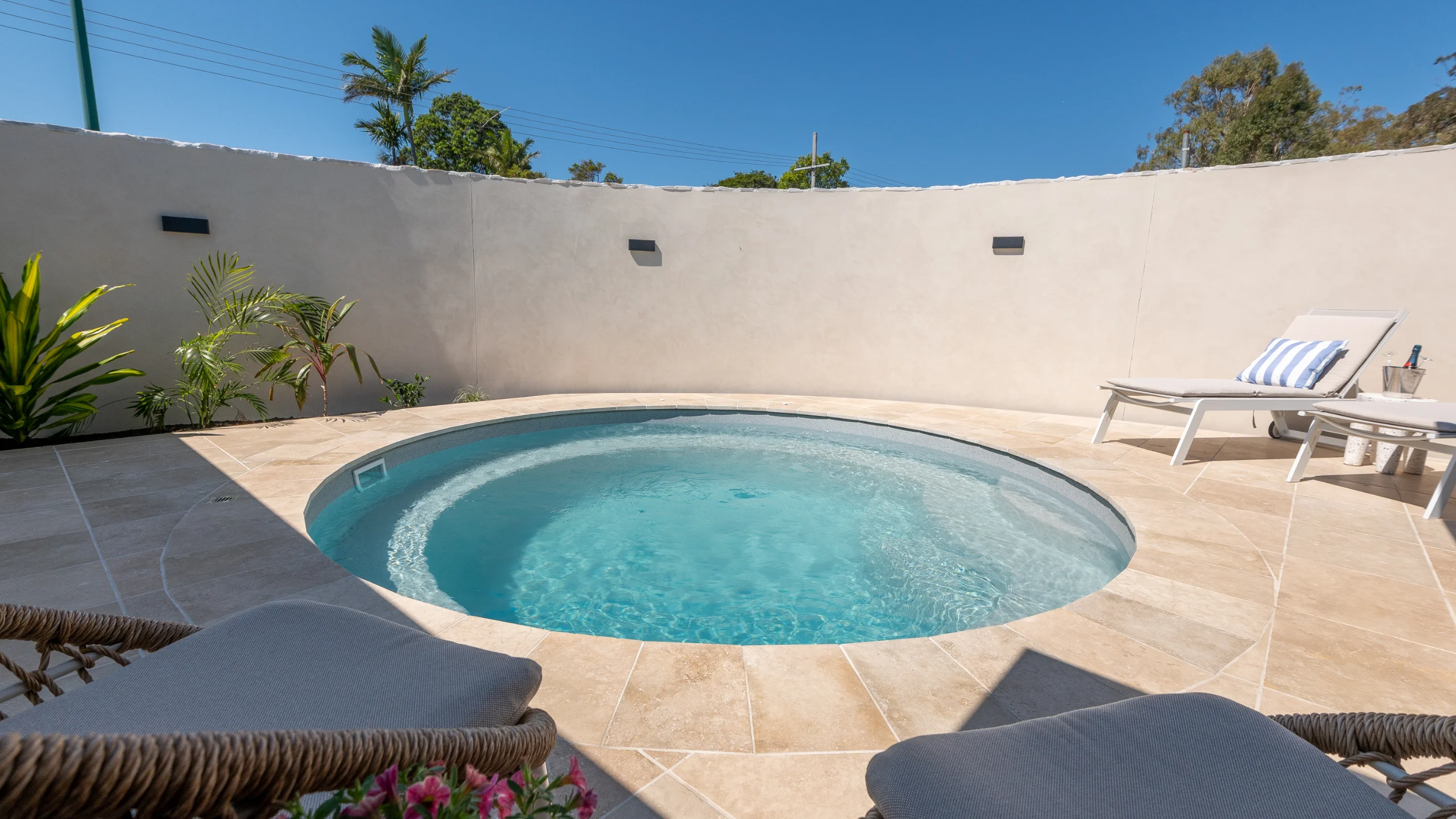
Until recently, round plunge pools were made from concrete. Precast concrete cylinders established the format because fibreglass pools were not available in circular designs. Design-certified round fibreglass pools are now available (we install Australia's only ones), so homeowners can compare both options.
Fibreglass generally offers faster installation, a smoother surface, lower running costs and more predictable pricing. Concrete allows custom sizing and remains the only option for pools larger than 4m in diameter.
We install fibreglass pools. You can verify the claims in this article with fibreglass and concrete pool builders.
The comparison at a glance
| Round fibreglass pool | Round concrete pool (precast or cast on site) | |
|---|---|---|
| Time to swimming | Days after excavation. The finished shell is delivered and craned into place. | Weeks to months. The pool must be cast, cured, waterproofed, and rendered or tiled. |
| Interior surface | Smooth, non-porous gelcoat applied at the factory. | Render, pebble, or tile over concrete. Requires ongoing sealing to remain non-porous. |
| Crane lift | The shell weighs a few hundred kilograms. | A precast concrete plunge pool weighs several tonnes and requires a larger crane and more access. |
| Ongoing surface work | No resurfacing is required. The gelcoat is the finished surface. | Interior finishes are typically replaced every 10–15 years. |
| Water chemistry | The inert surface has lower chemical demand. | Fresh concrete raises pH while curing. Porous finishes can support algae growth. |
| Sizes | Available in 3m and 4m diameters. | Available in any size that a builder can form or a factory can precast. |
| Price transparency | Published installed prices range from $47,233 to $58,385, all-inclusive. | Prices are usually provided on application. The shell, finishing, coping, and filtration are often quoted separately. |
What our round fibreglass pools cost installed
Concrete round pools in Australia are usually sold price-on-application. Advertised prices, when provided, often cover only the shell.
The prices below come from our quoting system. They include excavation, crane hire, filtration, a mineral chlorinator, LED lighting, council approvals, and lifetime warranties.
| Model | Size | Depth | Water volume | Installed from |
|---|---|---|---|---|
| Infinity 3 | 3m × 3m | 1.45m level, rim bench | 6,275L | $47,233 |
| Infinity 4 | 4m × 4m | 1.45m level, full-perimeter bench | 10,410L | $58,385 |
When comparing these prices with a concrete pool quote, check that the scope is the same. Confirm whether the concrete quote includes excavation, interior finish, coping, filtration, electrical work, and council approvals. These items may be quoted separately.
Time: days versus months
A round fibreglass pool arrives as a finished shell. The factory completes the colour, surface, and structure. After excavation, the shell is craned into place, plumbed, backfilled, and filled. This work takes days. The quoted 10–12 week project timeline mainly covers approvals, fencing, and concreting around the pool.
A concrete pool is cast on site. The shell must be formed, sprayed or poured, and then cured for several weeks before waterproofing and interior finishing can begin. Precast concrete reduces the on-site construction time because the cylinder arrives cured. However, it still requires finishing, and the remaining schedule depends on the availability of concreters, tilers, and renderers.
Crane weight: a few hundred kilograms vs several tonnes
A fibreglass pool shell weighs a few hundred kilograms. A precast concrete plunge pool weighs several tonnes. A fibreglass shell can be lifted over a single-storey house from the street using a standard mobile crane. A concrete cylinder requires a larger crane, more setup time, and suitable site access.
This difference is important on tight SEQ sites, including battle-axe blocks and properties with overhead power or deep setbacks. We have installed round fibreglass pools on sites where a precast concrete pool could not be placed.
A lighter shell can also require lighter footings on reactive clay soils and reduces reliance on a single high-stakes lift.
Surface: the difference you feel for twenty years
A fibreglass pool has a gelcoat interior surface. It is smooth, non-porous, and does not require rendering, re-pebbling, or resealing. A concrete pool requires a separate interior finish, such as render, pebble, or tile. This finish is applied after the structure is built and typically needs replacement every 10–15 years.
Surface porosity affects maintenance costs. Porous surfaces can retain algae, minerals, and metals. As a result, concrete pools generally require more brushing and chlorine. New concrete can also increase the water’s pH while it cures, requiring owners to add acid during the first year. Gelcoat is chemically inert, so water balancing does not need to account for the surface.
This difference is more significant for a 6,000–10,500 litre plunge pool, where lower heating and treatment costs are key benefits. An inert surface helps maintain those lower costs. Both materials support a magnesium mineral pool, with the same dosing requirements. However, a fibreglass pool requires about one 25kg bag to establish and generally needs less intervention to remain balanced.
Structure and certification
Concrete pool performance depends on the steel schedule, concrete mix, ground conditions, and construction quality. When built correctly, a concrete pool can last for decades. Quality control is managed separately for each installation.
Aqua Technics manufactures every round fibreglass pool we install. It is one of Australia’s only design-certified round fibreglass pools. The circular shell follows the same engineering and certification process as a rectangular shell. It includes a lifetime structural warranty and uses the same Graphene Nano-Tech construction as the rest of the range.
Round fibreglass pools were historically unavailable because meeting these certification requirements is difficult. As a result, concrete was the standard construction method for round pools.
Ten-year ownership: where the totals diverge
Compare the purchase price with the costs of ownership over ten years.
| Over ten years | Round fibreglass | Round concrete |
|---|---|---|
| Interior surface | No additional finish required; gelcoat is the finish | Typically requires one re-render or re-pebble cycle |
| Chemical demand | Lower due to the inert, non-porous surface | Higher due to the porous finish, pH drift, and increased chlorine use |
| Cleaning | Walls require wiping; the surface does not provide an anchor for algae | Render or pebble surfaces require regular brushing |
| Warranty | Lifetime structural warranty on the shell | Varies by builder; finishes have separate, shorter warranties |
We do not provide a cost estimate for concrete because resurfacing and chemical costs vary by finish and builder. These surface costs also represent a larger proportion of the total cost for a small pool than for a 10m pool.
Where concrete genuinely wins
Concrete is the better option in two cases:
- Size: Round fibreglass pools have a maximum diameter of 4m, which is the practical limit for transporting a moulded shell by road. A 5m or 6m round pool requires concrete.
- Customisation: Concrete supports custom depths, spa ledges at specific heights, and shapes that are not fully round. Cast concrete does whatever the formwork does.
Concrete pools require more time and finishing work.
For pools up to 4m, the standard round fibreglass range includes a rim bench in the Infinity 3, a full wading bench in the Infinity 4, and four gelcoat colours.
How to choose
Consider these three questions:
- Is the pool 4m or smaller? Fibreglass is an option for pools up to 4m. Compare installation time, surface, and price certainty. For circular pools of 5m or larger, choose concrete.
- What access is available? Sites with tight access and limited crane space may be better suited to a fibreglass shell weighing a few hundred kilograms. This is less important on sites with open access.
- Do you need a published price? Our two round pools have published installed prices of $47,233–$58,385. Ask concrete pool suppliers for a single finished price before comparing options.
Compare the total installed price for both fibreglass and concrete pools, not only the shell price.
FAQs
Are fibreglass round pools as strong as concrete?
Yes. Our round fibreglass shells are certified to the same required standard. They are Australia’s only design-certified round fibreglass shells and include a lifetime structural warranty.
Concrete pools can also be strong. Fibreglass shell quality is controlled during factory manufacturing. Concrete pool strength depends on each individual pour.
How long does a concrete plunge pool take compared to fibreglass?
Cast-on-site concrete pools typically take several months, including curing and interior finishing. Precast concrete pools require less time on site but still need interior finishing after placement.
A fibreglass pool is installed as a finished shell. Shell installation takes several days. The full project typically takes 10–12 weeks, including approvals and surrounding work.
Which is cheaper to maintain?
Fibreglass is cheaper to maintain. Its gelcoat surface does not require resurfacing, support algae growth, or affect water pH. This reduces chemical use and avoids the 10–15-year refinishing cycle associated with concrete interiors. For a small-volume plunge pool, these savings represent a significant share of total running costs.
How much does a round pool cost in Australia?
Our fully installed round fibreglass pools cost between $47,233 for the 3m Infinity 3 and $58,385 for the 4m Infinity 4. The price includes excavation, crane hire, filtration, a mineral chlorinator, LED lighting, council approvals, and lifetime warranties.
Concrete round pools are typically priced per project. Finishing and equipment may be quoted separately.
Can I get a round fibreglass pool bigger than 4 metres?
No. A 4m diameter is the largest moulded round shell that can be transported by road. For larger round pools, use concrete construction.
If you need more swimming length you're after, consider a rectangular shell from our small or larger ranges.