Fibreglass Pool Maintenance: Schedule, Costs & Care
What a fibreglass pool needs week to week: the cadence, water balance targets, running costs and the gelcoat rules, for South East Queensland.
Technically reviewed by Caleb Druhan, General Manager (QBCC licence 15087383) on
Published · Updated
What maintenance does a fibreglass pool actually need?
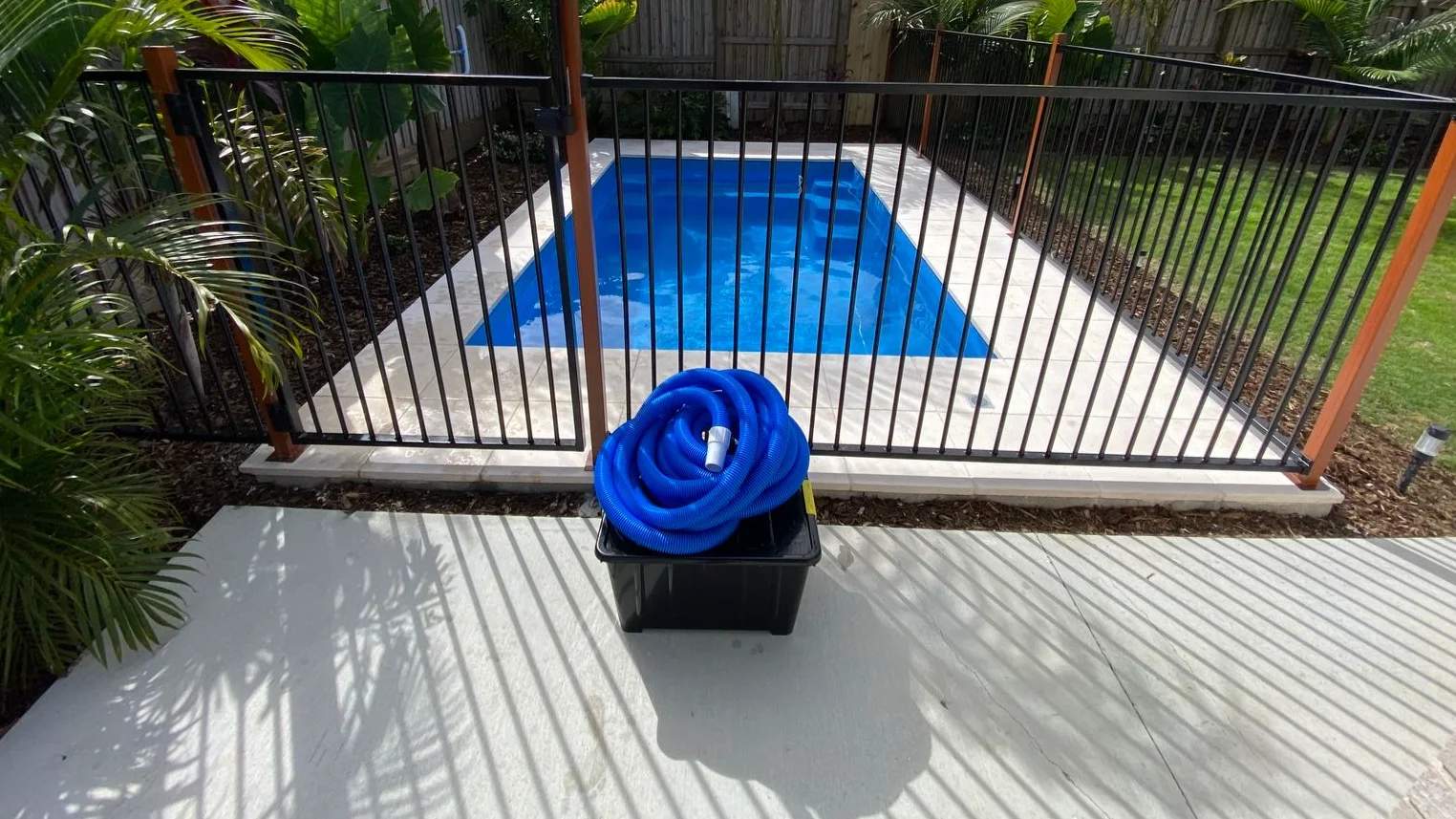
Fibreglass pool maintenance comes down to three standing jobs: keeping the water in chemical balance, running the filtration long enough to turn the water over, and brushing the surface lightly. The interior of a fibreglass pool is a smooth, non-porous gelcoat surface, so algae and dirt get far less grip than they do on a porous plaster or concrete finish. For most owners that is 15–20 minutes a week, plus a monthly water test. The water is held at free chlorine 1–3 ppm, pH 7.2–7.6, total alkalinity 80–120 ppm and calcium hardness 200–400 ppm. The pump runs 4–8 hours a day, long enough to turn the water over twice. Chemicals and power for a Brisbane fibreglass pool cost $500–$900 a year. One rule outranks every other: the shell is never fully drained. A Kensington shell weighs 1,223 kg and holds 51,700 L, so the water is what holds the shell down, and draining a fibreglass pool is a builder's job.
“One rule I'll put my name on after 15 years in this game: never drain a fibreglass pool. The water is what holds the shell in the ground. I've seen what happens when someone empties one to give it a good scrub and it's not a cheap fix. Everything else on this page is a ten minute weekly habit.”

Everything else on the schedule is either a check or a part replacement. The list is that short because the interior needs no upkeep of its own. The inside face of a fibreglass pool is moulded gelcoat, a non-porous layer, and algae cannot anchor into it the way it anchors into a porous plaster or concrete finish. What is left to maintain is the water: chemistry, circulation and a light brush. A fibreglass pool therefore runs on less sanitiser and takes less scrubbing than a concrete pool, whose porous interior pushes up both the chemical demand and the brushing.
The three standing jobs:
- Water balance. Water balance is the read-and-correct half of the routine: pH, free chlorine, total alkalinity and calcium hardness, tested against their bands and adjusted when a reading sits outside one. It is the part of the routine that does the protective work. Sanitiser in the water stops algae establishing in the first place.
- Filtration. The pump draws water through the skimmer and the strainer basket ahead of it, pushes that water through the filter, and returns it to the pool through the return outlets. The filter removes the fine particles the skimmer and strainer never catch, sunscreen residue and sediment among them. Run the pump long enough to turn the water over twice a day, which is 4–8 hours depending on pool size and pump specification.
- Light brushing. Brushing lifts settled dirt off the walls and floor before it sits long enough to stain, and on gelcoat it is light work with a soft nylon brush. A fibreglass pool needs less brushing than a concrete pool for the same reason it needs less sanitiser: there is nothing in the surface for growth to grip.
A fibreglass pool is lower-maintenance, not maintenance-free. The chemistry still has to be read and corrected, baskets still fill with leaves, and filters still load up with debris. The gelcoat takes the surface work off the list and leaves the water work exactly where it was.
How often does each maintenance job need doing?
Each maintenance job runs on its own cadence: daily for skimming, weekly for testing, vacuuming and basket-emptying, monthly for the full water test, periodic descaling for the salt or mineral cell, and multi-year for the filter parts.
| Job | How often | Why |
|---|---|---|
| Skim the surface | Daily, and every day in leaf-fall season | Debris skimmed off the surface never sinks; debris left to sink settles on the floor, breaks down and stains. |
| Test the water | At least once a week, and again after heavy rain, heavy use or a large water addition | Rain, bathers and a big top-up all shift pH and dilute sanitiser faster than evaporation does. |
| Empty the skimmer and pump baskets | Every few days to weekly, and always after a large gathering | A clogged strainer basket or a dirty filter strains the pump and slows circulation. |
| Brush the walls and floor | Whenever dirt has settled on the walls or floor; less often than a porous concrete or plaster interior needs. Soft nylon bristles only. | Algae cannot anchor into non-porous gelcoat, so brushing only lifts settled dirt. |
| Vacuum the floor | About once a week, or whenever debris has settled on the floor | The skimmer only takes what floats. Anything that has already sunk has to be vacuumed or it stays there. |
| Check the water level | Ongoing: hold it at or above the midpoint of the skimmer opening, halfway to three-quarters up it | Below that the skimmer loses suction and the pump can run dry. Above it the skimmer stops working. |
| Full water test (pH, total alkalinity, calcium hardness, stabiliser) | Monthly rather than weekly | The weekly test covers the fast-moving readings; alkalinity, calcium hardness and stabiliser move slowly and are read on a longer cycle. |
| Check filter pressure | When the pressure rises: Thursday Pools sets the trigger at a rise of 8–10 psi above the clean baseline | Pressure rise is how a loaded filter announces itself. A sand filter is backwashed when the gauge reads high. |
| Clean the salt or mineral cell | Periodically, whenever scale has built up on the plates | Mineral build-up deposits on the generator plates as flaky white scale, and a scaled cell produces less chlorine. |
| Replace the filter cartridge element | Roughly every two years | The cartridge element is a consumable, and a rinse eventually stops restoring it. |
| Replace the filter media | Every 5–10 years depending on usage | Filter media is also a consumable, with a working life measured in years. |
The periodic items are the ones worth a calendar reminder. A scaled cell makes less chlorine and a loaded filter slows circulation, and neither announces itself the way a leaf on the surface does.
What water balance does a fibreglass pool need?
A fibreglass pool is held at four readings, each inside its own band: free chlorine, pH, total alkalinity and calcium hardness.
- Free chlorine, 1–3 ppm. The sanitiser actually available in the water to kill algae and bacteria.
- pH, 7.2–7.6. How acidic or alkaline the pool water is. It governs how effectively the free chlorine sanitises.
- Total alkalinity, 80–120 ppm. The buffer that holds pH steady. In band, pH moves less after rain, a large top-up or a chemical addition.
- Calcium hardness, 200–400 ppm. The dissolved calcium in the water.
Test at least once a week, and test again after heavy rain, heavy use or a large water addition. All three do the same thing from different directions: they shift pH and dilute the sanitiser faster than ordinary evaporation does. A South East Queensland summer storm dumps organic debris and rainwater into a pool in an afternoon, which is why the test follows the storm rather than the calendar.
Stabiliser (cyanuric acid) is read in the monthly full test. It is on the list because Queensland sun strips unstabilised chlorine out of the water, and stabiliser is what exists to prevent that.
How is the routine different on a mineral or magnesium pool?
A mineral or magnesium pool runs the same routine as any other fibreglass pool, and what changes is what the water carries and what the cell needs. A mineral system still produces chlorine, so the four target bands stay where they are. The water carries magnesium and potassium salts as well, and those minerals soften how the water feels.
Magnesium pool maintenance changes what goes into the water and leaves the cadence alone. Skimming, basket-emptying, brushing, vacuuming and the weekly test are the same jobs at the same intervals. The mineral cell is the one piece of equipment with a job of its own: mineral build-up deposits on the generator plates as flaky white scale, so the cell is descaled periodically.
How much cleaning does the surface itself need?
A fibreglass pool needs less surface cleaning than a concrete or plaster pool, because the gelcoat is non-porous and gives algae and dirt almost nothing to hold onto. In a normal week the surface work is a light brush of the walls and floor plus a vacuum of whatever has settled.
Brush with soft nylon bristles and nothing else. Wire and stainless-steel brushes, steel wool, scouring pads and stiff bristles all scratch gelcoat, and the fine scratches they leave are the rough spots where algae and staining later take hold.
A scratch is permanent because there is so little material there to lose. The gelcoat is a thin surface layer, and it is the shell's primary barrier against water intrusion, algae and chemical attack. Cut through that layer and the barrier is gone at that point, and no cleaning method or chemical brings it back.
What does it cost to run and maintain a fibreglass pool?
Chemicals and power for a Brisbane fibreglass pool run $500–$900 a year, less where rooftop solar offsets the pump. Beyond that annual figure there are two consumable parts on multi-year cycles, one line item a fibreglass pool does not carry at all, and servicing if you choose to buy it.
The consumables are filter parts. A cartridge element is replaced roughly every two years, once rinsing no longer restores it, and filter media is replaced every 5–10 years depending on usage. Neither is a frequent purchase, and both are cheap next to the surface cost a pool of another type carries.
The line item a fibreglass pool does not carry is resurfacing. A concrete pool carries a resurfacing cycle and a vinyl pool a liner-replacement cycle, and a fibreglass shell has neither, which is where the lifetime maintenance gap between the pool types sits. What separates them is the existence of the line item: a fibreglass pool's finished interior is the moulded gelcoat itself, and there is no applied surface to renew on a cycle.
The pool pump is one of the largest electricity users in the house. Where a home has rooftop solar, running the pump in daylight hours offsets it. We advise against off-peak tariffs for pool equipment, because the operating windows are increasingly unpredictable.
Does a fibreglass pool need waxing or polishing?
No. A fibreglass pool held in balanced water stays glossy without a wax or polish cycle, and no manufacturer schedule calls for one.
Wanting to polish the surface usually points at the water. A dull or chalky patch is oxidation or calcium scale, and both come from water that drifted out of its bands and stayed there. Polishing treats the appearance and leaves the cause running, so the dullness returns.
A deep scratch is a different thing entirely. Dullness is a condition on intact gelcoat; a scratch that cuts into the gelcoat is damage, and damage to the gelcoat is a fibreglass pool repair job. Pool stains sit between the two: an organic or metal stain sits on intact gelcoat, and polishing does not lift it.
When is it worth paying for a pool service instead?
Most owners run a fibreglass pool themselves, and paying for a service is a decision about time and about recovery jobs rather than about the pool type. The weekly cadence is the whole of the routine an owner performs, and it needs a net, a brush and a test kit rather than a trade.
A service visit earns its money in three situations:
- The household travels. Baskets fill, the water level drops and the chemistry drifts whether anyone is home or not.
- The pool has gone green. Recovering a green pool is a different job from maintaining a clear one.
- Nobody is checking the water for weeks at a time. Where the weekly test does not reliably happen, paying someone to do it is what holds pH and sanitiser in band before a green pool starts.
Servicing is quoted per visit, and the price varies by pool and by how often the visit happens.
What changes about caring for a fibreglass pool in winter?
In South East Queensland, preparing your fibreglass pool for winter is the same routine at lower intensity. The pool stays full, the filtration keeps running, and chemical demand falls because cold water and weaker UV consume less sanitiser than a January afternoon does. Pump run time comes down from the summer setting, and how far it comes down depends on pool size and pump specification.
MFP Easy builds fibreglass pools across South East Queensland: Brisbane, the Gold Coast, Ipswich, Logan, Moreton Bay, Noosa, Redlands, the Sunshine Coast, the Lockyer Valley and Somerset. The swim season here runs year-round, which is why pools in this part of Australia are not closed for the cold months at all. The water stays balanced, the skimmer stays fed, and the test still happens after a storm.
The water level rule does not change in winter, and it applies hardest in the off-season, when a pool feels least in use. The water inside is what holds the shell down against groundwater pressure, and an empty or low shell can shift, lift or crack, taking the rigid PVC plumbing with it. We tell every owner never to drain the shell themselves; if work ever needs the water out, it is a job for us or another builder.
A cover holds heat in, cuts evaporation, keeps debris out and reduces chemical demand by blocking the UV that destroys chlorine.
Does a fibreglass pool need to be winterised or closed for the cold season?
Closing a pool is a freezing-climate procedure, and Australian pools are not closed. Water expands as it freezes, and burst pipes and cracked equipment are what the whole close-down exists to prevent. One rule carries across either way: the water level is not dropped. An empty or low shell can shift or lift.
How do you open a fibreglass pool back up after the cold season?
Reopening belongs to freezing climates as well, and a South East Queensland pool never needs it, because it runs year-round. Where a pool has been closed for the season, the restart is short: uncover it, top the water up to the skimmer, restart the filtration and run it a full day, then test and rebalance.
FAQs
What is the average lifespan of a fibreglass pool?
The US manufacturer Latham Pools puts an inground fibreglass shell at 50 to 60+ years with proper care. The Australian resurfacer Reef Pools puts shells into resurfacing between 15 and 50 years, and puts a resurface at another 10–15 years of life after that. The two sides of the trade disagree, and both sell the outcome they describe: a manufacturer sells shells, a resurfacer sells resurfacing. A fibreglass shell carries no scheduled resurfacing or liner-replacement cost.
What are common pool maintenance mistakes?
The four mistakes that damage a fibreglass pool are draining the shell, brushing with the wrong brush, letting the water level fall below the skimmer, and leaving the chemistry untested for weeks. Draining is the worst of them, because the water inside is what holds the shell down. A wire brush, steel wool or a scouring pad scratches the gelcoat permanently. A level below the skimmer costs the skimmer its suction and can run the pump dry. Untested water drifts far enough that recovery becomes a job.
Can you drain a fibreglass pool to clean it?
No. A fibreglass pool is cleaned full, and the shell is not emptied to get at a stain, an algae bloom or a dirty floor. The water is the load that holds the shell against the ground, and without it groundwater pressure can lift or shift the shell and crack the rigid plumbing running off it. Balanced water, a filter running its turnover and a soft brush do the cleaning that an owner might otherwise reach for a drain to do.
What is the downside of a fibreglass pool?
Fewer shape and size options than a poured concrete pool. A fibreglass shell is moulded in a factory, so the shape, the depth and the size are chosen from a manufacturer's range of models rather than drawn to fit the site. A block that needs an unusual shape, or a pool longer than the largest model in the range, has to be built as a poured concrete pool.
How much does it cost to maintain a fibreglass pool per year?
$500–$900 a year for a Brisbane fibreglass pool, covering chemicals and the power to run the pump, and less again where rooftop solar carries the pump through daylight hours. On top of that annual figure sit two consumables on long cycles, a filter cartridge element roughly every two years and filter media every 5–10 years. There is no resurfacing or liner-replacement cost on a fibreglass shell. Servicing, if you buy it, is a third-party charge quoted per visit, and it varies by suburb and pool size.