Pool Slides Australia: Types, Space & Safety Guide
A practical guide to pool slides in Australia — slide types, space and depth needs, safety, cost factors, and which pool shapes suit a swimming pool slide.
Published · Updated
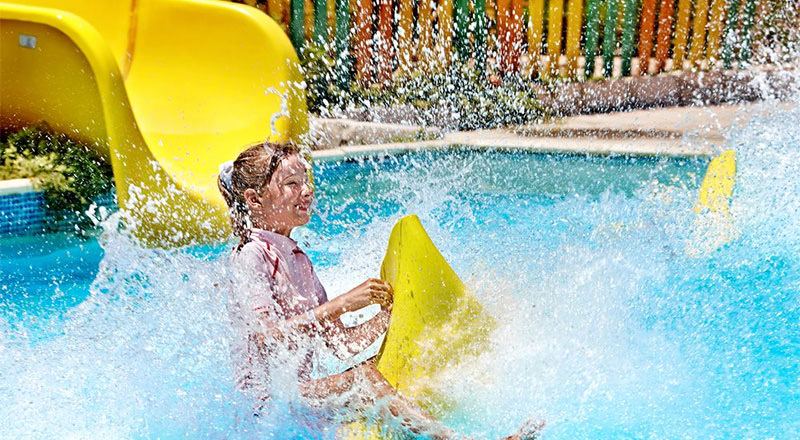
A pool slide turns an ordinary backyard swim into the thing the kids beg for every afternoon. It is also the single most common "can we add this?" question we field once a family has chosen their shell. The honest answer: yes, most of the time — but the slide you can safely fit depends on how deep your pool is, how much dry space you have beside it, and how the slide is anchored. Get those three things right before you fall in love with a particular model.
Pool slides in Australia range from small children's slides that clip onto a spa step through to permanent bolt-down flumes with curves and enclosed tunnels. Here is how to work out which one fits your pool, your block and your budget.
What types of pool slides can you add to a backyard pool?
The main choice is between a permanent bolt-down slide and a removable or inflatable one. Permanent slides anchor into the paving or concrete beside the pool and stay put year-round; removable slides pack away and suit families who want the fun without a fixed installation.
Within those two camps, the common formats we see on Queensland pools are:
| Slide type | Best for | Space needed | Notes |
|---|---|---|---|
| Straight flume | Small kids, tight yards | Low | Simplest and cheapest; short run into the water |
| Curved / left- or right-bend | Older kids and adults | Medium | Curve direction must match your pool layout |
| Twisting / spiral | Big-splash factor | High | Longest run; needs the most deck space and depth |
| Enclosed tunnel | Wow-factor installs | High | Can wrap around a water feature or raised wall |
| Toddler / wading slide | Children under about 6 | Very low | Sits on a step or shallow ledge; often portable |
| Inflatable | Occasional use, holidays | Varies | No anchoring; pack away between uses |
Named permanent models families often shortlist include the Turbo Twister, the Typhoon, the Cyclone, the Rogue 2, the Big Ride and the Vortex. Many manufacturers will also custom-build a slide to wrap around a waterfall wall or raised feature, so a curved or tunnel slide can flow around your existing landscaping rather than fighting it. Slides are just one of a long list of special pool additions, alongside water blades, spa jets and swim jets.
How much depth and space does a pool slide need?
A permanent slide needs deep water at the run-out and clear dry deck beside the pool for the ladder and structure. As a rule of thumb, bigger and faster slides demand more of both — a spiral slide that launches an adult needs more depth beneath it than a short toddler slide clipped to a step.
Two measurements decide everything:
- Water depth at the entry point. The water where a rider lands has to be deep enough to absorb them safely. Follow the depth the slide manufacturer specifies for that model — a twisting adult slide will call for noticeably more than a straight children's slide.
- Deck footprint. The slide's base, steps and swing radius all sit on the paving. A compact plunge pool often has no spare deck for a full-height slide, whereas a family rectangular pool usually does.
This is why slide plans should be sorted before your pool is craned in, not after. If we know a slide is coming, we can position the shell so the deep end lines up with the slide run-out and leave enough paving on the entry side. Retrofitting a slide onto a pool that was set with the shallow end facing the only free deck space is where families get stuck.
Which pool shapes suit a slide best?
Rectangular and freeform pools with a defined deep end suit slides best, because they give you both the depth at the run-out and a straight edge to mount against. Small plunge pools and narrow lap pools are the hardest to fit a permanent slide to.
| Pool shape | Slide suitability | Why |
|---|---|---|
| Family rectangle | Excellent | Deep end plus long straight coping for mounting |
| Freeform / lagoon | Good | Curved slide can follow the organic edge |
| Pool with raised feature wall | Good | Tunnel or curved slide can wrap the feature |
| Lap pool | Limited | Narrow and often uniform depth |
| Plunge / courtyard | Poor for permanent | Little deck space; portable or spa-step slide only |
If a slide is high on your family's list, factor it in while you are still choosing a shell. Choose a shell with the deep end and deck space in mind, and flag the slide early so the layout is planned around it.
Are pool slides safe, and how are they secured?
A permanent pool slide is safe when it is anchored correctly, matched to the water depth, and used within its weight limit. The two failure points are movement and shallow water, and both are avoidable.
Permanent slides bolt into the concrete or paving surrounding the pool, or are built to wrap around and fix to a solid object. That anchoring is what stops the structure shifting under a rider. A slide that rocks or slides on its base is the most common backyard hazard, so the mounting surface has to be sound and the fixings rated for the load.
Weight limits matter. The standard limit for most pool slides sits around 113 kg, though many manufacturers can custom-build a slide rated to carry more. Check the figure for the specific model rather than assuming — a slide sized for children is not built for an adult launching off it.
A slide does not change your pool-fencing obligations. In Queensland every pool must still comply with the pool safety standard (QDC MP 3.4) and hold a valid pool safety certificate, and the slide and its steps must not create a climbable point over the barrier. Keep the slide's ladder and structure clear of the fence line.
What affects the cost of a pool slide?
Slide price is driven by size, whether it is permanent or portable, and how much custom fabrication and anchoring the install needs. A small portable children's slide is a modest add-on; a custom tunnel slide wrapping a water feature is a considered investment.
The cost levers, roughly in order of impact:
- Permanent vs portable. Bolt-down slides cost more than inflatables or clip-on step slides, and they add install labour.
- Size and complexity. Longer runs, curves, spirals and enclosed tunnels use more material and engineering than a straight flume.
- Custom fabrication. Wrapping a slide around a waterfall or raised wall is bespoke work.
- Anchoring and deck prep. If the paving needs strengthening or reworking to take the fixings, that adds to the job.
Many suppliers offer payment plans so a slide can go in straight away rather than waiting. Your exact figure depends on the model and your deck, and we confirm it in your quote once we have measured the space.
FAQs
What is the weight limit on a backyard pool slide?
Most pool slides are rated to around 113 kg. Some manufacturers custom-build slides to hold more, so check the rating for the specific model before an adult uses a slide sized for children.
Can I add a slide to a pool that's already installed?
Often yes, if the pool has enough water depth at the run-out and clear deck space for the structure. It is far easier when the slide is planned before installation, because the shell can be positioned so the deep end lines up with the slide. Retrofitting onto a shallow or space-tight layout is the hard case.
Do pool slides need deep water?
Yes. The water where a rider lands must be deep enough to absorb the landing safely, and the depth required rises with the size and speed of the slide. Always follow the depth the slide manufacturer specifies for that model.
Are inflatable pool slides a good alternative?
Inflatable slides are a good low-commitment option for occasional use and small children. They pack away between uses and need no anchoring, but they do not offer the stability or longevity of a bolted-down permanent slide.
Does adding a slide affect pool safety certification?
A slide does not remove any fencing requirement. Your pool must still meet Queensland's pool safety standard and hold a valid certificate, and the slide and its steps must not create a climbable point over the barrier.