Round Pool Pros and Cons: Shape, Space & Cost
Seven real advantages of a round pool — and the four drawbacks nobody mentions. Prices, depths, running costs and fencing implications from the installer of Australia's only certified round fibreglass shells.
Published · Updated
Direct answer
A round pool is among the most affordable pools we install, one of the cheapest to run, and the only shape that fits some blocks at all — and it will never be a swimming pool in the stroke-and-turn sense. That's the trade in one sentence. Here's the full ledger, from the people who crane these shells into Brisbane backyards, so you can decide whether a circle is your pool or just a nice idea.
Our round pools come in two diameters — 3m and 4m, all at a level 1.45m depth — and they're the only design-certified round fibreglass pools made in Australia.
What a round pool costs installed
Every price below is the live installed figure from our quoting system: excavation, crane, filtration, mineral chlorinator, LED lighting, council approvals and lifetime warranties included.
| Model | Size | Depth | Water volume | Installed from |
|---|---|---|---|---|
| Infinity 3 | 3m × 3m | 1.45m level, rim bench | 6,275L | $47,233 |
| Infinity 4 | 4m × 4m | 1.45m level, full-perimeter bench | 10,410L | $58,385 |
For context, our rectangular plunge pools start at $46,053 installed (the 4m Malta) and our 6–7m medium pools run $55,003–$78,273 — the 3m Infinity 3 sits about $1,200 above the floor of the range, and well under every medium pool.
The pros
1. It fits where nothing else does
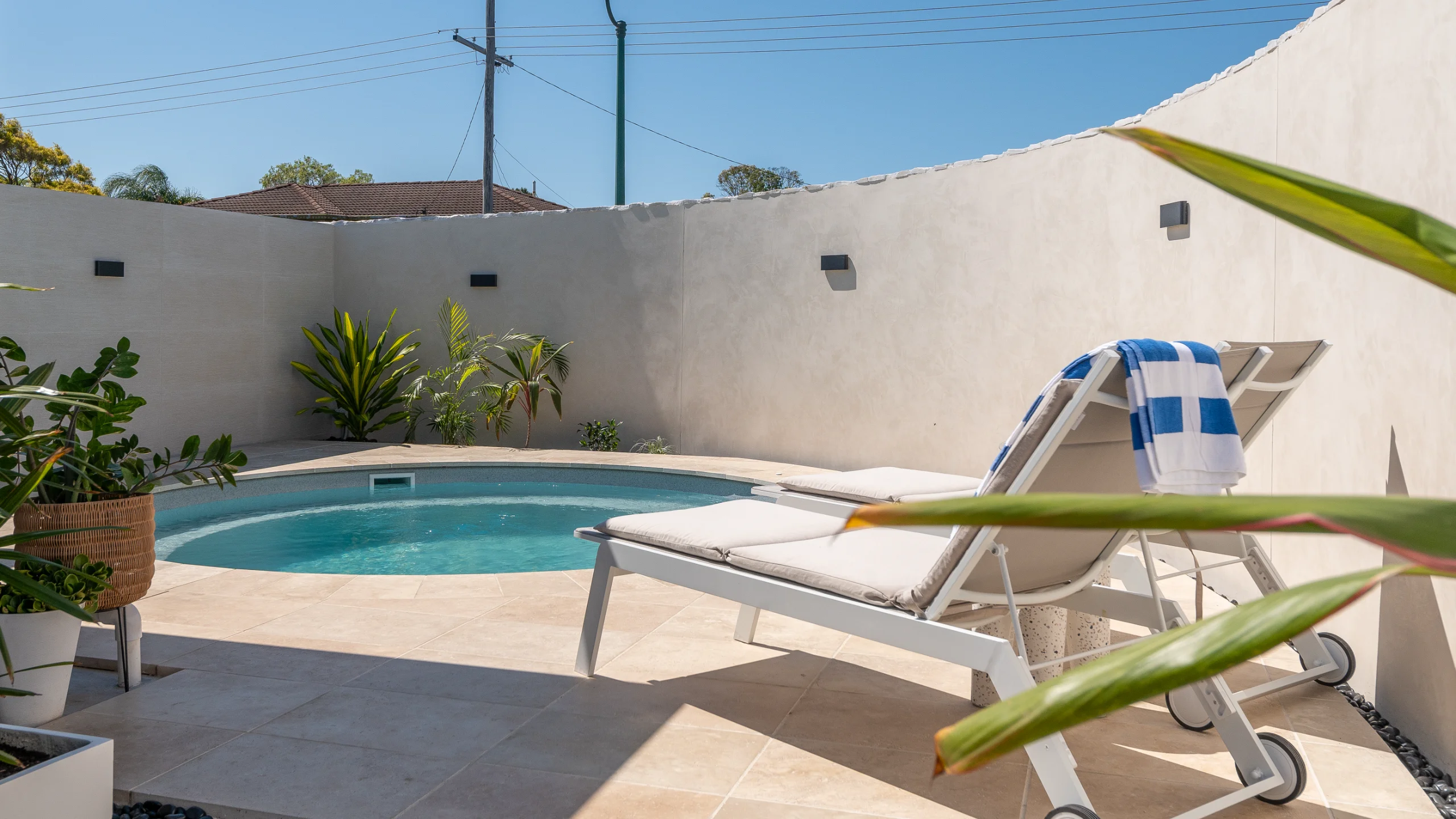
A 3m round pool sits in a courtyard, a corner, or beside a deck without dominating it. Most of the round pools we install go into spaces where no rectangular pool would fit — the choice wasn't round vs rectangular, it was round or nothing.
2. It's among the most affordable pools we install
The 3m Infinity 3 is $47,233 installed — about $1,200 above the Malta, the lowest-priced pool in our range. Part of that is the build itself: a smaller shell means a smaller excavation, less spoil carted off site, and a lighter, shorter crane lift. Every model's live installed price is published before you ever talk to a salesperson.
3. Small water volume keeps running costs low
A round plunge pool holds 6,275–10,410 litres; a full-size 8–11m pool holds 40,000–50,000. Everything that scales with water volume scales down: heating, chemicals, pumping. A 9kW heat pump holds one at swimming temperature through a South East Queensland winter, and a mineral conversion establishes on about one 25kg bag.
4. The whole pool is usable
A level 1.45m floor means no dead shallow corner and no unusable deep end. Adults stand anywhere, confident swimmers have the full circle, and the depth suits wading, floating and soaking everywhere in the pool.
5. It's a social shape
Everyone in a round pool faces the middle. The Infinity 3 builds on this with a bench seat set into the rim, and the Infinity 4 runs a bench around its full perimeter — in practice it gets used like a sunken lounge that happens to be full of water.
6. A faster, smaller build
Less digging, less concrete around the shell, a lighter lift. The pool itself is craned in as one finished piece, and the disruption to the rest of the yard is genuinely less than a full-size install.
7. Certified structure, not a compromise
Round fibreglass barely exists in Australia because certifying a circular moulded shell is hard. Ours are design-certified by Aqua Technics — same engineering standard, same certification path, same lifetime structural warranty as every rectangular pool we install, with the same Graphene Nano-Tech shell construction.
The cons
You can't swim in it
Not laps, anyway. A 3m or 4m round pool is for cooling off and soaking. If you'll genuinely swim, you want a longer pool — a 5m rectangular pool gives a short swim line, and our lap pools (8.25m–11.48m) give the real thing.
No shallow entry for little kids
The level 1.45m floor that makes the pool great for adults is over a young child's head. Rectangular plunge pools like the 4m Serenity grade from 1.1m, which is the kinder depth profile for toddlers. (The QLD pool fencing rules apply identically either way.)
Two sizes, take them or leave them
Round fibreglass shells are hard to engineer and mould, so the range is 3m or 4m — there's no 5m round and no custom diameter. Past 4m, a round pool has to be a concrete round pool: quoted per project, built over months rather than days. The alternative is a rectangular plunge pool, which grades from a 1.1m shallow end and runs to 5.5m long.
Curves cost more per metre to finish
The pool itself is cheap; the landscaping around a curve isn't always. Curved coping, decking cut to a radius and glass fencing following an arc all cost more per metre than straight runs. The standard answer is to set straight fence panels and square paving around the circle and let planting soften the corners — it's a design decision worth making early, and we flag it at the site visit.
The verdict
Buy a round pool for what it is: a heated plunge pool that fits the part of the yard you'd otherwise pave, ready every day of the year, at one of the lowest installed prices in fibreglass. Don't buy it as a substitute for a swimming pool — that's a different purchase. Either way, book a site visit and we'll tell you which one your block actually supports.
FAQs
What are the benefits of a round pool?
The practical ones: it fits corners and courtyards no rectangular pool can use, it's among the most affordable pools to buy (from $47,233 installed) and to run (6,275 litres to heat and treat), the level 1.45m floor makes the entire pool usable, and the circular geometry turns it into a social space — everyone faces the middle.
Which is better, a round or oval pool?
In fibreglass the question mostly answers itself: certified oval fibreglass shells aren't really made, so oval pools are typically above-ground liner pools or custom concrete. Between a round and a rectangle — the two moulded shapes that exist — round wins on placement flexibility and the rectangle wins on swim line and shallow-end depth for kids; on price the two shapes now sit within about $1,200 of each other at the entry point.
What is the best shape pool to get?
The one your block supports and your use justifies. For a corner or courtyard used for cooling off and entertaining, a round plunge pool. For a narrow strip, young kids, or a short swim line, a rectangular plunge pool. For genuine exercise, a lap pool of 8 metres or more. Shape follows use — a beautiful pool in the wrong shape for your household is the one that stops getting used.
What is the healthiest type of pool?
Water chemistry matters more than shape. A mineral (magnesium) pool is the gentlest mainstream option — softer water, less chlorine, easier on skin and eyes — and a round plunge pool is among the cheapest to run as one, since mineral dosing scales with litres and the 3m Infinity 3 holds 6,275 of them. Every pool we install includes a mineral chlorinator as standard.
How deep is a round pool?
Both of our round models hold a level 1.45m across the entire pool — no shallow end, no deep end. It's floating and standing depth for adults everywhere in the circle.
Do round pools add value to a home?
A compliant, well-landscaped plunge pool is an asset in the Brisbane market, where outdoor living drives buyer interest — but treat value as a bonus, not the business case. The consistent feedback from our owners is about use: small pools get used daily because they're cheap to keep warm year-round.