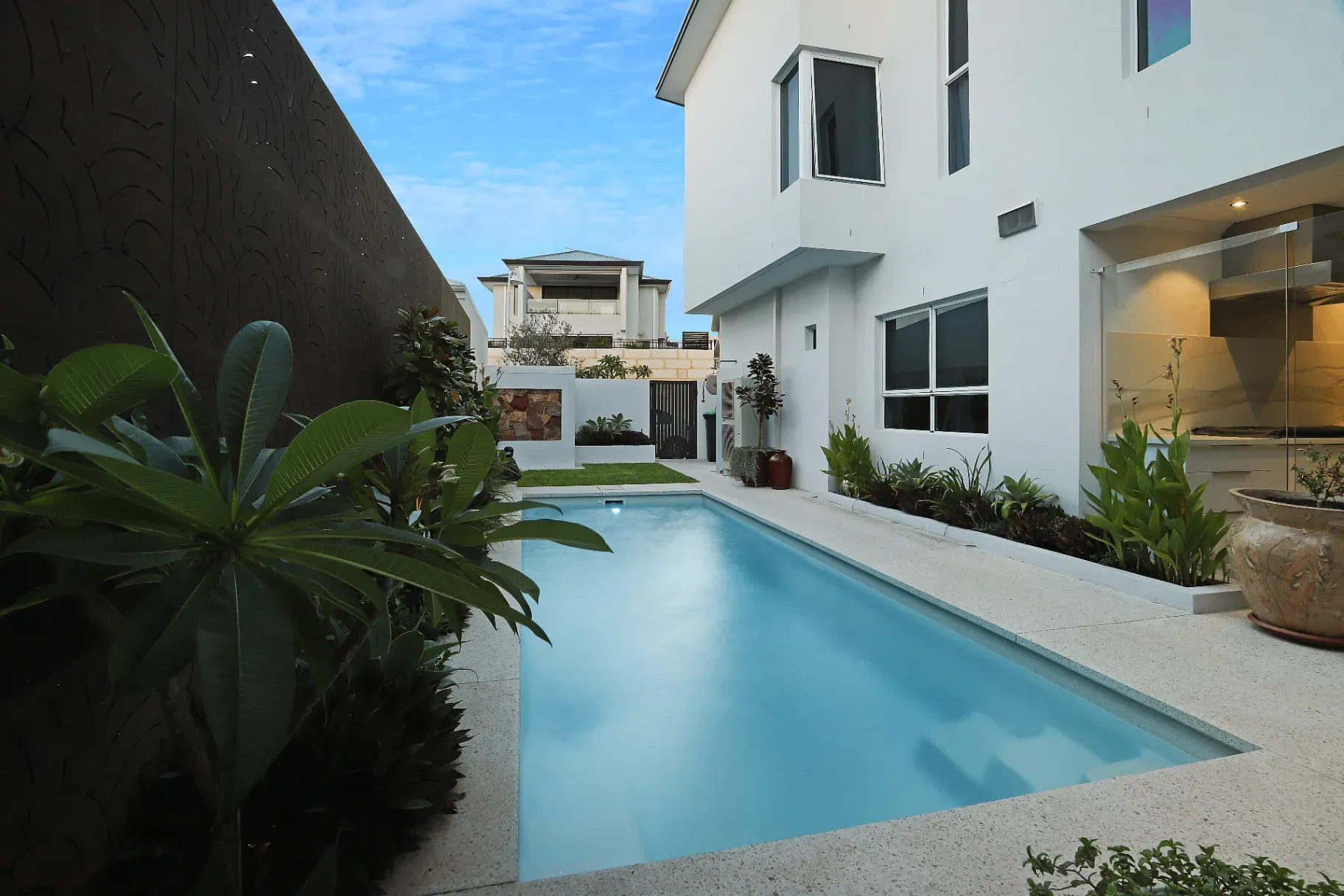
Concrete Pools Brisbane: Costs, Timelines & Alternatives
MFP Easy builds fibreglass, not concrete. What concrete pools in Brisbane genuinely offer, what drives the price, and when each construction wins.
Written by Tehbyn Nova, Head of Operations & Growth
Published
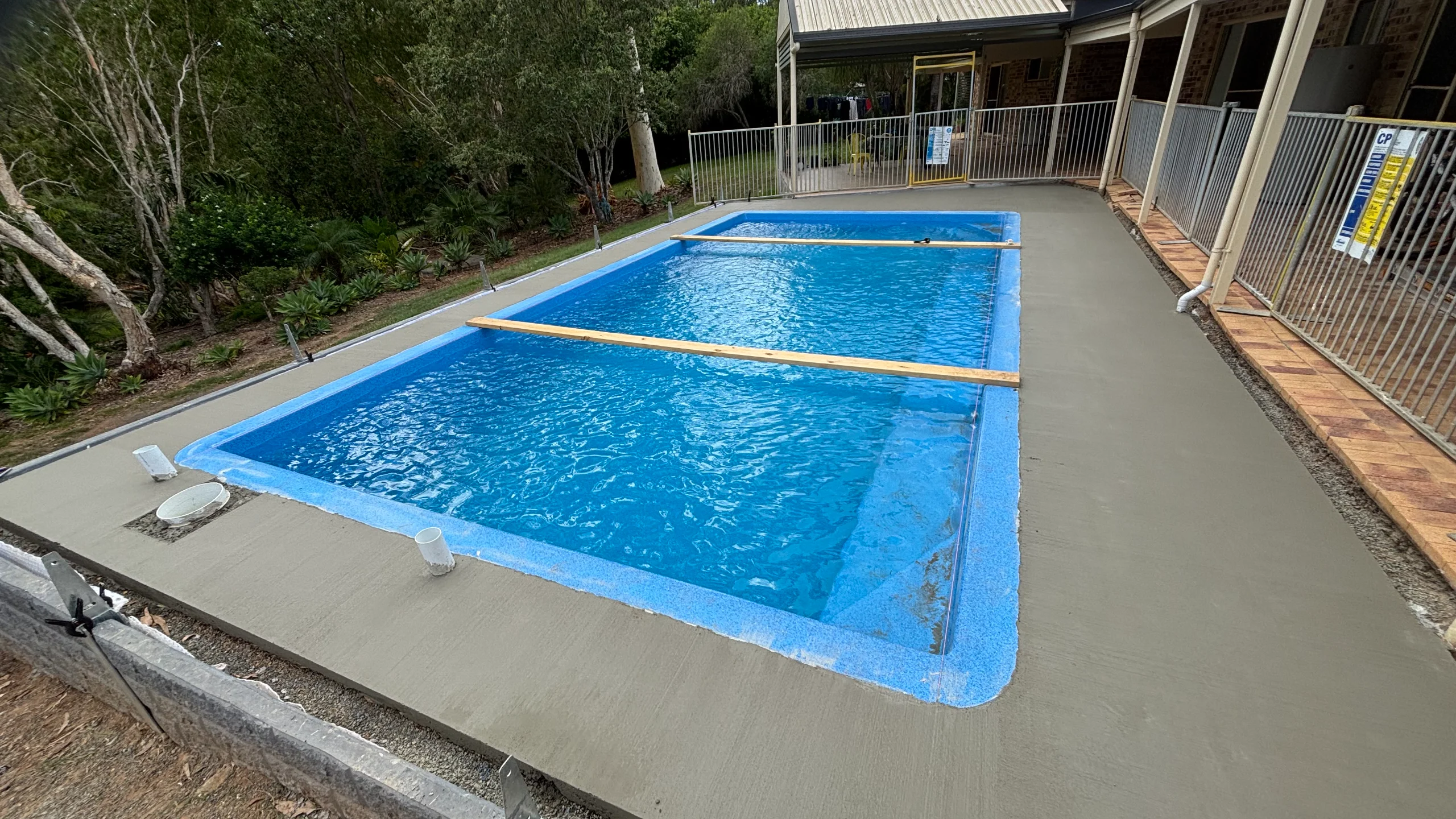
MFP Easy builds fibreglass pools across South East Queensland. We do not build concrete pools, and we do not publish a shortlist of Brisbane concrete pool builders. Concrete is a legitimate way to build a swimming pool: the structure is formed on site, so it takes shapes and dimensions no factory mould produces, and some briefs only a concrete pool can meet.
Concrete pools in Brisbane are also quoted per project rather than published, built over months rather than weeks, and finished with an interior surface that has a shorter service life than the structure under it.
What are the benefits of concrete pools vs fibreglass pools?
A concrete pool can be built to any outline, dimension and depth profile its engineering permits, because it is formed on site. A fibreglass pool shell is made in a fixed mould and delivered by road, which settles its shape and size before the block is measured. The three main benefits of a concrete pool:
- Freeform and bespoke outlines. A concrete pool takes the shape of its formwork and steel, so a curved lagoon edge, a kidney outline or a pool tracing an irregular boundary is buildable. A fibreglass pool comes only in outlines that exist as moulds, and no shell can be drawn to one backyard's geometry.
- Dimensions beyond the mould and the truck. A concrete pool has no manufactured size ceiling: the block, the budget and the engineer set its dimensions. A fibreglass pool shell must be liftable by crane and legal to carry on a road, which caps how large one moulded shell can be. The moulded range MFP Easy installs runs to 11.48m long; the round shells specifically top out at 4m in diameter.
- Engineering one-offs. A concrete pool can be structurally integrated with the site, cantilevered over a fall, tied into a retaining wall, or built with a wet edge spilling into a catchment tank. A fibreglass pool shell arrives with its floor profile, bench and step positions moulded in, and those positions are set in the mould, not on the block.
Are concrete pools more expensive than fibreglass pools?
A finished concrete pool in Brisbane generally costs more than a fibreglass pool of similar size and specification, because a concrete pool is assembled on site from a sequence of separate trades while a fibreglass pool arrives as one manufactured product. Steel fixing, spraying or pouring, interior finishing and tiling are each quoted, scheduled and invoiced on their own; a moulded shell carries all of it inside one factory price.
Concrete pools in Brisbane are quoted per project. Four variables drive a concrete quote most:
- Shell size and depth. Water volume determines excavation volume, steel tonnage, concrete volume and filtration sizing together, so a deeper pool of the same length is a larger job on each line.
- Interior finish. The interior of a concrete pool is a separate trade applied after the structure cures. Render, exposed pebble and full tiling are different materials with different labour, so the finish is quoted as its own line.
- Coping and surrounds. Coping, paving and the concrete around the pool are often quoted separately from the structure, so two Brisbane quotes can describe the same pool and stop at different points in the backyard.
- Ground conditions and site access. Reactive clay soils across much of South East Queensland determine the engineer's steel schedule and footing design, and a backyard no concrete truck can park beside requires a pump with enough line to reach the excavation.
A concrete quote and a fibreglass quote compare only when both stop at the same point: a filled, fenced, approved pool. MFP Easy publishes its installed fibreglass pool prices rather than quoting on application — the 40 models we install run from $46,053 to $108,867 installed, with excavation, crane, filtration, mineral chlorinator, LED lighting and council approvals inside every figure.
How long does a concrete pool take to install compared to a fibreglass pool?
A concrete pool is built in place through a sequence of trades separated by a cure period, so a concrete pool project is measured in months. A fibreglass pool shell is moulded, coloured and finished in a factory before it reaches the property, so the shell installation is measured in weeks.
The concrete sequence runs in a fixed order:
- Excavate. The excavator opens the hole to the engineer's dimensions and carts the spoil off site, leaving an excavation the steel fixer can work inside.
- Steel and formwork. The steel fixer places the reinforcement cage to the engineered schedule and sets the formwork that shapes the walls. Inspections fall at the stages the certifier sets for that approval.
- Spray or pour the shell. The concrete crew forms the structure, spraying concrete against the steel or placing it into formwork, leaving the shell structurally complete.
- Cure. The shell gains strength over a period set by the engineer's specification, and no interior finishing trade can start until the shell has cured.
- Finish the interior. The renderer or tiler applies the surface the swimmer touches, over waterproofing where the chosen system requires it, and the interior colour and texture are set.
- Coping, surrounds and fill. The paver lays the coping and surrounds, then the pool is filled and the water balanced to swimming condition.
A fibreglass pool installation replaces stages two to five with a delivery. The crew prepares the base inside the open excavation, and the crane lifts the fibreglass pool shell over the house or through the side access onto that base. Where side access is too narrow for machinery, the shell travels over the roofline instead — the crane needs a setup position and a clear lift path, which is checked at the site assessment. The crew plumbs the shell, backfills against its walls and fills the pool. No cure period interrupts the sequence, because the factory completed the structure and the interior surface together. Fencing, surrounds and council approvals then set the project length.
What maintenance and upkeep is required for concrete vs fibreglass pools?
A well-built concrete pool lasts decades as a structure, and its interior finish does not last as long as the structure beneath it, so resurfacing is a scheduled ownership cost. A fibreglass pool's interior is gelcoat, which is the finish and the face of the structure at once — nothing to re-render, re-pebble or reseal.
Upkeep separates at the interior surface. A rendered, pebbled or tiled concrete interior is porous and a gelcoat interior is not, which is where the running-cost gap between fibreglass and concrete pools comes from.
Appearance runs the other way. A concrete pool's interior can be re-rendered, re-pebbled or re-tiled in a different colour at each resurfacing, and the outline altered with it. A fibreglass pool's gelcoat colour, shape and depth are set at the factory for the life of the pool.
When to choose a concrete pool over a fibreglass pool?
A concrete pool is the right call when no moulded shell meets the design or the site. Three conditions decide it, and each one can point either way.
| Condition | Concrete answers it when | Fibreglass answers it when |
|---|---|---|
| Outline and size | The design needs a bespoke outline, or a pool beyond mould and truck dimensions | An existing rectangular, round or L-shaped model matches the brief |
| Structural integration | The pool is engineered into a fall, a retaining structure or a wet edge | The pool sits within a level or gently graded backyard |
| Site logistics | No crane setup position or clear lift path exists, so nothing can be landed in one piece | Street and side access are tight, and one crane lift beats weeks of repeated trade access |
Where the design and the site allow either construction, the choice reduces to customisation against build duration, surface and price certainty. MFP Easy's fibreglass shells cover the round, small, medium, large and lap pool types, each with a published installed price.
If you have a concrete quote in hand, book a site visit and we will measure the block, confirm crane access and put a finished fibreglass figure beside it.
FAQs
What is the typical cost of a concrete pool in Brisbane?
No published typical price exists for a concrete pool in Brisbane, because concrete pools are quoted per project. The structure, the interior finish, the coping and the surrounds are usually priced as separate lines, so an advertised concrete figure is often the structure rather than a finished pool. Ask for one finished figure with the scope itemised. The cost of a fibreglass pool is published in category bands instead, so the comparison number exists before anyone visits.
What are the disadvantages of a concrete pool?
A concrete pool has three main drawbacks against a fibreglass pool, and each bites a different buyer. The build runs in months rather than weeks, which matters most to anyone working to a summer deadline. The render, pebble or tile interior is a wearing surface renewed during the pool's life, which matters most to a long-term owner. The price is assembled from trades quoted separately, so the total settles late — that one matters most on a fixed budget.
Is it cheaper to get a concrete pool?
A finished concrete pool of comparable size and specification generally costs more than a fibreglass pool in Brisbane, not less. The exception is a design no moulded shell offers, such as a bespoke outline or a pool built into a retaining structure: on those briefs a concrete pool is not the dearer option — it is the only one being priced.
How long will a concrete pool last?
A concrete pool's structure lasts decades when engineered and poured correctly, and so does a fibreglass pool shell. The interior surface is where they differ: a concrete pool's render, pebble or tile finish typically wears out before the structure does and is renewed during the pool's life, while a fibreglass pool's gelcoat is the structural surface and is never resurfaced. Whichever construction you choose, have the builder put the warranty structure — who warrants the shell or structure, and who warrants the interior finish — in writing before contract.
What is the most expensive part of installing a pool?
The largest single cost in an inground pool is the pool itself — the structure and interior finish on a concrete pool, or the manufactured shell on a fibreglass pool. Excavation and spoil removal, the surrounding concrete and paving, and the safety fence follow on either construction type. Difficult site access raises all of them, because a backyard the machinery cannot reach adds crane size, pumping distance or hand labour.
Do you need council approval for a pool in QLD?
Yes. An inground swimming pool in Queensland requires building approval before work starts, issued by a building certifier — privately engaged or through the local council — and the pool is entered on the state's pool safety register once built. The pool barrier must comply with the Queensland Development Code MP 3.4, and a Form 23 pool safety certificate is required before a property with a pool is leased; at sale, the seller either provides the certificate or gives the buyer formal notice that one must be obtained after settlement. We lodge the building approval as part of the build.