In-Ground vs Above-Ground Pools: Costs Compared
Above-ground, in-ground or semi-inground fibreglass? Real installed costs, QLD approval rules, lifespan and resale value compared — and when each genuinely makes sense.
Published · Updated
Direct answer
Above-ground pools look like the budget path: a few thousand dollars, no excavation, done in a weekend. In-ground pools look like the "real" pool. But the most interesting option for many Queensland blocks is the one nobody advertises — a fibreglass pool installed partially above ground. Here's the honest comparison across price, lifespan and liveability: when semi-inground beats both, why the "cheap" above-ground sticker is rarely the real number, and what QLD fencing law demands of every pool over 300mm deep (yes, inflatables included).
The real cost comparison
| Above-ground (steel/vinyl) | Semi-inground fibreglass | In-ground fibreglass | |
|---|---|---|---|
| Upfront cost | $3,000–$15,000 | $50,000–$75,000 | $45,000–$82,000 |
| Lifespan | 7–15 years (liner 5–9) | 25+ years, lifetime shell warranty | 25+ years, lifetime shell warranty |
| Adds property value | Rarely | Yes | Yes — typically the most |
| Council approval (QLD) | Yes, if >300mm deep | Yes | Yes |
| Fencing required | Yes | Yes | Yes |
| Feel | Temporary | Permanent, architectural | Permanent |
The surprise for most people is the fencing and approval line: in Queensland, any pool holding more than 300mm of water needs building approval and compliant fencing — above-ground included. By the time an above-ground pool is legally installed with fencing, decking and a decent filtration system, the "cheap" option often lands at $15,000–$25,000 for an asset with a liner that needs replacing within a decade and near-zero effect on resale value.
The cheap above-ground pool: what you actually get
Walk into any big-box retailer in summer and you'll find above-ground pools from a few hundred dollars (inflatable ring) to a few thousand (steel-frame kit). That price is genuine — for the pool itself. What it doesn't include:
- A compliant fence — typically $2,000–$8,000 depending on layout, and legally non-optional in QLD
- Building approval and pool registration — the >300mm rule catches almost every kit pool sold
- Adequate filtration — the cartridge pumps bundled with budget kits are usually undersized for Queensland heat, where warm water turns green fast
- Something to stand on — families almost always end up adding steps or a deck
- Longevity — vinyl liners typically last 5–9 years, and budget steel walls corrode faster in our humid coastal climate
None of this makes a cheap above-ground pool a scam — it makes it a short-term product with a long-term compliance bill attached. If you're comparing options, compare the legal, installed number, not the box price.
Above-ground pools with decks: the hidden second project
Almost everyone who buys an above-ground pool ends up researching decking for it, and there's a reason: a bare above-ground pool has one entry point (a ladder), nowhere to sit, and a wall you can't supervise children over. A surrounding deck fixes all three — and typically costs $5,000–$15,000+ built to code, often more than the pool itself.
The deck also complicates compliance: a platform at pool-edge height creates a new climbable structure, and the barrier line usually has to move — decks routinely trigger a fencing redesign. If you're going to spend pool-plus-deck money anyway, that total starts overlapping with a permanent small fibreglass pool, which is exactly the comparison worth running before you commit.
Can you get a fibreglass pool above ground?
Mostly yes — with one important caveat. A fibreglass shell is engineered to be supported: the strength model assumes backfill around the walls and a prepared base underneath, which is why you won't see quality fibreglass pools sold as freestanding units the way steel-frame kits are.
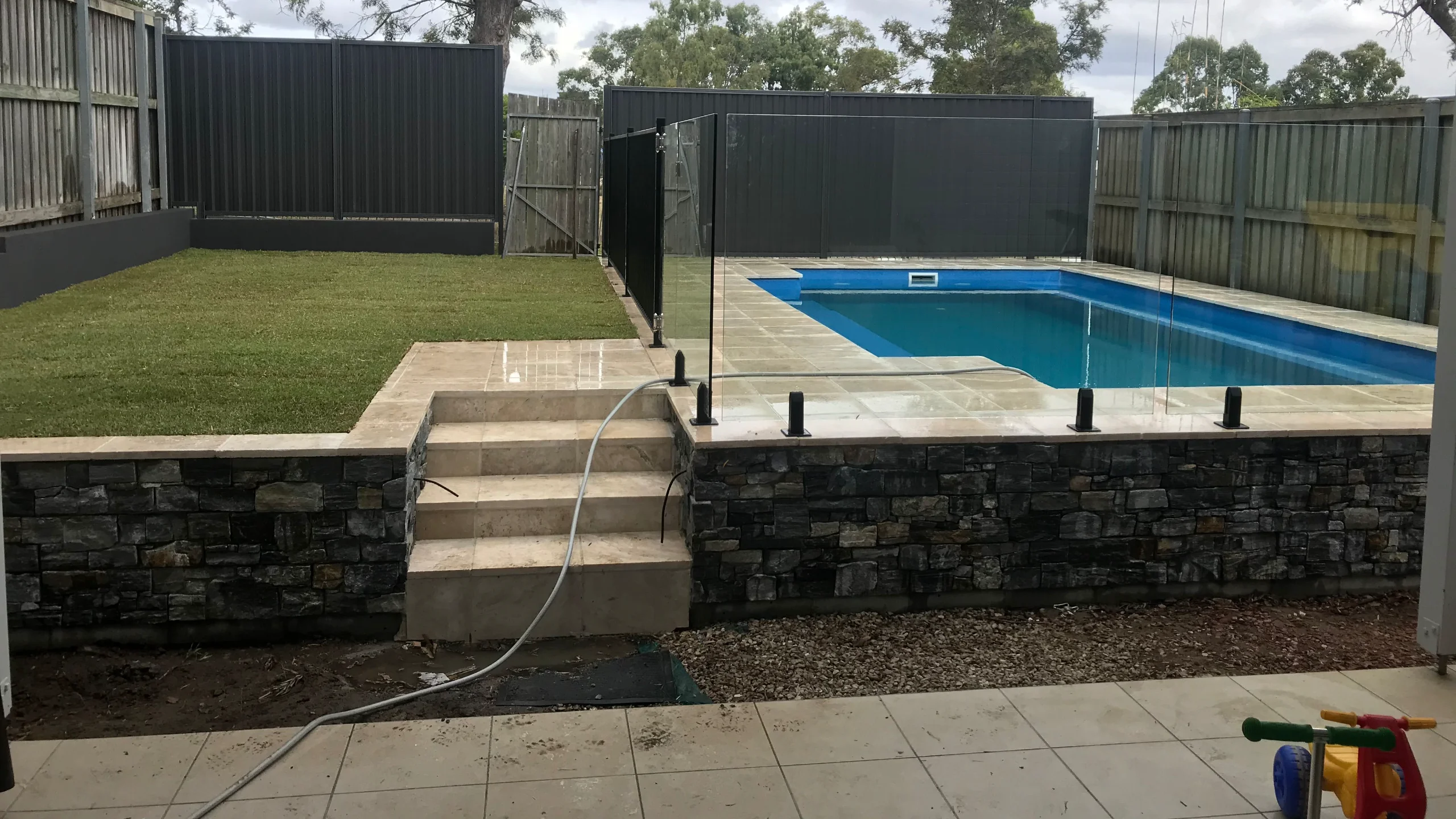
What fibreglass does brilliantly is semi-inground installation — the shell sits partly in the ground and partly proud of it, the exposed portion structurally supported by engineered retaining, then clad or decked. Because the shell stays within its engineering specification, you keep the lifetime structural warranty, the smooth gelcoat interior and the Pool ColourGuard® surface — just not fully buried.
(You'll also see "concrete above-ground pools" advertised — a sprayed shell inside blockwork. Genuinely permanent, but they cost as much as in-ground concrete, take months to build, and need the same fencing and approvals. A semi-inground fibreglass shell gets the same look in a fraction of the time.)
Semi-inground: how it's engineered, and when it wins
A semi-inground install works like this: we excavate to a reduced depth, crane the shell in, then support the exposed wall section with engineered retaining or blockwork before backfilling the buried portion as normal. The raised edge is capped with coping and clad in timber, stone or rendered block — a deliberate architectural feature, not a compromise.
When it beats both alternatives:
- Sloping blocks — instead of massive cut-and-fill or retaining walls, the pool steps out of the slope, often saving significant excavation cost
- Rock — where full-depth excavation means days of rock-breaking at hourly rates, raising the shell 400–800mm can be the cheapest path to a pool
- Tight or flood-prone sites — raised installs can solve drainage and overland-flow issues that would complicate a full dig
- Design — a raised edge at seat height (around 450mm) doubles as bench seating for the whole entertaining area
You get the permanence, warranty and feel of a real pool, full compatibility with pool heating, minerals and automation, and — on the right site — a lower installed price than forcing a full in-ground dig. On flat, easily dug blocks, fully in-ground usually costs the same or less, so semi-inground is a site-driven decision, not a default.
Above-ground plunge pools: the fastest-growing version
The biggest search trend in this category is the above-ground plunge pool — a compact fibreglass shell, partially raised, decked to the waterline. It photographs like a resort feature, suits small Brisbane and Gold Coast backyards, and because plunge shells are short, the retaining and decking bill stays modest. Our plunge range starts from about $45k fully installed, and every model under 5 metres suits a raised install:
Prices are live all-inclusive installed prices (pool, standard installation, filtration and handover) for standard site conditions in South East Queensland.
All-inclusive pricing covers excavation, crane, premium filtration, mineral chlorinator, LED lighting, council approval and engineering certification, so the plunge pool prices quoted model by model are installed figures rather than shell-only ones.
QLD fencing rules apply to above-ground pools too
This catches a lot of buyers out, so here it is plainly. In Queensland, any structure capable of holding more than 300mm of water — kit pool, inflatable, spa or in-ground pool — requires building approval and a compliant safety barrier, and the pool must be registered on the QLD pool register. Compliant means:
- Fence height minimum 1200mm, with gaps under 100mm
- A 900mm non-climbable zone around the barrier (no chairs, pot plants, BBQs or climbable trees inside it)
- Self-closing, self-latching gates that open away from the pool
An above-ground pool's own wall can sometimes form part of the barrier if it meets height and non-climbable requirements — but ladder or deck access still needs compliant gating, and any surrounding deck changes the equation. Get the barrier wrong and you're exposed to fines and real drowning risk. Pool fencing can be laid out to follow the garden line instead of cutting the backyard in half, but it isn't included in installed pool pricing (ours or anyone's honest quote), so budget for it whichever route you take.
Resale value: the honest version
Nobody can guarantee what a pool does to your sale price — but the pattern agents describe is consistent. A permanent, approved, well-presented in-ground or semi-inground pool is a feature South East Queensland buyers actively search for. An ageing above-ground pool tends to work the other way: buyers see a liner nearing replacement and a structure they may want removed, and many vendors dismantle them before listing. The distinction isn't snobbery — it's asset life. A fibreglass shell with a lifetime structural warranty is still a pool in 25 years; a vinyl liner is a consumable.
When above-ground pools genuinely make sense
Renters with landlord approval, a strict short-term horizon, or budgets where $20k+ simply isn't on the table this decade. If the pool is a five-year plan rather than a twenty-year one, above-ground is the rational buy — just budget the real compliant number (fence, approval, decent pump), not the sticker.
Why in-ground fibreglass wins the long game
Installed in 10–12 weeks from first chat to swimming — the shell itself is craned in and swimmable within days — warranted for life, gentler on feet and swimwear than concrete, cheaper to heat thanks to the insulating shell, and the version every valuer and buyer recognises as a permanent improvement. Finance is available from roughly $150/week through Handypay, and all-inclusive installed pricing is published for every model — or book a free site visit and we'll tell you whether your block suits in-ground, semi-inground or neither.
FAQs
Can a fibreglass pool be installed above ground?
Partially, yes — fibreglass shells engineered for semi-inground installation can sit with a portion above grade, fully supported and warranted. Fully freestanding installation isn't how the shells are engineered; the strength design assumes backfill support.
How much does an above-ground pool really cost installed?
A compliant setup — pool, pump and filter, fencing, decking or steps, approval and certification — typically lands at $15,000–$25,000 for a quality steel-wall vinyl pool in QLD. Budget kits exist below that, but they cut exactly the corners (liner thickness, filtration, fencing) that determine lifespan and legality.
Do above-ground pools need council approval in Queensland?
Yes — any structure capable of holding more than 300mm of water requires approval and compliant safety barriers in QLD, the same as an in-ground pool.
Is semi-inground cheaper than fully in-ground?
On difficult sites (rock, steep slopes), often yes — reduced excavation can outweigh the extra retaining and decking. On flat, diggable blocks, fully in-ground is usually the same price or cheaper. A free site visit settles it for your block specifically.
Do I need a fence around an above-ground pool in QLD?
Yes. Any pool deeper than 300mm needs a compliant barrier: 1200mm minimum height, gaps under 100mm, a 900mm non-climbable zone and self-closing gates. The pool's own wall can sometimes count as part of the barrier, but ladder and deck access still needs compliant gating — and the pool must be registered on the QLD pool register.
Can you heat an above-ground pool?
You can, but it's the least efficient pool to heat — thin walls exposed to air on every side lose heat quickly, so expect higher running costs and treat a cover as essential. An in-ground or semi-inground fibreglass shell holds heat far better.
Can you put an above-ground pool in the ground later?
Steel-and-vinyl above-ground pools generally can't be buried — the walls aren't engineered for soil loads, and doing so usually voids the warranty and shortens the structure's life. If you want a sunken or partially sunken pool, start with a shell engineered for it: that's exactly what semi-inground fibreglass is for.
^"From $150/week" is based on a loan of $42,800 repaid weekly over 7 years at the 7.19% p.a. comparison rate (interest rates from 6.57% p.a.): approx. $150 a week, total amount repayable approx. $54,499. You can finance all or part of your project.
Comparison rate calculated on an unsecured personal loan of $30,000 over 5 years. WARNING: This comparison rate applies only to the example or examples given. Different amounts and terms will result in different comparison rates. Costs such as redraw fees or early repayment fees, and cost savings such as fee waivers, are not included in the comparison rate but may influence the cost of the loan.
Estimates only — actual rates based on credit assessment. Finance to approved applicants by Handy Finance (OurMoneyMarket Lending Pty Ltd ABN 64 605 231 669, Australian Credit Licence 488228). Interest rates from 6.57% p.a. to 18.99% p.a. (comparison rates from 7.19% p.a.). Terms, fees and eligibility criteria apply. This is general information only.