Types of Swimming Pools: Every Option Compared
Every type of swimming pool explained — fibreglass, concrete, vinyl, plunge, lap, infinity, swim spas — with installed costs in Australia and how to choose.
Published · Updated
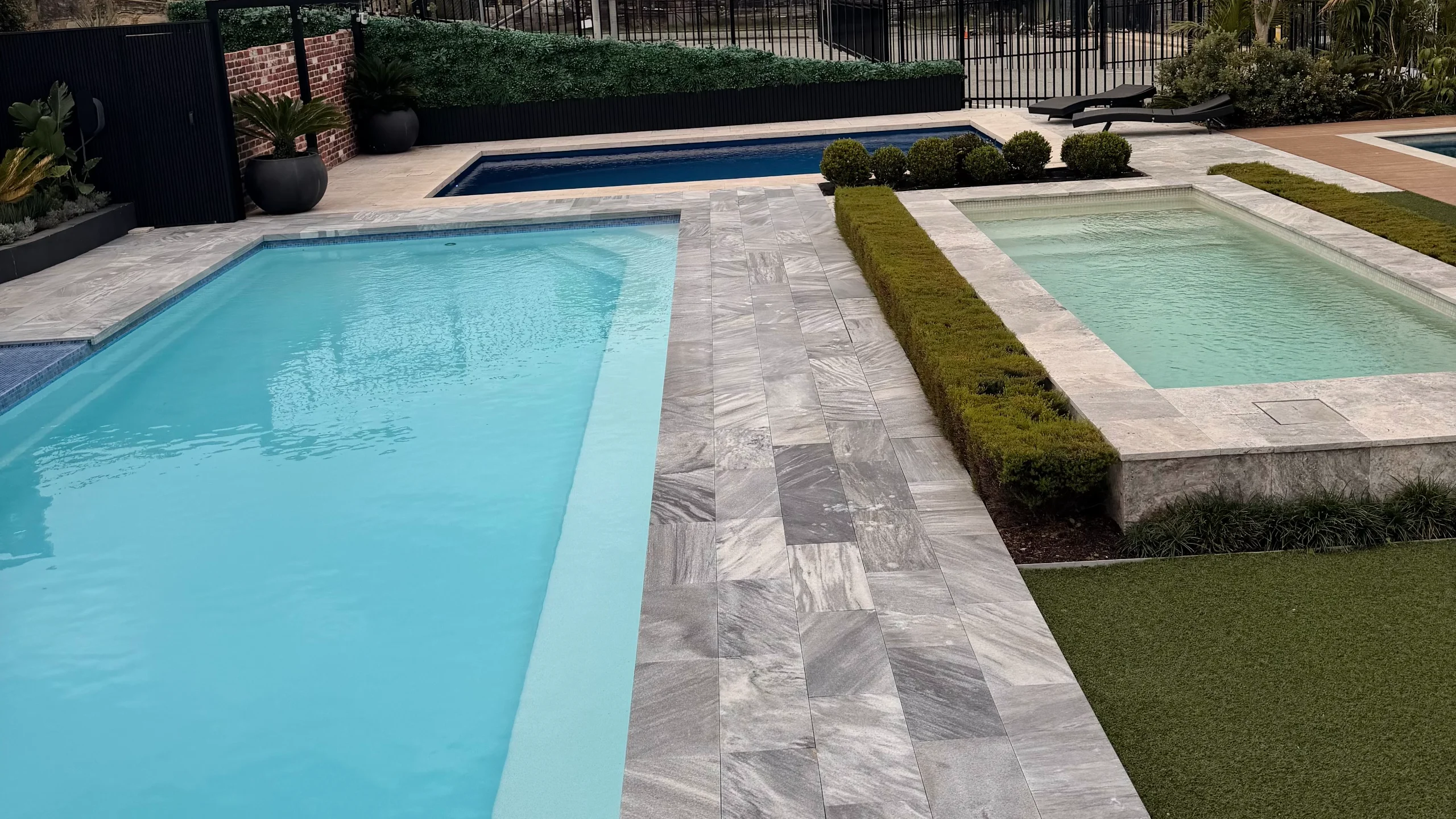
Direct answer
Choosing a pool starts with choosing a type — and the labels get used loosely enough that half the quotes people compare aren't for the same thing. A "small pool" quote might be a vinyl kit, a plunge shell, or a concrete courtyard build at three very different prices. Here's every mainstream type of swimming pool explained: what it is, roughly what it costs installed in Australia, and who it actually suits — with links to our deeper guides on each one.
How many types of swimming pool are there?
Fewer than the brochures suggest. Every residential pool is really a combination of four choices:
- Construction — fibreglass, concrete or vinyl-liner
- Position — in-ground, above-ground or semi-inground
- Shape and purpose — plunge, lap, family, infinity, beach-entry and so on
- Water treatment — chlorine, salt water or magnesium minerals
Any pool you've ever seen is just those four dials set differently. Work through them in that order and the "which pool?" question mostly answers itself.
Types by construction
Construction is the biggest decision because it sets your budget, your timeline and your maintenance for the next 25 years.
Fibreglass pools
Fibreglass pools arrive as a finished one-piece shell, craned into the excavation and swimmable within days — fully installed and handed over in around 10–12 weeks. The mould fixes the pool shapes and sizes on offer — rectangles from 4m to 11m, rounds at 3m and 4m — so choosing happens from a catalogue, not a drawing board. The smooth gelcoat interior is gentle on skin and hostile to algae, the shell retains heat well, and quality manufacturers back the structure for life. We install Aqua Technics shells exclusively — Graphene Nano-Tech® construction with a Lifetime Structural Warranty and Lifetime Interior Surface Guarantee. Installed range is roughly $45,000–$82,000; the live bands below come straight from our quoting system.
Concrete pools
Concrete pools are built in place — sprayed as gunite or shotcrete over a steel frame — so any shape or size is possible — this is the option for 15-metre-plus lap pools, true vanishing edges and fully custom geometry. The trade-offs are real: 6–12 month builds, interiors (render, pebble or tile) that need resurfacing every 10–15 years, a rougher surface that harbours algae and chews through more chlorine, and installed prices typically starting $75,000–$100,000+ before landscaping.
Vinyl-liner pools
Vinyl-liner pools stretch a flexible liner over a steel or polymer frame — the cheapest permanent construction upfront, but liners puncture, fade and need replacing every 5–9 years, and Australian buyers have largely moved on. Most above-ground pools are vinyl-lined, and the moulded plastic (polyethylene) pools from big-box stores sit a rung below even those — portable, usually unfiltered, and closer to a summer toy than a permanent pool.
A quick note on surfaces and finishes, since it's a common comparison point: fibreglass gelcoat is the smoothest and lowest-maintenance interior available; concrete render and pebble finishes feel coarser underfoot and need periodic acid washing and resurfacing; fully tiled concrete looks superb but sits at the top of the price range.
| Pool size | Length | Depth | Installed from |
|---|---|---|---|
| 3m to 4m | 1.45m level | $45,847 | |
| 4m to 5.5m | 1.0m to 1.78m | $45,613 | |
| 6m to 7m | 1.0m to 1.88m | $54,443 | |
| 7.2m to 8m | 0.98m to 1.96m | $60,374 | |
| 8.5m to 11m | 1.0m to 2.0m | $72,535 |
Live all-inclusive installed pricing for standard site conditions in South East Queensland — updated straight from our quoting system.
Site access, slope, rock and equipment choices are what move those numbers up or down.
Types by shape and purpose
Plunge, courtyard and cocktail pools (3–5m)
Three names for broadly the same idea: a compact pool sized for cooling off, soaking and small-block living rather than laps. "Cocktail pool" usually means the smallest of the bunch — think our 3m × 3m Terrace 3 — while "courtyard pool" just describes where it goes. They're the cheapest pools to heat, run and fence, and modern designs squeeze in benches, ledges and swim-jet options. Small-block pools are our specialty. Plunge pools typically land around $45k–$60k installed.
Lap pools
Long and narrow — usually 7 metres and up, around 2.5 metres wide — with a clear, obstruction-free swim corridor for fitness. Fibreglass handles lap pools comfortably up to 11–12 metres (our Kensington is 11m × 4m); beyond that you're into concrete territory.
Family and entertainer pools (8–11m)
The classic backyard pool: wide enough for games, long enough for a proper swim, with benches and shallow zones for supervising adults and smaller kids. Models like our Westminster and Kensington carry the most usable water area per dollar of any pool type.
Infinity-edge pools
Water vanishing over a wet edge into the view — spectacular on sloping blocks with something worth looking at, and expensive everywhere because of the catch tank, extra pumping and structural work. The more affordable look-alike approaches include above-deck fibreglass installs with acrylic-window effects.
Beach-entry (zero-entry) pools
A gradual sloping entry instead of steps — brilliant with toddlers and anyone with limited mobility, but the ramp eats significant swim space and a true beach entry generally requires concrete construction. Many families get 90% of the benefit from a fibreglass pool with a wide, shallow entry ledge instead.
Swim spas
Short heated pools (usually 4–6m) with jets to swim against — a spa and gym-pool hybrid, typically run 3–8°C warmer than a pool. Good for year-round training in a tight footprint; less good for kids' play and entertaining.
Natural pools
Chemical-free pools filtered by a planted "regeneration zone" of gravel and aquatic plants. Beautiful and genuinely swimmable, but niche in Australia: they need roughly double the footprint (the plant zone is extra), specialist builders, and water that runs greener and warmer than most owners expect. Worth knowing they exist; rarely the right answer on a suburban block.
Indoor pools
Common in commercial gyms, rare at home in Queensland — an enclosed pool needs serious ventilation and dehumidification to stop condensation wrecking the building, and the enclosure usually costs more than the pool. In our climate, an outdoor pool with a heat pump and thermal blanket delivers 9–12 month swimming for a fraction of the cost.
Rectangle or freeform: does shape matter?
More than people expect. Rectangles maximise swimmable area for their footprint, suit lap swimming, make pool covers and blankets simple, and match contemporary homes — which is why most modern fibreglass ranges lead with them. Freeform and kidney shapes soften a tropical or established garden and can wrap around existing trees or rocks, but you lose usable swim length, and covers, blankets and robotic cleaners all work harder on curves. If you're heating the pool, that cover-compatibility point is worth real money every winter.
A handful of specialty shapes turn up in higher-end builds: perimeter-overflow pools sit flush with the deck so the water mirrors the sky like a sheet of glass, geometric pools use sharp angles, spillways and bubblers for an architectural look, and free-form designs mimic a natural lagoon set among planting. All three are custom concrete territory rather than off-the-shelf fibreglass shells.
Types by water treatment
Any construction can run any water type — this choice is about feel and running cost, not safety:
- Traditional chlorine: lowest equipment cost, most hands-on dosing.
- Salt water chlorination: a chlorinator converts dissolved salt into chlorine automatically — softer feel, less manual dosing, the Australian default for decades.
- Magnesium mineral: mineral salts replace most of the sodium chloride — noticeably silkier water, and owners report it's gentler on skin and eyes. It's what most of our customers now choose, and a mineral chlorinator is included in our standard installed price.
In-ground, above-ground, or in between
In-ground pools dominate for good reason — permanence, feel, and the full range of construction types. Above-ground pools (mostly vinyl kits) suit rentals, short horizons and tight budgets, but still need the same compliant fencing once they hold more than 300mm of water. Semi-inground fibreglass is the clever middle path on sloping or rocky blocks: the shell sits partly out of the ground with a deck built to meet it, saving a fortune in excavation and retaining.
Which pool type is best for young kids?
The honest answer is that supervision and a compliant barrier matter far more than pool type — in Queensland any pool deeper than 300mm needs building approval and a fence at least 1200mm high with self-closing gates. That said, type does shape day-to-day life with little ones:
- Wide entry steps and ledges (standard on most modern fibreglass family models) give toddlers a safe splash zone under your hand.
- Plunge pools are easy to supervise corner-to-corner and cheap to heat for shoulder-season swimming lessons.
- Beach entries are lovely but not a safety feature — a crawling child reaches water faster on a ramp than at a step.
- Deep, narrow lap pools are the least kid-friendly layout until children swim confidently.
How to choose
Three questions settle most decisions:
- What fits? Measure the usable flat(ish) area and subtract fencing setbacks. If that's under 6 metres, you're shopping plunge and small pools — and they're better than they've ever been.
- What's it for? Kids and entertaining point to width, benches and shallow zones. Fitness points to length or a swim jet. Cooling off points to a plunge.
- How long will you own it? Five years or less favours cheap and temporary; anything longer favours fibreglass in the ground with a lifetime warranty.
A free site visit answers question one definitively — we measure access, slope and setbacks and tell you exactly which of our 30 models fit.
FAQs
What type of pool is cheapest to install?
Above-ground vinyl pools are cheapest upfront ($3,000–$15,000 plus compliance costs). Among permanent pools, fibreglass installs cheapest — typically $20,000–$40,000 less than an equivalent concrete pool once finished.
What type of pool is best for a small backyard?
A fibreglass plunge or small pool (3–5.5m). One-piece shells need less working room than in-situ construction, and models like the 3m × 3m Terrace 3 fit genuine courtyards.
Which pool type lasts longest?
Quality fibreglass and well-maintained concrete both exceed 25 years. Fibreglass keeps its original interior (with a lifetime surface guarantee on ours); concrete needs resurfacing every 10–15 years to get there.
What's the most popular pool type in Australia?
Fibreglass now dominates new residential installations — the speed of installation, warranties and low maintenance fit how Australians actually use pools.
What are the three main types of inground pools?
Fibreglass (pre-made shell, fastest install), concrete (built in place, fully custom, most expensive) and vinyl-liner (cheapest, but liners need replacing every 5–9 years). In South East Queensland, fibreglass and concrete account for nearly all new inground builds.
Which type of pool is easiest to maintain?
Fibreglass, by a comfortable margin. The non-porous gelcoat surface resists algae, so it typically needs less chlorine, less brushing and no resurfacing — concrete and vinyl both demand more chemical balancing and eventual interior renewal.
What are the pros and cons of each pool type?
Fibreglass: fast, low-maintenance and mid-priced, but limited to pre-designed shapes up to about 12m. Concrete: any shape or size, but slow, dearest to build and run. Vinyl: cheapest in, dearest over time as liners wear. For most SEQ backyards the fibreglass trade-off wins, which is why it's what we build.