Salt Water vs Magnesium vs Chlorine Pools: Costs Compared
Salt water, magnesium and chlorine pools compared for a fibreglass shell: what each costs to run, what salt corrodes, and how conversion works.
Published · Updated
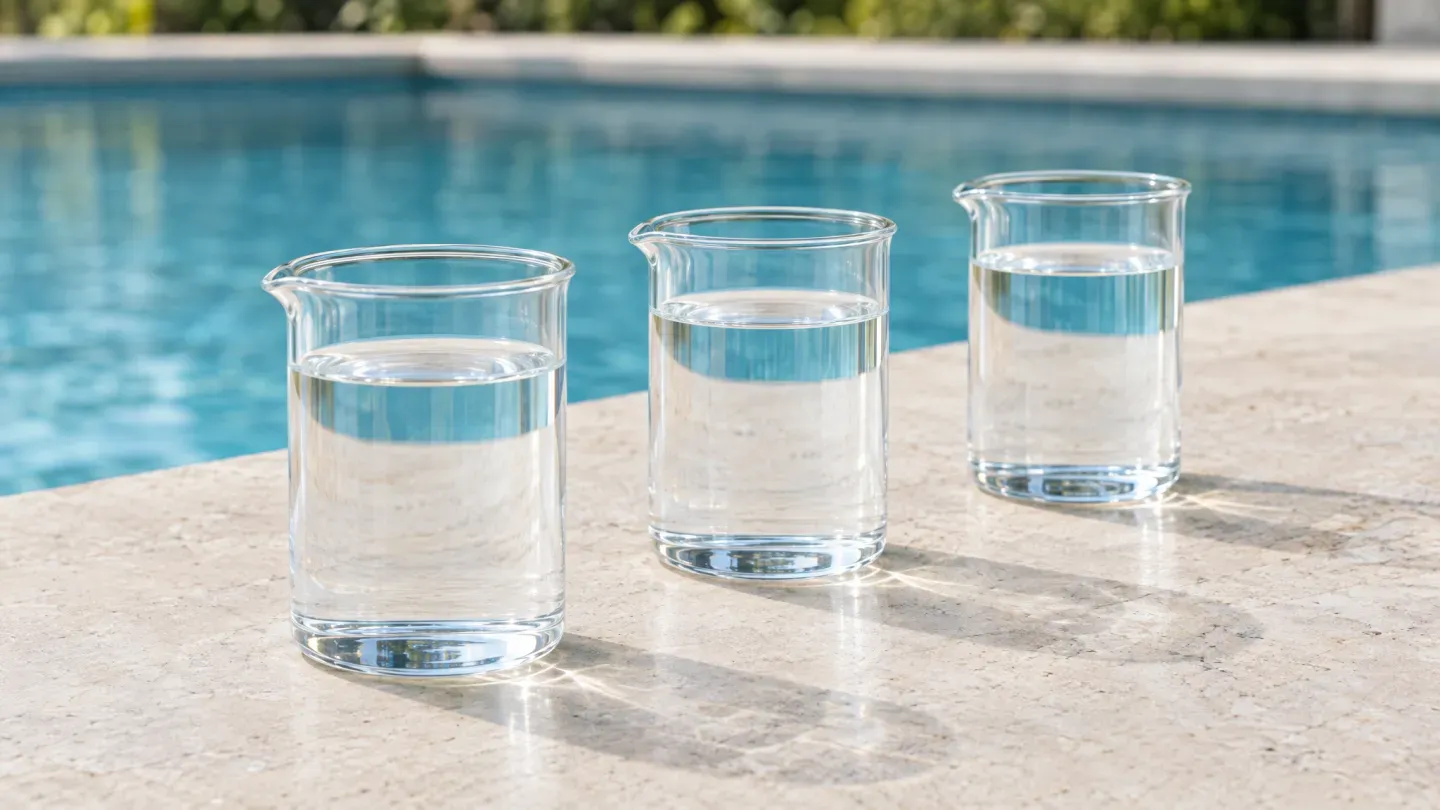
A fibreglass pool can use salt water, magnesium minerals, or manually added chlorine. The pool shell is the same for each system.
All three systems use chlorine to sanitise the water. The difference is how the chlorine is supplied:
- A salt water pool uses a chlorinator cell to generate chlorine from dissolved salt.
- A magnesium pool uses a cell to generate chlorine from a magnesium and potassium mineral blend.
- A manually dosed pool uses chlorine added by hand from a bucket or drum.
A fibreglass pool has a non-porous, chemically resistant gelcoat surface. Salt exposure does not degrade this surface in the same way it can affect plaster or vinyl-lined interiors.
The main differences between the systems are annual consumable costs, equipment purchase and replacement costs, and the effects of the water on metal fittings and surrounding areas.
Can a fibreglass pool be a salt water pool?
Yes. A fibreglass pool has a non-porous, chemically resistant gelcoat interior. Salt water does not erode or roughen this surface.
A salt water pool still uses chlorine. A salt chlorine generator is installed on the equipment pad. When the pump runs, the generator passes an electrical current through salt dissolved in the water. Electrolysis converts the salt into chlorine. The chlorine forms hypochlorous acid, which kills bacteria and algae.
The result is chlorinated water with low salinity. Salt water is a method of generating chlorine, not an alternative to chlorine.
We build fibreglass pools across South East Queensland. The sanitiser is selected during the quote stage. The same fibreglass shell can use salt, magnesium or manually dosed water treatment.
Salt can damage concrete and vinyl-liner pool interiors. In a concrete pool, salt can erode the cement and plaster finish. It is more abrasive on plaster than on an aggregate finish. In a vinyl-liner pool, the steel walls behind the liner can corrode and leak if the liner is compromised.
A fibreglass shell has no cement finish or steel wall. These failure modes do not apply to fibreglass pools.
Does salt water damage a fibreglass pool over time?
Salt water at normal pool salinity does not degrade a fibreglass shell. However, it can corrode metal components in and around the pool, including aluminium and steel finishes.
The following components are most likely to be affected:
- Ladders, handrails and rails fixed to the shell. These components are exposed to both pool water and splash. Older or poorly maintained systems with brass or aluminium parts can fail faster.
- Light fixtures and heaters. Pool light housings remain underwater, while heaters circulate water through metal components. Both have continuous contact with salt water.
- Automatic pool cover mechanisms. Tracks, rollers and fixings installed along the coping are close to the water and can be damaged by salt.
- Aluminium and steel finishes on the surrounds. Salt residue can corrode nearby aluminium and steel. It can also mark decking and edging when splashed water dries.
Evaporation leaves salt deposits on pool surrounds. Water splashed onto the coping dries and leaves salt behind. Repeated wetting and drying increases the concentration of these deposits. Rinse the surrounds with fresh water after use to reduce corrosion.
Fixings, coping and light surrounds should be specified for use with salt water. Salt residue can corrode aluminium and steel near the pool, but it does not damage the gelcoat.
Is salt or chlorine better for a fibreglass pool?
Neither option is better for the pool shell. A fibreglass pool’s gelcoat is not affected by salt water or manually dosed chlorine. The main differences are chemical handling, water feel, equipment requirements, and ongoing costs.
| Salt water pool | Manually dosed chlorine pool | |
|---|---|---|
| What sanitises the water | Chlorine, generated at the cell from dissolved salt whenever the pump runs | Chlorine, bought as a liquid or granular product and added by hand |
| Chemical handling | Pool salt added in bags; no chlorine bought, carried or stored | Chlorine bought, stored and dosed to the pool's demand |
| Swim feel (as marketed) | Salinity about as salty as a teardrop, softer feeling water, no processed-chlorine smell, no eye sting underwater | Processed chlorine described as harsher on skin and hair, and as provoking reactions in some swimmers |
| Equipment on the pad | Chlorinator with two wear parts: the cell and the control board that powers it | No chlorinator: pump and filter only |
| Where the ongoing money goes | Pool salt, pump electricity, and eventual cell and board replacement | Chlorine bought through the season |
A salt water pool produces chlorine on the equipment pad. This avoids buying, transporting, and storing chlorine. With a manually dosed pool, the owner buys, stores, and adds chlorine to maintain the required free chlorine level. This is done alongside the chemicals a fibreglass pool needs and their required levels.
Salt water pools are marketed as more comfortable for swimmers. Water at salt-pool salinity is also described as safe if a small amount is swallowed. These are marketing claims rather than measured differences. Both systems use the same form of chlorine at the same free chlorine level.
The two systems have different upfront and ongoing costs. A manually dosed pool costs less to install because it does not require a chlorinator, but chlorine must be purchased throughout the season. A salt water pool costs more to install because it requires a chlorinator, but pool salt is cheaper than purchased chlorine. Salt water systems also require eventual replacement of the cell and control board.
How does a magnesium pool compare with a salt water pool?
A magnesium pool uses dissolved magnesium and potassium minerals instead of sodium chloride alone. It still sanitises the water with chlorine generated by a cell.
A magnesium mineral pool uses roughly half as much chlorine as a salt water pool. The minerals provide the comfort benefits. This system is also well suited to a fibreglass shell.
The following features are the same for both systems:
- The gelcoat is inert to both salt and mineral water.
- A cell generates chlorine while the pump runs.
- Routine maintenance includes checking salinity, inspecting the cell, correcting pH and keeping stabiliser within range.
A magnesium pool has three disadvantages compared with a salt water pool:
- Minerals cost more per top-up than pool salt. Magnesium and potassium blends cost more per bag than granular pool salt. Mineral top-ups are required for as long as the pool uses the system.
- Fewer chlorinators support minerals. A mineral system requires a compatible chlorinator. Fewer compatible mineral units are available than salt chlorinators, which can limit replacement options.
- Maintenance requirements do not decrease. Shell care, water testing, pump hours and cell maintenance remain the same. The main differences are comfort and chlorine demand.
What do salt, magnesium and chlorine pools cost to run?
Consumable costs are about $20 per year for salt in a salt water pool and about $150 per year for chlorine in a manually dosed pool. Magnesium mineral blends cost more per bag than pool salt, but a magnesium mineral pool has roughly half the chlorine demand of a salt water pool. These figures do not include replacement cells or control boards.
Published running-cost comparisons usually include consumables only. They exclude the equipment used to generate chlorine. Salt water and magnesium mineral pools use a chlorinator cell and a control board. Both parts require replacement over time. A manually dosed pool does not use these parts.
| Salt water pool | Magnesium mineral pool | Manually dosed chlorine pool | |
|---|---|---|---|
| Consumables each year | About $20 a year of pool salt | A magnesium and potassium mineral blend that costs more per bag than pool salt, with roughly half the chlorine demand of a salt water pool | About $150 a year of chlorine |
| Equipment that wears out | Salt cell, with replacement from about $700 depending on the brand and cell size, plus the control board | Mineral chlorinator cell and control board | None: pump and filter only |
| Pump electricity | The pump runs about eight hours a day, and sometimes longer for larger pools. The chlorinator produces chlorine only while the pump is running | The chlorinator produces chlorine only while the pump is running | The pump provides filtration and circulation. It does not generate chlorine |
| Chemical handling | Bags of salt, plus acid to correct pH drift | Bags of minerals, plus acid to correct pH drift | Chlorine purchased and dosed manually |
A chlorinator includes a cell and a control board. A new chlorinator includes both parts. Each part is purchased separately when it fails.
A magnesium mineral pool uses the same cell and control board as a salt water pool. Its mineral bags cost more, but its chlorine demand is lower. A manually dosed pool does not require a chlorinator cell or control board.
How do chlorine, salt and mineral pools differ at a glance?
Mineral pools, also called magnesium pools, use a dissolved mineral blend that contains magnesium chloride. As the pump circulates the water, a mineral chlorinator cell converts part of the dissolved blend into chlorine.
Backyard pools use one of three chlorination systems.
| Manually dosed chlorine | Salt water | Mineral (magnesium) | |
|---|---|---|---|
| Dissolved feedstock | None. Chlorine enters the pool as a bought product | Sodium chloride, sold as plain pool salt | A product-specific blend containing magnesium chloride; MagnaPool also contains potassium chloride |
| Chlorine source | Liquid, granules or tablets, dosed by hand | A salt chlorinator cell makes it on site | A mineral chlorinator cell makes it on site |
| What the owner buys | Chlorine as a product, on a regular routine | Bags of pool salt, occasionally | Bags of mineral blend, occasionally |
| Chlorinator cell | Not fitted | Rated for sodium chloride | Rated for the mineral blend |
| The sanitiser in the water | Chlorine | Chlorine | Chlorine |
All three systems produce chlorinated water. The choice determines the feedstock, chlorinator cell and handling routine.
Is a mineral pool just a salt water pool with a different name?
No. A mineral pool uses the same electrolysis process as a salt water pool but uses a different salt product. Both systems dissolve salt in the pool water and pass the water through a cell that converts the dissolved salt into chlorine.
A salt water pool uses sodium chloride. A mineral pool uses a blend that contains magnesium chloride, and many mineral blends also contain sodium chloride. Top-ups require the mineral blend rather than plain pool salt.
Magnesium registers as hardness in water tests, so a mineral pool requires additional hardness monitoring. A “magnesium salt water pool” is a mineral pool: the phrase describes the salt water mechanism and the magnesium chloride blend, not a separate product.
Is a mineral pool better than a manually dosed chlorine pool?
A mineral pool is a chlorinated pool in which a cell continuously generates chlorine from a mineral blend dissolved in the water. The owner occasionally adds minerals but does not buy, store, or manually add chlorine. Claims that mineral pools are chlorine-free are therefore false.
A manually dosed chlorine pool uses the same sanitiser, but the owner buys chlorine as a liquid, granules, or tablets and adds it according to test readings. Swimmers sometimes report that mineral pool water feels gentler on their skin and eyes, but these are reports about comfort rather than measured health outcomes.
The difference in smell is smaller than many buyers expect. The sharp smell commonly attributed to chlorine comes from chloramine. Chloramine levels depend on how the pool is balanced and operated, not on which system adds or generates the chlorine.
Where do freshwater, ozone and ioniser systems fit?
Trace-metal ionisers, ozone or AOP units, and freshwater systems are separate product classes. None is a mineral system.
A trace-metal ioniser, sold as a copper or silver cartridge or as an electrode unit, doses metal ions into circulating water. The ions suppress algae and supplement the pool’s existing sanitiser. The ioniser generates no chlorine and adds no magnesium, so the pool must obtain chlorine from one of the three systems in the table above.
An ozone or AOP unit introduces a short-lived oxidiser into water passing through the plumbing. The oxidiser breaks down contaminants before the water returns to the pool. The unit operates with a chlorinator, not as a replacement for one. Maytronics rates the reduction in chlorine demand from ozone at up to 80%, but the chlorinator must still supply the residual measured by water testing.
Freshwater systems are marketed as operating with little or no dissolved salt. They use oxidisers or ion dosing for sanitising instead of a salt-fed cell. A freshwater pool is not a mineral pool, regardless of shelf labelling.
A mineral setup consists of a cell, filter and mineral blend. These components are listed under mineral pool systems and equipment.
Which pool water is healthiest to swim in?
All three pool systems use chlorine for sanitation, and no measured health advantage distinguishes one system from another. They differ in how chlorine enters the water, which consumables the owner must buy and store, and how swimmers describe the water.
Swimmers may describe mineral pool water as gentler on their skin and eyes, but these owner-reported observations are not supported by clinical results. Claims that magnesium pool water supports relaxation or muscle recovery require the skin to absorb magnesium during swimming. No established evidence shows that this absorption occurs in a swimming pool.
Water balance has more effect on swimmer comfort than the system type. A well-balanced pool of any type can be comfortable, while a neglected pool of any type is not. For an assessment of individual claims, including comparisons with float-tank concentrations, see magnesium pool benefits and drawbacks.
Which system suits a new fibreglass pool?
A new fibreglass pool can use manual dosing, a salt chlorination system, or a mineral chlorination system. The shell and plumbing are the same for all three, so the decision depends on the preferred operating and maintenance requirements.
Manual dosing requires the least equipment but the most chemical handling. A salt system generates chlorine automatically and uses the least expensive consumable of the three systems. A mineral system also generates chlorine automatically but uses a mineral blend instead of salt. The mineral blend costs more per bag and provides the water feel for which owners select this system.
Mineral systems are generally quoted as a paid upgrade from salt systems for new pools. The price includes a chlorinator with the required capacity and the initial mineral charge. For pools we build, the mineral chlorinator and the first year of minerals are standard inclusions, so selecting mineral instead of salt does not add a line item to our quote. This inclusion applies only to our package and does not represent mineral-system pricing generally. See magnesium pool cost for installed price ranges and annual running-cost comparisons.
What does a salt water chlorinator need on a fibreglass pool?
A salt water chlorinator requires:
- The correct output capacity for the pool’s water volume
- The salt level specified by the manufacturer
- A clean salt cell
Pool salt levels are commonly maintained between 3,000 and 4,000 ppm. Use the target specified by the chlorinator manufacturer.
Use pool salt that is food grade, granular, non-iodised, and at least 95% pure. Salt with a purity of 99% or higher is preferred. Impurities can stain the pool and reduce chlorine generation efficiency. Do not use rock salt or halite because it does not fully dissolve.
A salt cell typically lasts three to seven years. Its service life depends on operating hours and water balance. Inspect and clean the cell every three to six months, or sooner if white mineral scale is visible on the plates.
The control board can fail separately from the salt cell. If the board fails, the chlorinator stops generating chlorine even when the cell is working. The board can be replaced independently.
The salt chlorinator or mineral system is selected during the pool build based on the pool’s water volume and included in the quote.
How do you maintain a salt water fibreglass pool?
A salt water fibreglass pool requires the same testing, brushing, and filtration as other fibreglass pools. The salt system adds six tasks to standard fibreglass pool maintenance.
- Test the salt level. Check salinity during regular water testing. Add salt when the level is low. If the salt level is too low, the cell stops producing chlorine. If it is too high, the chlorinator shuts down.
- Inspect and clean the cell. Remove the chlorinator cell and check its plates for flaky white scale. Clean the cell when scale is present.
- Correct the pH. The pH in a salt water pool tends to increase, so acid must be added regularly.
- Check for calcium scale. High pH can cause calcium scale at the waterline and white mineral deposits on the cell plates.
- Maintain stabiliser levels. Keep cyanuric acid between 40 and 60 ppm. This is higher than the usual level for a manually dosed pool.
- Set the pump runtime. Run the pump for about eight hours per day. Larger pools may require more time. The chlorinator produces chlorine only while the pump is running, so pump runtime affects both sanitation and filtration.
A pool cover reduces UV exposure and chlorine loss. If the chlorinator output remains unchanged while the cover is on, the free chlorine level increases. Reduce the chlorinator output while the pool is covered.
Can you convert a salt water pool to magnesium?
Yes. The conversion process depends on the mineral system and the existing chlorinator.
Major brand conversion guides specify the following process:
- Partially drain and refill the pool to reduce salt and total dissolved solids to about 1,500 ppm.
- Replace the filtration media.
- Install a compatible mineral chlorinator.
- Add the required minerals.
Some mineral blends can instead be added directly to an existing salt water pool without draining it.
MagnaPool provides this six-step conversion process:
- Fit the hydroxinator.
- Replace the filter media with glass filtration media.
- Test the water.
- Add the minerals.
- Run the system.
- Maintain the required water balance.
Mineral dosing is based on pool volume. AstralPool's conversion guide for the Acquatherepé system specifies one 10 kg bag of Acquatherepé Transform per 20,000–25,000 L of water for a saltwater pool conversion.
Three Birds Renovations documented a mineral pool conversion with the following costs and timing:
- New system: from $2,400
- Ongoing minerals: about $45
- Conversion time: under one hour
This timing applies to a different process from a conversion that requires a partial drain and refill.
The existing chlorinator determines the required work. If the pool already has a mineral-compatible chlorinator, the conversion only requires changes to the water chemistry. If it has a salt-only chlorinator, the conversion requires a new unit and the full procedure specified by the system manufacturer.
FAQs
Are magnesium pools better than salt?
Magnesium mineral pools use about half as much chlorine as salt water pools. The fibreglass shell performs the same with either system. Magnesium minerals cost more to replace than pool salt.
What are the disadvantages of a magnesium pool?
Magnesium mineral blends cost more per top-up than pool salt. Fewer chlorinators support mineral blends. Maintenance requirements remain the same. A magnesium pool still uses a cell to generate chlorine, so you must monitor salinity, inspect the cell, correct pH, and maintain pump operating hours.
How much does it cost to convert a pool to magnesium?
Three Birds Renovations reported that its mineral pool conversion cost $2,400 for a new system and about $45 for ongoing minerals. The conversion took less than one hour.
The total cost depends on whether the existing chlorinator is compatible with minerals. The brand’s procedure also requires partially draining and refilling the pool to reduce the salt level to about 1,500 ppm. Direct-dose products do not require this step.
Can you put too much magnesium in a pool?
Yes. Calculate the dose based on the pool’s water volume. AstralPool’s conversion guide for the Acquatherepé system recommends one 10 kg bag of Acquatherepé Transform per 20,000–25,000 L of water when converting a saltwater pool.
Is salt water bad for fibreglass pools?
No. Salt water at pool salinity does not erode or degrade a fibreglass pool's non-porous, chemically resistant gelcoat.
Salt can corrode nearby metal components, including ladders, handrails, light fixtures, heaters, automatic cover mechanisms, and aluminium or steel finishes around the pool.
What is the downside of a salt water pool?
A salt water pool requires a chlorinator with two parts that wear out: the cell and the control board. A replacement cell costs about $700 or more, depending on the brand and cell size.
Salt can also collect on fittings and surfaces exposed to splashed water. This does not occur with a manually dosed pool.