How to Keep Your Pool Algae-Free: Prevention Guide
A green pool comes down to nutrients, sunlight and low sanitiser. The SEQ prevention routine, an algae ID table, and the exact shock-and-clear protocol.
Published · Updated
April 15, 2024
How to Keep Your Pool Algae-Free in South East Queensland
A pool turns green when three things line up: nutrients in the water, sunlight, and not enough sanitiser to kill the spores before they bloom. Fix the sanitiser and starve the nutrients and algae has nowhere to go. Everything below is how we keep that balance on the pools we build and service across SEQ — the weekly routine that prevents a bloom, and the exact protocol to clear one once it's taken hold.
Algae spores are always in your water. They blow in on the wind, ride in on swimmers, and wash down in stormwater. You can't keep them out. What you control is whether they can multiply, and that comes down to sanitiser level, circulation, and how much phosphate you leave in the water for them to feed on.
Green water isn't always a sign of neglect either. Get the wrong run of weather — a warm, still few days after a storm — and a pool can go from clear to cloudy-green overnight. Like most pool maintenance, staying ahead of it is a handful of small weekly tasks, not one big rescue.
Why do pools turn green?
Pools turn green because free chlorine has dropped below the level needed to kill algae faster than it reproduces. Once that line is crossed, a bloom can double in a day.
Three failures let it happen, and usually more than one is in play at once:
- Sanitiser too low. Free chlorine under about 1 ppm — or a stabiliser (cyanuric acid) level so high it's locking your chlorine up — leaves spores free to multiply. On a salt pool this often traces back to a chlorinator turned down for winter and never turned back up.
- Poor circulation. Water that doesn't move has dead zones: behind ladders, in the deep end, around steps. Sanitiser never reaches those pockets, and that's where a bloom starts.
- A food source. Phosphates and nitrates from leaves, lawn fertiliser, sunscreen and stormwater are algae fertiliser. High phosphate plus warm water plus sun is the exact recipe for green.
Warm water speeds all of this up, which is why blooms are a summer problem far more than a winter one.
Why algae is worse in South East Queensland
Algae is a bigger problem here than in cooler states because our water sits in the growth zone — above 26°C — for a large part of the year, and our summer storms dump the nutrients that feed it.
Through a Brisbane, Ipswich or Gold Coast summer, pool water regularly sits in the high 20s to low 30s. Chlorine burns off faster in warm, sunny water, and algae reproduces faster in it — so the same pool that stays clear all winter on minimal chemistry can bloom within days once the heat arrives.
Then there are the storms. The service calls we field spike in the week after a big February southerly. A storm does three things at once: it dumps organic debris and phosphate-rich runoff into the pool, it dilutes your sanitiser with rainwater, and the cloud cover often means the pump was run less. Warm water, a fresh load of food, and a chlorine level knocked flat — a lot of green pools in this part of the world can be traced to a specific storm three or four days earlier.
If a storm is forecast, the single most useful thing you can do is run the filter longer afterwards and check your chlorine the next morning, before the water has a chance to go.
How to identify the algae in your pool
Before you treat anything, work out which algae you have — green, mustard or black — because the effort to clear each one is very different. Green wipes out in a day; black is a multi-day job.
| Type | Appearance | Where it grows | How hard to remove |
|---|---|---|---|
| Green | Cloudy green water, slippery walls; suspended and on surfaces | Everywhere, especially sunny areas and after chlorine drops | Easy — shock, brush, filter |
| Mustard (yellow) | Yellow-brown, powdery, dusts off surfaces then resettles | Shady spots, steps, behind ladders, near lights | Moderate — chlorine-resistant, needs scrubbing + algaecide |
| Black | Dark blue-green spots with a raised, protected head | Porous surfaces — concrete, plaster, grout, tile lines | Hard — roots into the surface, resists normal chlorine |
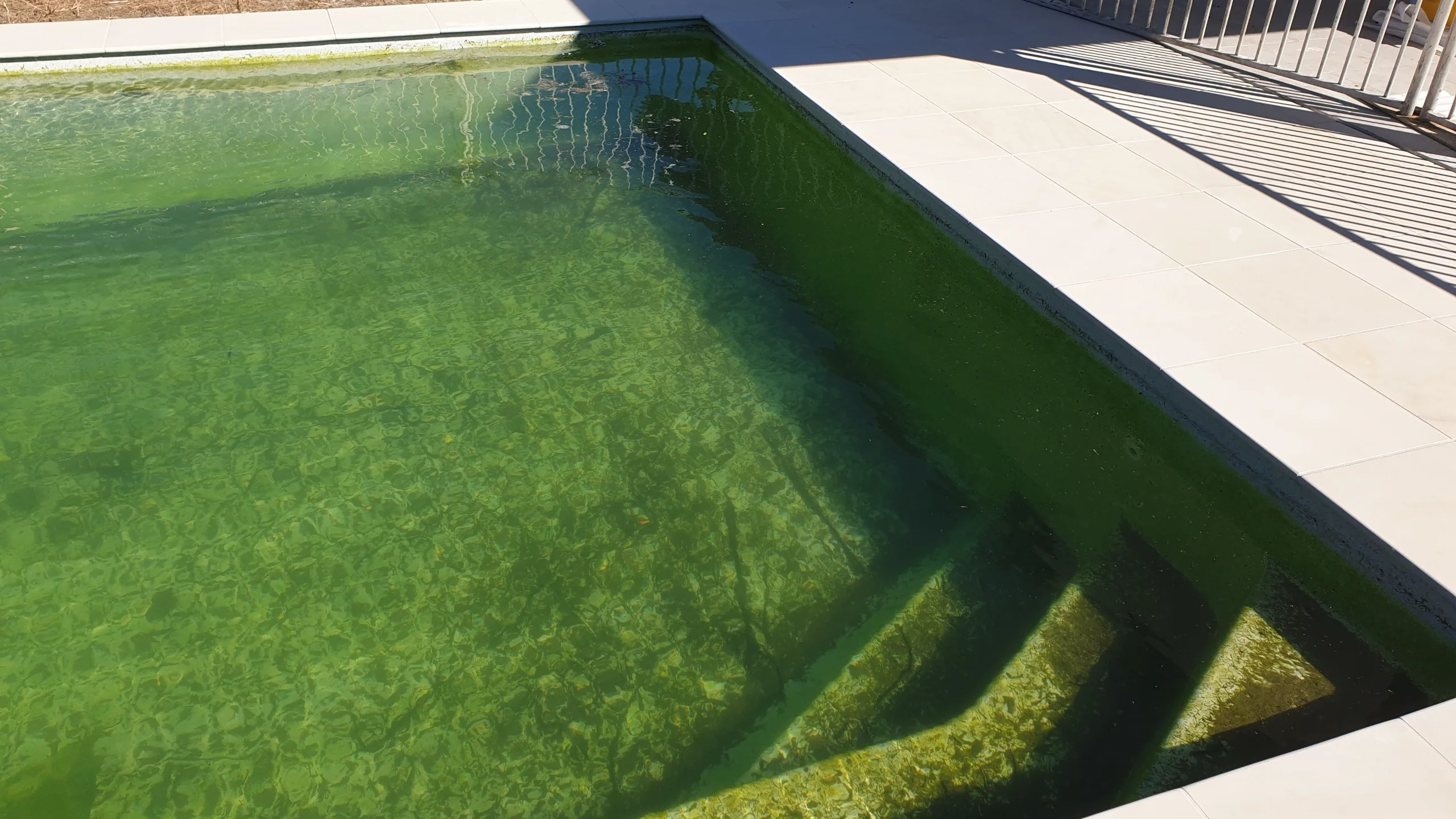
Green algae is what most people picture: the whole pool goes green and the walls turn slimy. It's the most common and the easiest to fix.
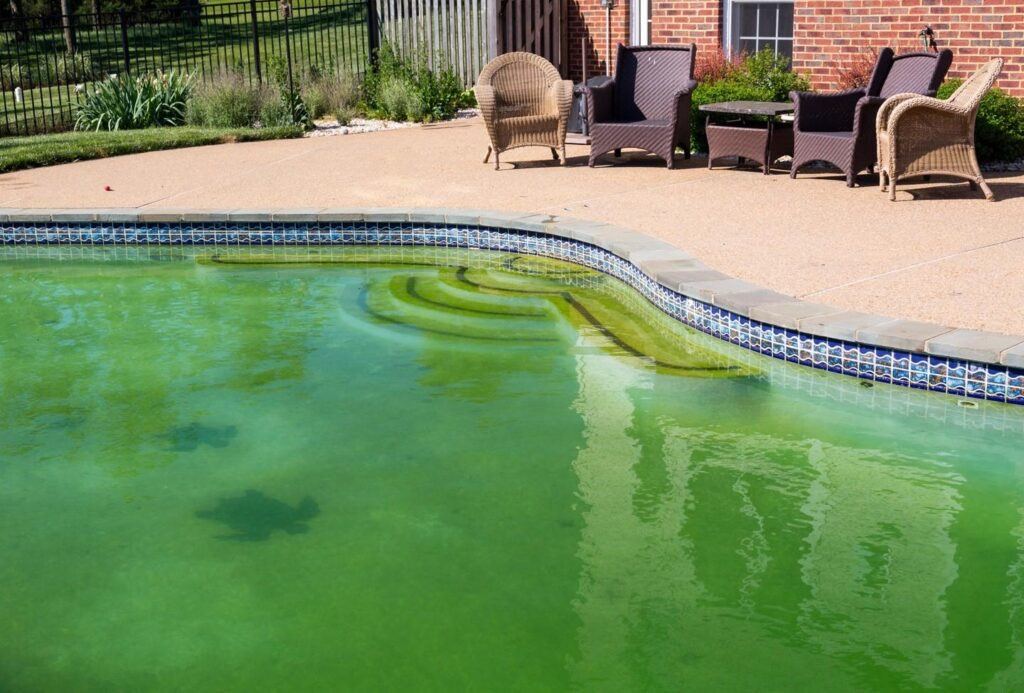
Mustard algae is sneakier. It's a strain of green algae that clings to shaded hard surfaces as a yellow-brown dust and shrugs off normal chlorine levels, so it comes back again and again if you don't physically scrub it and follow up with an algaecide. It's a common repeat offender, and removing mustard algae takes physical scrubbing plus an algaecide, not just a shock.
Black algae is the one to take seriously — and it's genuinely rare in a fibreglass pool. Despite the name it isn't really algae; it's cyanobacteria, and it survives by anchoring roots into porous surfaces and growing a protective cap over itself. That's why it's a menace in concrete, plaster and tile-grout pools and almost a non-issue in ours: a smooth gelcoat gives it nothing to root into, so it can't establish the way it does on a rough surface — more on that porosity difference below.
Where black algae (or its blue-green algae cousin) does appear, the health warnings from SEQ Water are worth respecting. Depending on the species, swallowing water containing the toxins can cause gastroenteritis — vomiting, diarrhoea, fever, headache — and may affect the liver, kidneys or brain; inhaling spray can trigger respiratory and flu-like symptoms; and skin contact can cause rashes and irritation. Don't swim in it.
Your weekly algae-prevention routine
Preventing algae is cheaper and easier than clearing it, and it comes down to five habits that together take about fifteen minutes a week.
1. Hold your sanitiser and balance. Keep free chlorine at 1–3 ppm (aim for the top of that in summer heat) and pH at 7.2–7.6 — algae struggles in a well-sanitised, correctly pH-balanced pool. Check that your stabiliser (cyanuric acid) is 30–50 ppm; much higher and it throttles your chlorine's ability to work, which is a hidden cause of pools that "have chlorine" but still go green.
2. Brush before you vacuum. Brushing the walls, steps and behind the ladder each week knocks loose the early biofilm that algae builds on, and exposes any starting patches to sanitiser. This is the step most people skip and the one that prevents mustard algae taking hold.
3. Run the pump long enough to turn the water over. Your pool should circulate its full volume at least once a day — in a SEQ summer that's usually 8–12 hours of filtration, more during a heatwave or after a storm. Moving water carries sanitiser into the dead zones where blooms start.
4. Keep phosphates down. Skim leaves out promptly, rinse sunscreen off before swimming where you can, and test phosphate levels a couple of times a season. If they're climbing, a phosphate remover strips out the food source so algae has nothing to feed on. Storm runoff is the big phosphate event — test after one.
5. Cover it and clean the filter. A well-fitted pool cover or blanket blocks the sunlight and debris algae needs, which is one of the simplest prevention tools going. And a filter only removes what it can reach — backwash or clean it on schedule so it's actually pulling fine matter out of the water.
Algaecide sits alongside this routine rather than replacing it. It's a preventive top-up and a mop-up for stubborn strains — useful as insurance and after clearing mustard algae — but it is not a substitute for chlorine. A pool kept on low chlorine and propped up with algaecide will still go green.
How to clear a pool that's already green
Clearing a bloom follows one sequence regardless of type — shock, brush, filter, clear, vacuum — and the only thing that changes is how hard you push each step. Get the water testing safe before anyone swims; that usually takes 12 to 24 hours, not weeks.
The core protocol:
- Test first. Check chlorine and pH with a kit so you know your starting point.
- Shock the pool. Use a purpose-built pool shock to super-chlorinate — dosed to the product's label, at dusk so sun doesn't burn it off before it works. Run the pump so it circulates.
- Brush every surface. Break the algae off the walls and floor so the chlorine can reach it. Dead algae is grey/white and drops to the floor.
- Filter 24/7. Leave the pump running continuously while the water clears. The water will go cloudy before it goes clear — that's dead algae, and it's a good sign.
- Clarify or floc if it stays cloudy. A clarifier gathers fine particles so the filter can grab them; a flocculant sinks them to the floor to be vacuumed to waste. Floc is faster for a heavy bloom but you'll lose some water vacuuming it out.
- Vacuum and re-test. Vacuum the settled debris, then re-test and rebalance chlorine and pH before swimming.
Green algae
Green is the straightforward one — the core protocol above clears it. Test, shock, brush, run the filter, then re-check your levels the next day and rebalance if needed.
Mustard algae
Mustard needs more scrubbing and a finishing algaecide because it resists chlorine and clings to shaded surfaces. Remove and clean any pool toys and equipment first (they harbour it), scrub every hard surface hard, then run the shock-brush-filter sequence. Once the water's clear and balanced, add an algaecide to kill what's hiding, and re-test before swimming.
Black algae
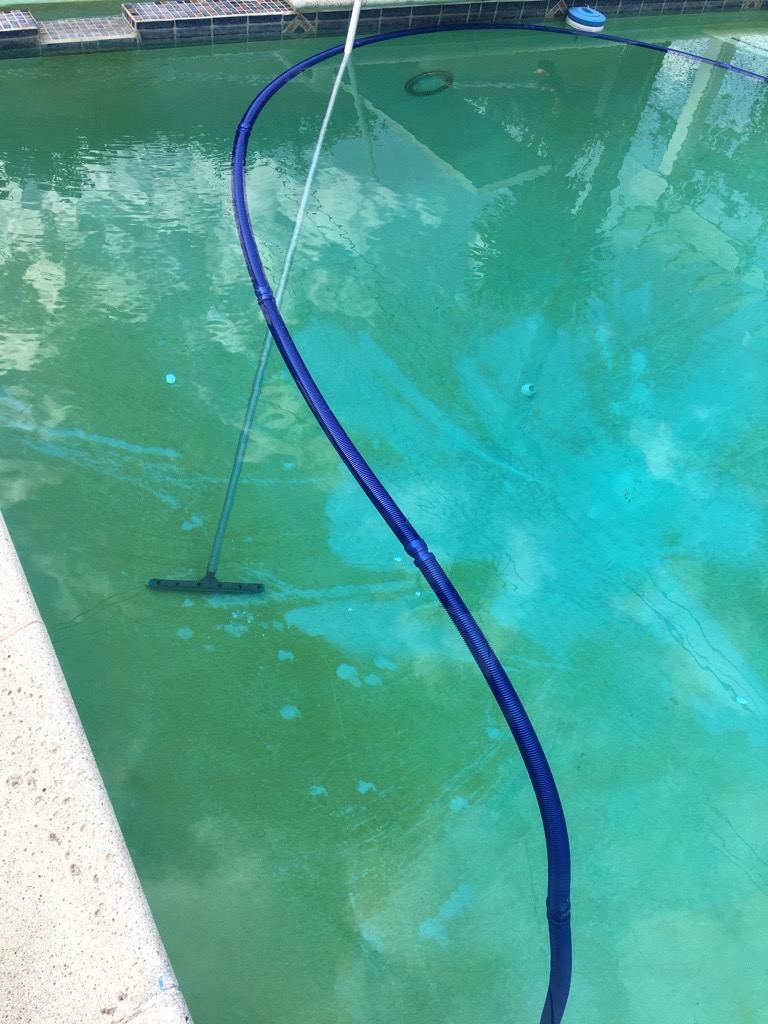
Black algae is the hardest to shift because it's rooted and capped, so chlorine alone won't touch it. You have to break it open mechanically first: scrub hard with a stiff brush, and work stubborn spots with the broken edge of a chlorine tablet (wear chemical-resistant gloves and eye protection). Then shock heavily — up to four times the normal dose — submerge your cleaning gear to disinfect it, and leave the pump running 24 hours. Scrub again while it circulates, clean the filter thoroughly so you're not reseeding the pool, then re-test and rebalance. Watch the affected spots for a week; if anything regrows, repeat. This is exactly the job you avoid by owning a non-porous pool.
Fibreglass vs concrete: why gelcoat fights algae
A fibreglass pool resists algae because its gelcoat surface is smooth and non-porous, so algae has nothing to grip and root systems can't establish. Concrete and plaster are microscopically rough and porous — algae wedges into that texture, which is why concrete pools are far more prone to stubborn, recurring blooms.
This is the core of the fibreglass vs concrete difference for maintenance. On a rough surface, mustard and black algae anchor into the pores and the grout lines and keep coming back even after you think you've cleared them. On a gelcoat, a brush wipes the surface clean and there's no texture for the next colony to hold onto — which is a large part of why our owners spend less on pool chemicals and less time scrubbing. It's one of the practical reasons to look at the fibreglass pool range if you're comparing build types.
Smooth doesn't mean maintenance-free. A fibreglass pool still needs its sanitiser held and its water circulated. It means that when you do the basics, they actually stick — and when a bloom does happen, it clears faster and doesn't leave a foothold behind.
FAQs
Why does my pool keep going green?
A pool that keeps going green has a recurring gap in sanitiser, circulation or nutrients — not bad luck. The usual culprits are free chlorine drifting too low between top-ups, a cyanuric acid (stabiliser) level so high it's crippling the chlorine you do add, poor water turnover leaving dead spots, or a persistent phosphate source like garden runoff. If it happens after every storm, it's the storm loading the water with food and rain diluting your chlorine — test and shock the day after.
What's the fastest way to clear a green pool?
Shock at dusk, brush every surface, run the filter non-stop, and add a clarifier or flocculant to drop the fine haze so you can vacuum it out. A straightforward green bloom clears in 12 to 24 hours this way. The two things that speed it up most are dosing the shock at night so sunlight doesn't waste it, and never turning the pump off while the water clears.
Does shock kill algae?
Yes. Shock is concentrated chlorine that super-chlorinates the pool — often called breakpoint or super-chlorination — raising free chlorine high enough to kill algae and the bacteria feeding on it. Regular chlorine maintains the day-to-day level that stops algae starting; shock is the heavy dose that kills an active bloom. For a bad bloom you may need to shock more than once.
Will algae damage a fibreglass pool?
No — algae won't damage the gelcoat, and it can't root into it the way it does into concrete or plaster. It's a water-quality and health problem, not a structural one. The bigger risk is chemical: repeatedly over-shocking or running chlorine very high to fight recurring algae can, over years, dull or fade gelcoat colour, so it's better to prevent blooms than to keep nuking them.
Can I swim in a pool with algae?
Not while it's visibly green or spotted. Green and mustard algae aren't directly poisonous, but they shelter bacteria that can make you sick, and green water hides the bottom, which is a drowning hazard. Black and blue-green algae can be genuinely toxic — swallowing the toxins can cause gastroenteritis and, depending on species, affect the liver, kidneys or brain. Get the water clear and testing safe first.
How long does it take to get rid of algae?
Anywhere from 12 hours to several days, depending on the type and how bad it is. Green usually clears within a day. Mustard takes a day or two because of the extra scrubbing and the algaecide step. Black algae can take the better part of a week with repeat treatments, since you're killing a rooted organism and watching for regrowth.
Can high chlorine cause a green pool?
High chlorine doesn't cause algae — no algae survives in a properly chlorinated pool. But if the water looks green or teal while chlorine is high, the cause is usually oxidised metals (copper or iron) rather than algae. That comes from metal-based algaecides, copper pipework, or bore water high in minerals. A metal-staining problem needs a sequestering agent, not more shock, so if the water's clear-but-coloured rather than cloudy-green, test for metals before you treat it as algae.