Fibreglass Pool Manufacturers: How Shells Are Made & Judged
Who manufactures fibreglass pools in Australia, how a one-piece shell is moulded, the standards and warranties that apply, and who installs ours.
Written by Tehbyn Nova, Head of Operations & Growth · Technically reviewed by Caleb Druhan, General Manager (QBCC licence 15087383) on
Published · Updated
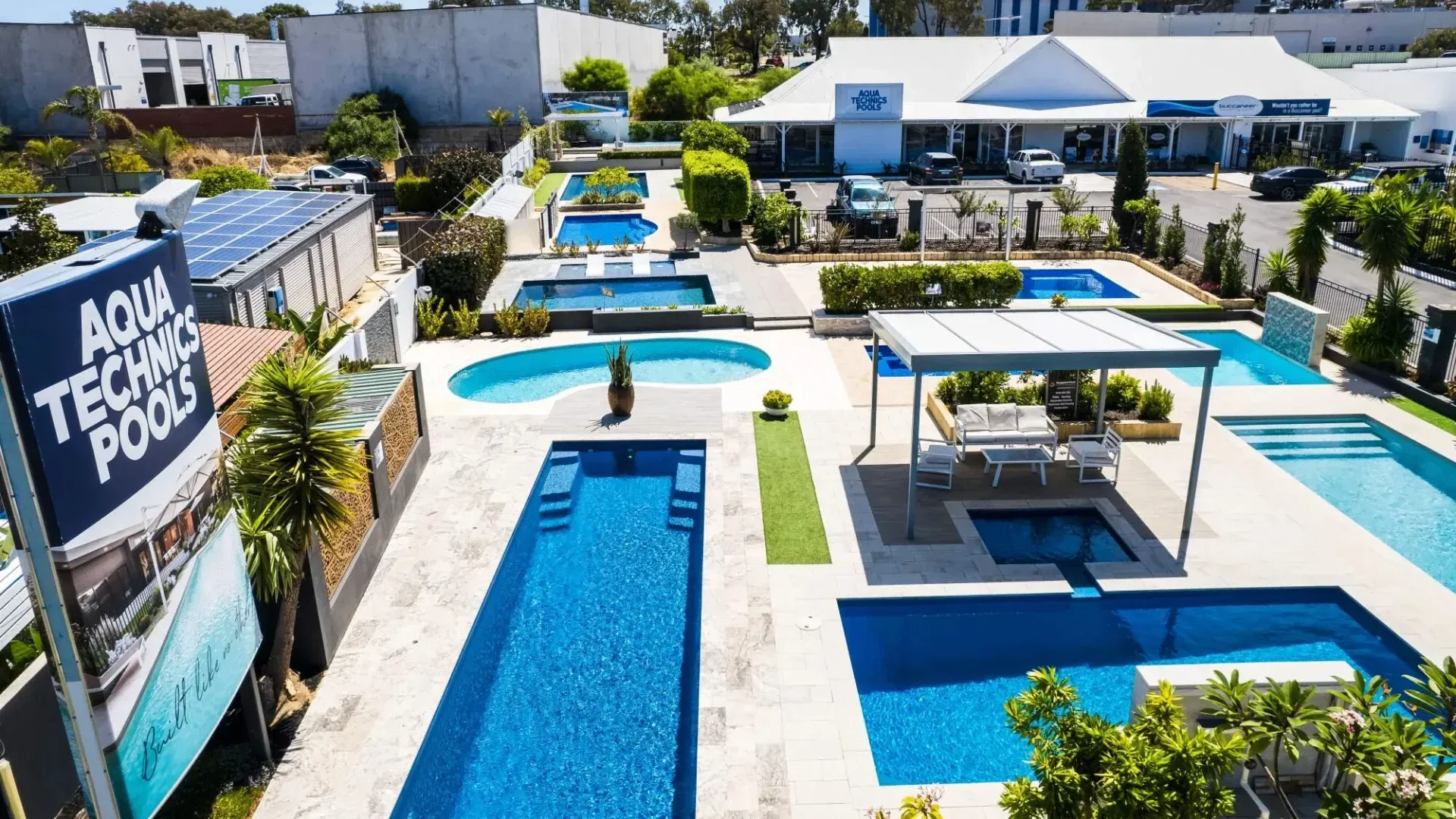
A fibreglass pool manufacturer produces the pool shell in a factory. An authorised dealer sells the manufacturer’s shells. A pool builder excavates the site, installs the shell, completes the plumbing and electrical work, installs the barrier, and hands over the finished pool. These roles are often performed by separate companies. Your contract is with the pool builder.
Aqua Technics manufactures the shells that MFP Easy installs at its manufacturing facility in Perth, Western Australia. MFP Easy installs fibreglass pools. We do not manufacture them.
This arrangement includes two warranties. The manufacturer provides the structural warranty for the shell. The installer provides the workmanship warranty for the excavation, plumbing, electrical work, and barrier. MFP Easy is the installer. When assessing a fibreglass pool, assess both companies.
Who manufactures fibreglass pools in Australia, and how is a manufacturer different from a pool builder?
Fibreglass pool shells for the Australian market are manufactured in Queensland, New South Wales and Western Australia. The manufacturer produces the shell in a factory. The pool builder installs the shell on your property under the relevant licence.
Aqua Technics
The shells we install- HQ & plants
- Perth, WA — HQ and manufacturing
- Ownership
- Australian, family owned
- Trading since
- 1976 — 50 years in 2026
- Scale & range
- Australia's most awarded pool manufacturer, 290+ industry awards; 37 shells in the range we install, 3.00 m to 11.48 m
- What's distinct
- Pool ColourGuard® patented dual-coat colour system; Graphene Nano-Tech® laminate, patent AU 2021240305; engineered 200mm edge beam with no secondary engineering works; certified AS/NZS 1838:2021, licence BMP 520101
Source: Aqua Technics published material; award record on our Aqua Technics page
Barrier Reef Pools
- HQ & plants
- Plants at Beaudesert, QLD and Forrestdale, WA
- Ownership
- Not published in our fact set
- Trading since
- Not published in our fact set
- Scale & range
- States it is Australia's largest fibreglass pool manufacturer, producing more than 4,800 pools a year — its own figures
- What's distinct
- Claims Australia's most awarded fibreglass pool company; one of two makers claiming the sole five-tick product certification
Source: Barrier Reef Pools company pages
Leisure Pools
- HQ & plants
- Founded Yatala, QLD; global HQ now Knoxville, Tennessee, USA
- Ownership
- US-headquartered global group
- Trading since
- 2000, Yatala
- Scale & range
- 150,000+ pools and 500+ dealers across 23 countries — global figures, self-reported
- What's distinct
- Not published in our fact set
Source: Leisure Pools Global Presence page
Narellan Pools
- HQ & plants
- Manufacturing in NSW and QLD
- Ownership
- Not published in our fact set
- Trading since
- 50+ years in the industry
- Scale & range
- Not published in our fact set
- What's distinct
- Not published in our fact set
Source: Pool Advisor builder guide
Masterbuilt Pools
- HQ & plants
- NSW, servicing the east coast
- Ownership
- Australian owned, family run
- Trading since
- 30 years in the industry
- Scale & range
- Not published in our fact set
- What's distinct
- Not published in our fact set
Source: Pool Advisor builder guide
The Fibreglass Pool Company
- HQ & plants
- Queensland
- Ownership
- Australian owned
- Trading since
- Not published in our fact set
- Scale & range
- Not published in our fact set
- What's distinct
- One of two makers claiming the sole five-tick product certification
Source: Pool Advisor builder guide; company site
Most manufacturers sell through dealer networks. Dealers are independently owned businesses authorised to sell and install the manufacturer’s pool shells. The manufacturer and installer are usually separate companies.
Some manufacturers use their own installation crews. A brand may also have multiple authorised dealers. The brand name does not necessarily identify the company that will complete the installation.
When choosing a fibreglass pool builder, confirm which company will install the pool and which warranties apply. The manufacturer’s warranty covers the shell. The builder’s warranty covers the installation work completed on your property.
MFP Easy is the installing builder. It trades as MFP Easy Contracting Pty Ltd from Brendale and holds QBCC Licence #15472089. Aqua Technics manufactures the shell.
“It's simpler than people expect. Aqua Technics manufactures the shell over in Perth, and once it's delivered to site it's in our care because we're responsible for the installation. An issue in the shell itself sits with the manufacturer's shell warranty, and the work done on the block, meaning the dig, the concrete, the paving and how the pool sits in the ground, sits with the install warranty. It's the same as most product versus installer situations, and if a customer's ever unsure which side something falls on, that's a conversation we're happy to have.”
How is a fibreglass pool manufactured?
A fibreglass pool is manufactured in a factory as a one-piece shell. The shell is sprayed and laminated inside a mould, cured, removed from the mould, trimmed, inspected, and delivered to the site for installation.
The manufacturing process includes these stages:
- Mould preparation. The factory prepares the mould used to form the shell. The mould defines the pool’s shape, size, and depth profile. These dimensions cannot be changed after manufacturing.
- Gelcoat. Gelcoat is sprayed into the mould first. It forms the interior surface of the finished pool and determines its colour and surface finish. Depending on the manufacturer, the gelcoat may be made and batched daily in the factory, sourced from a specialist supplier, or include an anti-microbial system. The finished surface is non-porous and resists algae and staining.
- Vinyl ester resin. Vinyl ester resin provides corrosion and chemical resistance. It may be applied as a separate layer behind the gelcoat or used throughout the laminate. It helps the shell resist osmosis and pool chemicals. Manufacturers that use vinyl ester throughout the laminate may offer a lifetime osmosis warranty.
- Polyester resin and glass reinforcement. The laminate consists of interwoven glass threads covered with polyester resin. It is built in layers of chopped strand and woven roving. The type, number, and order of these layers determine the shell’s stiffness.
- Added reinforcement or core layers. Some manufacturers add proprietary composite reinforcement, kevlar, separate reinforcement layers, or a structural honeycomb core. Each manufacturer uses its own layer specification and may state that these materials increase flexural and tensile strength.
- Cure. The laminate remains in the mould until it reaches its finished hardness. The cured shell forms a single structural piece.
- Demould. The cured shell is removed from the mould. Each pool design requires a fixed mould. Australian manufacturers publish ranges containing 8 to more than 75 designs.
- Trim. Excess fibreglass is removed from the edge of the shell. This creates the finished top edge used for the surrounding concrete and paving.
- Quality-assurance check. The manufacturer inspects the shell under its quality-control programme before it leaves the factory. Quality processes may include staged in-house checks, technical facilities for research, development and testing, and independent process audits.
The shell arrives at the site as a finished structural product. Its structure is not manufactured on the property. This allows faster installation than a concrete pool that must be poured and cured on site. Buyers inspect the finished product rather than supervise on-site shell construction.
What separates a well-made fibreglass pool shell from a poorly made one?
Seven factory-controlled criteria distinguish a well-made fibreglass pool shell from a poorly made one. Buyers can ask manufacturers to document each criterion before installation.
| Criterion | What good looks like | What it prevents |
|---|---|---|
| Gelcoat specification and batching | Gelcoat made to a stated specification using specialty-only materials and a controlled batching schedule | Fading and staining of the pool’s interior surface |
| Vinyl ester resin | Vinyl ester identified in the laminate specification, including whether it forms a separate barrier behind the gelcoat or is used throughout the laminate | Osmosis and chemical damage to the laminate |
| Laminate reinforcement and layup schedule | A documented schedule that identifies the glass type, such as chopped strand or woven roving, the number of layers, and any reinforcement or core layers | Excessive shell flex |
| Structural ribs and edge beam | Full-sized structural ribs and a wider edge beam. One manufacturer states that this design makes the shell independently structural without secondary engineering works | Dependence on secondary engineering works during installation |
| Step and bench support | Steps and benches reinforced underneath to support a standing adult without flexing, with documentation of the support method | Deflection when a person stands on a step or bench |
| Dimensional tolerance | A published dimensional tolerance. One US manufacturer states that its listed lengths, widths, depths, and volumes may vary by up to 3% | Problems with boundary setbacks or narrow access measurements |
| Documented quality control | A named, staged quality control process, technical testing facilities, and independent process audits | Undetected variation between production batches |
We have not found a manufacturer that publishes a shell thickness that buyers can compare directly with another manufacturer’s specification. One manufacturer states that its shells exceed Australian and worldwide thickness standards but does not identify the standard or provide a measurement. Ask the salesperson for the shell thickness and request written confirmation.
Across the 37 shells we install, weights range from 379 kg for the 4.00 m by 2.50 m Serenity to 1,286 kg for the 11.48 m by 4.45 m Saint Azur. Shell weights therefore vary by model.
Which manufacturer makes the best fibreglass pool, and how do you judge that yourself?
Manufacturers’ claims do not identify a clear best fibreglass pool. Barrier Reef Pools and The Fibreglass Pool Company both claim to be the only Australian fibreglass pool manufacturer with the same five-tick product certification. Both claims cannot be correct. Aqua Technics claims to be Australia’s most awarded swimming pool company. Barrier Reef Pools claims to be Australia’s most awarded fibreglass pool company. These claims cover different categories and do not use a shared counting period, so they cannot be compared directly.
Other manufacturers claim to be the global leader in fibreglass pool manufacturing, to make the most technologically advanced pools, to make the strongest pool, or to provide a unique level of quality control. Their laminate and gelcoat systems use trade names rather than published specifications. This makes direct comparison difficult.
MFP Easy installs Aqua Technics shells exclusively. The following assessment is therefore a dealer’s view, not a neutral ranking. It is based on items that can be checked.
Based on the manufacturers’ published material, we consider Aqua Technics and Barrier Reef Pools the main contenders. Barrier Reef Pools operates plants on both coasts and states that it is Australia’s largest fibreglass pool manufacturer based on its own figures.
We consider the case for Aqua Technics stronger. Our Aqua Technics page records more than 290 industry awards. Aqua Technics also offers the patented Pool ColourGuard® dual-coat colour system, the patented Graphene Nano-Tech® laminate under AU 2021240305, and an engineered 200mm edge beam that does not require secondary engineering works on site. The colour system and edge beam are unique to Aqua Technics shells. These features form the basis of our assessment.
Use the following four checks to make your own decision:
- Check the certification by its licence number. Ask which standard applies to the shell and request the licence number. Verify the number yourself. The statement “exceeds Australian standards” does not identify the standard or the certifier.
- Get the warranty terms in writing, including transfer. Request the full warranty document. Check whether the warranty transfers to a subsequent property owner. At least one Australian lifetime warranty does not.
- Establish who honours which warranty. The manufacturer covers the shell warranty. The installing builder covers the workmanship warranty. Ask both companies to confirm in writing what they cover and who you should contact if a problem occurs.
- Confirm which model actually fits the block. Australian manufacturers publish pools from roughly 2.6 m to 12.5 m long. Their ranges include between 8 and more than 75 designs, typically in 8 colours. Shortlist only the models that meet your access, setback, and yard requirements.
Can you buy a fibreglass pool direct from the factory?
Yes. You can buy a fibreglass pool shell in Australia without installation. Australian-made DIY pool kits are available nationally and can be delivered anywhere in Australia. Imported shells are also available through general online marketplaces. These are often listed in imperial dimensions and do not include installation.
DIY kit suppliers typically provide how-to videos, tip sheets, and phone support seven days a week.
The shell price does not include:
- Excavation
- Crane hire
- Plumbing and electrical work
- Pool barriers and certification
- Council lodgement
Our quotes list excavation and crane hire separately. Site access determines the excavation equipment required. Crane pricing depends on the lift distance.
We include a $900 allowance for a 20-tonne Franna crane on every job. The crane is upgraded based on lift distance.
| Lift distance | Crane | Cost |
|---|---|---|
| 0 m to 15 m | Small slew (13T to 16T) | $1,500 |
| 15 m to 20 m | Medium slew (40T) | $1,500 |
| 20 m to 30 m | Standard slew (55T/60T, no counterweight) | $2,000 |
| 30 m to 36 m | Standard slew with counterweight (60T) | $2,800 |
| 36 m to 48 m | Large slew (80T to 120T) | $3,200 |
Traffic control is charged separately when the street must be managed for delivery and crane access:
- Level 1 StopGo on one lane: $1,600
- Level 2 standard road closure: $3,100
- Level 3 large road closure: $3,800
- Level 4 all-day road closure: $5,300
Site access also determines the excavation equipment:
- Less than 1.38 m wide: Mini excavator
- 1.38 m to 1.57 m wide: Mini excavator and standard bobcat
- 1.57 m wide or more: Full-size machines
- 3 m wide or more, with the truck within 5 m of the hole: The truck can be positioned at the excavation
If the truck cannot be positioned at the excavation, spoil removal is priced using transport-distance brackets of 0 to 20 m, 20 to 40 m, or 40 to 60 m, based on where the truck can park.
An installed price includes these costs. To compare a shell price with an installed price, add all required installation costs to the shell price.
| Pool size | Length | Depth | Installed from |
|---|---|---|---|
| 3m to 4m | 1.45m level | $45,847 | |
| 4m to 5.5m | 1.0m to 1.78m | $45,613 | |
| 6m to 7m | 1.0m to 1.88m | $54,443 | |
| 7.2m to 8m | 0.98m to 1.96m | $60,374 | |
| 8.5m to 11m | 1.0m to 2.0m | $72,535 |
Live all-inclusive installed pricing for standard site conditions in South East Queensland — updated straight from our quoting system.
How long does it take to get a fibreglass pool from the factory, and when should you order?
Our completed projects have taken 3 to 8 weeks on site. The 8-week project involved a sloping block with restricted access.
The shell is ordered before excavation is scheduled. This is part of stage-one pre-construction, along with council lodgement, the soil test, fire-ant clearance, the site audit, filtration call-up, the traffic-control assessment and the 3D selection request. These tasks are completed before excavation starts.
The standard on-site schedule is:
- 7 days before installation: Site set-out and pre-plumbing of the shell in our yard.
- 2 days before installation: Excavation.
- 1 day after installation: Filtration construction and start-up.
- 7 days after start-up: Concreting.
- 7 days after concreting: Paving.
We hire the temporary pool safety fence for 8 weeks from the excavation date. This hire period is not the expected build duration.
Choose the month when you want the pool to be full, then work backwards through the schedule. Before confirming a date, ask the builder who is ordering the shell for the current lead time.
What standards and warranty should a fibreglass pool manufacturer be held to?
Two Australian Standards apply to fibreglass pools:
- AS/NZS 1838 covers shell design and manufacture. It applies to the manufacturer.
- AS 1839:2021 covers on-site installation. It applies to the builder.
Certification to AS/NZS 1838 does not confirm that the pool will be installed to AS 1839:2021. Compliance with AS 1839:2021 does not confirm how the shell was laminated.
Manufacturers may also claim AS/NZS ISO 9001 quality management systems for their plants. Independent checks can include Australian Standards product certification, SAI Global standards, and measurement and testing by an authorised independent auditor.
SPASA is the Australian industry award body. Manufacturers and builders may cite SPASA awards. These awards indicate industry recognition. They do not identify a specification against which a product was tested.
The manufacturer provides the structural warranty for the shell. Australian and US manufacturers commonly offer a lifetime structural warranty. Some also offer a lifetime osmosis warranty when vinyl ester is used throughout the laminate.
The builder provides a separate workmanship warranty for the installation. Shell and installation claims are made to different companies. Each claim is assessed independently.
Check how the warranty defines “lifetime.” For example, one Australian manufacturer offers an optional lifetime internal-surface warranty at purchase. The warranty does not transfer to a subsequent property owner, so it ends when the property is sold.
Do not rely on terms such as “best available” or “industry-leading.” One manufacturer uses the first description, while another uses the second for a limited lifetime warranty. Review the warranty terms to determine the actual coverage.
Who manufactures the fibreglass pools we install?
Aqua Technics manufactures the fibreglass pool shells that MFP Easy installs. The shells are manufactured in Perth, Western Australia. MFP Easy completes the work on your property.
Check the following details before choosing a pool:
- Certification: The shells are certified to AS/NZS 1838:2021 under licence BMP 520101. You can use the licence number to verify the certification.
- Warranties: The shells include an Extended Lifetime Structural Warranty and a Lifetime Interior Surface Guarantee. Conditions apply. Review both warranty documents for details.
- Responsibility: Aqua Technics honours the shell warranty. MFP Easy is responsible for workmanship completed on your property under QBCC Licence #15472089.
- Pool sizes: We install 37 models ranging from 3.00 m to 11.48 m long. The range includes the 3.00 m by 3.00 m Infinity 3, which is 1.45 m deep, and the 11.48 m by 4.45 m Saint Azur. Depths across the range extend from a 0.90 m shallow end to a 2.00 m deep end.
The Graphene Nano-Tech laminate is patented under AU 2021240305. The patent document is publicly available.
MFP Easy has built more than 250 pools across Brisbane and the Gold Coast. Every pool shown in our gallery was built by our team. We trade as MFP Easy Contracting Pty Ltd from Brendale and service Brisbane, North Brisbane, the Gold Coast, the Sunshine Coast and Ipswich.
Prices are live all-inclusive installed prices (pool, standard installation, filtration and handover) for standard site conditions in South East Queensland.
FAQs
What is the life expectancy of a fibreglass pool?
A fibreglass pool has separate life expectancies for the shell and the surface. The moulded shell provides the structure. Manufacturers typically offer a lifetime structural warranty, but this is not a guarantee. The gelcoat is the interior surface and wears over time.
Manufacturers publish service-life estimates ranging from more than 30 years to 50 or 60+ years with proper care. These figures are self-published and are not specific to Australian conditions. Do not rely on a single estimate.
What happens to a fibreglass pool after 25 years?
After 25 years, a fibreglass pool usually has a sound structure and an aged interior surface. The moulded shell provides the structure, while the gelcoat forms the wearing surface. These components age differently.
Lifetime structural warranties are common but not universal. Manufacturers also differ on whether the gelcoat requires resurfacing. One manufacturer states that its pools never need resurfacing. A US firm has resurfaced fibreglass pools in fifteen states for more than a decade.
What is the downside of a fibreglass pool?
A fibreglass pool shell is moulded at the factory. Its shape, size, and depth cannot be changed on site.
Features also vary by manufacturer. Two manufacturers include a safety ledge around the full perimeter. A third omits the ledge to make cleaning easier because ledges can trap dirt.
Moulded shells are non-diving pools unless the manufacturer states otherwise.
What colour fibreglass pool is best?
The best colour depends on the gelcoat and your preferred shade. Gelcoat is the pool’s interior surface layer and is sprayed into the mould first. Manufacturers state that it provides resistance to UV, chemicals and chlorine, which helps reduce fading.
Australian manufacturers typically offer eight colours. Ask which gelcoat system is used for your chosen colour and what interior surface warranty the manufacturer provides. Then select your preferred shade.
What happens to the warranty if a fibreglass pool manufacturer goes out of business?
A pool has two separate warranties from two companies:
- The manufacturer provides the structural warranty for the shell. This warranty depends on the manufacturer remaining in business.
- The installing builder provides the workmanship warranty for excavation, plumbing, electrical, barriers, and paving. This warranty does not depend on the manufacturer.
MFP Easy holds QBCC Licence #15472089 for installation work, regardless of the manufacturer's trading status. Before signing, obtain both warranties in writing from the relevant companies.