Fibreglass Pool Shell: Materials, Strength & Weight
What a fibreglass pool shell is made of, how the laminate is built, the Australian standard it meets, and what our shells weigh by model.
Written by Tehbyn Nova, Head of Operations & Growth · Technically reviewed by Caleb Druhan, General Manager (QBCC licence 15087383) on
Published
What is a fibreglass pool shell?
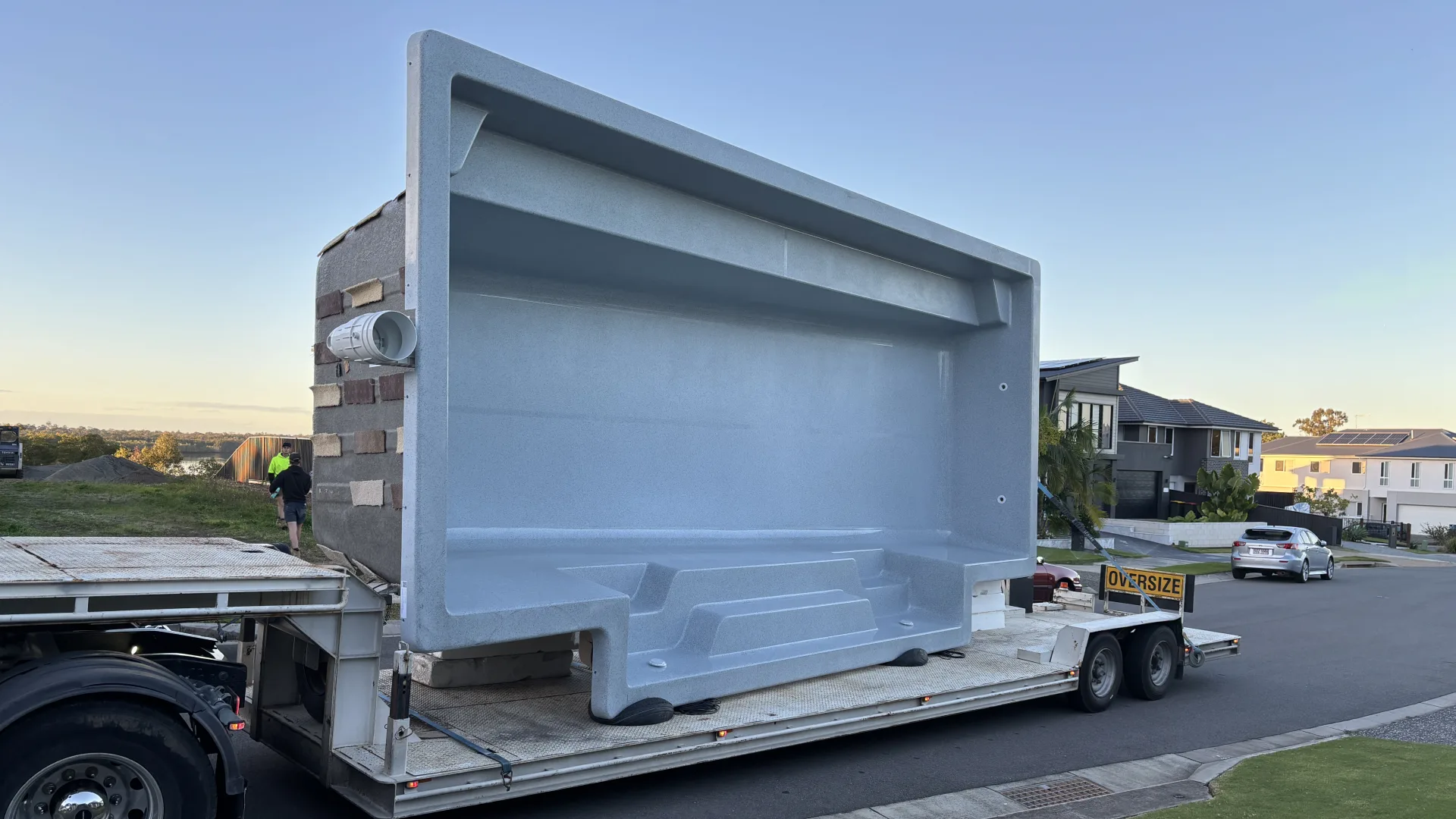
A fibreglass pool shell is a one-piece fibreglass pool manufactured in a factory. It is delivered to the site by truck and installed in an excavated hole. The finished interior surface and plumbing openings are integrated into the composite laminate. The shell is structurally self-supporting when delivered.
A fibreglass pool shell is different from a panel pool assembled on site or a vinyl liner pool installed over a frame. The shells we install are manufactured by Aqua Technics at its plant in Jandakot, Western Australia.
Each shell’s dimensions are determined by its mould and published as a specification. The range includes:
- Lengths from 3.00 m for the Infinity 3 to 11.48 m for the Saint Azur
- A maximum width of 4.45 m for the Saint Azur
- A maximum depth of 2.00 m for the Amalfi, Kensington and Saint Louis
What is a fibreglass pool shell made of?
A fibreglass pool shell is a composite laminate made from glass reinforcement and resin. It has several layers. From the water-facing surface to the ground-facing surface, these are:
- Gelcoat. The gelcoat is the coloured interior surface. It contains the water and is the surface that swimmers touch. It is sprayed into the mould before the glass layers are applied. It seals and finishes the laminate but does not carry structural loads.
- The vinyl-ester barrier coat. This layer sits behind the gelcoat. It resists water absorption and helps prevent osmotic blistering.
- The structural glass laminate. This layer consists of glass reinforcement saturated with resin and applied in multiple plies. It carries structural loads, maintains the pool’s shape, and resists pressure from the water and surrounding ground. It also supports the shell before backfilling.
- A core or reinforcement layer. This layer sits within or behind the structural laminate. It increases the laminate’s stiffness and strength.
- An external seal or flow coat. This is the outermost layer. It seals the exterior surface against ground moisture.
Layer counts and reinforcement materials vary by manufacturer. They are part of how manufacturers build and certify the laminate.
A published layer count applies only to that manufacturer’s shell and manufacturing process.
Core and reinforcement systems also vary. Manufacturers may use polypropylene honeycomb, structural honeycomb, a ceramic-composite core, laminates containing Kevlar, carbon or basalt fibre, or strengthening ribs moulded into the wall. Manufacturers do not necessarily use the same materials.
The shells we install use a Graphene Nano-Tech interior surface system. This system is covered by granted Australian patent AU 2021240305 and the Lifetime Interior Surface Guarantee. Conditions apply. Graphene Nano-Tech is an interior surface system, not a structural core. Our shells do not suffer osmosis.
How strong is a fibreglass pool shell, and is it meant to flex?
A fibreglass pool shell can flex in response to ground movement. A concrete shell is rigid and can crack if the ground moves enough. Fibreglass laminate can tolerate some movement without structural damage.
The gelcoat is less flexible than the structural laminate. Excessive flexing can cause fine hairline cracks, called spider cracks, in the coloured surface. These cracks are cosmetic and do not affect the shell’s structural strength.
More significant ground movement can shift the entire shell. Shell movement under groundwater pressure changes the shell’s position in the ground and is different from spider cracking.
The shell is self-supporting when delivered. During installation, it is placed on a bedding layer. The surrounding materials then hold it in position. How the shell is bedded and restrained depends on the bond beam and backfill. The bond beam secures the top edge. The backfill fills the gap between the shell and the excavation. AS 1839:2021 governs this installation work.
What Australian standard does a fibreglass pool shell have to meet?
A fibreglass pool shell must be designed to AS/NZS 1838:2021 and installed to AS 1839:2021.
- AS/NZS 1838:2021 applies to the design of the pool shell.
- AS 1839:2021 applies to the installation of the pool shell.
The shells we install are manufactured under licence BMP 520101. Before signing a contract, ask the builder to provide:
- The design standard for the shell.
- The manufacturing licence number.
A statement that a shell “exceeds Australian standards” does not identify either item and cannot be verified without further information.
Installation requires prior approval from the local building regulator. This requirement applies to in-ground and above-ground swimming pools, including fibreglass pools.
The shell we install has two guarantees, subject to their conditions:
- Extended Lifetime Structural Warranty for the shell structure.
- Lifetime Interior Surface Guarantee for the interior surface.
Our installation work is covered by the MFP Easy 7-Year Workmanship Guarantee. This guarantee applies to work completed on site, not to the manufactured shell.
How is a fibreglass pool shell manufactured?
A fibreglass pool shell is manufactured in a factory using a mould. The mould defines the shell’s shape, size and depth.
- Apply the gelcoat. Gelcoat is sprayed into the mould. The mould face forms the pool’s interior surface.
- Apply the resin and glass. Layers of glass reinforcement and resin are applied over the cured gelcoat. A core or reinforcement layer forms the structural laminate.
- Cure the shell. The shell remains in the mould until the resin hardens and the laminate holds its shape.
- Remove the shell from the mould. The cured shell is removed in one piece.
- Trim the shell. Excess laminate is removed.
- Inspect and test the shell. The factory inspects and tests the completed shell. The shell is then despatched in one piece and installed by crane.
The factory controls the temperature and humidity while the gelcoat cures. It records production data for each shell, including material weights, wall thickness and hardness.
The hand lay-up process can cause minor differences between shells. These can include variations in surface shade or texture. These differences are cosmetic.
Openings for the skimmer box and drains and return fittings are cut at the factory after the shell is removed from the mould. They are not cut into the pool wall on site.
Installation and filling take about 5 to 7 days after delivery. A complete fibreglass pool project, including the surround, takes about two to six weeks. A concrete pool takes three to six months.
The factory mould limits the available shape, size and depth. Buyers must select an existing model and cannot order a custom shell. They can select the gelcoat colour and surround.
How much does a fibreglass pool shell weigh, and how does it get into the hole?
Dry shell weights range from 341 kg for the 4.0 m × 2.0 m Elba spa to 1,286 kg for the 11.48 m Saint Azur.
| Model | Size | Dry shell weight | Water volume |
|---|---|---|---|
| Serenity | 4.00 m × 2.50 m | 379 kg | 9,500 L |
| Portofino | 5.50 m × 2.50 m | 498 kg | 13,200 L |
| Empire | 6.00 m × 3.00 m | 622 kg | 18,700 L |
| Oxford | 7.00 m × 3.00 m | 738 kg | 26,230 L |
| Castello | 7.50 m × 3.60 m | 805 kg | 25,600 L |
| Valentina | 8.00 m × 4.00 m | 909 kg | 38,700 L |
| Westminster | 9.00 m × 4.00 m | 988 kg | 39,490 L |
| Saint Azur | 11.48 m × 4.45 m | 1,286 kg | 52,780 L |
Shell weight determines how it is moved from the truck into the excavation. Two-thirds of our installations use a crane. The other installations use a truck hoist. Excavators are not used to place fibreglass pool shells.
The standard crane is a 20-tonne Franna. If a larger crane is required, the crane is selected based on lift reach. The reach bands are:
- 0 to 15 m
- 15 to 20 m
- 20 to 30 m
- 30 to 36 m
- 36 to 48 m
Longer lift distances require larger cranes.
Can you buy a fibreglass pool shell on its own?
Yes. Several Australian suppliers sell fibreglass pool shells separately, with or without an equipment kit, and deliver them across Australia.
MFP Easy sells installed pools only. We do not provide shell-only pricing.
If you are comparing pool costs, use the installed price of a fibreglass pool. A shell-only purchase does not include installation. The shell must be installed to AS 1839:2021 and approved by the local building regulator before installation. It is not covered by the MFP Easy 7-Year Workmanship Guarantee, which applies to our installation work.
| Pool size | Length | Depth | Installed from |
|---|---|---|---|
| 3m to 4m | 1.45m level | $45,847 | |
| 4m to 5.5m | 1.0m to 1.78m | $45,613 | |
| 6m to 7m | 1.0m to 1.88m | $54,443 | |
| 7.2m to 8m | 0.98m to 1.96m | $60,374 | |
| 8.5m to 11m | 1.0m to 2.0m | $72,535 |
Live all-inclusive installed pricing for standard site conditions in South East Queensland — updated straight from our quoting system.
FAQs
How long does a fibreglass pool shell last?
A fibreglass pool shell typically lasts 30 years or more. The Extended Lifetime Structural Warranty covers the shell’s structure. The Lifetime Interior Surface Guarantee covers its interior surface. Conditions apply to both. The shell is designed to remain in the ground for its full service life.
What happens to a fibreglass pool after 25 years?
After 25 years, a fibreglass pool shell remains within its service life of more than 30 years. Our shells do not suffer from osmosis. The Lifetime Interior Surface Guarantee covers the interior surface, subject to conditions. The Extended Lifetime Structural Warranty covers the one-piece composite laminate structure.
What is the downside of a fibreglass pool?
The main limitation of a fibreglass pool is its fixed shape. Manufacturers produce each shell from a pre-made mould. Buyers must choose from existing models and cannot specify a custom shape, size, or depth. Gelcoat colour and pool surrounds can be customised. Available models range from 3.00 m to 11.48 m in length.
Does a fibreglass pool need concrete around it?
Yes. A concrete bond beam is installed around the top edge of the fibreglass pool shell. It holds the shell in position in the ground.
How much is a fibreglass pool shell on its own?
We do not provide shell-only pricing. We sell installed pools, so we quote the total installed price.
A shell must be installed to AS 1839:2021 and approved by the local building regulator before it can be used as a swimming pool. Other Australian suppliers sell shells and kits separately, with or without an equipment kit.