Choosing a Fibreglass Pool Builder: Comparison Checklist
How to compare fibreglass pool builders in Queensland: shell maker vs installer, warranty structure, deposit rules and what to ask before you sign.
Written by Tehbyn Nova, Head of Operations & Growth · Technically reviewed by Caleb Druhan, General Manager (QBCC licence 15087383) on
Published · Updated
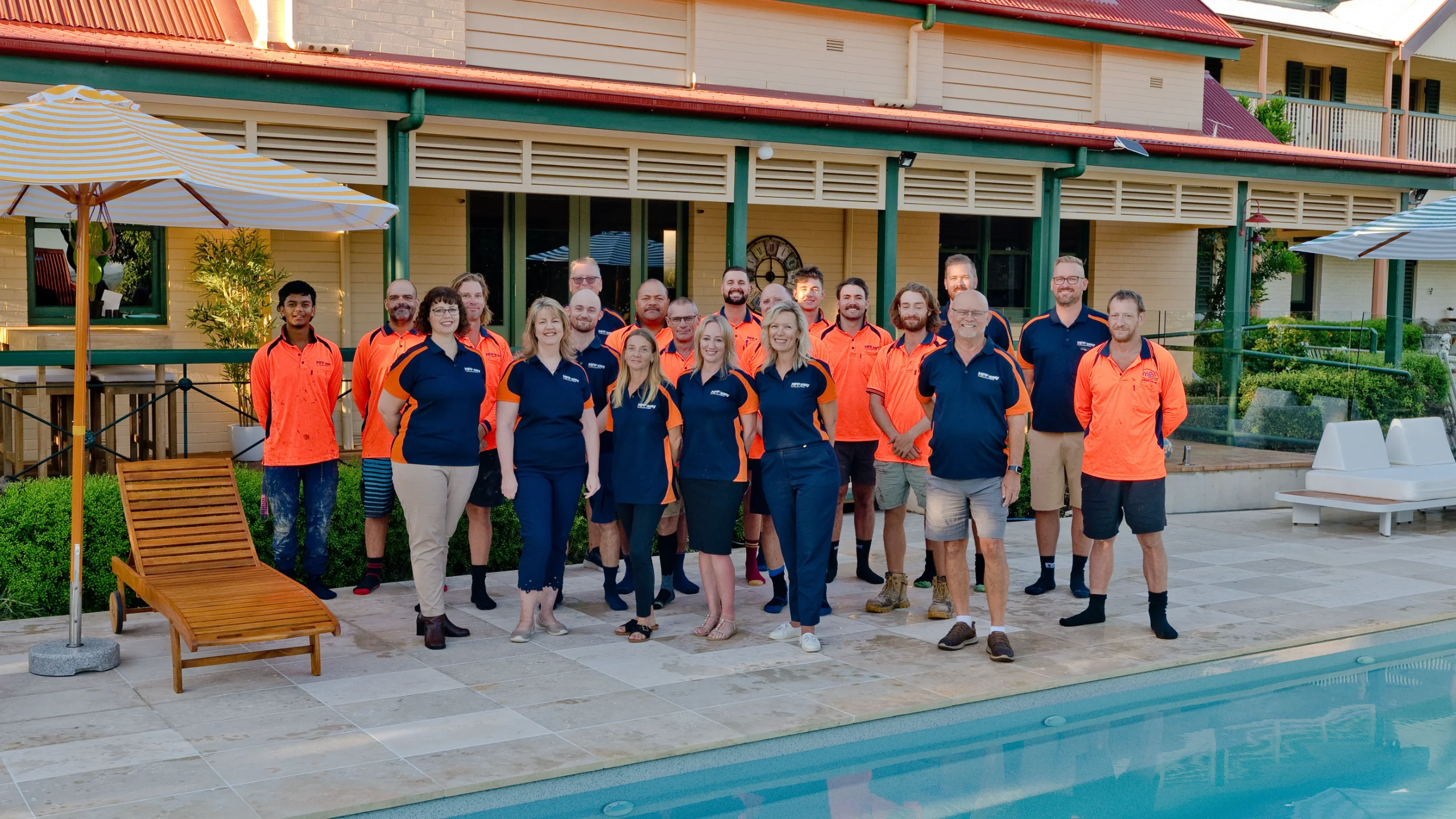
Choosing a fibreglass pool builder in Queensland requires checking two separate businesses: the pool shell manufacturer and the installation contractor.
Before signing a contract, check:
- The company’s licence class
- The scope included in the quote
- Which business provides each warranty
- How your payments are protected if the company stops trading
What actually separates one fibreglass pool builder from another?
Compare builders by checking:
- The licence held by the company signing the contract
- The work included in the quote
- The contract and warranty documents
- Completed projects you can inspect
The fibreglass shell manufacturer is often different from the company that sells and installs the pool. Australian manufacturer websites show that shells are commonly sold through licensed dealers. The manufacturer may not own these dealers. It may also state that dealers are not employees or agents and that it is not responsible for their work. Some manufacturers also operate their own dealer networks.
Start by separating the shell maker from the installer. Assess each business separately. Terms such as “specialist” and “expert” do not require a qualification. Check the contracting business’s licence class, the scope of work in the quote, and the attached warranty documents.
Builder and manufacturer websites often list years in business, installation totals, awards, and star ratings. The published information may not explain how these figures are calculated, so they cannot be independently verified from the website.
Trade licence classes have defined scopes. QBCC has a licence class called “Swimming pool construction, installation and maintenance (installation)”. This class includes the installation of prefabricated and fibreglass pools. The separate “(construction)” and “(maintenance and accessories)” classes cover other work. Use a QBCC licence check to confirm that the company quoting the job is licensed for the work included in the quote.
The licence defines the work the company is permitted to perform. The quote and signed contract define the work the company has agreed to complete.
How do you check a pool builder's QBCC licence?
Use the QBCC free online licence register. The check takes about two minutes. The Queensland Building and Construction Commission publishes every licence it issues. Check the licence before accepting a quote.
- Open the QBCC website and go to the online licence search.
- Search using the company’s licence number or exact business name. A licensed builder should display its QBCC number on its website, quotes, and vehicles.
- Confirm that the licence is current and not suspended or expired.
- Confirm that the licence class covers swimming pool installation. A licence for minor work or another trade does not cover pool installation.
- Review the licence history. Check whether directors have moved between deregistered companies, as this can indicate a phoenix operator.
Do not use a company that does not include a QBCC number on its paperwork. Also check that the number matches the business name shown in the register.
MFP Easy holds QBCC licence 15472089. You can verify this number using the same search.
Which questions should you ask a fibreglass pool installer before you sign?
Ask these seven questions before signing:
- Who manufactures the shell, and who installs it? Request the names of both businesses, or confirm that one business handles both. The shell brand does not identify the installer.
- Who provides the workmanship warranty and the shell warranty? Most published Australian fibreglass pool builder and manufacturer websites describe shell structural cover as “lifetime”. The gelcoat or interior finish usually has a separate, shorter warranty. Request copies of the workmanship, shell, and interior finish warranties. Confirm which business is responsible for each warranty.
- How is the deposit calculated, and when are progress payments due? The contract should show the deposit as a percentage within the QBCC cap. Each later payment should be linked to a completed stage, with the amount due stated.
- What happens if excavation encounters rock? The contract should explain how rock is identified, who confirms it, and how additional work is priced and approved as a variation.
- Who arranges building approval and final certification? In Queensland, the local council or a private certifier must approve the pool before installation. QBCC states that the builder usually organises this approval. QBCC also requires the completed pool to be entered on its register. Confirm which steps are included in the quoted price.
- Who supplies and certifies the pool fence? Pool fencing is within the installation licence scope. The builder may include it in the contract or require you to arrange it. Confirm who supplies the fence and obtains barrier compliance certification.
- How many stages are in the build schedule, and how many can I view? Our standard build schedule has 45 tasks across 9 stages. Customers can view 25 tasks, including the site audit, markout, excavation, crane, filtration and start-up, concreting and paving, fence reinstatement, and handover. Ask the builder to state how many stages and tasks you can view when tracking progress.
The builder should explain the trade-offs as well as the selling points.
Request these five contractual guarantees in writing:
- A cash penalty if the builder misses the completion date.
- A fixed price that cannot be changed through hidden fees.
- Direct contact with the business owner.
- Written terms covering the deposit if approvals are not granted.
- A separate installer workmanship warranty.
Written guarantees are part of the contract and can be enforced. Sales assurances may not be enforceable.
“The trap in this industry is the quote that looks cheap because of what's been left off it. A salesman gets you excited about the pool price, then never mentions the electrician to connect power, the certified fence, or the concrete surrounds that actually finish the project, and those come as painful surprises months later. We do everything in our power to avoid that. Fencing and electrical are priced through our third party contractors as close estimates at the very first visit, so the number you're weighing up is the number for a finished, certified, swimmable pool. Whoever you get quotes from, make them put the whole project on paper before you sign.”

How do you tell the best fibreglass pool company from a merely good one?
Do not compare the headline numbers published on company websites without checking what they measure. Australian fibreglass pool builders and manufacturers use different units. A figure may refer to pools installed by the company’s crews, homes supplied with a shell, families served, or shells produced. These figures are not directly comparable.
Ask each builder to define the number using three details:
- What is being counted?
- What time period does the figure cover?
- What region does it cover?
MFP Easy is a QBCC-licensed pool builder that installs more than 250 pools each year in South East Queensland. This figure refers to pools installed by the business in one year and one region. Ask other builders to provide the same details. If a company does not state whether its figure refers to installations or factory output, do not use it for comparison.
Award totals are also insufficient for comparing builders. Industry awards include state and national association titles, as well as recurring “best builder” claims. For each award, check its name, year, and category. Then assess the company using criteria with published definitions.
Three criteria have published definitions:
- Licence class: This defines the work the company may legally perform.
- Australian Standards: AS 1838–2021 covers the design and fabrication of premoulded fibre reinforced plastics swimming pools. AS 1839–2021 covers their installation. Ask which standard applies to the shell and which standard the builder follows during installation.
- Industry association membership: Pool Spa Life, the consumer site of SPASA, states that members “are the only builders with access to SPASA contract documents”. It describes these documents as meeting relevant state and federal legislation. It also states that members agree to an association code of ethics and that membership is voluntary.
What do fibreglass pool company reviews actually tell you?
Review text provides information about a specific job. A star average provides less detail, especially when it is based on a small number of reviews. Published Australian fibreglass pool builder profiles have between 32 and 95 reviews, and at least one profile is dated 2023. Read the individual reviews rather than relying on the average rating.
Start with the one-star and two-star reviews. Identify which stage of the build each complaint relates to. The average rating does not provide this context.
Ratings also do not show the finished work. Ask the builder to provide completed pools in the same size class and on blocks comparable to yours. Reviews for those specific jobs are more relevant than the builder’s overall average.
What happens to your money if the pool company goes into liquidation?
In Queensland, claims are made through the Queensland Home Warranty Scheme, not the failed company. QBCC requires this cover for nearly all residential building work valued above $3,300, including materials, labour and GST. The work covered includes constructing or installing swimming pools.
The scheme may cover incomplete contracted work and defective work that a licensed contractor has not rectified.
Cover lasts for 6 years and 6 months. It starts on the earliest of these dates:
- The premium payment date
- The contract date
- The date work begins
Different claim types have separate eligibility periods and claim deadlines.
| Type of loss | The condition that must be met | When the claim must be lodged |
|---|---|---|
| Non-completion, work started | Contract ends no later than 2 years after the day work began | Within 3 months of the contract ending |
| Structural defects | Awareness falls inside the 6 year 6 month window that starts on the cover commencement day | Within 3 months of becoming aware |
| Non-structural defects | Awareness falls inside 6 months of the work being substantially complete | Within 7 months of substantial completion |
These deadlines apply independently of the overall 6-year-and-6-month cover period. For example, a non-structural defect first identified seven months after substantial completion is outside the 6-month awareness period, even if the overall cover remains active.
QBCC states that the scheme covers up to $200,000 for various categories of loss. Optional additional cover increases the maximum to $300,000. Covered losses may include:
- Refunding a deposit when work did not begin
- Completing unfinished work
- Rectifying defects and subsidence after construction
The standard $200,000 cover includes a $5,000 sub-limit for alternative accommodation, removal and storage.
Two payment practices can reduce the available protection.
First, do not pay a deposit above the QBCC limit. The maximum deposit is:
- 10% for work valued up to $20,000
- 5% for work valued at $20,000 or more
Any amount paid above the applicable limit cannot be recovered through a scheme claim for a deposit refund.
Second, do not pay a progress claim early or above the amount specified in the contract. Pay only the contract amount for each stage and only when payment is due. Paying more or paying early can reduce the protection available under the scheme.
An industry protection may also apply. Pool Spa Life states that SPASA members must provide statutory warranty entitlements. It describes this as assurance that the contract will be completed if the contractor becomes insolvent or dies.
Should you buy factory-direct or through a builder?
Buy through a builder if you want a single contract price and one licensed party responsible for the complete installation.
A factory-direct purchase includes only the moulded shell. A builder’s installed price includes the shell and the site work required for installation.
The shell is manufactured to fixed specifications determined by the mould. The range we install is 3.0 m to 11.48 m long, with shell weights from 341 kg to 1,286 kg. These specifications are fixed. Site requirements vary by property.
Published prices from Australian fibreglass pool builders and manufacturers typically include:
- Excavation
- Shell delivery and craning
- Concrete coping
- Plumbing
- Filtration
When checking whether the quote is complete, confirm that it includes each required item.
Our current site-work costs are:
| Line item | Cost |
|---|---|
| Crane allowance (Franna 20T) | $900 |
| Crane upgrade, 0–15 m lift distance | $1,500 |
| Crane upgrade, 15–20 m lift distance | $1,500 |
| Crane upgrade, 20–30 m lift distance | $2,000 |
| Crane upgrade, 30–36 m lift distance | $2,800 |
| Crane upgrade, 36–48 m lift distance | $3,200 |
| Traffic control, Level 1 stop/go, one lane | $1,600 |
| Traffic control, Level 2 standard road closure | $3,100 |
| Traffic control, Level 3 large road closure | $3,800 |
| Traffic control, Level 4 all-day road closure | $5,300 |
| Earthmoving | $50 per cubic metre |
| Concrete slab removal | $170 per square metre |
| Stormwater diversion | $600 |
Site-work costs depend on the property and street conditions:
- Crane costs depend on the lift distance across the property.
- Traffic control costs depend on the street where the crane operates.
- Earthmoving is charged per cubic metre of material moved.
- Concrete slab removal is charged per square metre of existing slab over the pool footprint.
| Pool size | Length | Depth | Installed from |
|---|---|---|---|
| 3m to 4m | 1.45m level | $47,233 | |
| 4m to 5.5m | 1.0m to 1.78m | $47,706 | |
| 6m to 7m | 1.0m to 1.88m | $56,656 | |
| 7.2m to 8m | 0.98m to 1.96m | $60,475 | |
| 8.25m to 11m | 1.0m to 2.0m | $69,428 |
Live all-inclusive installed pricing for standard site conditions in South East Queensland — updated straight from our quoting system.
With a factory-direct purchase, the site work is not scoped, priced, or contracted as part of the shell purchase. You must determine these costs before installation. An installed-price contract defines these costs in advance.
How do you find a fibreglass pool installer who actually covers your area?
Ask the builder which named region they service. Then confirm that your suburb is included in that region.
Australian fibreglass pool builders and manufacturers typically publish service coverage by named region. These regions do not have measurable boundaries. Distance from the builder’s yard does not confirm whether your property is covered. Builders quoting in the same suburb may publish overlapping or different region names. Check the builder’s published service area.
Also confirm which site conditions the builder measures. Access width and haul distance affect the quote.
We measure access width before pricing the excavation. The width determines the equipment used:
- Under 1.38 m: mini-excavator method
- 1.38 m to 1.57 m: mini-excavator with a standard bobcat
- 1.57 m and over: full-size machines
- 3 m or more, with the truck within 5 m of the hole: truck-to-hole dig
We also measure the haul distance from the hole to the truck. The distance bands are:
- 0–20 m
- 20–40 m
- 40–60 m
Longer haul distances cost more.
Ask each builder which inputs they measure and when they measure them. The quote confirms the figures after the site has been measured.
FAQs
What to check before engaging a builder?
Before accepting a quote or signing a contract:
- Ask several pool builders to inspect your site and provide written quotes.
- Check each builder’s licence and licence history.
- Confirm that the licence class covers pool installation.
- Review what each builder’s warranty covers.
- Confirm that the contract lists the deposit and each progress payment.
What questions should I ask before installing a pool?
Ask these seven questions:
- Who manufactures the pool shell, and who installs it?
- Who provides the workmanship warranty, separately from the shell warranty?
- How are the deposit and progress payments staged?
- What happens if rock is found during excavation?
- Who arranges the building approval and final certification?
- Who supplies and certifies the pool fence?
- How many build stages are included?
What is the downside of a fibreglass pool?
Fibreglass pools are limited to the shapes available in the manufacturer’s range because the shells are factory-moulded.
Pool Spa Life states that concrete offers “total creative freedom” and can handle “decades of wear when properly maintained”. However, concrete pools can take several weeks or months to build, generally have a higher initial cost, and require resurfacing every 10 to 15 years.
What is the lifespan of a fibreglass pool in Australia?
With proper maintenance, a fibreglass pool can retain its shape and finish for more than 30 years. Pool Spa Life states that fibreglass pools do not require resurfacing. Almost all published Australian manufacturer and builder websites describe the shell’s structural cover as “lifetime”. The gelcoat or interior finish has separate, more limited cover.
What is the most expensive part of putting in an inground pool?
Site work usually accounts for the cost differences between quotes. A fibreglass shell is a factory product with a fixed specification, while site conditions vary. Costs can include earthmoving by the cubic metre, removal of a concrete slab over the pool footprint, crane hire based on lift distance, traffic control, and stormwater diversion.