Pool Water Features: Types, Prices & How to Choose
Compare pool water feature types — water blade walls from $3,200 installed, deck jets from $1,075 — with real prices and advice from a SEQ pool builder.
Published · Updated
Direct answer
A water feature earns its place on sound and sightline, not just looks. The two we install most on fibreglass pools are the water blade feature wall — $3,200 installed for the small wall, $3,500 for the large — and deck jets, from $1,075 for a pair. Below is every common type, what each one actually costs, and how to pick between them.
Water feature walls: the one we build most
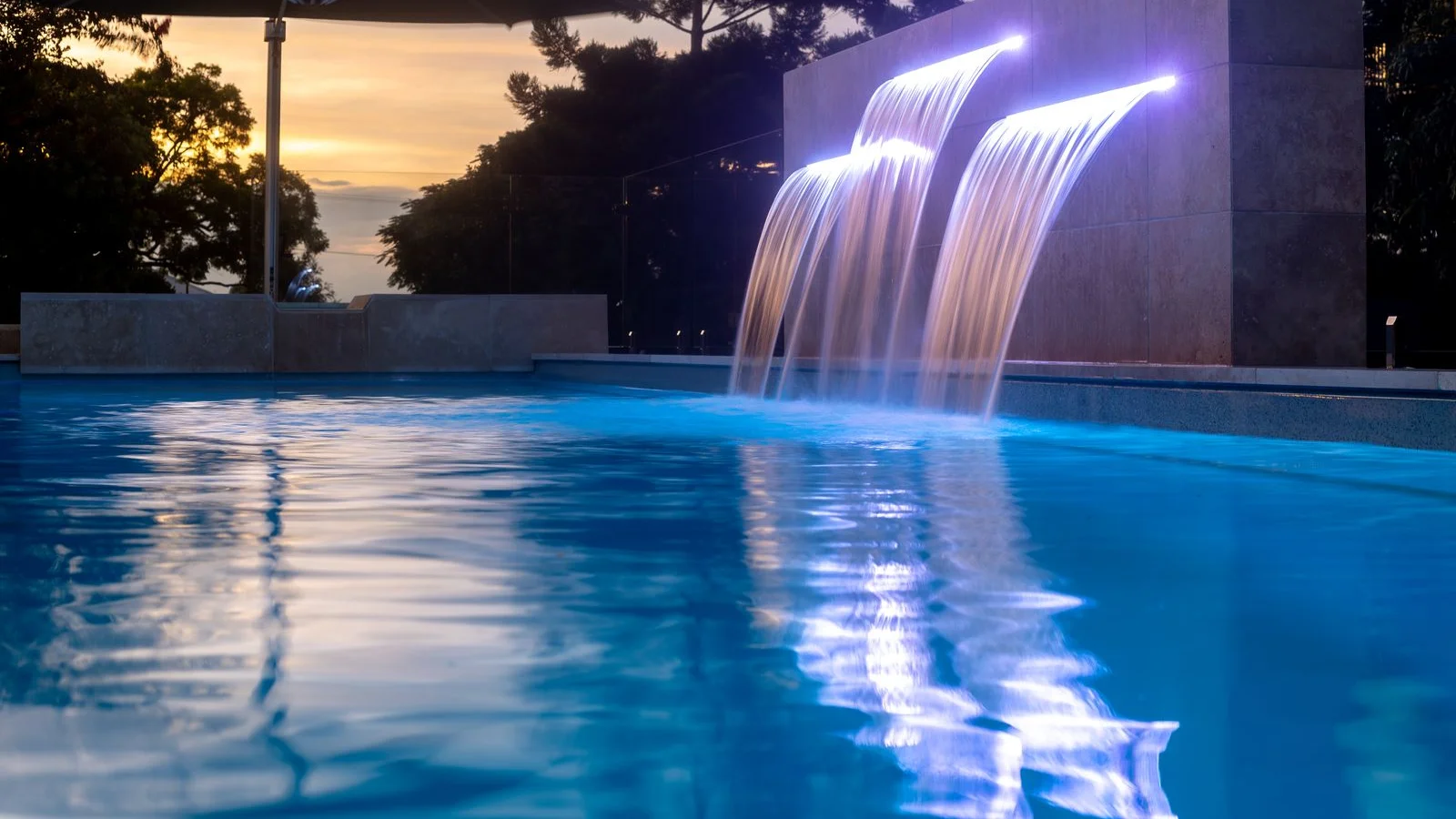
A feature wall is a built blockwork wall behind the pool with a stainless water blade set into its face, sheeting water back into the pool. It does two jobs at once: it's the water feature, and it turns the fence line behind the pool into the backdrop of the whole yard.
We build these to spec in-house rather than dropping in a catalogue unit, and every surface is chosen on the quote: the front face in stack stone or a bag-washed render, the top and sides finished to match your coping, and timber-look slat wing walls available to extend the feature across the fence line so it reads as one designed wall rather than a box behind the pool. The wall above is one of ours — an award-winning Kensington pool and spa build in Booval, running two LED blades at staggered heights. Current installed prices:
| Water features, installed | Price | |
|---|---|---|
| Water Feature Small | 1.6m x .80m | $3,200 |
| Water Feature Large | 2m x 1m | $3,500 |
Installed with your pool build — the same figures that appear on a real quote.
The blade itself has options. A 900 mm LED blade adds $300 and a 1,200 mm blade adds $400 — the LED strip sits in the spillway, so the sheet of water glows at night. If the back of the wall faces the house or an entertaining area, back cladding finishes that side to match for $1,000; a wall that sits hard against a boundary fence usually doesn't need it.
Because the wall is blockwork on a footing, we build it with the pool surround, and its plumbing goes in the same trenches as the rest of the pipework. That's the main reason a feature wall is far cheaper to include at build time than to add later — a retrofit means cutting up finished paving to run pipe.
Every pool water feature type, compared
| Type | What it looks like | Worth knowing |
|---|---|---|
| Water blade / sheer descent | A flat, glassy sheet falling from a slot spillway | The classic feature-wall look; quiet at low flow, louder as the wall gets taller |
| Deck jets | Narrow arcs of water leaping from the paving into the pool | The budget pick — $1,075 installed for a pair, $1,347 for four |
| Laminar jet | A perfectly clear, bubble-free arc that looks like a glass rod | The premium jet; usually concealed in garden beds and lit with LEDs |
| Sun jet (foam jet) | A short geyser bubbling straight up | Sits on a sun ledge or shallow shelf; kids treat it as a toy, which is the point |
| Scupper | Water spilling from a spout or across a short ledge on a raised wall | Suits formal, architectural designs; often run in rows of two or three |
| Rain curtain | Thin streams raining down from an overhead beam | The most theatrical and the loudest; needs a structure to hang from |
| Rock waterfall | Natural stone stacked at the pool edge with water tumbling over | As much a landscaping build as a water feature; suits sloping blocks |
| Spillover spa | A raised spa spilling over its edge into the pool | Comes from choosing a pool-and-spa shell, not bolted on later |
Here's each one in more detail.
Deck jets
Deck jets are the cheapest way to get moving water into a pool: $1,075 installed for a pair, $1,347 for four. The nozzles sit flush in the paving or hide in a garden bed, throwing a narrow arc a metre or two into the water.
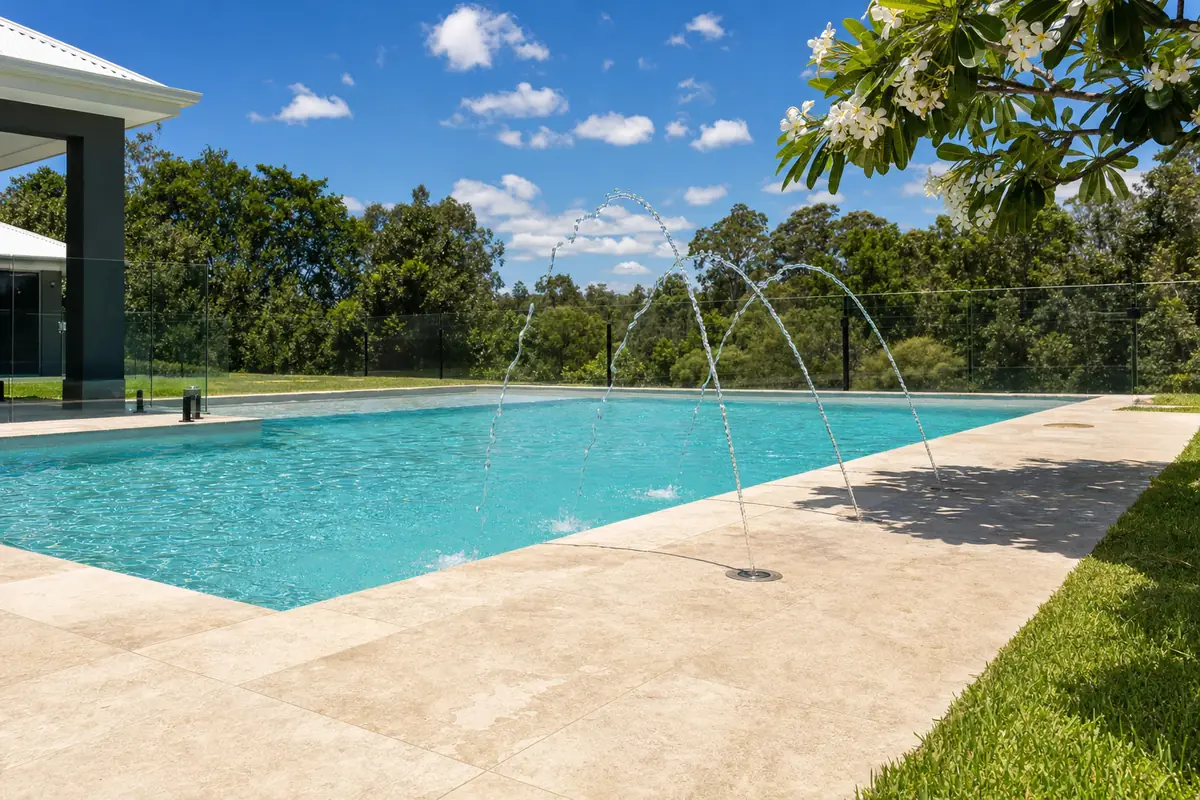
The sound is a light patter rather than a rush, which makes them the safest choice near an outdoor dining area. They're also the least disruptive feature to retrofit, since the pipe runs are small — though it's still cheaper to lay them with the original build.
Laminar jets
A laminar jet conditions the water through a flow straightener so the arc leaves the nozzle with no bubbles at all — a transparent, unbroken rod of water that looks like bent glass. Add an internal LED and the whole arc carries the light, which is the party trick: at night the jets read as glowing ribbons.
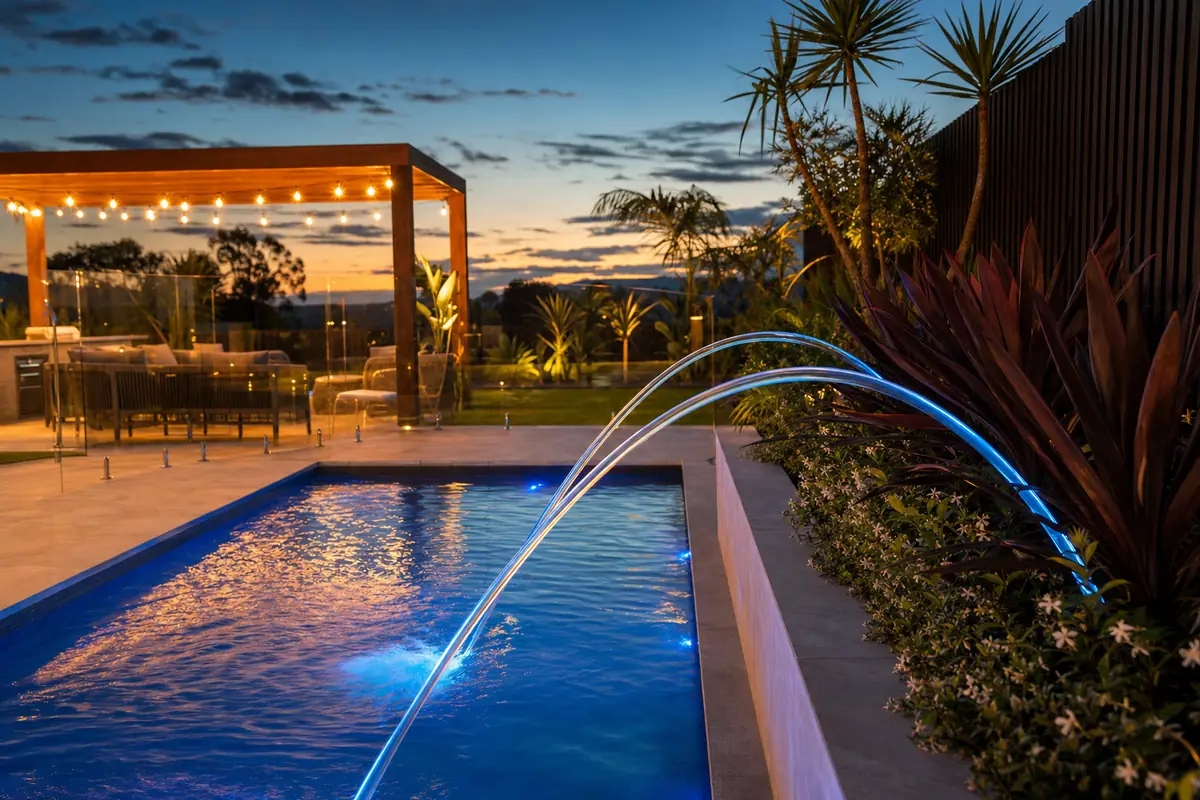
They're the dearest of the jet family and the housings are usually buried in garden beds, so they suit a considered design rather than an impulse add. If night-time effect is the goal, weigh them against upgraded pool lighting first — lighting transforms the whole pool for less.
Sun jets (foam jets)
A sun jet — also sold as a foam jet or bubbler — pushes a short, foaming geyser straight up from a nozzle, usually set into a sun ledge or shallow shelf where the water is only a few hundred millimetres deep.
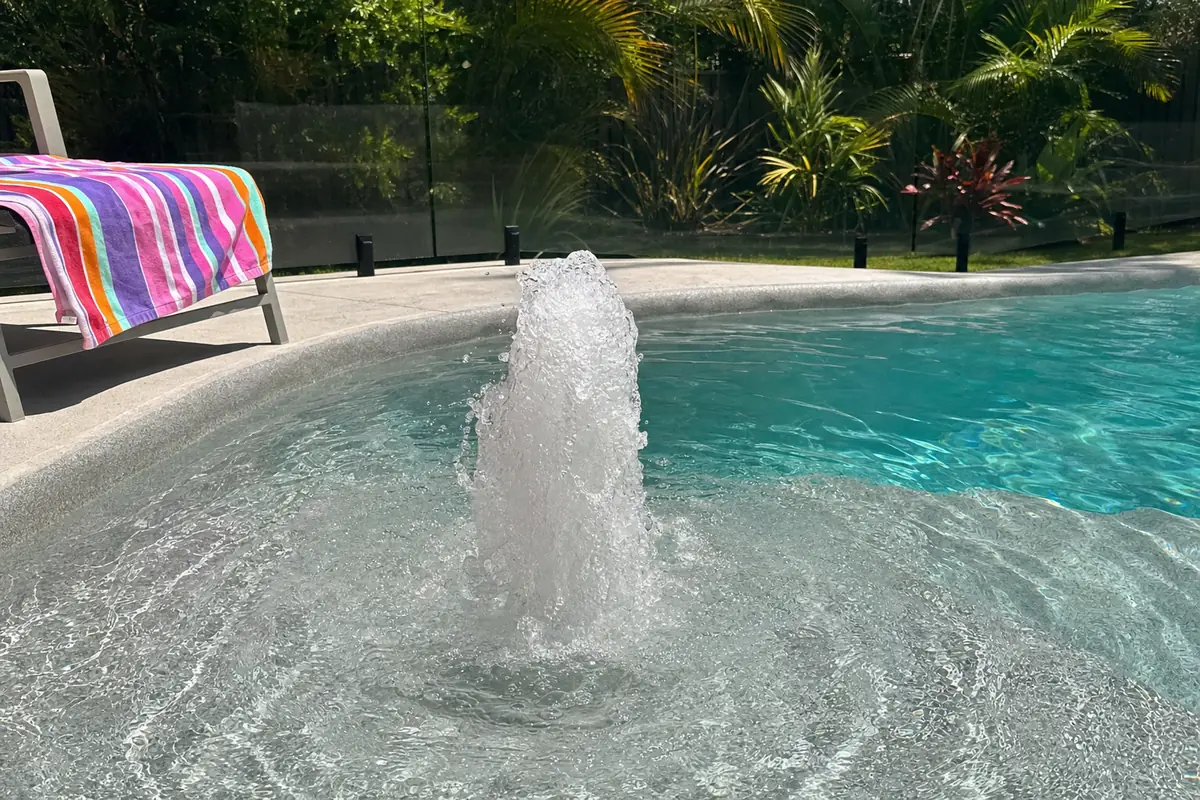
It's the feature kids use most: a fountain at toddler depth. The aeration also knocks a little heat out of the water on hot afternoons, which in a Queensland January is exactly what you want.
Scuppers
A scupper is a spout — usually a rectangle of stainless steel or brass — set into a raised wall, pouring a smooth ribbon of water into the pool. Run in rows of two or three, scuppers give the most formal, architectural look of any feature here.
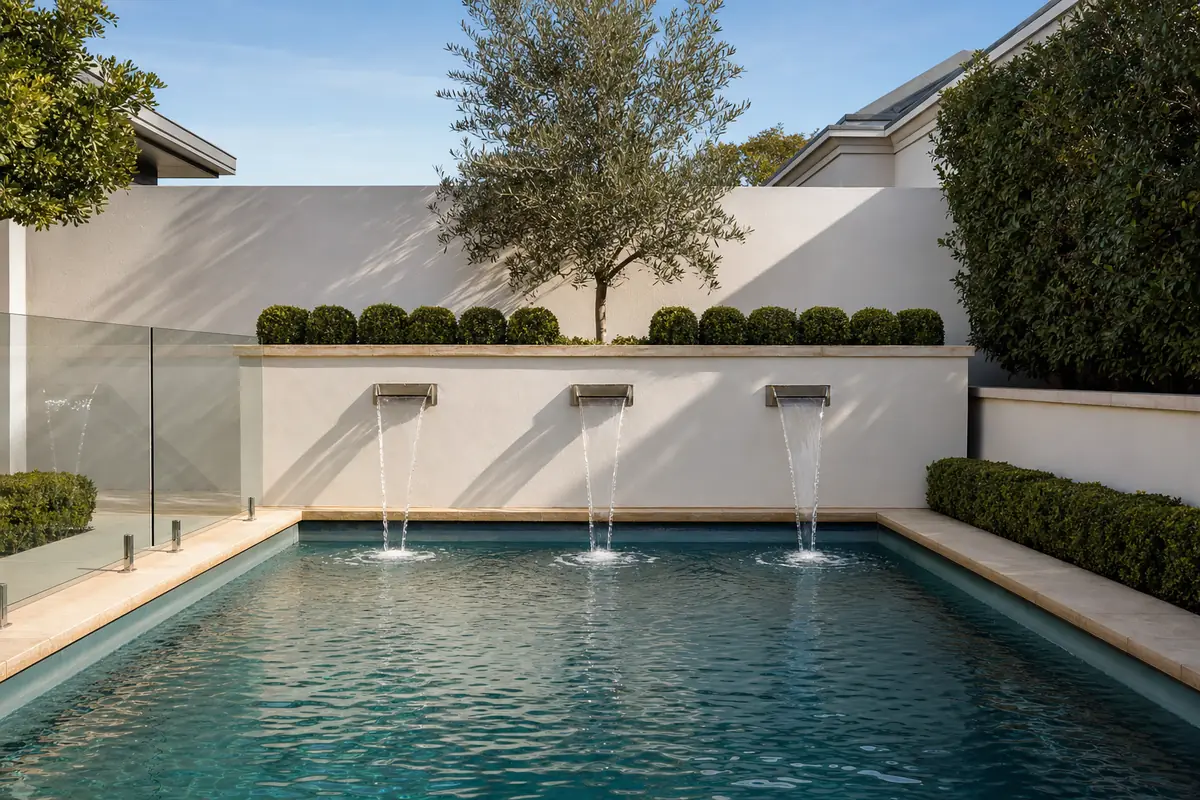
Structurally they need what the blade wall needs: a blockwork wall on a footing with plumbing behind it. If you're already building a feature wall, swapping the blade for scuppers (or combining them) is a design choice more than a cost jump.
Rain curtains
A rain curtain drops dozens of thin streams from an overhead beam or pergola edge into the pool below — a wall of falling water you can see through.
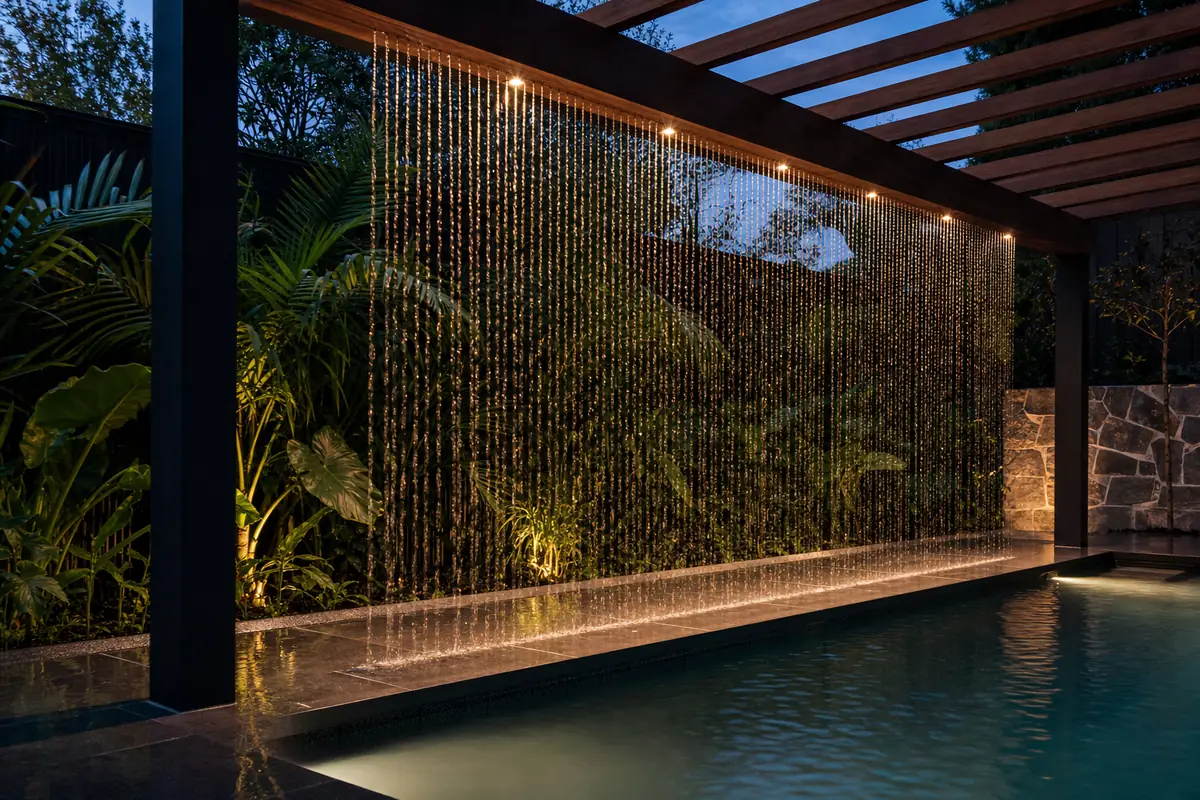
It's the most theatrical option and the loudest. It also needs something to fall from, so it only works where a pergola, cabana edge or structural beam already crosses the water line — which is why you see it on resort builds more than backyards. Budget for the structure, not just the feature.
Rock waterfalls
A natural rock waterfall stacks boulders or stone at the pool edge and tumbles water over them. Done well it makes the pool look like it was always part of the yard; done cheaply it looks like an aquarium ornament, so the stone selection and placement matter more than the plumbing.
This one is really a landscaping project with a pump attached — it pairs naturally with sloping blocks and retained gardens, and it's worth planning alongside the rest of the yard in one pass.
Spillover spas
A spillover spa isn't an add-on at all: it comes from choosing a pool-and-spa shell where the spa sits raised beside the pool and spills over its edge in a constant, gentle sheet. You get the water sound every time the system runs, plus an actual spa. Whether a spool or spa combo suits your block comes down to how much swim length you are willing to trade for jets, heat and a smaller footprint.
How to choose: sound, sightline, budget
Start with sound, because you'll live with it every time the feature runs. A water blade at low flow is a murmur you can talk over; a rain curtain is genuinely loud. A feature beside the alfresco dining table wants to be quieter than one across the far side of the pool. Flow is adjustable on most features, but each type has a character it can't escape — a deck jet always patters, a blade always hushes.
Then sightline. The best position is the one you see from inside the house — the kitchen window, the living room, the alfresco — not the one that looks best standing at the water's edge. In practice that puts the feature wall on the far side of the pool facing the living areas, which is exactly where it also hides the boundary fence. We work this out on the site plan, and it's why the 3D render matters: a feature that looks right on a brochure can point the wrong way on your block.
Budget last, because the spread is wide. Deck jets are the entry point. The blade wall costs more but doubles as landscaping — it's the single feature most likely to make the pool your property's centrepiece, and the one that adds visible value to the home. Laminar jets and rain curtains sit at the top of the range and mostly appear on resort-style briefs alongside spa jets and lighting packages.
One running note: a water feature aerates the water, which lifts evaporation and slowly nudges pH upward, so expect to dose a little more acid in a heavy-use week. Run the feature while you're outside enjoying it rather than around the clock and both effects stay trivial.
We also handle poolside landscaping, so the wall, paving and planting land as one design instead of three trades' worth of compromises. When you're ready, book a free design consult and we'll put the water feature into a 3D render of your own backyard before you spend anything on it.
FAQs
How much does a water feature cost for a pool?
Deck jets start at $1,075 installed for a pair. A water blade feature wall is $3,200 installed for the small wall (1.6 m × 0.8 m) or $3,500 for the large (2 m × 1 m), plus $300–$400 if you want an LED blade and $1,000 if the back of the wall needs cladding. Anything site-dependent is confirmed in your quote once we measure.
Can I add a water feature to an existing pool?
Yes, but it costs noticeably more than including it in the build, because the plumbing has to be trenched under finished paving. Deck jets are the least disruptive retrofit; a feature wall retrofit means excavation and a new footing. If there's any chance you'll want one, rough in the plumbing during the build even if the wall comes later.
Which pool water feature is the quietest?
Deck jets at low flow, then a water blade on a low wall. Sound rises with drop height and water volume, so a tall sheer descent is louder than a short one, and a rain curtain is the loudest feature of all. If the pool sits close to a bedroom or dining area, choose a low blade or jets and keep the flow dialled down.
Do water features increase running costs?
Slightly. The feature runs off pump time you may not otherwise use, and the falling water increases evaporation and aeration — aeration gradually raises pH, so you'll use a little more acid. Running the feature only while you're using the pool area keeps all of this negligible.
What's the difference between a water blade and a sheer descent?
They're the same family of feature: a slot spillway producing a flat sheet of water. "Sheer descent" is the generic term for the spillway style; a water blade is the stainless unit set into a wall that produces it. Ours come in 900 mm and 1,200 mm widths, with or without an LED strip in the spillway.