14 Pool Landscaping Ideas for Australian Backyards
14 pool landscaping ideas for Australian backyards: paving, plants, rocks, decking, lighting and fencing around a fibreglass pool, with real installed costs.
Published · Updated
Direct answer
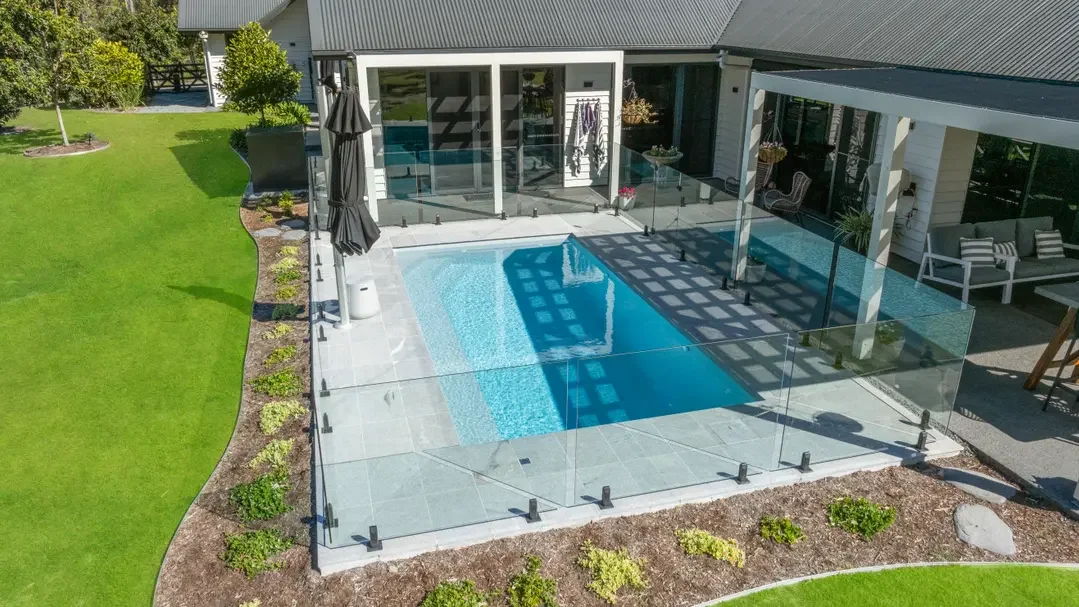
A fibreglass shell going into the ground is the easy part. What turns it from a piece of blue equipment into the place everyone gathers is the metre or two of ground that wraps around it. Get the surround right and the pool reads as the centre of the backyard; get it wrong and even a beautiful shell sits there looking like a spa bath dropped on a building site.
Most of the value in poolside landscaping is decided before a single plant goes in — coping, paving, level changes, drainage, where you climb out dripping. A lot of those choices are cheapest to lock in while our pool builders still have machines on site. Below are fourteen ideas that work in an Australian backyard, drawn from pools we have installed across South East Queensland, with real installed prices where we publish them so you can budget honestly. Our pool landscaping rates are published in full, so the prices below are the same ones that land in a quote.
1. Zone the surround before you plant
The first ring around any inground pool is hard surface, not garden. On a fibreglass shell this ring does real work: it stops soil and mulch washing into the water, gives you somewhere to put a chair and a towel, and creates the non-climbable zone the certifier checks against the barrier.
Think in zones rather than one uniform apron. A wide entertaining area on the sunny side where the outdoor setting lives, a narrower path around the shaded end, a soft garden edge where the fence runs. Different widths for different jobs reads as designed; a 1.2 metre concrete band the whole way round reads as a footpath.
2. Pave the wet edge in large-format stone
Paving is the default poolside surface in South East Queensland because it handles wet feet, summer heat and storms without complaint. The decisions that matter are the coping and the joints, not the colour swatch.
The coping — the edge piece that overhangs the shell lip — sets the whole look. Bullnose gives a soft rounded edge that is kinder on shins and on pool covers; square-edge reads more contemporary. Whatever you pick, pour the surround to fall away from the pool so rain and splash-out run to the garden, never back into the water carrying leaf litter and phosphate.
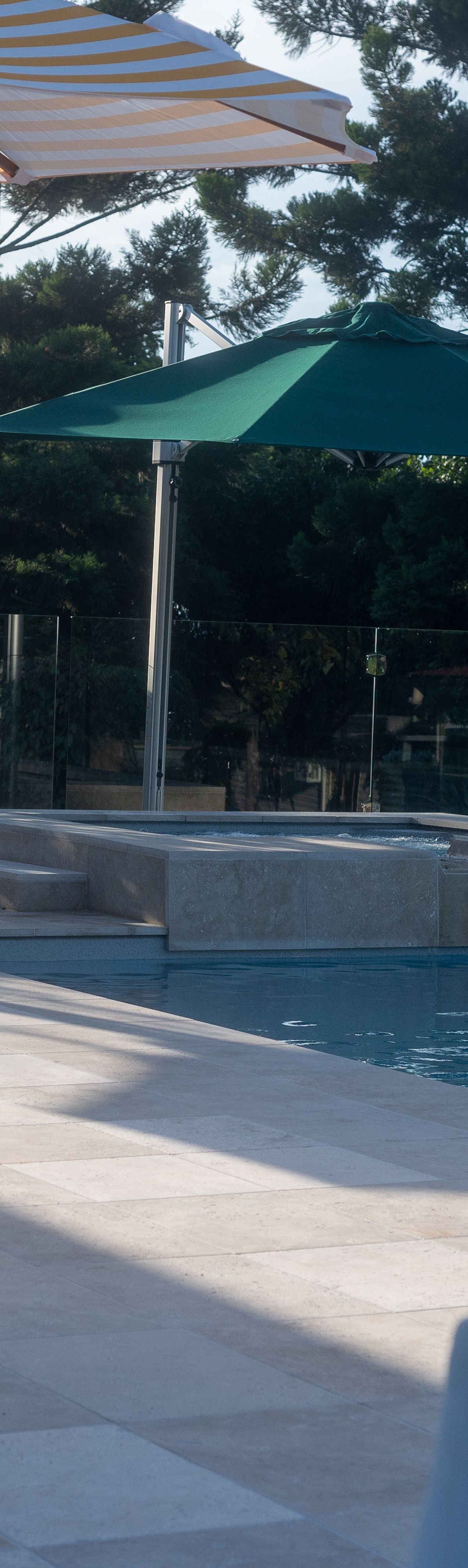
Large-format pavers and poured concrete both crack if they are not relieved. That is what expansion and control cuts are for, and decorative saw cuts double as a design feature to break a big grey expanse into panels. We run concrete cuts from $50, so zoning a slab is a small line item, not a renovation.
3. Build a deck for a raised or sloping shell
Timber or composite decking suits a raised shell, a sloping block, or anyone who wants warmth underfoot instead of stone. A deck can sit flush with the coping so you step straight from board to water, which is hard to achieve with pavers on a slope without a lot of fill. It also hides the exposed side of a partially above-ground shell far more elegantly than a rendered wall.
The trade-offs are honest. Timber needs oiling and the odd board replaced; composite costs more up front but skips the annual upkeep; both run hotter in full western sun than light pavers. Many of the best backyards use both — decking for the entertaining zone, paving for the wet immediate surround. Choosing between pool decking options is mostly a decision about upkeep versus up-front cost.
4. Go grass-free with pebble beds and pavers
Skipping lawn entirely is the lowest-maintenance surround there is, and it is the right call on shaded blocks, small yards, or soil that refuses to grow a decent lawn. A grass-free surround leans on pebble beds, paving, artificial turf and potted plants to fill the ground plane without a mower ever coming out.
Pebble and gravel beds over a weed mat give texture and drainage for very little money, and they read well when edged crisply against paving rather than left to spill. Artificial turf earns its place because it drains, drops no clippings into the skimmer, and stays green through a Queensland summer with no watering. The full range of no-grass pool surround ideas trades mowing and watering for a one-off material cost.
5. Keep the lawn — but add a mowing strip
Real lawn still feels best underfoot, and there is nothing wrong with running it up to a poolside garden as long as there is a mowing strip between the grass and everything else. A mowing strip is a flush paved band, usually one paver wide, that the mower wheel rides along. It stops grass creeping into beds, keeps clippings out of the pool, and means you never whipper-snip a raw edge against the coping.
The catch with lawn near a fibreglass pool is what runs off it. Fertiliser, clippings and soil all end up in the water if the ground falls the wrong way, and after a summer storm that is a filter full of organic load. Grade the lawn to fall away from the shell and keep a hard buffer at the water's edge.
6. Choose the right plants around your pool
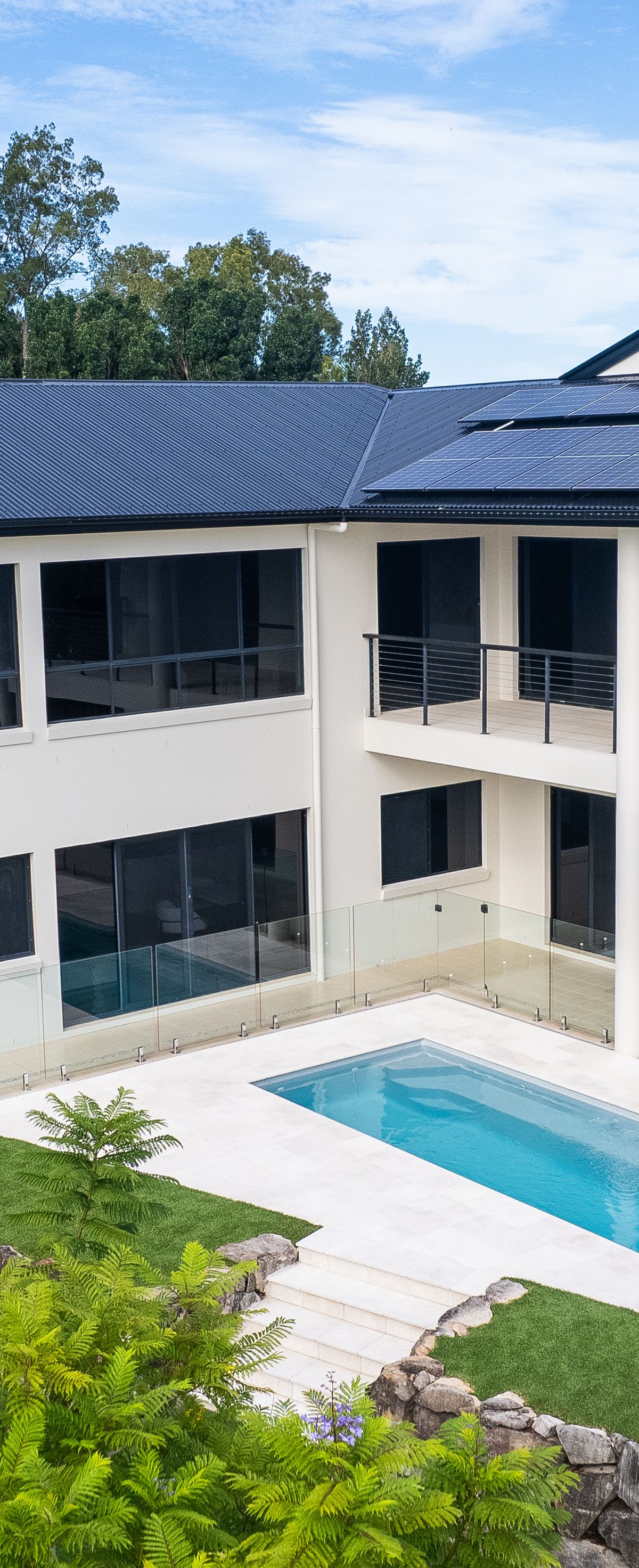
Plant selection around a pool is a filtering exercise, not a wishlist. Four things rule a plant in or out.
Root behaviour comes first. A fibreglass shell sits in an engineered bed of sand or crusher dust, and aggressive roots — figs, running bamboo, large gums — chase moisture and can lift paving over the years. Keep vigorous-rooted trees well back, or choose clumping and dwarf forms that stay put.
Litter is next. Every leaf, flower and seed pod that drops near the water is something you skim or something that stains the surround. Evergreens with small firm leaves beat deciduous feature trees at the edge. Save the frangipani for the far corner where its drop lands on lawn.
Salt and mineral tolerance matters more than people expect on a magnesium or saltwater pool, because splash-out carries dissolved minerals onto the nearest foliage all summer. These hardy performers handle SEQ sun, salt splash and low water on the leaf:
| Plant | Why it works poolside | Best position |
|---|---|---|
| Lomandra 'Tanika' | Tough, clumping, no invasive roots, very low litter | Fence line and surround edges (kept low) |
| Dianella (flax lily) | Strappy, drought and salt tolerant, mass-plants well | Borders and garden beds |
| Westringia (coastal rosemary) | Clips into a neat low hedge, coastal-hardy | Low hedge along paving |
| Agapanthus | Sun-loving, robust, seasonal flower | Sunny beds set back from the edge |
| Native grasses (Poa, Lomandra) | Soften rocks and edges, minimal drop | Around boulders and borders |
| Frangipani | Deciduous, high leaf and flower litter — avoid near water | Far corner over lawn only |
The fourth filter is the fence line, and it is not optional. Under the Queensland pool safety standard the barrier has a non-climbable zone — nothing within it can give a child a foothold. That includes plants, pots and overhanging branches. A shrub inside that zone fails a pool safety inspection even if the fence itself is perfect. Plan tall planting outside the barrier and keep the fence-line garden low.
7. Landscape with rocks and boulders
Natural stone gives a pool the look of a spring-fed waterhole rather than a swimming pool, and it is one of the most requested styles we see. Real stone has to be craned and set, which is where the cost sits — the rock is cheap, the machine and labour to place a one-tonne boulder are not. Artificial boulder systems are lighter, easier to position, and come in shapes you can plan a layout around, which is why they now own the mid-range of this look.
A few well-placed large rocks read better than a scatter of small ones. Group them, part-bury them so they look like they grew there rather than being tipped from a truck, and tuck native grasses into the gaps. Stone paired with water spilling between the rocks is the shortcut to the natural-lagoon effect.
8. Layer the planting in rings
An old trick that still works: treat the pool as the bullseye and plant outward in rings. Low strappy plants and ground cover nearest the water, medium shrubs behind them, taller screening at the back — outside the barrier. The layers give depth from every angle, deliver privacy where you want it, and keep the tallest, leaf-dropping material furthest from the water. Potted plants let you fake a ring on a paved surround where there is no garden bed to plant into.
9. Use potted plants for flexible greenery
Pots do the heavy lifting on a paved or decked surround. They are portable, you control the soil so nothing invasive gets near the shell, and you can shift them off the deck when you are hosting. Vary the heights and pot sizes for a layered look rather than a soldier's row, stand a few on plinths for dimension, and group odd numbers. Pots near the water dry out fast in summer, so plan for more frequent watering or a simple drip line.
10. Light the landscape after dark
Landscape lighting is what makes the money you spent visible at night, which is when a pool actually gets used through a Queensland summer. There are two layers: the light in the pool and the light on everything around it.
The in-pool LED is the anchor, and adding a second or third light along a longer shell is cheap — extra LED lights run $325 each — and worth it for an even wash rather than one bright spot. The landscape layer is uplights on feature plants, a wash across a rendered wall, a low glow along steps. Keep it warm and low; a pool lit like a car park kills the mood.
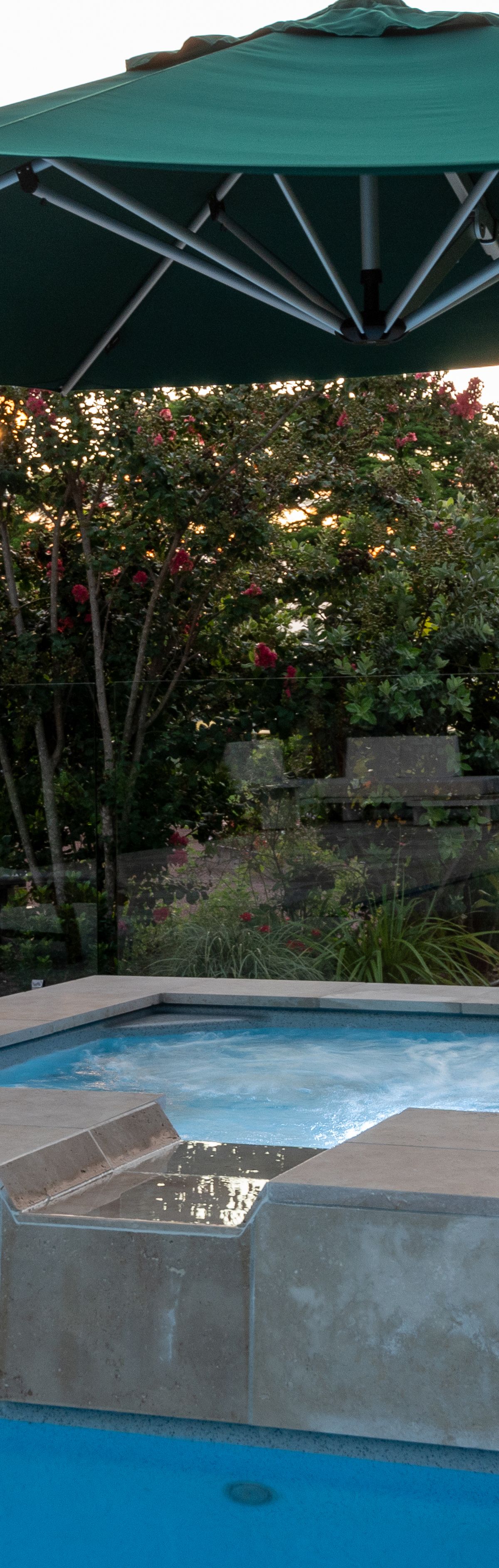
11. Add a water feature or deck jets
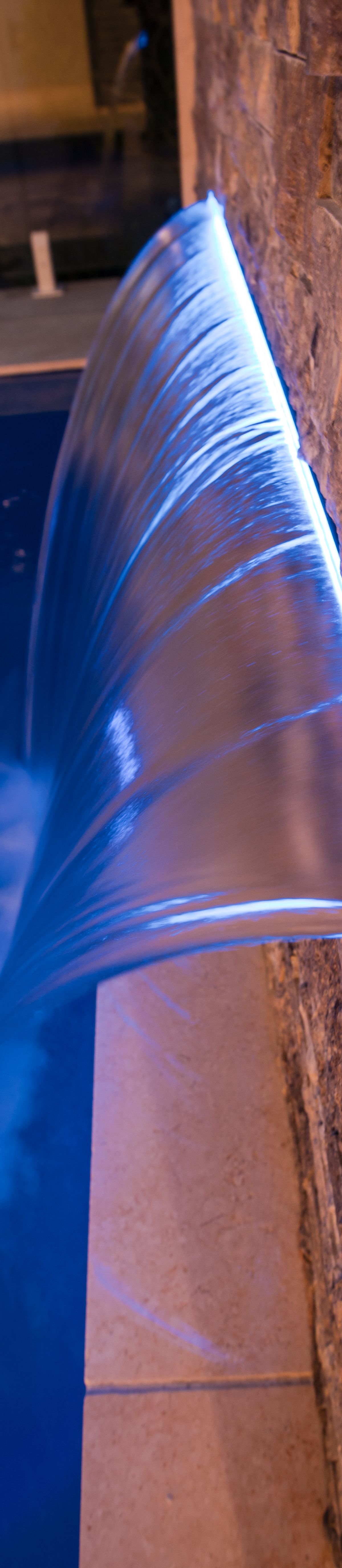
The sound of moving water is what separates a backyard that looks like a resort from one that just photographs like one. On a fibreglass pool the cleanest way to get it is to build the feature in while the pool is being installed rather than bolting one on later.
Deck jets are the easiest win — arcs of water that shoot from the surround into the pool. They start from $1,075 installed and transform the feel of the water for a modest spend. A water feature built into a raised wall or spilling spa adds both sound and movement. On a sloping block a spillover edge takes this to its conclusion, though a vanishing edge only works where the ground falls away.
12. Design a small courtyard pool zone
A courtyard around a plunge or compact fibreglass pool rewards restraint. Pick one surface material and carry it to the boundary so the eye reads the whole floor as one plane — that single move makes a tight space feel larger than breaking it into competing zones. Go vertical for greenery with climbers on a wall or slim potted plants rather than eating floor space with beds. A mirror-finish tile or rendered feature wall behind a water blade gives a small yard depth and a focal point with no footprint at all.
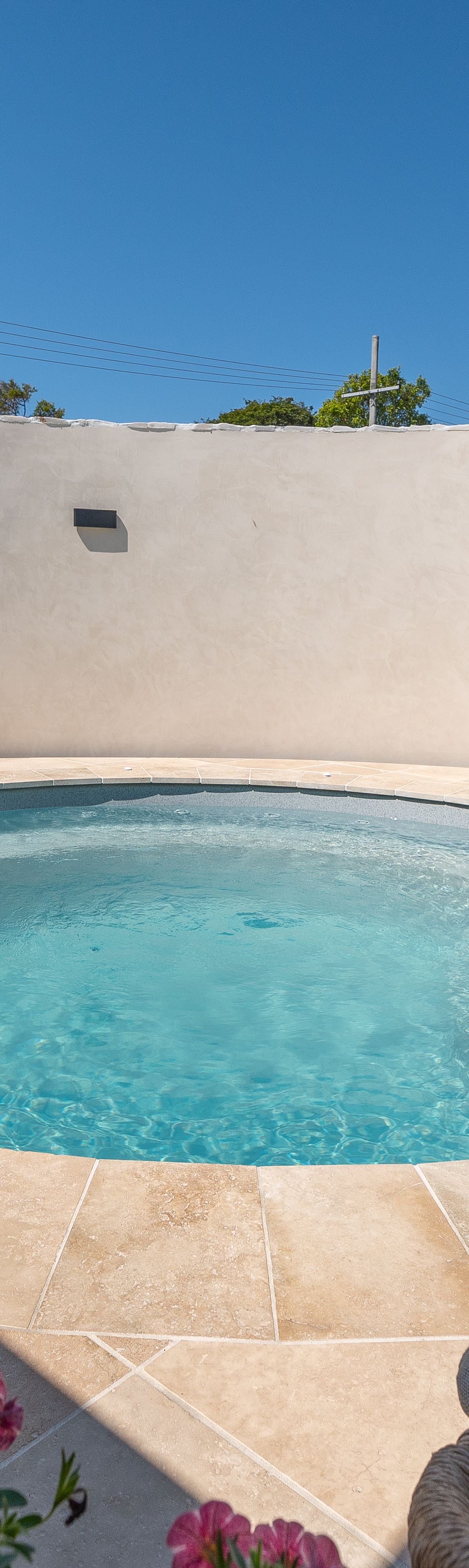
13. Frame the view with the right pool fence
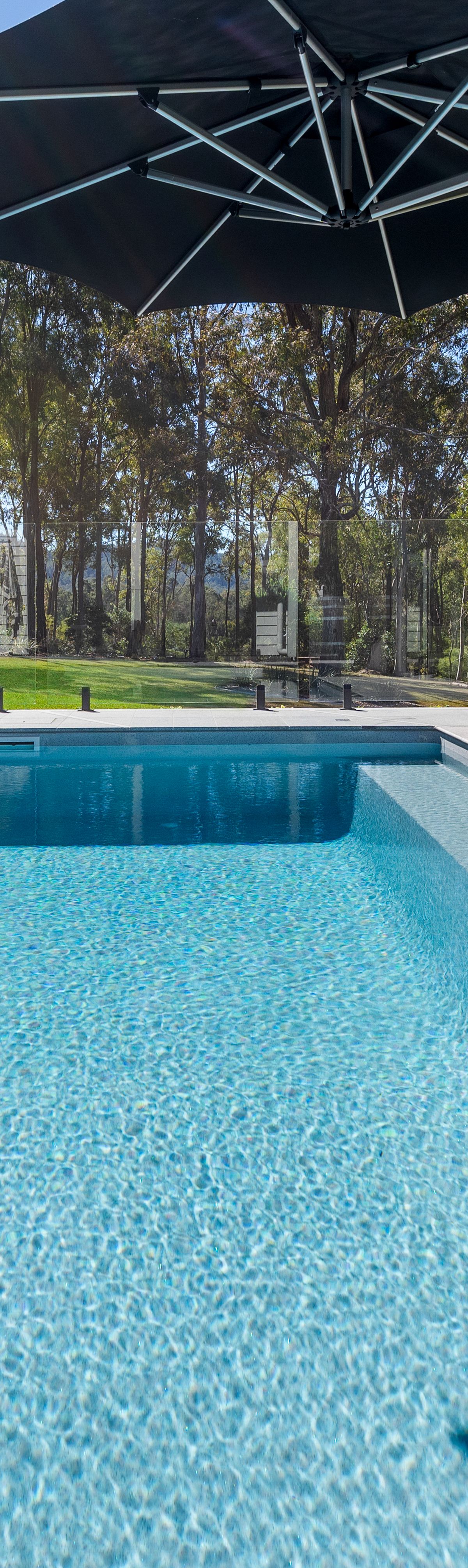
In any yard the barrier is in shot constantly, so the fence is a landscaping decision, not just a compliance one. Frameless glass keeps sightlines open across the garden and costs more per metre; flat-top aluminium is the value option and disappears against dark planting. We install pool fencing from $165 per metre for flat-top up to $436 per metre for frameless glass, and that choice does more to the finished look than any plant. Set garden beds and screening outside the fence so the non-climbable zone stays clear.
14. Make the entry a feature and go up a level
A wide entry ledge doubles as a shallow lounging shelf and reads as a design feature rather than a set of steps, and on a sloping block it is often where a drop-edge or retaining wall does its work. Those walls are engineered — rendered drop-edge walls run $500 to $700 per square metre depending on height and finish — so price them into the pool project rather than treating them as a later garden job, because they decide how much usable flat space you end up with. Pool entry options run from wide ledges to ramps to standard steps, and each one suits a different backyard.
Which pool landscaping ideas work best across Australia?
All fourteen ideas above work anywhere in Australia — what changes with the climate is which ones to reach for first. The surround decides how the pool handles heat, storms and dry spells, so the shortlist shifts as you move around the country:
- Queensland and northern Australia — heat and summer storms set the priorities: pale paving that stays walkable barefoot, a surround graded to shed storm runoff away from the water, and clumping, salt-tolerant natives like lomandra and dianella that handle full sun and splash-out.
- New South Wales, Victoria and the cooler south — the shoulder seasons reward warmth: darker stone that holds the day's heat underfoot, wind screening around the entertaining zone, and more freedom with deciduous feature trees, which drop their leaves in months when southern pools are barely used.
- Perth, Adelaide and the dry west — long dry summers push the grass-free ideas up the list: pebble beds, artificial turf and coastal-hardy planting like westringia keep a surround green without the watering a lawn demands.
What pool landscaping suits a Queensland backyard?
Shade, drainage and storm-proof planting, in that order. The pools we install across South East Queensland get used deep into the evening for most of the year, so the surround has to work in January: light-coloured paving or decking on the sun side — which surface stays coolest underfoot is usually the deciding question — shade over the lounging zone, and landscape lighting, because summer swimming here happens after dark. Grade every hard surface to fall away from the water, since one South East Queensland storm cell can put a filter's worth of leaf litter and phosphate into an unguarded pool in an afternoon, and keep the fence-line planting low so nothing grows into the barrier's non-climbable zone between inspections. The plant table in idea 6 is the SEQ shortlist: everything on it tolerates sun, salt splash and a missed watering.
FAQs
How much does pool landscaping cost in Australia?
There is no single figure, because "landscaping" covers everything from a pebble bed to a full paved and walled surround. As a guide to the built elements we install: pool fencing runs $165 to $436 per metre depending on flat-top aluminium versus frameless glass, decorative and expansion concrete cuts start at $50, rendered drop-edge or retaining walls are $500 to $700 per square metre, deck jets start at $1,075, and extra in-pool LED lights are $325 each. Plants, pavers and mulch sit on top and vary with the yard. The surround items we install are itemised and confirmed in your quote once we measure the block.
What should I plant around a fibreglass pool?
Choose plants with well-behaved roots, low litter and tolerance for splash-out. Hardy natives like lomandra, dianella, westringia and native grasses handle Queensland sun, salt and mineral splash and drop very little into the water. Keep deciduous feature trees, figs, running bamboo and anything with an aggressive root system well away from the shell and the paving. Along the pool fence, keep planting low so nothing breaches the non-climbable zone the barrier has to maintain.
What's the cheapest way to landscape around a pool?
A pebble or gravel bed over a weed mat, edged against a simple paved surround, with potted plants for greenery, is the lowest-cost and lowest-maintenance route. Artificial turf costs more up front than seed but saves mowing, watering and clippings in the pool. The expensive mistakes to avoid are big unrelieved concrete slabs that crack, and thirsty tropical plants that need constant replacing — spend a little on control cuts and the right plant list and you save more later.
Do I need council approval for pool landscaping?
The pool and its safety barrier are regulated and certified, but most soft landscaping — planting, paving, mulch, pots — usually does not need approval on its own. Structural work is different: retaining walls above a certain height, work near boundaries or easements, and anything that changes drainage or affects the certified pool barrier can trigger approval or an inspection. Rules vary by council and by site, so confirm with your local council or building certifier before you build a wall or alter the fence line. Nothing you plant or build can compromise the barrier's compliance.
Grass or paving around a pool — which is better?
Paving wins on maintenance and on keeping the water clean; lawn wins on cost and on how it feels underfoot. The common answer is both — a hard paved band at the immediate water's edge to handle wet feet and splash-out, with lawn beyond it separated by a mowing strip so clippings and soil never reach the pool. If your block is shaded, small, or has soil that won't grow good grass, skip the lawn and go with a no-grass surround instead.
How do I keep leaves and debris out of a landscaped pool?
Position leaf-dropping trees away from the water, grade the surround to fall to the garden not the pool, and put a hard buffer between any lawn and the coping. Evergreen, small-leaved plants at the edge shed far less than deciduous feature trees. A summer storm in South East Queensland will still drop leaf and phosphate load into the water, so a surround designed to drain outward and a bit of distance on the big trees does more for your filter than any single gadget.