Pool Entry Steps: Full-Width, Corner & Bench Options
Compare pool entry steps for fibreglass pools — full-width wading steps, corner steps, benches, ledges and accessibility. What suits SEQ backyards.
Published · Updated
Direct answer
How you get in and out of the water shapes how a pool actually gets used. It rarely tops the list when people are choosing size and shape, yet the pool entry steps decide whether toddlers can wade in safely, whether grandparents can manage a swim, and whether the shallow end becomes the spot everyone sits with a drink on a hot Brisbane afternoon.
Fibreglass pools have an advantage here that concrete and vinyl don't: the steps, benches and ledges are moulded into the shell at the factory. There's no tiling a step edge that later cracks, no separate structure to seal. What you pick is baked into the design from the first quote, so it pays to understand the options before you commit to a shape.
What are the main pool entry step options?
The main swimming pool entry steps fall into five types: full-width wading steps that span the shallow end, corner steps tucked into one end, moulded benches and Baja ledges for sitting, beach-style sloped entries, and stainless steel ladders. Fibreglass shells almost always use moulded steps and benches because they come as part of the shell, while ladders are a bolt-on retrofit more common on above-ground or older pools.
Here's how the common choices compare:
| Entry type | Best for | Space needed | Notes |
|---|---|---|---|
| Full-width entry steps | Families, easy access, lounging | Spans the shallow end | Most popular on modern fibreglass shells |
| Corner steps | Compact yards, keeping swim lane clear | One corner only | Space-efficient, less seating |
| Bench / Baja ledge | Sitting in shallow water, kids play | Along a wall or step | Often paired with steps, not a sole entry |
| Beach / sloped entry | Resort look, wade-in access | Large footprint | Needs a big pool to work |
| Stainless steel ladder | Retrofit, deep-end exit | Minimal | Hard for small children and less mobile swimmers |
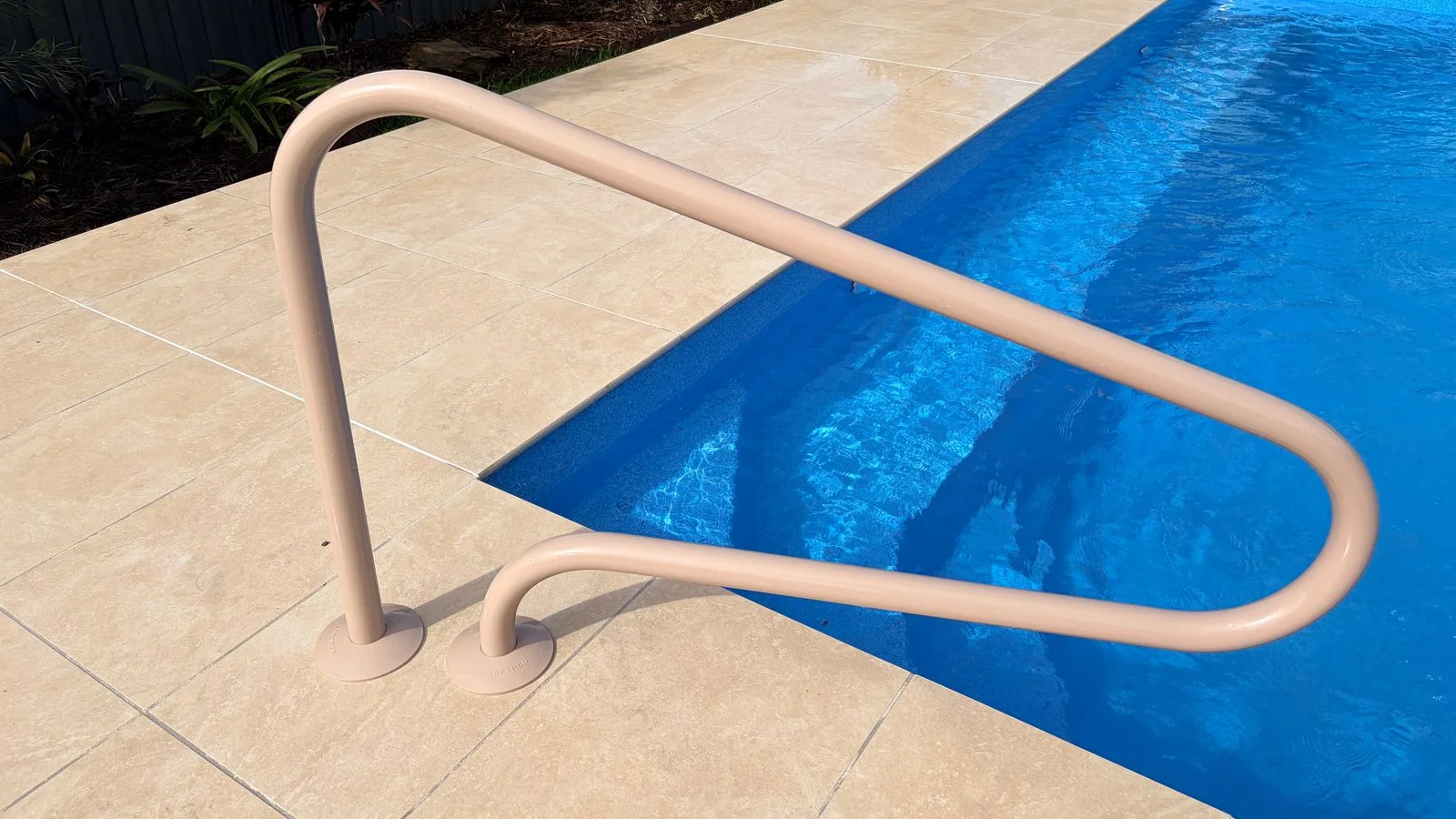
| Hand grab rails, installed | Price | |
|---|---|---|
| Hand Grab Rail - White | Hand Grab Rail – White RTD-348W | $1,507 |
| Hand Grab Rail – Graphite Grey | Hand Grab Rail – Graphite Grey RTD 348 | $1,507 |
| Hand Grab Rail - Black | Hand Grab Rail – Black RTD-348BL | $1,507 |
| Hand Grab Rail – Taupe | Hand Grab Rail – Taupe RTD-348T | $1,507 |
Colour-matched rails fitted during installation — one price across all colours.
Why full-width entry steps suit most backyards
Full width entry steps run the entire width of the shallow end, giving the easiest, safest way in and out of the pool. Because the treads are wide and shallow, a child can walk down holding a parent's hand instead of climbing, and there's no narrow ladder to negotiate. Styles like the Hayman, Bedarra and Terazza shells are built around this format for exactly that reason.
The width does double duty. When the pool isn't being swum in, that top step becomes a sitting ledge — knees-deep water where you can cool off, supervise kids, or set up a couple of chairs. On the models we install most across the Gold Coast and Sunshine Coast, this shallow shelf is where the pool gets used the most on a 35-degree day.
The trade-off is footprint. Full-width steps eat into the swimming length, so on a shorter shell you're choosing between a generous entry and lap space. It's a straightforward decision once you know whether the pool is mainly for swimming or mainly for lounging and play.
When corner steps are the smarter choice
Corner steps make sense when yard space is tight or you want to keep the main body of the pool clear for swimming. By tucking the treads into one end, corner steps leave the length open, which matters on a narrow block or a plunge pool where every metre of swim area counts.
They're also cleaner-looking on small pools. A full-width step can make a compact shell feel like it's mostly steps; a corner entry keeps the water reading as water. The compromise is seating — you lose the wide shallow shelf, so if lounging is a priority you'll want to pair corner steps with a separate bench.
Benches, ledges and Baja shelves for sitting
A bench or Baja ledge is a moulded shelf that lets you sit submerged in shallow water without taking up entry space. It's not an entry point on its own — it works alongside steps. Baja shelves (also called tanning or splash ledges) sit just below the surface and suit toddlers playing, an umbrella base, or an adult cooling off up to the waist.
Two ways these show up in fibreglass designs:
- Wall benches run along one side, giving a row of seating for a crowd without cluttering the swim zone.
- Baja / splash ledges are wider, shallower shelves near the steps — ideal for young kids and for setting a lounger part-in the water.
If you entertain, a bench added to corner or full-width steps often gets more use than the steps themselves.
Beach entries and ladders — where they fit
A beach entry is a gently sloped, zero-edge entry that mimics walking into the sea, and it's luxurious but hungry for space. The slope has to be long enough to gain depth gradually, so beach entries only work on large pools with a big footprint. On a standard suburban block they're rarely practical — the same wade-in feel comes more efficiently from a full-width step and a Baja ledge.
Stainless steel ladders are affordable, space-saving and fine as a deep-end exit, but they're hard work for small children and anyone with limited mobility. On a moulded fibreglass shell they're usually a secondary exit at the deep end rather than the primary way in.
Choosing steps for accessibility and safety
For older swimmers, young children or anyone with mobility limits, wide and shallow beats narrow and steep every time. Full-width steps with generous tread depth and a gradual rise are the most forgiving. A few features worth specifying up front:
- Handrail provision — a moulded step edge can take a grab rail; decide before installation so the fixing point is planned.
- Contrasting step edges — a visible edge line helps swimmers judge depth and reduces slips.
- A shallow first step — a top tread at ankle-to-knee depth lets kids and older swimmers pause before committing.
Whatever the entry, QLD pool fencing and safety rules still apply to the barrier around the pool — the steps make the pool easier to use, not exempt from compliance.
Because the steps are part of the shell, the right time to get this right is at design stage. It's worth walking through the full-width, corner and bench options against how your household will actually use the water.
FAQs
What are the best pool entry steps for young children?
Full-width entry steps with wide, shallow treads are the safest for small children. The gentle rise lets a child walk down holding a hand rather than climbing a ladder, and the top step doubles as a shallow shelf where toddlers can play under supervision. Pairing steps with a Baja ledge adds a low-water play area.
How much space do full-width entry steps take up?
Full-width steps span the entire width of the shallow end and typically take up the first section of the pool's length. On a shorter shell that noticeably reduces swimming distance, so on compact pools many people choose corner steps instead to keep the swim lane clear.
Can you add a ladder to a fibreglass pool?
Yes. A stainless steel ladder can be fitted as a deep-end exit on a fibreglass pool, usually alongside moulded steps at the shallow end. Ladders are space-saving but harder for small children and less mobile swimmers, so they work best as a secondary exit rather than the main entry.
What's the difference between a Baja shelf and a step?
A step is for getting in and out; a Baja shelf (or splash ledge) is a wider, shallow shelf for sitting, playing or placing a lounger in a few centimetres of water. Baja shelves aren't an entry point on their own — they're paired with steps to add shallow seating and play space.
Do wider entry steps make a pool safer?
Wider, shallower steps are generally safer because they're easier to judge and walk down than a narrow ladder or steep step. Contrasting edge colours and a handrail add further security for children and older swimmers. Steps don't replace the pool fence, which still has to meet Queensland safety requirements.