QLD Pool Fence Regulations & Safety Laws Guide
Every measurement a QLD pool fence is checked against — heights, gaps, gates, the CPR sign and certificates — under QDC MP 3.4, with current penalties.
Published · Updated
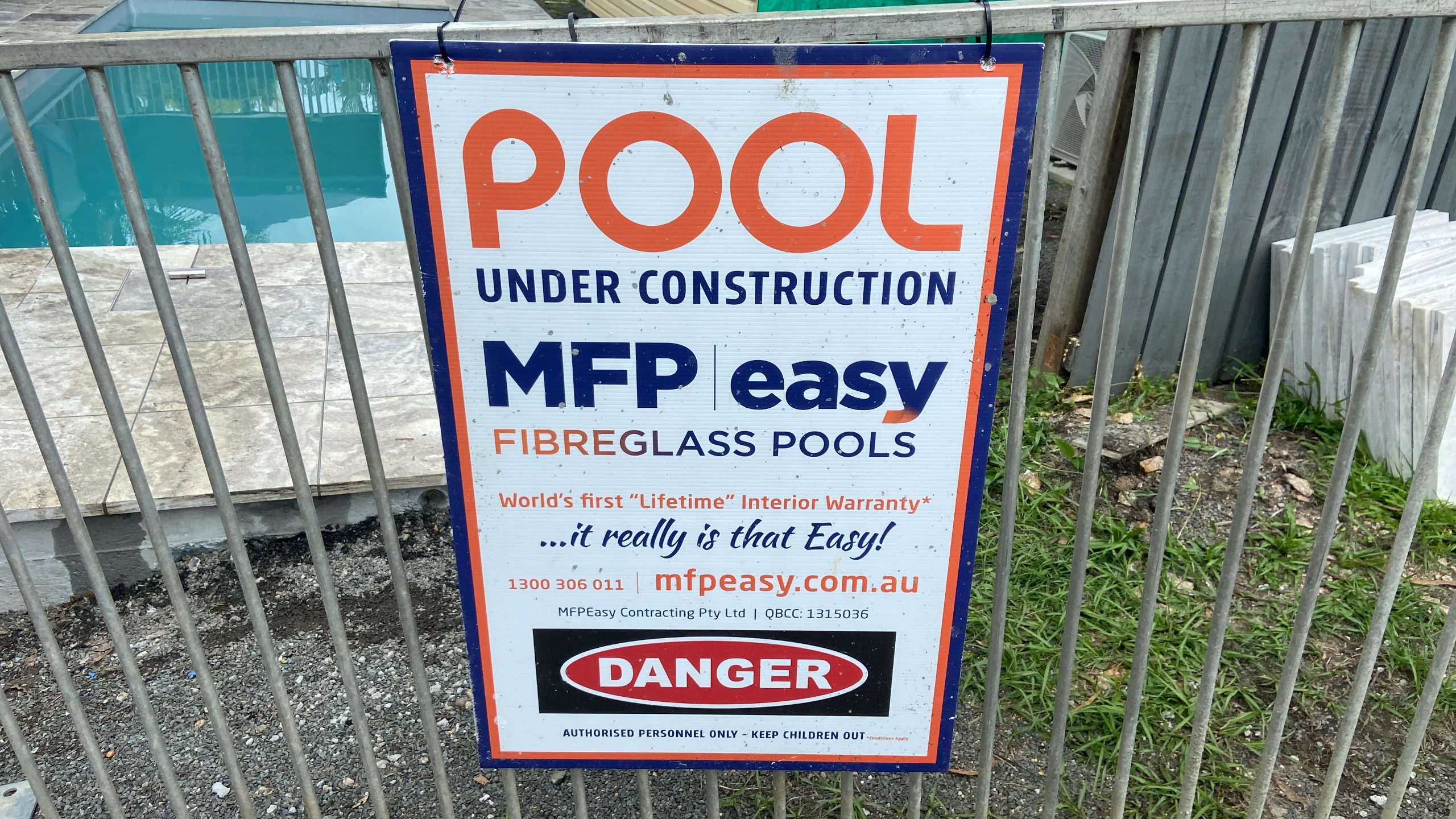
A residential pool fence in Queensland must comply with the pool safety standard, which the Building Act 1975 defines as part MP 3.4 of the Queensland Development Code. That part is titled Swimming pool barriers, and it calls up and modifies the Australian Standard AS 1926.1:2007 Amendment 1. Where the two differ, MP 3.4 wins. Later editions of that Australian Standard do not apply in Queensland unless the Queensland Development Code calls them up. The Building Act and the Building Regulation 2021 give the standard its legal force, and the obligation to comply sits with the pool owner.
The law reaches further than most owners expect. A regulated pool is a swimming pool sitting on regulated land, a category that includes residential blocks and units alike, and the barrier forms part of it. A swimming pool, in turn, is any structure capable of holding 300mm or more of water and used mainly for swimming, wading or paddling. Spas count, including a spa with a lockable lid. Fishponds and ornamental structures do not, though one actually used for swimming may be treated as a pool.
Pool fencing is required by law across Australia. Each state and territory publishes its own requirements for fence height, gaps, hinges and climbable objects, so figures published for another state do not carry across to a Queensland pool. Everything below is the Queensland position, and it does not replace the code itself or an inspection of your own barrier by a licensed pool safety inspector.
| Instrument | What it governs | Scope |
|---|---|---|
| Queensland Development Code, part MP 3.4 (Swimming pool barriers) | The barrier: height, gaps, climbability, gates, doors and windows | Queensland, all regulated pools |
| AS 1926.1:2007 Amendment 1 | The underlying barrier dimensions, as called up and modified by MP 3.4 | Applies through MP 3.4, not on its own |
| Building Act 1975 | Defines the regulated pool and the pool safety standard, and sets the penalties | Queensland |
| Building Regulation 2021 | Prescribes the resuscitation sign and the construction warning sign | Queensland |
| Local council rules | Fence height above 2m; also decides fencing exemption applications | The council area your block sits in |
What must a compliant pool fence have in Queensland?
Six measurements decide whether a Queensland pool fence complies. They address the four ways a young child reaches water: over the barrier, under it, through it, or through the gate. A barrier that misses one of the six does not meet the standard, however good the rest of it is. A compliant barrier also keeps dogs and other pets out of the water when nobody is watching.
| Requirement | What Queensland requires | Instrument |
|---|---|---|
| Barrier height | At least 1200mm from the finished ground level up to the top of the fence, at every point along its length | MP 3.4, restated by the QBCC |
| Gap under the barrier | No more than 100mm between finished ground level and the bottom of the barrier | AS 1926.1:2007 through MP 3.4 |
| Gaps between vertical elements | Posts, slats or wires up to 100mm apart, allowed only where the horizontal rails on the outside face sit at least 900mm apart | MP 3.4 modifications, restated by the QBCC |
| Holes and gaps generally | No hole or gap greater than 100mm in any direction, anywhere in the fence | QBCC restatement of the standard |
| Non-climbable zone | A continuous 900mm zone, with climbable objects at least 900mm clear outside the fence, and 300mm clear inside it where the fence is under 1800mm high | MP 3.4 schedule 1 |
| Gate | Must not open towards the pool, must be self-closing, and must self-latch from any open position | MP 3.4 schedule 1 and AS 1926.1:2007 clause 2.5 |
Height is measured at a right angle to the ground or stable surface under the fence, which is what catches fences on steps and sloping ground. A fence that measures 1200mm on the flat can fall short where the ground drops away, because the requirement holds at every point along the run. At a set of stairs, the measurement runs from the top of the stair tread nosing straight up to the top of the fence. Height is measured on the same side of the fence as the non-climbable zone.
The gap under the barrier turns on what the fence stands on. The surface underneath has to be solid, because sand and garden mulch can be pushed aside by a small child until the gap is wide enough to crawl through. That failure is common under glass panels at stairways, where the levels change and the bottom rail follows a step.
How big is the non-climbable zone in Queensland?
Queensland requires 900mm, where AS 1926.1 sets the zone at 1000mm. MP 3.4 makes that substitution through its schedule 1 modifications, so anyone quoting the Australian Standard's own number at you is quoting a figure Queensland has changed.
The 900mm is measured between horizontal rails, from the top surface of one rail to the top surface of the rail below. A compliant fence needs at least one such gap. That is a rail-spacing test on the fence itself. A separate clearance test applies to the objects around it: anything a small child could climb has to be at least 900mm clear of the outside face. Where the fence is under 1800mm high, the same objects have to sit at least 300mm clear of the inside face.
The list of what counts is broad. It takes in barbecues, outdoor furniture, trees and overhanging branches, pot plants, rockeries and raised garden beds, garden edging, steps and ledges, trampolines and toys, air-conditioning units, taps and pipework, umbrellas, deck ledges, window sills and climbable security screens.
Two further rules shape where the zone has to reach. Outside the fence, the zone extends 900mm past the end of a run, and past any point where the fence meets another barrier or object. At the other end of the scale, the zone can fall away entirely. A fence that otherwise complies and stands at least 2400mm high needs no non-climbable zone, and neither does one of at least 1800mm carrying a compliant cranked top.
On South East Queensland blocks we see a pool pump or a garden tap set in exactly the wrong spot, which turns a compliant fence into a foothold. Once the paths are poured, the fix is to move the plumbing or move the fence, and both are expensive at that stage.
What if the horizontal rails are closer than 900mm apart?
Where the horizontal rails on the outside face sit closer together than 900mm, the 100mm allowance for vertical elements falls away and the fence has to be treated. Queensland gives two routes. The first modifies the fence so it cannot be climbed. That means a timber wedge of at least 60 degrees fitted to the top of the rails, plus vertical palings set very close, leaving under a 10mm gap between them. The second builds the fence to at least 1800mm and relies on a non-climbable zone on the inside face.
What does the pool safety standard require of gates, latches and hinges?
A pool gate must swing away from the pool area, close itself, and latch itself from any open position, including from barely ajar. The latch then has to be out of a child's reach, and Queensland gives two ways of achieving that. A latch on the outside of the gate sits at least 1500mm above finished ground level, measured to the underside of the release handle. It also clears the top of the highest lower horizontal member by 1400mm. A latch on the inside sits 150mm or more below the top of the gate, or below any hand-hole. That inside latch is then covered by a shield of 450mm radius, with no gap over 10mm inside it when the gate is closed. Those two arrangements are alternatives. A gate needs one or the other, and neither may leave a gap over 10mm around the latch handle.
Hinges carry their own rule, because a child climbs a gate the same way they climb a fence. Gate hinges sit at least 900mm apart, measured from the top of the lower hinge to the top of the top hinge. Where they are closer than that, the lower hinge takes a 60-degree safety cap.
Propping the gate open is itself an offence. Wilfully interfering with a barrier so that it stops complying breaches the Building Act 1975, and it can attract a fine or a prosecution in the magistrates court.
Can a boundary fence be used as the pool barrier?
A dividing fence can serve as part of the pool barrier, on conditions. It has to be at least 1200mm high. Below 1800mm, the non-climbable zone has to be on the outside face, meaning the side facing away from the pool, and there can be no accessible climbable item within 300mm on the inside. At 1800mm or more, the zone may sit on either face. The neighbour's side carries its own test. Where it has no 900mm gap between rails, the fence needs the 60-degree wedge treatment, or it has to go to 1800mm with an internal zone. Where the existing dividing fence already stands over 1800mm, a replacement has to match that height, unless the neighbour agrees to a change.
What are the rules for doors and windows onto the pool area?
No door may give direct access to an outdoor pool area in Queensland. The Australian Standard allows a child-resistant doorset as part of a barrier; MP 3.4 switches that clause off for everything except indoor pools. Where an indoor pool does use one, the handle sits at least 1500mm high, the door swings away from the pool, and it self-closes and self-latches.
A window opening onto the pool area can form part of the barrier in two situations. The first is where the sill sits at least 1800mm clear above the pool area. The second is where the window is at least 1200mm high on the inside face, with no climbable object within 900mm. A window that meets neither has to be restricted so it cannot open more than 100mm. That means a permanent security screen, or permanently fixing the openable section. A window lock does not satisfy this, because it can be left unlocked or opened with the key. Louvres have their own set: gaps no greater than 100mm, fixed so they cannot be removed without a tool, and glass that is strong and rigid.
One structure is expressly allowed to open onto the pool area. A patio, pergola, verandah, deck or balcony with at least one permanently open side may give direct access, provided the rest of the barrier complies. That open side has to stay open, so blinds, insect screens or shade cloth across it defeat the exception.
Does a Queensland pool need a resuscitation sign?
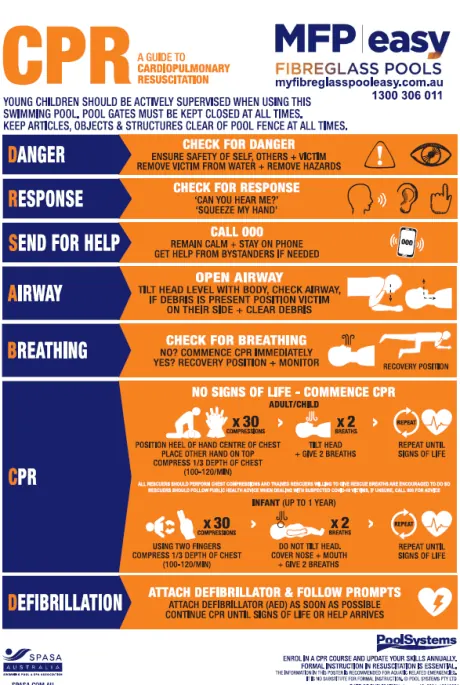
Every regulated pool in Queensland must display a resuscitation sign, with a narrow historical exception for some pre-existing outdoor pools. The requirement comes from section 13 of the Building Regulation 2021, made under the Building Act, so it sits alongside MP 3.4 as part of the pool safety standard proper. The specification is exact.
- Placement. Attached to the barrier, or displayed near the pool, so it stays conspicuous and easily visible to anyone standing near the water.
- Size. At least 300mm by 300mm.
- Material. Durable and weatherproof, and every statement or diagram on it clear and legible.
- Emergency statement. A prominent statement covering how to act in an emergency, which the regulation illustrates with calling an ambulance, staying with the injured person and giving first aid.
- CPR content. First aid procedures shown in the way set out in the Australian Resuscitation Council's ANZCOR guideline 8, Cardiopulmonary resuscitation, dated January 2016. The QBCC advises that a sign should stipulate 30 chest compressions followed by 2 breaths.
A faded, cracked or missing sign is a compliance failure in its own right.
When does the pool barrier have to be up?
Before the pool holds 300mm or more of water, which makes water depth the trigger in Queensland. A pool under construction does not have to comply with the pool safety standard until it is close to being filled to that depth. From that point the barrier obligation is live, and filling past 300mm without a building certifier's certificate stating the pool is a complying pool is an offence carrying a maximum of 165 penalty units.
A separate obligation starts earlier, before construction does. A warning sign has to go up on the land before work starts, warning that a pool is under construction and that there is danger to young children. It sits within 1.5m of the road frontage, visible from the road, mounted with its bottom edge at least 300mm above ground, made of weatherproof material, and lettered in bold at least 50mm high. One road frontage is enough. The sign stays up until the certifier issues the complying-pool certificate.
Temporary fencing bridges the middle of the build, and Queensland limits how long it can. A temporary fence may stand in for a permanent barrier for up to three months, and only where the building certifier who approved the pool application has inspected and approved it, on a Form 16. Beyond three months it needs further written approval from that certifier. Temporary fencing is also required when sections of an existing fence come out for repair or replacement.
On an MFP Easy build the temporary safety fence is a standard scheduled task, set to start with the excavation, and the hire runs eight weeks. The hire is a third-party line billed to you at cost. Where an existing boundary fence has to come out so machinery can reach the dig, removal and reinstatement are scheduled tasks too. Your contract sets whether we carry that work or you do, and the site access form you complete before the dig records the arrangement.
Who is responsible for the pool barrier in Queensland?
Three parties carry pool barrier obligations on a residential build: the pool owner, the building certifier and the local council. Their duties do not overlap. The owner's runs continuously, the certifier's is a single test before the pool is filled, and the council's applies only where you build above 2m or ask for an exemption.
| Responsible party | Obligation | When it applies |
|---|---|---|
| Pool owner | Ensure the pool complies with the pool safety standard and the barriers are kept in good condition | At all times, and before the certifier can issue the final inspection certificate |
| Building certifier | Inspect and certify the barrier, then give the final inspection certificate | Before the pool is filled to 300mm or more, once the permanent compliant fence is built |
| Local council | May set rules of its own about increasing fence height to more than 2m, and decides fencing exemption applications | Where you build above 2m, or where you apply for an exemption |
What rules apply to a pool fence higher than 2m?
Your local council's rules apply on top of the barrier standard once the fence goes above 2m. A pool fence built to the barrier standard sits well under that height, so MP 3.4 settles it on a standard build. Where the council does have rules at that height, contact them before you build.
Can you get an exemption from the pool safety standard?
Two exemptions exist in Queensland, and both are decided by your local council on application: a disability exemption and an impracticality exemption. Queensland has no permanent exemption for older pools. Existing pools came under the current standard on their pool safety standard application day, and those transitional windows have all elapsed, so an older barrier is judged against the same rules as a new one. An application has to name the part of the pool safety standard it seeks relief from and describe the replacement measure that will keep young children away from the water. The barrier is the legal minimum rather than the whole of pool safety: handrails, ramps, steps and pool lifts are the pool safety features for kids and elderly swimmers that owners add by choice.
What certificates does a Queensland pool need, and when?
Two different certificates attach to a Queensland pool, and they belong to different moments.
The certifier who granted your pool building approval inspects and certifies the barrier before the pool is filled to 300mm or more. That certifier issues one of two documents: a Form 17, the final inspection certificate covering pools and barriers, or a Form 11 certificate of occupancy, where the building contains a regulated pool. A copy goes to the QBCC, which enters the details on the pool register. Registration therefore follows from the certifier's lodgement on a new build. A permanent compliant fence has to exist before that certificate can issue, which puts the fence on the critical path to a finished pool.
The second certificate is the pool safety certificate, Form 23, issued by a licensed pool safety inspector. You need a current one to sell or lease a property with a pool. It runs two years for a non-shared pool and one year for a shared pool. A recent Form 17 or Form 11 can stand in its place on a newly built pool. A buyer who takes on a property without one has 90 days from settlement to get it. Where a seller has none, a Form 36 notice is lodged with the QBCC, and a Form 36 grants no relief from the standard itself. If an inspection fails, the inspector issues a Form 26 nonconformity notice and re-inspects within three months.
Penalties are set in penalty units by the Building Act 1975.
| Offence | Provision | Maximum penalty |
|---|---|---|
| Pool not compliant with the standard, or barriers not kept in good condition | s 232 | 165 penalty units |
| Filling the pool to 300mm or more without the certifier's complying-pool certificate | s 234 | 165 penalty units |
| Opening a gate or door to the pool and leaving it unsecured while not in use | s 245T, access to a regulated pool to be kept secure | 165 penalty units |
| Wilfully interfering with a barrier so the pool stops complying | s 245U | 165 penalty units |
| No warning sign displayed during construction | s 233 | 20 penalty units |
The Queensland Government states the penalty unit value as $172.70, current from 1 July 2026. Local councils and the QBCC also issue on-the-spot fines, which are separate from those court maximums. Brisbane City Council confirms it inspects pool barriers and issues on-the-spot fines without publishing an amount, and the dollar figures in the QBCC's home owner's guide carry that document's own May 2019 date.
How is the pool fence scoped into an MFP Easy build?
We install two barrier types alongside the pool build: frameless glass and flat-top metal. The standard applies to both in the same way, so what differs between them is sightlines and price. These are our current installed rates.
| Installed price | 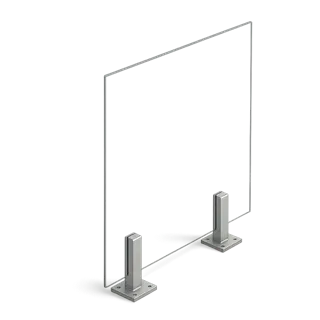 Frameless glass Frameless glass | 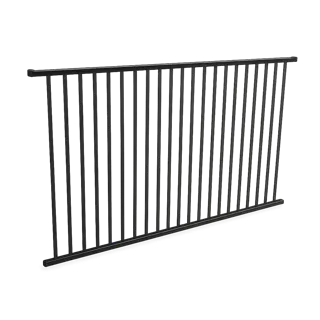 Flat-top metal Flat-top metal |
|---|---|---|
| Fencing, per metre | $462 | $198 |
| Self-closing gate, per unit | $495 | $330 |
| Panels on a retaining wall, per metre | $297 – $737 | $385 – $605 |
| Earthing (where required) | $40/m | $150 per job |
| Timber post upgrade, per metre | — | $66 |
| Typical pool: 20m fence + 1 gate | $9,735 | $4,290 |
Live rates from our quoting system — glass and metal fencing installed to QLD pool-barrier standards alongside your pool build.
The lines below sit around the fence itself, and each one is triggered by a condition on your block or by your selections.
| Fencing line | What triggers it | Amount |
|---|---|---|
| First gate | A fence run of 5 linear metres or more | Included |
| Fence earthing, electrical connection | The fence sitting less than 1200mm from the waterline | $350 |
| Fence earthing, along the fence run | Earthing required on a glass or metal fence | $40 per linear metre |
| Wooden post upgrade, flat-top metal | Optional, charged over the full fence length | $50 per linear metre |
| Temporary safety fence hire | Standard from excavation, eight-week hire | At cost |
All figures are GST-inclusive. The earthing, post and temporary-fence lines are passed through at cost, so what appears on your quote is what the supplier charges us.
The look of the barrier is where you have room to move, and the pool fencing ideas that pass certification are the ones to shortlist. How the fence line meets steps, coping and planting, and where each safety step falls from the warning sign before excavation to the certifier's final inspection, are both settled at design stage.
Getting the fence line, the gate swing and the non-climbable zone onto the drawing beats discovering them at inspection. If you want your barrier planned that way, call us on 1300 30 60 11.
FAQs
How high does a pool fence have to be in Queensland?
At least 1200mm, measured from the finished ground level up to the top of the fence. The measurement is taken at a right angle to the ground, and it has to hold at every point along the run. A gap of no more than 100mm is allowed underneath. A boundary fence used as part of the barrier also has to reach 1200mm, and it carries the non-climbable zone on the outside face unless it stands 1800mm or higher.
When does a new pool have to be fenced?
Before there is 300mm or more of water in it. A pool under construction is outside the standard until that point, and filling past it without a building certifier's complying-pool certificate is an offence. On an MFP Easy build a temporary safety fence is scheduled from the excavation on an eight-week hire. A temporary fence can only stand in for a permanent one for three months, and only with the approving certifier's inspection behind it.
Do I need council approval for a pool fence?
The pool safety standard and MP 3.4 set what the fence has to achieve, and your building certifier signs off on the barrier. Your local council may have rules of its own once the fence goes above 2m, so contact them before building at that height. The council is also the body that decides disability and impracticality exemption applications.
What makes a pool fence fail?
A gap over 100mm under the barrier or between vertical elements fails it. So does a hole over 100mm anywhere in the fence, or a climbable object inside the 900mm outside clearance, or inside the 300mm inside clearance on a fence under 1800mm. On the gate, opening towards the pool, failing to self-latch, or a latch within a child's reach all fail. Horizontal rails less than 900mm apart on the outside face fail the same way, unless the fence has been wedged and close-paled, or built to at least 1800mm with an internal zone.
Do I need a CPR sign?
Yes. A resuscitation sign is required at every regulated pool under section 13 of the Building Regulation 2021, subject to a narrow historical exception for some pre-existing outdoor pools. It has to be at least 300mm by 300mm, durable and weatherproof, and attached to the barrier or displayed near the pool where it is easily visible. It also has to show CPR procedures in the way set out in ANZCOR guideline 8.
What certificate do I get at the end of the build?
The certifier who granted the pool building approval issues a Form 17, the final inspection certificate covering the pool and its barrier, or a Form 11 certificate of occupancy. It comes once the permanent compliant fence is built, and before the pool is filled to 300mm or more. A copy goes to the QBCC, which enters the details on the pool register.
Do I need a pool safety certificate to sell my house?
Yes. A pool safety certificate is required to sell or lease a property with a pool in Queensland. It runs two years for a non-shared pool and one year for a shared pool, and a recent Form 17 or Form 11 can stand in its place on a newly built pool. A buyer who settles on a property without one has 90 days to obtain it.