L-Shaped Pools: Fibreglass Layouts, Sizes & Costs
Whether an L-shaped fibreglass pool exists in Australia, what the two-zone layout does, the moulded shells that deliver it, and what each costs.
Published · Updated
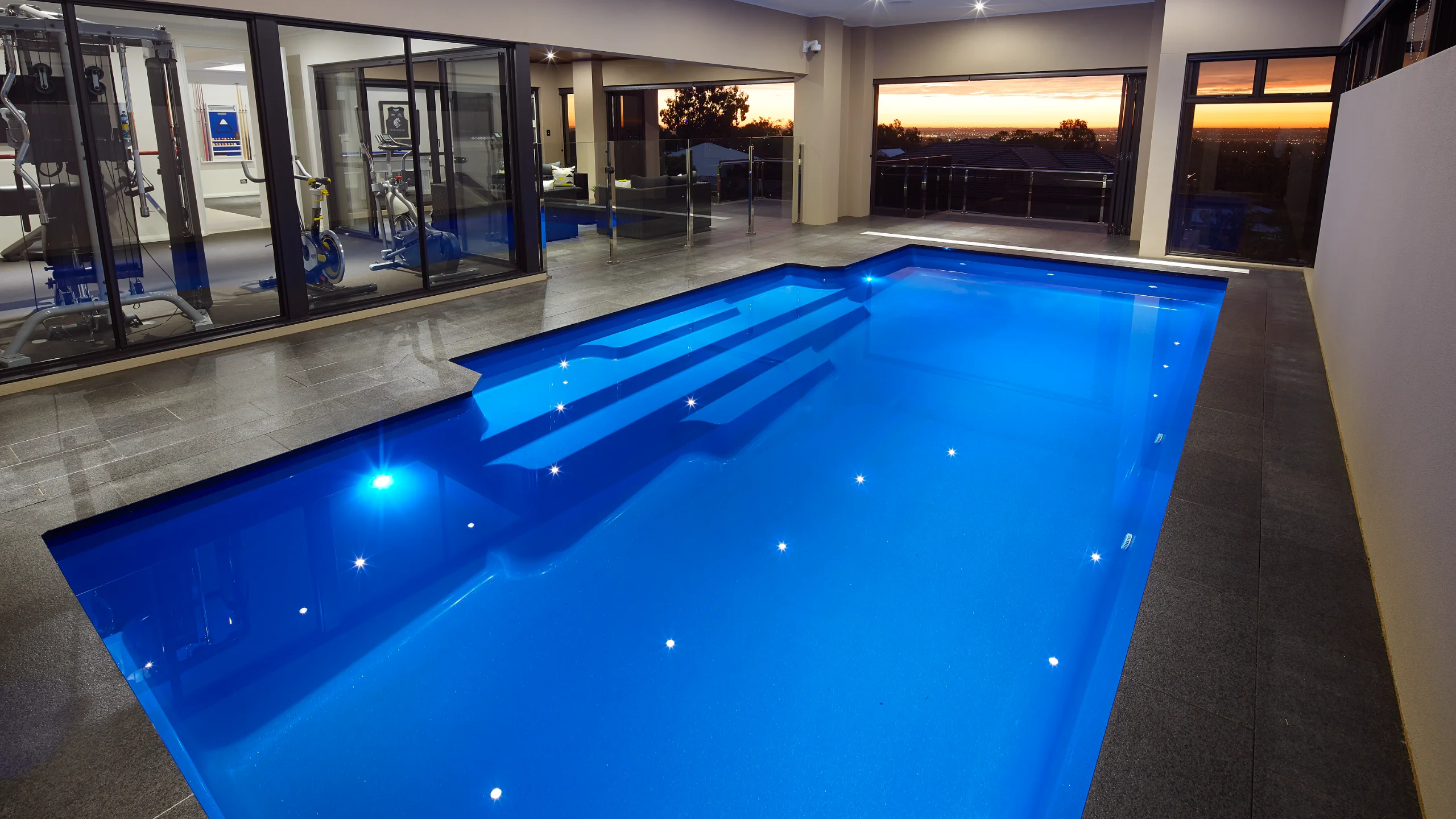
Direct answer
An L-shaped swimming pool has a long section and a shorter section that meet at one corner. This layout is also called a corner pool.
Can you get an L-shaped fibreglass pool?
MFP Easy does not offer an L-shaped shell in its moulded range. Fibreglass pool shells are made using fixed moulds, so buyers select from available shapes, sizes, and depths rather than specifying a custom outline.
The Allure measures 5.00 m by 2.50 m. The Amalfi measures 9.00 m by 3.60 m. These moulded dimensions cannot be changed for an individual backyard.
A moulded shell can still provide separate shallow and deep zones. A graded floor and entry steps at the shallow end create a shallow area for children or lounging and a deeper area for swimming. These features are moulded into the shell before delivery.
Latham lists Full-L and Lazy-L shapes in fixed sizes. It does not state what materials these shapes use.
What does an L-shaped pool do that a rectangle does not?
An L-shaped pool places two zones at a right angle. One leg can provide shallow water for children or lounging. The other can provide deeper water for swimming. The longer leg can serve as a swim lane, while the shorter leg can contain a spa, lounge area, or bench. A rectangular pool places these uses end to end.
An L-shaped pool can fit into a corner block, wrap around a patio or fixed landscaping feature, and separate entry steps from the swimming area. A rectangular pool has straight sides that can align with a fence, house wall, or patio edge. It also provides an uninterrupted swim lane. Barrier Reef Pools Perth states that an L-shaped pool can fit into an existing backyard, maximize the usable area around it, and improve accessibility.
A rectangular moulded shell can also provide two depths. The Bellagio is 7.50 m by 2.50 m, with a depth of 1.10 m at the shallow end and 1.80 m at the deep end. The graded floor provides shallow water for children and deep water for swimming. The floor creates the depth zones without requiring an L-shaped layout.
An L-shaped pool has four drawbacks:
- It requires more yard area than a rectangular pool with the same swim length. The second leg adds water and paving outside the swimming axis.
- The inside corner reduces circulation. Water moves more slowly at the corner than along a straight wall. Debris can settle there and support algae growth.
- Robotic cleaners can have difficulty navigating the corner.
- Automatic and solar covers do not fit the outline easily. An automatic cover uses a straight track, so it cannot cover the second leg.
How do T-shaped fibreglass pools deliver the same zoning?
A T-shaped fibreglass pool provides two separate zones without a custom build. The shell is supplied in its final shape. The crossbar contains the entry steps and lounging area, while the stem remains open for swimming.
The zones are created by three features:
- A graded floor
- Entry steps at the shallow end
- A separate moulded spa shell when the short section is intended for a spa
The shallow and deep areas are moulded into the shell at the factory. The depths are included in the published fibreglass pool dimensions and layout for each shell. Five stocked shells have a graded floor:
| Shell | Length × width | Shallow end | Deep end | Volume |
|---|---|---|---|---|
| Amalfi | 9.00 m × 3.60 m | 0.90 m | 2.00 m | 30,600 L |
| Bedarra | 7.50 m × 3.80 m | 1.30 m | 1.80 m | 30,500 L |
| Castello | 7.50 m × 3.60 m | 0.98 m | 1.92 m | 25,600 L |
| Bellino | 6.50 m × 3.60 m | 1.06 m | 1.84 m | 22,300 L |
| Avellino | 6.00 m × 4.00 m | 1.10 m | 1.80 m | 27,040 L |
The entry steps are moulded into the shallow end. This keeps the deep end clear for swimming. Steps can also be easier to use than a ladder. In a small pool, however, they use part of the available floor space.
If the short section is intended for a spa, use a separate spa shell. The Elba spa measures 4.0 m by 2.0 m and holds 4,920 L. The Bastia spa measures 3.2 m by 2.0 m and holds 3,800 L. Both are separate units installed beside the pool.
Are L-shaped pools more expensive than rectangular ones?
Yes. Barrier Reef Pools Perth states that a rectangular pool costs less than an L-shaped pool. L-shaped pools require more shell material, excavation, coping, and construction time.
A custom L-shaped concrete pool is formed and poured on site. It has a longer construction time and requires a finish for its porous interior. A moulded shell arrives with a finished interior.
For moulded shells, the price depends on the footprint and depth rather than the shape. MFP Easy prices the 4 m round Infinity 4 and the 4.5 m by 3.5 m rectangular Latina within about $1,250 of each other. The shell is formed in the factory, so its shape does not add forming work during installation.
MFP Easy’s installed moulded-shell prices are grouped by pool category:
| Pool size | Length | Depth | Installed from |
|---|---|---|---|
| 3m to 4m | 1.45m level | $45,896 | |
| 4m to 5.5m | 1.0m to 1.78m | $45,660 | |
| 6m to 7m | 1.0m to 1.88m | $54,454 | |
| 7.2m to 8m | 0.98m to 1.96m | $60,385 | |
| 8.5m to 11m | 1.0m to 2.0m | $72,546 |
Live all-inclusive installed pricing for standard site conditions in South East Queensland — updated straight from our quoting system.
Is an L-shaped or T-shaped pool right for your yard?
Choose the pool shape based on site access and whether anyone in the household swims laps. The access width beside the house determines which excavation equipment can reach the yard:
- Up to 1.38 m: a mini digger fits.
- 1.38 m to 1.57 m: a mini excavator with a standard bobcat fits.
- 1.57 m or more: full-size plant fits.
- 3 m or more, with the hole within 5 m of the truck: the truck reaches the hole directly.
The finished shell is lifted from the delivery truck and lowered into the excavation by crane. Crane bookings are based on lift distance. The distance bands are 0–15 m, 15–20 m, 20–30 m, 30–36 m and 36–48 m. The pool’s position in the yard determines the required crane booking.
An L-shaped pool is usually too short for lap swimming. A moulded shell with a crossbar does not provide additional swimming length. For lap swimming, consider fibreglass lap pools, which have a long, straight shape.
Prices are live all-inclusive installed prices (pool, standard installation, filtration and handover) for standard site conditions in South East Queensland.
Choose a wider moulded shape if you want a two-zone layout but do not need lap-swimming length. Choose from large fibreglass pools if you want both lap-swimming length and a large water area.
FAQs
What is an L-shaped pool called?
An L-shaped pool may be called an L-shape or a corner pool. Latham identifies two variants: the Full-L and the lazy-L. The Full-L has straight lines and defined angles. It is also called a true L.
What is a lazy L pool?
A lazy-L pool is an L-shaped pool with a curved inside corner. It is a variation of the Full-L pool. The lazy-L uses a gradual radius curve instead of defined angles. Latham offers 6-inch and 2-foot corner radius options. Both designs use the same two-leg layout but have different corner treatments.
What is the typical size of an L-shaped swimming pool?
Latham offers Full-L pools in the following sizes:
- 14 by 28 feet
- 16 by 32 feet
- 18 by 36 feet
- 20 by 40 feet
Latham offers Lazy-L pools in these sizes:
- 14 by 28 feet
- 16 by 32 feet
- 18 by 40 feet
- 20 by 42 feet
MFP Easy sells shells in metric dimensions. The Amalfi measures 9.00 m by 3.60 m and holds 30,600 L.
What is the cheapest pool shape to build?
For moulded shell pools, cost depends more on footprint and depth than shape. MFP Easy prices the 4 m round Infinity 4 and the 4.5 m by 3.5 m rectangular Latina within about $1,250 of each other. Custom shapes, such as L-shaped pools, cost more because they must be formed and poured on site.
Why are L-shaped pools harder to maintain?
L-shaped pools are harder to maintain because the inside corner limits circulation. Debris can collect where the two sections meet, which can support algae growth. Robotic cleaners may also have difficulty reaching the corner. Automatic and solar covers often do not fit the non-standard shape.