Infinity Pools Australia: Costs & Design Options
How infinity pool installation works in South East Queensland — real infinity pool cost in Australia, drop-edge fibreglass options, and sloped-block advice.
Published · Updated
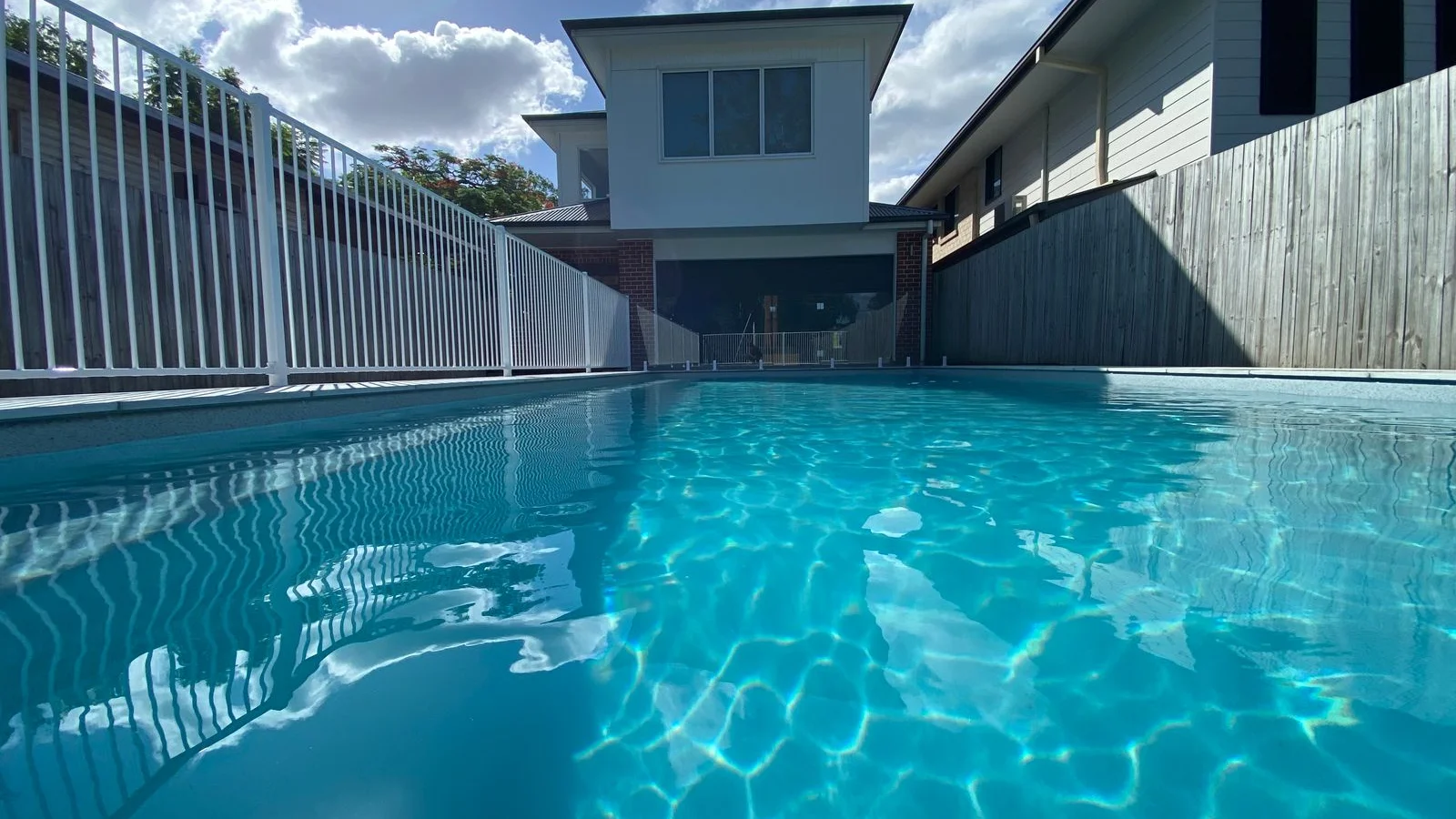
Direct answer
An infinity edge is one of the most requested and misunderstood pool design features. Most search results for infinity pool installation show resort photography rather than practical information for Australian homeowners. This guide explains how infinity edges work, typical costs, site requirements, and options for sloping blocks.
What an infinity pool actually is
An infinity pool has at least one wall positioned slightly below the water line. Water flows continuously over this wall. From the pool or house, the wall appears to disappear, making the water surface look as if it merges with the horizon, ocean, valley, or skyline. Other names include infinity edge pool, negative edge, vanishing edge, and wet edge.
The effect depends on aligning the lower wall with the view. This requirement affects where these pools are built, why sloping blocks are common, and how much they cost. On a flat suburban block, the same investment may produce less visual impact.
How an infinity edge works
A true infinity edge is a precision weir with four main components. Each component adds cost.
- The weir wall. One wall is built 2–5mm below the operating water level. It must be level along its full length. Small variations cause water to flow over lower sections and leave higher sections dry. This requires precise formwork and tiling.
- The catch trough. Water flows over the weir wall into a hidden trough at its base. The trough functions as a second, narrow pool. It must handle normal flow and surge. For example, when six people jump into the pool, the displaced water flows over the edge at once. An undersized trough can overflow.
- The second pump. A dedicated edge pump returns water from the trough to the main pool. This maintains flow over the weir. It operates in addition to the standard filtration pump, so the pool requires two hydraulic systems.
- Auto top-up. The moving water increases evaporation. Most wet-edge pools include an automatic water leveller to prevent the edge pump from drawing air, which is noisy and expensive.
The quoted cost of an infinity edge typically includes the catch trough, the additional hydraulic system, precise edge construction, and structural engineering for installation on a slope.
| Drop-edge wall finishes, per m² installed | Price | |
|---|---|---|
| Drop Edge - Strip Finish | $500/m² | |
| Drop Edge - Clad | $700/m² | |
Installed per-square-metre rates for the two drop-edge finishes we build — the quoted figure, margin included.
Negative edge, wet deck and knife edge — the difference
These terms are often used interchangeably, but they refer to different pool edge designs.
| Term | What it is | Where it suits |
|---|---|---|
| Infinity / negative / vanishing edge | One or more walls sit below the water level, allowing water to spill into a trough below | Sloping blocks with an open view |
| Wet deck (zero edge / slot edge) | Water sits flush with the surrounding deck on all sides and drains into a narrow slot grate | Flat, architectural courtyards |
| Knife edge | A variation of either design that removes the coping so the water meets a thin tiled edge | High-end builds that require a minimal edge line |
All three use a below-water edge, a catch system, and a dedicated pump. They also have the same main cost drivers. A wet deck works on a flat block because the effect comes from the flush deck rather than a long-range view.
What infinity pools cost in Australia
Custom concrete wet-edge pools in Australia typically start at $100,000–$150,000. Costs can exceed $200,000 on steep sites after retaining, engineering, and access are included. This is significantly more than a conventional inground pool.
The wet edge is only one part of the additional cost. The trough, extra pump, and tiling increase the price, but site conditions are usually the main cost factor. Sloping blocks require more complex excavation, access, retaining, and engineering.
- Excavation and access. Creating a level platform on a slope requires more spoil, more machine time and may involve rock excavation. Tight or steep access may require smaller machines or a larger crane.
- Retaining and structure. The downhill side of the pool may need to function as a structural wall that supports the pool and platform. Engineered retaining on a steep block can cost tens of thousands of dollars before pool components are installed.
- Engineering and certification. Elevated or semi-suspended structures on slopes require site-specific engineering, including soil tests, footing design, and certifier approval.
Drop-edge fibreglass — the lower-cost path
A fibreglass wet-edge pool can cost less than an equivalent concrete build on a suitable block. Some shells can be installed with a spillway wall and catch trough. The shell arrives finished, which reduces in-ground formwork, interior tiling, and wet trades. Pricing remains site-specific, but the starting cost is lower.
Suitability depends on the slope and site access. If the land slopes toward a view, price a drop-edge fibreglass pool before choosing custom concrete. Not every shell is suitable for an elevated, view-facing position. The deeper, cleaner-lined models are generally the most suitable.
Sloped blocks on the Gold Coast and Sunshine Coast
Infinity edge pools are suited to sloping sites on the Gold Coast and in the Sunshine Coast hinterland. Check the following site requirements before proceeding.
- A fall of at least a metre or two across the pool zone, sloping away from the house. The view side must face downhill so water can spill over the edge.
- An unobstructed view. Suitable views include bushland, water, a valley, or a skyline. An infinity edge may not be cost-effective if it faces a neighbouring fence.
- Access for machines. Limited side access on steep blocks can increase crane and excavation costs. These costs are assessed during the site visit.
- Compliant fencing. Queensland pool safety rules require a compliant barrier at least 1200mm high, gaps under 100mm, a 900mm non-climb zone, self-closing gates, and registration on the state pool register. Infinity pools commonly use frameless glass on the view side. Confirm the fencing design with the certifier before pouring the concrete.
Living with an infinity edge
An infinity edge requires more maintenance and operating cost than a standard pool.
- Two pumps and higher power use. In addition to normal filtration, the edge pump typically runs for several hours each day to keep the wall wet. This increases running costs compared with a single-pump pool.
- More top-up water. The moving sheet of water evaporates faster than a still surface, especially in windy conditions. Automatic top-up systems replace the water, but increase water use. An overnight cover can reduce evaporation.
- Additional cleaning. Leaves and debris flow over the edge and collect in the catch basin. The basin is often narrow and difficult to access, so it requires regular cleaning.
- More frequent chemical balancing. Aeration at the edge reduces chlorine and affects pH. Wet-edge pools generally require more frequent balancing than standard pools.
- Visible scale and waterline marks. These marks can form on the weir wall and are particularly noticeable on dark tiles. Regular cleaning with a soft brush may be required.
These requirements are manageable, but buyers should account for them before choosing an infinity-edge pool.
The infinity look without the trough
A backyard infinity pool typically provides an open view, a clean horizon line, and a resort-style appearance. Depending on the site, standard pool construction can create a similar result without custom engineering.
- Raise the pool. On a sloping yard, place the shell above ground level and install glass in front. This creates an infinity-edge appearance from inside the pool.
- Use a dark interior. Deep, reflective colours create a resort-style appearance similar to an infinity pool.
- Use frameless glass fencing. Glass maintains a clear sightline without visible rails.
- Add a raised spillway wall or water feature. This adds the sound and movement of falling water associated with wet-edge pools.
These options can be included in a standard all-inclusive installation, including excavation, crane access, filtration, lighting, and approvals. See what our pools cost when comparing a standard installation with a custom engineering project.
Small infinity pools: the Infinity 3 and Infinity 4
The Infinity 3 and Infinity 4 are round plunge pools with diameters of 3m and 4m. Both models have a full-width bench and geometric lines. They are suitable for courtyards and city blocks. View installed prices:
Prices are live all-inclusive installed prices (pool, standard installation, filtration and handover) for standard site conditions in South East Queensland.
Both models can use the elevated-install option described above. An Infinity 4 can be installed with frameless glass and a dark interior. Both models include the Aqua Technics Lifetime Structural Warranty, as does every shell we install across Brisbane, the Gold Coast, Sunshine Coast and Ipswich.
FAQs
How much does infinity pool installation cost in Australia?
Wet-edge pools typically cost $100,000–$150,000. Costs can exceed $200,000 on steep or difficult-to-access sites.
These pools are best suited to sloping blocks with a view. For flat blocks, an "infinity look" design is usually more suitable. Drop-edge fibreglass pools can have a lower entry cost, depending on the site.
How does an infinity edge pool work?
One wall is built a few millimetres below the water level. Water flows over the wall into a hidden catch trough. A second pump returns the water to the pool, and an automatic filler replaces water lost through evaporation. The edge appears to vanish because the top of the wall is below the water line.
Can fibreglass pools have an infinity edge?
Yes. Some fibreglass pool shells can be installed with a spillway wall and catch trough. This requires site-specific engineering and pricing. It generally costs less than an equivalent concrete build because the shell arrives finished.
Can you build an infinity pool on a flat block?
Yes, but a flat block does not provide the visual drop needed for the infinity effect. Without a lower area beyond the edge, the negative edge looks like a standard water feature. For flat blocks, consider a wet-deck pool or an elevated pool with frameless glass.
What's the cheapest way to get the infinity look?
Use an elevated installation on a sloping block, frameless glass fencing, and a dark pool interior. This option costs less than a wet edge and provides a similar appearance in photographs.