Fibreglass Pool on a Sloping Block: Costs & Options
A fibreglass pool can go on a sloping block. How the fall is handled by cutting, retaining or raising the shell, and what each one adds.
Written by Tehbyn Nova, Head of Operations & Growth · Technically reviewed by Caleb Druhan, General Manager (QBCC licence 15087383) on
Published · Updated
Can a fibreglass pool go on a sloping block?
Yes. A fibreglass pool can be installed on a sloping block. The site must be prepared to provide a level base and support around the shell.
The pool shell is moulded in one piece at the factory and delivered to the site. It is placed into a prepared excavation. The shell is not modified to match the slope.
The shell must be installed level. This requires creating a flat area for the pool. There are three methods, which can be combined:
- Cut into the high side. Excavate the higher ground to create a level platform.
- Retain the low side. Build a retaining wall to support the lower side of the platform.
- Stand the shell proud. Install part of the shell above the natural ground level and build supporting structures around it.
How much fall is too much for a pool site?
The amount of workable fall depends on whether excavation and retaining can create a flat, level platform under the pool shell. We confirm the fall with a level survey.
We measure the fall across the pool footprint, not the entire yard. A yard may slope steeply near the back fence but remain relatively flat under the pool footprint. Any drop beyond the footprint affects landscaping and retaining, not the pool excavation.
The excavation must also account for the shell depth:
- The Allure is 5.00 m long and ranges from 1.10 m at the shallow end to 1.60 m at the deep end.
- The Bedarra is 7.50 m long and ranges from 1.30 m to 1.80 m.
- The Amalfi is 9.00 m long and ranges from 0.90 m to 2.00 m.
Fall across the footprint increases the required excavation depth. On a sloping site, the high side must be excavated deeper than the shell depth alone requires.
A small fall can usually be managed by digging deeper on the high side. A larger fall may require a retaining wall or installation of the shell above ground level on the low side. The level survey determines which approach is required.
Should the pool be cut into the high side or built out on the low side?
On a sloping block, the pool can be cut into the high side or built out on the low side. This choice affects spoil volume, machine access, retaining requirements, and cost.
Cutting into the high side produces more spoil. Material removed from the bank must be removed with the material from the pool hole. Pool excavation pricing accounts for the spoil volume, cart-out distance, and plant that can access the site.
Building out on the low side requires less excavation and produces less spoil. However, the low side of the pool platform must be supported by retaining or a structural platform.
The narrowest point of the side access determines the machine size:
- Under 1.38 m: mini plant only.
- 1.38–1.57 m: a mini excavator plus a standard bobcat.
- 1.57 m and over: full-size plant.
If the access width is at least 3 m and the truck can get within 5 m of the pool hole, spoil can be loaded directly into the truck. On other sites, the spoil must be carted from the hole to the truck. Cart-out distances are grouped into 0–20 m, 20–40 m, and 40–60 m.
Access width and cart-out distance affect the cost of each option. Cutting into the high side generally produces more spoil. If access is under 1.38 m, that spoil must be moved using mini plant. The cart-out distance is measured from the pool hole to the truck location.
Building out on the low side produces less spoil but requires a structure to support the low side.
Does a fibreglass pool on a slope need a retaining wall?
A fibreglass pool on a slope needs a retaining wall if the excavation cannot accommodate the fall of the land. The wall retains the ground beside the pool. It does not support the pool.
On a sloping block, the retaining wall creates a flat, level platform for the pool shell. It also separates higher and lower ground so runoff can be directed around the pool.
The retaining wall requires drainage behind it. This drainage removes water from the soil and prevents it from building up against the wall. Paving around the pool must fall away from the pool so surface water drains outward.
The pool shell is supported by its base and the backfill around it. The retaining wall has its own footing and drainage system. The pool and wall must remain separate. An engineer specifies the wall height, construction and distance from the pool shell for the individual block. The retaining wall is engineered for the site and quoted separately from the pool.
Not every sloping block requires a retaining wall for the pool. If the fall across the pool footprint can be accommodated during excavation, the platform can be cut level and the pool installed without a wall. If one wall is not practical, multiple retaining walls can be used to create terraces.
Can the pool sit partly above ground on a slope?
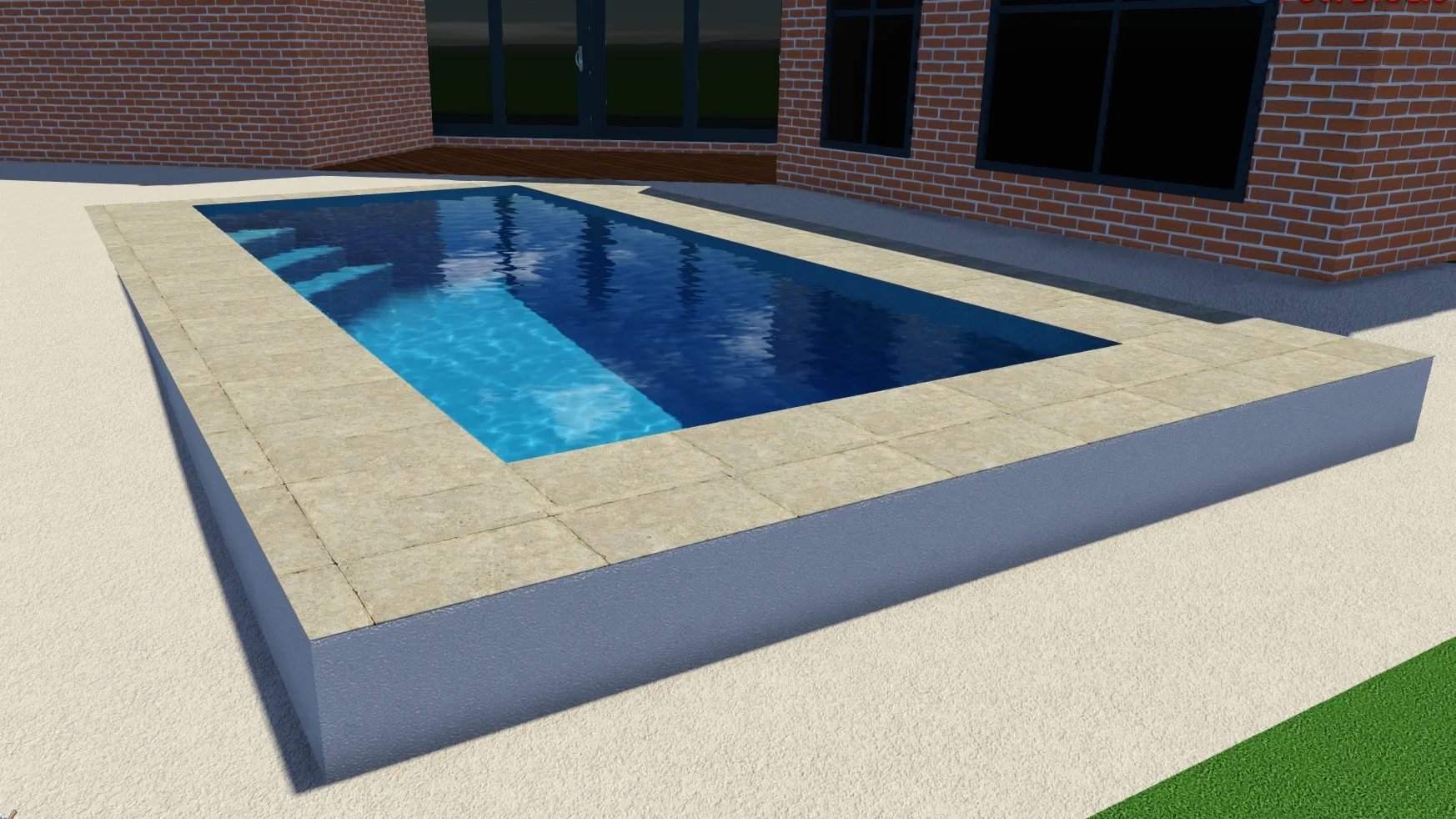
Yes. A fibreglass pool shell can be installed in-ground, partly above ground, or completely above ground. Sections above natural ground level require retaining walls, a framed deck, or an engineered support structure.
On a sloping block, the high side of a partly raised shell sits in the excavated area. Raising the shell reduces excavation on the high side and increases exposure on the low side. The exposed section requires additional structural support. Installation engineering determines how far a standard shell can sit above natural ground level.
The low side requires a deck or raised paved platform. This means finishing the raised side of the pool is part of the installation. See Paving and decking around a pool for information about pool surrounds.
A shell can also be installed completely above ground. The entire perimeter then requires structural support and finishing.
Rib-reinforced shells are a separate product class. Other manufacturers mould these shells with structural ribs that are filled with concrete on site. These shells can sit partly or completely above ground without retaining walls. We install standard moulded fibreglass shells supported by the base, backfill, and surrounding structure.
What does a sloping block add to the price?
A sloping block can increase excavation, spoil removal, retaining wall, and crane costs. The pool itself does not cost more because the block slopes.
The following rates apply to slope-related work:
| Slope-driven line | Rate (GST inc.) |
|---|---|
| Earthmoving (cut and fill), per cubic metre | $69.93 |
| Excavator, per hour | $246.15 |
| Franna crane allowance | $1,258.74 |
Customer rates include GST and were retrieved on 15 August 2026.
Earthmoving costs $69.93 per cubic metre. The total depends on the volume of ground moved to create the platform. Cutting into the high side usually moves more material than building out on the low side. The same rate applies to each cubic metre.
Excavator hire costs $246.15 per hour. The required time depends on access width and cart-out distance. Using mini plant through a side gap under 1.38 m, with a cart-out distance of 40–60 m, takes longer than using full-size plant with the truck within 5 m of the excavation.
The Franna crane allowance is $1,258.74 for one lift at standard reach. The slope does not change the shell’s weight. It can affect crane setup and the distance required to place the shell in the excavation.
Our fibreglass pool prices show what a standard installation includes. Base installed prices start at the following bands.
| Pool size | Length | Depth | Installed from |
|---|---|---|---|
| 3m to 4m | 1.45m level | $45,847 | |
| 4m to 5.5m | 1.0m to 1.78m | $45,613 | |
| 6m to 7m | 1.0m to 1.88m | $54,443 | |
| 7.2m to 8m | 0.98m to 1.96m | $60,374 | |
| 8.5m to 11m | 1.0m to 2.0m | $72,535 |
Live all-inclusive installed pricing for standard site conditions in South East Queensland — updated straight from our quoting system.
Retaining walls for sloping blocks are not included in the base installed price. Each wall is engineered and quoted for the specific block. Additional costs may include earthmoving, excavator time, crane requirements, and retaining walls.
FAQs
Is it possible to put in a pool on a slope?
Yes. A fibreglass pool can be installed on a sloping block. The platform can be cut into the high side, supported by a retaining wall on the low side, or installed partly above the natural ground level. The pool shell is installed level.
What happens if you put a pool on unlevel ground?
A fibreglass pool shell must be installed level. The water remains level regardless of the ground slope. The site can be levelled through excavation, retaining, or structural support on the low side.
Does a pool have to be perfectly level?
Yes. The pool shell must be level. The surrounding paving should slope away from the pool so runoff drains outward rather than into the water.
What is the best pool for a sloping block?
Choose a pool with a footprint that fits the flat platform available on the block. Our range includes round, small, medium, large, and lap pools. On a sloping block, shorter pools require less excavation than lap pools across the same slope. A level survey determines which pool categories the block can support.
Is a retaining wall included in the pool price?
No. The base installed price does not include retaining walls for sloping blocks. An engineer specifies the wall’s height, construction, and distance from the pool shell. The retaining wall is quoted separately.