Crack in a Fibreglass Pool: Causes, Repair & Costs
How to tell gelcoat crazing from a structural crack in a fibreglass pool, how each is repaired, and what crack repair costs in Australia.
Written by Tehbyn Nova, Head of Operations & Growth · Technically reviewed by Caleb Druhan, General Manager (QBCC licence 15087383) on
Published
Direct answer
Cracks in fibreglass pools fall into three categories based on their depth in the shell. The depth determines whether the repair requires gelcoat work, a laminate rebuild, or a builder to open the surrounding area.
Is the crack in a fibreglass pool gelcoat crazing, a spider crack, or a structural crack?
Fibreglass pool cracks are classified by their depth:
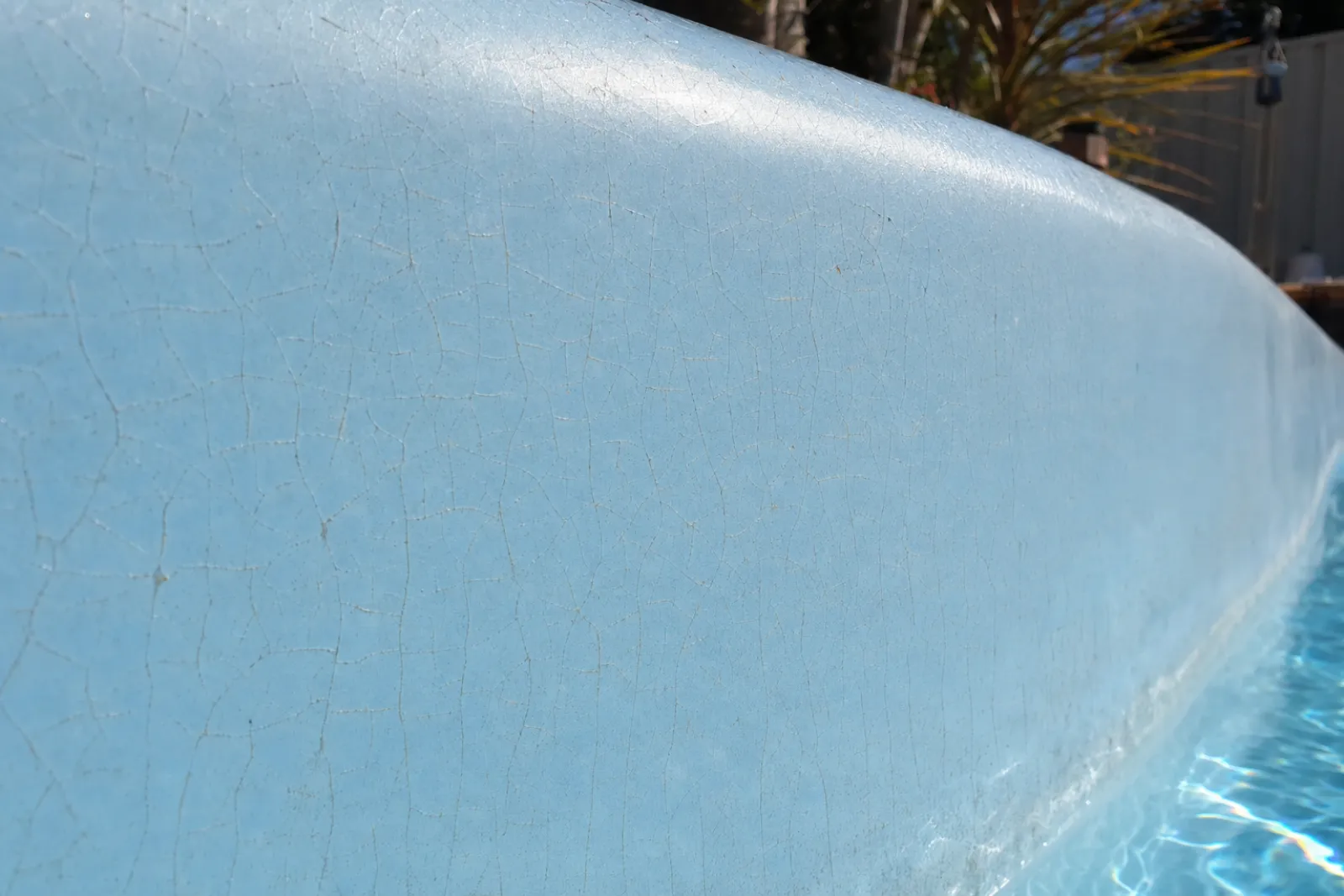
- Gelcoat crazing is a fine network of lines in the coloured gelcoat.
- Spider cracks are hairline cracks in the gelcoat that usually radiate from one pressure point.
- Structural cracks extend through the gelcoat into the load-bearing glass-and-resin laminate.
Gelcoat crazing and spider cracks are cosmetic. They do not affect the laminate or shorten the life of the pool. Structural cracks affect the laminate and usually cause water loss.
Check whether the pool holds water at its operating level inside the skimmer throat. If it does, the damage is limited to the gelcoat. If the water level continues to fall, the pool is leaking and requires assessment by a builder.
A fibreglass pool consists of a single moulded glass-fibre-and-resin laminate. During manufacture, the gelcoat is sprayed into the mould first. The structural glass and resin are then applied behind it. The visible coloured surface is a finish layer, not the structural layer.
The shell is pre-cured and installed in the excavation as one piece. It does not have replaceable panels. Damage is therefore classified by the layer it reaches, not by its location in the pool.
| Gelcoat crazing | Spider cracks | Structural crack | |
|---|---|---|---|
| What it looks like | A fine network of hairline lines spread across an area of the surface | Individual hairline cracks, often radiating from one point | A distinct line that does not polish out, sometimes weeping or discoloured |
| How deep it goes | The gelcoat only | The gelcoat only | Through the gelcoat into the glass-and-resin laminate |
| Does the pool lose water | No | No | Usually, and the level keeps dropping below the skimmer throat |
| What it means for the shell | Cosmetic; the laminate is untouched and the pool's life is unchanged | Cosmetic; marks a point of pressure that exceeded what the gelcoat could flex to absorb | Structural; the laminate carrying the load is broken |
| Who fixes it | A gelcoat repairer, or nobody | A gelcoat repairer | The pool builder, after an on-site assessment |
Damage limited to the gelcoat is cosmetic and does not require a builder. A crack that penetrates the laminate or weeps is structural and requires assessment.
A crack that weeps is a fibreglass pool leak. Use the pool’s ability to hold its operating level to distinguish gelcoat damage from structural damage. The operating level is inside the skimmer throat, about one-third to halfway up the opening. The skimmer box height determines this level.
If the water continues to fall below the operating level, the pool is losing water. The visible crack might not be the source of the leak.
What causes a fibreglass pool to crack?
There are five main causes of cracks and surface damage in a fibreglass pool. Improper installation is the most commonly identified cause. Installation faults may take years to become visible.
- Installation and bedding. An uneven bed, inadequate bedding, unsupported walls or poor site drainage can place uneven loads on the pool. If support is missing, pressure becomes concentrated in one area. The gelcoat can crack when it cannot flex enough to absorb that pressure. We use 7 mm blue stone aggregate for backfill instead of sand. Its angular particles interlock to provide wall support and drainage. Sand can wash out. When saturated, it can also liquefy and place more pressure on the wall than the water inside the pool provides in the opposite direction.
- Ground and soil movement. Soil settlement, nearby construction and shifting ground can place uneven pressure on the shell. Fibreglass laminate can flex with some ground movement, while a rigid concrete shell may crack. Ground movement can cause cracks or bulges in a fibreglass shell.
- Groundwater against an unsupported shell. Groundwater in saturated soil applies inward and upward pressure to the outside of the shell. Pool water applies outward pressure from inside. When the pool is full, these pressures offset each other. When it is empty or partly empty, groundwater can bulge a wall, lift an unsupported section of the floor, or distort or crack the shell.
- Point loading and impact. A concentrated load or hard impact can exceed the gelcoat’s ability to flex. Hairline cracks may extend from the affected area. The gelcoat can be visibly cracked even when the laminate behind it remains intact.
- Abrasion from metal, glass and stiff brushes. Metal, glass and other sharp objects can scratch the gelcoat. Wire brushes, stiff bristles and metal scrapers can also scratch or gouge it. Shallow scratches may be buffed out. Deeper damage requires a gelcoat repair. Abrasion causes scratches and gouges in the gelcoat rather than cracks in the laminate.
We order every shell from Aqua Technics. The shells arrive with standard plumbing holes only. Jets, lights and other features are cut after de-moulding and pre-plumbed at our yard. Staff prepare the following week’s pools at the yard instead of completing this work on site. No plumbing components are moulded into the shell. Plumbing at the yard provides better visibility and helps prevent leaks and malfunctions.
Poor water chemistry is not one of these five causes. Unbalanced or over-chlorinated water can fade, chalk or stain the gelcoat. It cannot crack the laminate. If a pool has both a cracked surface and a water chemistry problem, they are separate faults. Correcting the water chemistry will not repair the crack.
Can draining a fibreglass pool crack it?
Yes. An empty or partially empty fibreglass pool shell is at high risk of cracking, creasing, bulging, or shifting. Draining the pool without professional supervision may also void the warranty.
When the pool is full, the weight of the water counteracts groundwater pressure and holds the shell on its bedding. When the pool is drained, groundwater can press against the shell without any internal pressure to counteract it.
Do not drain a fibreglass pool yourself. A professional should drain it only when required for a repair and after managing the groundwater. The process includes assessing the site and groundwater, removing water from around and under the shell, bracing the walls, and keeping the pool full while the groundwater work is completed.
SPASA advises caution when groundwater is about 1.5 to 1.8 m below the surface. Groundwater pressure can cause walls to bulge or sections of the floor to lift. These issues require an on-site assessment and cannot be assessed from a photograph of the water line.
Can a crack in a fibreglass pool be repaired?
Yes. Pool repair and leak detection firms can repair cracks in fibreglass pool shells. The repair method depends on the type and extent of the damage.
Gelcoat crazing and spider cracks affect the surface. Repair involves grinding back the damaged area, filling it, and refinishing the gelcoat.
Cracks that extend into the laminate require structural repair. The damaged laminate is rebuilt with glass and resin before the surface is refinished.
Localised damage can usually be patched. Widespread damage may require resurfacing the pool interior. This decision depends on how much laminate must be rebuilt, not on how the crack looks from the water’s edge.
A durable repair must rebuild any damaged structural laminate. Applying a coating over failed laminate does not restore structural integrity. Resurfacing over compromised laminate has failed again within two years on jobs costing $12,000.
An inspection determines the type and extent of the damage. A fibreglass pool repair service can assess the pool and complete the required work.
How is a crack in a fibreglass pool repaired, step by step?
A structural crack in a fibreglass pool is repaired by rebuilding the laminate. Filling the visible crack is not sufficient. The following ten-stage process comes from allnex's Aquaguard pool resurfacing application guide, which is used by most Australian fibreglass resurfacers.
- Lower the water level and dry the shell. The repairer drains the pool after managing groundwater. The walls are braced if there is a risk of movement. Work begins only when the shell is dry.
- Grind the damage back to solid laminate. The repairer grinds the damaged area into a V-groove that extends beyond the crack on all sides. This allows the new laminate to bond to sound material.
- Inspect the exposed laminate. The repairer checks the full extent of the damage. A crack that appears localised may extend farther through the laminate.
- Remove dust and wipe with acetone. The repairer removes grinding dust and other residue, then wipes the area with acetone. Resin does not bond correctly to a dusty surface.
- Rebuild the laminate to the original thickness. The repairer applies chopped strand mat at 0.45 kg/m² with a minimum 2:1 resin-to-glass ratio. The laminate is consolidated to remove trapped air and rebuilt to the same thickness as the surrounding shell. A thinner patch creates a weak area.
- Sand the rebuild and repair air bubbles. The repairer opens, fills and sands any remaining voids before applying the finish.
- Apply the fillcoat. The repairer applies the fillcoat at a wet film thickness of 0.5 to 0.6 mm. The surface must be dry and free of dust.
- Cure and sand the fillcoat. After the fillcoat cures, the repairer sands it to the profile required for the topcoat.
- Apply the gelcoat topcoat in two passes. The two passes provide the colour and finished surface.
- Cure before refilling. The finished lining must cure for at least seven days before the pool is refilled.
The guide schedules the main application work within one day. The laminate is applied in the morning, followed by the topcoat late in the afternoon. Some products require inter-layer curing periods of 12 to 24 hours.
The final cure period determines when the pool can be refilled. Seven days is the minimum. The repairer performs an acetone rub test after five days. Cooler conditions may require a longer cure.
The repairer matches the repair colour to the existing finish. The final appearance depends on that finish. A repair cannot be guaranteed to be invisible.
Concrete repair methods are not used for this process. Rebar staples, hydraulic cement, and epoxy or polyurethane injection are intended for concrete substrates. Fibreglass repairs rebuild the glass-and-resin laminate because it carries the structural load.
After the laminate has fully cured, the repairer wet-sands the surface from 320-grit to 600-grit and buffs it with a white medium-cut rubbing compound. This is standard marine composites practice for gelcoat surfaces.
Can a fibreglass pool crack be repaired underwater without draining the pool?
An underwater patch may stop a leak temporarily, but it is not a permanent repair. No Australian source identifies underwater patching as a permanent repair for a fibreglass shell. Products intended for underwater use also specify important limitations.
Selleys Knead It Aqua is a two-part epoxy putty available in 50 g and 110 g sizes. It is suitable for fibreglass, pools and emergency underwater repairs. It sets 20 to 30 minutes after mixing. However, Selleys does not recommend it for joints or cracks subject to movement because the cured product is hard and inflexible. It is also not recommended where hydrostatic pressure is present before curing. It is therefore unsuitable for a shell crack that is still moving.
Poured leak sealers do not directly repair cracks. Fix-A-Leak seals holes up to 3 mm in diameter. The dosage is 1 L for a pool of up to 83,000 L. Lo-Chlor Leak Sealer is intended for pools losing up to one inch, or about 25 mm, of water per day. It works within 24 hours. Its FAQ lists concrete, plaster, Diamond Brite, porcelain tile and cementitious materials, but not fibreglass. Both products require the filter media to be bypassed or the cartridge to be removed during circulation. Pool-specific underwater sealants are available from US sources, but no equivalent Australian-supplied product for fibreglass pool shells was located.
Some repairs require the pool to be drained. A laminate rebuild requires a dry, abraded surface and a seven-day cure. Gelcoat resurfacing also requires a dry surface. Repairs below the shell, including buried plumbing, main drain lines and washed-out bedding, require excavation rather than patching.
Draining a fibreglass pool can create additional risks. An underwater patch may be used temporarily while drain-down, groundwater conditions and bracing are assessed and planned. It should not be treated as the final repair.
Do fibreglass pool crack repair kits, epoxies and sealers actually work?
A retail fibreglass repair kit can repair a hairline crack, chip, or scratch in the gelcoat if the shell is clean, dry, and properly prepared. It cannot rebuild damaged laminate, reliably match the factory finish, or correct the cause of the crack.
Australian retailers generally sell multipurpose fibreglass repair products rather than pool-specific kits. Bunnings sells Protite fibreglass kits in two sizes:
- The 250 g kit contains 250 g of resin, 0.25 m² of chopped matting, and 15 ml of catalyst.
- The 1 kg kit contains 1 kg of resin and 1 m² of chopped matting.
The products are listed for repairing cracks, dents, holes, and other damage in fibreglass, metal, and timber surfaces. The repaired surface is described as water resistant. The kits do not publish approval for pools, continuous immersion, or chlorinated water. They also do not provide a coverage figure for a pool shell. One square metre of chopped matting is sufficient for a repair patch, not a complete pool interior.
Retail repair kits have four main limitations:
- They do not restore laminate strength. A kit can fill and cover a crack in the gelcoat. If the crack extends into the glass-and-resin laminate, filling the visible crack does not repair the structural damage.
- They may not match the existing colour and gloss. New resin and pigment may look different from a shell that has been exposed to sunlight and pool water for several years. The difference can remain visible after curing, especially if the existing surface has faded or become chalky.
- They do not correct the cause. Bedding, backfill, ground movement, and installation faults can cause shell cracks. Applying a repair product does not address these issues. Refer recurring cracks or groups of cracks in the same area to a professional.
- They require a dry surface. Surface preparation, resin application, and curing require dry conditions. For cracks below the waterline, this requires lowering the pool water level. Draining a fibreglass pool requires care.
Australian pool repairers generally treat cracks wider than about 3 mm or longer than about 300 mm as structural damage. Structural repairs can require vacuum bonding and resin injection, which retail kits cannot provide.
In Queensland, pool repair work valued above $3,300 must be completed by a QBCC-licensed contractor. Do not use a retail kit for laminate damage. DIY resurfacing is not suitable for a fibreglass pool.
What does fibreglass pool crack repair cost in Australia?
Published Australian prices for similar repairs vary by a factor of three to five. The table lists each price range and its source. These are not prices quoted by us. We do not publish a repair price list. We provide a quote after inspecting the shell and determining the required laminate work.
| Work | Published range | Source |
|---|---|---|
| Localised patch repair | $800 to $3,000 | Fibreglass Pool Check |
| Full interior resurface | $5,000 to $20,000 or more | Fibreglass Pool Check |
| Full resurface, 6 × 2.5 m pool | $2,100 to $3,200 | hipages |
| Full resurface, 9 × 4 m pool | $5,100 to $7,700 | hipages |
| Gelcoat replacement or repaint | $800 to $1,800 | hipages |
| Resurfacing, Brisbane | From $8,000 to $15,000 or more | Rod Cameron Pools |
The hipages and Rod Cameron Pools ranges for resurfacing do not overlap. This variation means there is no single national price for fibreglass crack repair.
A quote depends on four main factors:
- Labour rate. Labour costs $60 to $90 an hour in South East Queensland and $80 to $120 an hour in Sydney. The same work costs more in Sydney.
- Travel. Regional Queensland projects may include a $500 to $1,500 premium for transporting the crew and materials to the pool.
- Access. Difficult access may add $1,000 to $2,000. Grinding equipment, resin, mat and extraction equipment must be moved to the shell, and waste must be removed.
- The size of the laminate rebuild. The required laminate work determines whether the repair is a patch or a resurface. Its extent may only be confirmed after the damaged area is ground open and inspected.
Resurfacing applies when damage is widespread rather than localised. It is not a different grade of patch repair.
How is a crack in a fibreglass pool different from a crack in a concrete or gunite pool?
The substrate determines the repair method and cost.
Concrete and gunite repairs use materials and methods designed for concrete. Minor structural cracks may be sealed with epoxy or polyurethane injection. Smaller cracks may be repaired with hydraulic cement, which sets rapidly. Rebar staples may be installed across a crack to prevent it from spreading.
These methods do not apply to fibreglass laminate. A cracked fibreglass shell is repaired with resin and chopped strand mat, then refinished with gelcoat. The glass and resin carry the load in the shell.
Small cracks are generally more difficult and expensive to repair in concrete than in fibreglass. Fibreglass laminate can flex with ground movement. Concrete is less adaptable and may crack under the same conditions.
Is a cracked fibreglass pool covered by warranty, and when is the pool replaced instead of repaired?
A fibreglass pool can have up to four warranties from up to three parties:
- The shell manufacturer provides written structural and surface warranties.
- We provide a 7-year workmanship warranty and are responsible for the installation.
- Aqua Technics shells installed by us include a Lifetime Interior Surface Guarantee. Conditions apply.
| Pool size | Length | Depth | Installed from |
|---|---|---|---|
| 3m to 4m | 1.45m level | $45,896 | |
| 4m to 5.5m | 1.0m to 1.78m | $45,660 | |
| 6m to 7m | 1.0m to 1.88m | $54,454 | |
| 7.2m to 8m | 0.98m to 1.96m | $60,385 | |
| 8.5m to 11m | 1.0m to 2.0m | $72,546 |
Live all-inclusive installed pricing for standard site conditions in South East Queensland — updated straight from our quoting system.
Manufacturer warranties often do not cover the cost of draining, bracing, refilling, and re-balancing the pool during a repair. A covered repair may therefore still involve costs for the owner. A structural warranty can only be claimed while the issuing company is still trading.
In Queensland, work valued above $3,300 must be completed by a licensed contractor and includes QBCC home warranty insurance. The cover lasts for 6 years and 6 months from the earliest of:
- The contract date
- The premium payment date
- The start of work
The insurance remains with the property if it is sold. It covers defective or incomplete work. It also covers subsidence or settlement beneath the pool up to $200,000.
Replacement is required when the shell has structural damage or no longer holds water. A pool that has floated cannot be recovered and must be replaced.
Replacement requires a crane to lift the old shell over the house or fence. Lift distances can range from 0–15 m to 36–48 m, depending on the pool’s location. The shells we install weigh between 341 kg dry and 1,286 kg for the largest model, which measures 11.48 m by 4.45 m.
If a shell has moved but has not floated, it may be possible to remove, re-bed, reset, and re-level it instead of replacing it.
The decision to repair or replace is made after an on-site inspection. We do not diagnose cracks from photographs. A builder opens the pool surround and measures the movement before deciding what work is required. A hairline crack in the gelcoat and a shell that has moved on its bedding can look similar from the water’s edge.
Laminate failure is uncommon when a shell is installed correctly and kept full. A well-made fibreglass shell that is correctly installed and maintained can have a structural life of 30 years or more.
FAQs
What is the average lifespan of a fibreglass pool?
A well-made, correctly installed, and maintained fibreglass pool shell can last 30 years or more. This estimate applies to the shell, not related equipment. Pumps, chlorinators, and heaters have separate replacement cycles. Proper installation is important because owners cannot inspect it after the pool is installed.
Does fibreglass crack easily?
No. Fibreglass laminates can flex with ground movement that may crack a rigid concrete shell. Structural laminate failure is uncommon when the shell is installed correctly and kept full.
The surface gelcoat can crack if pressure exceeds its capacity to flex. This can cause cosmetic spider cracks that do not affect the structure.
What do you fill fibreglass cracks with?
The repair method depends on the depth of the crack:
- For gelcoat-only damage, fill and refinish the crack with gelcoat.
- For cracks that reach the laminate, grind out the damaged area and rebuild it with chopped strand mat and resin to match the original laminate thickness. Then apply fillcoat and a gelcoat topcoat.
Do not use hydraulic cement or epoxy injection on a fibreglass shell. These methods are for concrete.
How can I fix a hairline crack in fibreglass?
For a hairline crack confined to the gelcoat:
- Grind the crack into a shallow V.
- Remove the dust.
- Wipe the area with acetone.
- Fill the crack with gelcoat.
- Allow the gelcoat to cure.
- Sand the repair, starting with 320-grit and finishing with 600-grit.
- Buff the area with a white medium-cut rubbing compound.
Keep the surface dry throughout the repair. If the crack weeps or the pool is losing water, contact a builder for assessment.
What are common mistakes to avoid in fibreglass repair?
Avoid these five common mistakes:
- Working on a damp or dusty surface. This prevents the fillcoat from bonding.
- Refilling before the seven-day cure period is complete.
- Failing to consolidate the laminate. This traps air in the repair.
- Using concrete repair methods, such as rebar staples, hydraulic cement, or epoxy injection, on a fibreglass shell.
- Draining the pool without managing groundwater first. This can cause a larger crack.