Dogs and Fibreglass Pools: Safety, Water & Design Guide
Can dogs swim in a fibreglass pool? What claws do to gelcoat, which water suits a dog, filter load, and the entry a dog can climb out of.
Published · Updated
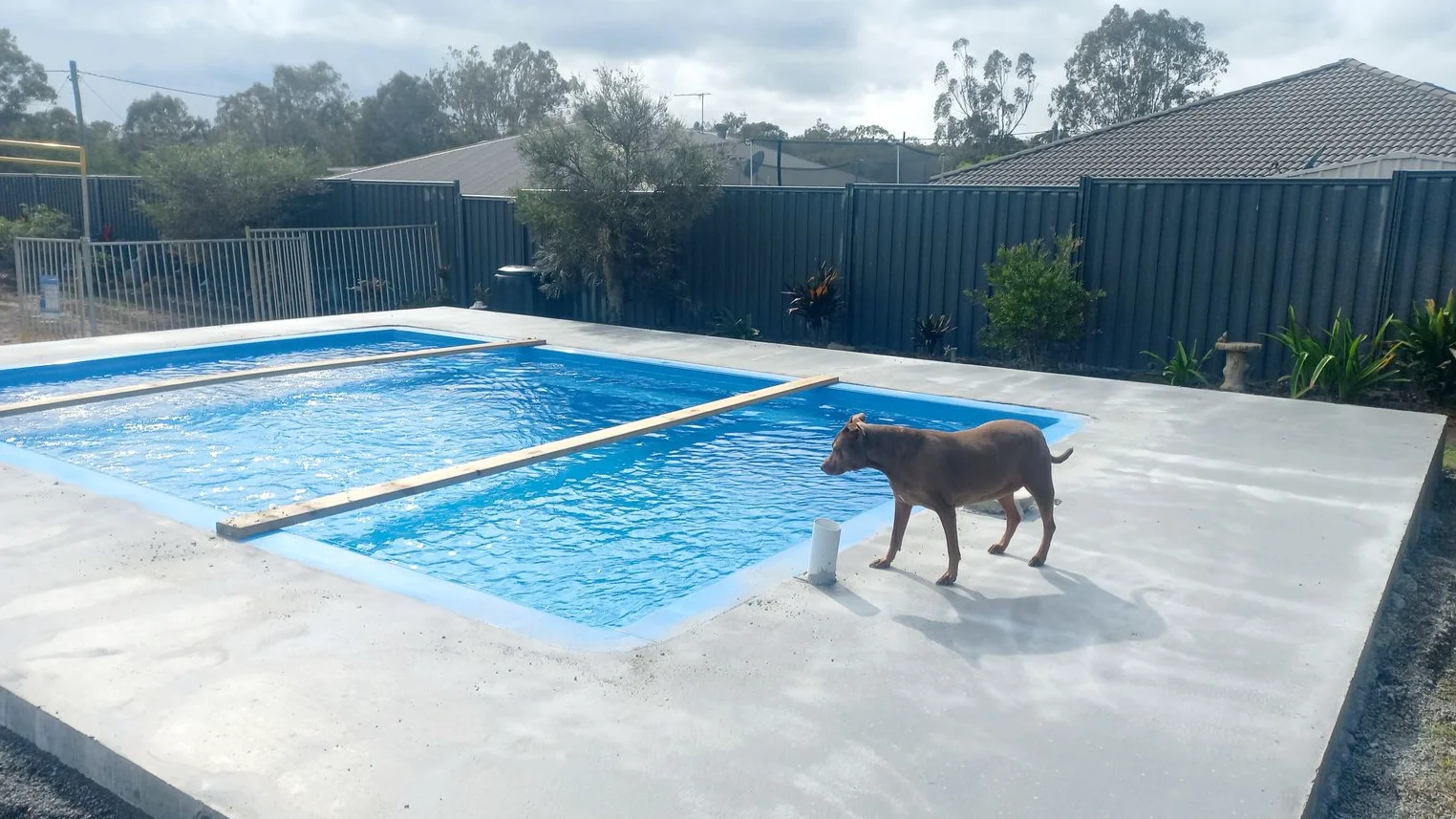
Direct answer
Dogs can use fibreglass pools. Safety depends on the pool shell, exit, water conditions, and the dog.
A fibreglass pool, called a fiberglass pool in the United States, is a moulded shell installed in the ground. Its outer surface is gelcoat. Choose an entry that allows the dog to walk out without assistance.
Can a dog swim in a fibreglass pool?
Yes. A dog can swim in a fibreglass pool when:
- The water is balanced and free of algae.
- The dog can swim safely.
- The dog can reach and use the pool exit without assistance from any part of the pool.
A dog’s claws do not cut or tear the gelcoat surface.
Do not allow a dog to swim in these situations:
| Situation | Why it matters | What to do instead |
|---|---|---|
| The water is unbalanced or contains algae | The water is not safe for the dog | Balance the water and remove the algae. Wait until the water is clear before allowing the dog to swim |
| The dog cannot swim safely | Breed, body shape, and age can affect swimming ability. Weak swimmers can tire quickly when they cannot stand in the water | Use a dog life jacket. Enter the pool with the dog and keep it near the shallow step |
| The dog drinks the pool water | Treated pool water is not suitable for drinking | Place a full bowl of fresh water at the pool edge and direct the dog to it before swimming |
| The dog is elderly, unwell, or recovering | Swimming requires physical effort. A vet should determine whether the dog can swim safely | Keep the dog out of the pool and consult a vet before the next swim |
MFP Easy builds and installs fibreglass pools across South East Queensland. Service areas include Brisbane, Gold Coast, Ipswich, Logan, Moreton Bay, Noosa, Redlands, Sunshine Coast, Lockyer Valley, and Somerset council areas.
We install more than 250 fibreglass pools each year. In Brisbane, pool water is suitable for swimming for about eight months of the year, or 12 months with a heat pump.
Will a dog's claws scratch a fibreglass pool?
A dog's claws make contact with the gelcoat. Gelcoat is the non-porous, pigmented outer surface of the fibreglass shell. It is designed for contact with swimmers, dogs, and pool tools.
Wear is most likely on exit steps, where swimmers and dogs push off, and along the waterline.
A fibreglass pool shell is manufactured as one finished piece. The surface is cured in the factory. The shell is then delivered and craned into a pre-excavated hole. Australian shells have moulded non-slip steps and floors without sharp edges. The grip texture is part of the shell.
A vinyl liner is a replaceable sheet fitted over the pool walls and floor. A dog's claw can puncture or tear it. A fibreglass pool has no liner. Its interior surface is gelcoat.
| Pool interior | What claws contact | What wears | What is replaceable |
|---|---|---|---|
| Fibreglass shell | Gelcoat, the moulded pigmented outer surface of the shell | The gelcoat itself, showing first at the exit step and along the waterline on a hard-used pool | Nothing: the gelcoat is the shell's own moulded surface, so there is no liner to replace |
| Vinyl liner | A replaceable vinyl sheet fitted over the pool walls and floor | The sheet, which can be punctured or torn | The liner: a failed sheet comes out and a new one goes in |
| Concrete pool | An interior finish applied on site, which can be textured | The applied finish | No liner here either: the finish is applied on site rather than moulded into a shell |
How does a fibreglass pool compare to a hard-plastic or metal dog pool?
A hard-plastic dog pool holds 250 to 700 litres. You fill and empty it manually. A fibreglass pool holds thousands of litres and uses a pump, filter, and sanitiser.
A hard-plastic dog pool is a moulded polyethylene trough. It has a reinforced top edge and a drain bung in the base. Its open sides allow a dog to enter from any direction.
This type of pool is suitable for one dog that needs to cool down. It does not require construction. You can fill it from a tap or rainwater tank, drain it, and move it into the shade. It is available from retail suppliers.
A hard-plastic dog pool is the smallest above-ground option. The differences between an above-ground pool from an inground pool apply in four areas:
- Depth. A 250 to 700 litre hard-plastic pool allows a dog to stand in the water but is not deep enough for swimming. The dog's feet remain on the base.
- Swimming. A dog needs enough depth to lift off the bottom and enough length to move through the water. A fibreglass pool provides both. A hard-plastic pool does not.
- Water treatment. A hard-plastic pool does not have a filter or sanitiser. You must empty and replace the water. A fibreglass pool uses a pump, filter, and sanitiser to maintain the water between uses.
- Longevity. A hard-plastic pool is portable and can be replaced when required. A fibreglass pool is a permanent structure installed in the ground.
A hard-plastic dog pool is a retail product. A fibreglass pool requires installation, and the price includes construction.
| Pool size | Length | Depth | Installed from |
|---|---|---|---|
| 3m to 4m | 1.45m level | $45,896 | |
| 4m to 5.5m | 1.0m to 1.78m | $45,660 | |
| 6m to 7m | 1.0m to 1.88m | $54,454 | |
| 7.2m to 8m | 0.98m to 1.96m | $60,385 | |
| 8.5m to 11m | 1.0m to 2.0m | $72,546 |
Live all-inclusive installed pricing for standard site conditions in South East Queensland — updated straight from our quoting system.
Your quote confirms site-dependent costs after measurement. Yard size determines whether a pool will fit. In a small backyard, shell selection is the main consideration.
Purpose-built fibreglass dog pools are also available. Options can include entry and exit ramps, custom sizes, and custom colours. These pools are intended for dog daycare centres, dog parks, and groomers. For domestic use, the main options are a hard-plastic dog pool or an inground fibreglass pool.
Is salt, chlorine or mineral water better for a dog?
None of these systems is better for a dog if the free chlorine level is the same. The main differences are water salinity and how the system adds chlorine.
A salt chlorinator uses electrolysis to convert dissolved salt into chlorine. A salt pool is therefore a chlorine pool.
A mineral chlorinator uses the same process with a blend that includes magnesium and potassium. A mineral pool contains chlorine, salt and dissolved minerals.
All three systems use sanitiser to kill contaminants from swimmers and dogs. They also use the pool chemicals that keep the water balanced to maintain pH and alkalinity. Balanced water has a pH of 7.2 to 7.6 and free chlorine between 1 and 3 mg/L. For dogs, maintaining these levels is more important than the system used to add or produce chlorine.
| Sanitiser | What is actually in the water | What the dog experiences | After the swim |
|---|---|---|---|
| Chlorine, dosed by hand | Chlorine added directly as liquid, granules or tablets, held at 1 to 3 mg/L free chlorine | Free chlorine at the operating level, with no added salinity | Rinse with fresh water, dry the ears |
| Salt, via a salt chlorinator | Dissolved salt, electrolysed by the chlorinator into chlorine at the same 1 to 3 mg/L operating level | The same free chlorine level, in mildly salty water | Rinse with fresh water, dry the ears |
| Mineral, via a mineral chlorinator | Dissolved salt plus magnesium and potassium, electrolysed into chlorine at the same operating level | The same free chlorine level, in water carrying the added minerals | Rinse with fresh water, dry the ears |
After swimming, rinse the dog with fresh water and dry its ears. Follow this process for all three systems. Rinsing removes treated water and other material from the coat.
Choose the sanitiser system during the quote process. The options are chlorine dosed by hand, a salt chlorinator or a mineral chlorinator. If the household has a dog, include this requirement when selecting the system.
What does a swimming dog do to the pool filter?
A swimming dog adds hair, dirt, and organic matter to the pool water. The filtration system removes this material. Hair usually collects in the skimmer and pump baskets before it reaches the filter.
Domestic pools typically use one of two filter types:
- Sand or media filters, which require backwashing.
- Cartridge filters, which require hosing and provide finer filtration than sand filters.
After a dog swims:
- Skim the surface and empty both baskets. Use a net to remove floating hair. Empty the skimmer and pump baskets. Full baskets restrict water flow and reduce filtration performance.
- Test and rebalance the water. Dirt, grass, and organic matter can increase phosphate levels. Test the water and adjust the pH to between 7.2 and 7.6. Treat phosphates if the test shows that levels are increasing. Balanced water helps the sanitiser process the additional load.
- Clean the filter. For a cartridge filter, hose the element until the water from the pleats runs clear. For a sand or media filter, backwash until the sight glass runs clear. Clean the filter when needed rather than following the normal schedule.
- Shock the pool if the water is dull or the swimming load was heavy. Add the shock treatment and run the filtration system. Keep people and dogs out of the pool until the water is clear and free chlorine is within the 1 to 3 mg/L operating range.
Swimming dogs do not normally damage the filtration system. However, baskets and filters require more frequent cleaning.
Which design features make a fibreglass pool dog-friendly?
The following features can make a fibreglass pool more suitable for a dog:
- Beach entry
- Wide first step
- Bench or swimout at the shallow end
- Suitable coping
- Pool ramp
The beach entry, first step, and bench or swimout are moulded into the pool shell. Coping is selected during construction. These features must be selected before installation. A pool ramp can be added after installation.
A beach entry is also called a zero entry or walk-in entry. It is a shallow shelf that slopes into the water at the shallow end of the pool. A dog can use the slope to enter and exit the pool without climbing a step.
A wide first step gives a dog space to stand and push off. A bench or swimout at the shallow end gives a tired dog a place to stand and rest in the water.
A dog's claws have the most contact with the shell at the first step because the dog uses this step to exit. The first step has a moulded non-skid surface that forms part of the shell.
Dogs cross the coping and paving when entering and leaving the pool. These surfaces can become too hot for their paws. To test the coping, place the back of your hand flat on the surface for seven seconds. If you cannot keep your hand there, the surface is too hot for a dog.
| Feature | What it solves for the dog | Specified at build or retrofitted |
|---|---|---|
| Beach entry (zero entry, walk-in entry) | Lets the dog walk in and out on a slope with no step to climb | Specified at build: the slope is moulded into the shell |
| Wide first step | Gives the dog a landing big enough to stand on and push off from when climbing out | Specified at build |
| Bench or swimout at the shallow end | Gives a tiring dog somewhere to stand and rest without leaving the water | Specified at build |
| Pool ramp | Gives the dog a climbable exit in a pool with no beach entry and no reachable step | Retrofitted to a pool already in the ground |
| Coping choice | Decides how hot the surface is that the dog crosses to reach the water | Specified at build |
The mould determines the pool's entry geometry. Select the beach entry, first-step width, and bench or swimout before ordering the shell. For an installed pool, add a ramp if the dog cannot reach or climb the existing step. A ramp can also help an ageing dog that can no longer use the step.
FAQs
Is it sanitary for a dog to swim in a pool?
Yes. A properly filtered, sanitised, and balanced pool is safe for a dog. The skimmer and filter remove hair and debris. The sanitiser treats contaminants in the water.
Do not allow a dog to swim if it is unwell, has an open wound, or has recently received treatment for fleas or a skin condition. Wait until the condition has cleared.
Do you need to rinse chlorine off a dog after swimming?
Yes. After each swim:
- Rinse the dog with fresh water to remove treated water and debris from its coat.
- Dry the dog’s ears to remove trapped water.
Use this routine for chlorine, salt, and mineral pools. All three maintain the same operating chlorine level.
Is pool shock toxic to dogs?
Keep dogs out of a freshly shocked pool. Test the water before allowing a dog near the pool. Wait until the water is clear and the free chlorine level is within the normal operating range of 1 to 3 mg/L. Do not determine safety based only on the time since treatment.
How long can a dog stay in the pool?
There is no fixed time limit. Remove the dog when it shows signs of fatigue, such as riding lower in the water or paddling less effectively. Ensure the dog can reach and use an exit from anywhere in the pool. If the dog cannot exit without assistance, remove it immediately.
What is the seven-second rule for dogs?
Use the seven-second rule to check whether a surface is too hot for a dog's paws:
- Place the back of your hand flat on the pool coping or surrounding paving.
- Hold it there for seven seconds.
- If you cannot keep your hand on the surface, do not let the dog cross it.
During a Queensland summer, let the dog swim early in the morning or after the sun is no longer on the paving.
Does a dog change Queensland's pool fencing or safety certificate requirements?
No. Queensland's pool safety standard (QDC MP 3.4) requires a barrier at least 1,200 mm high and gates that are self-closing and self-latching. These requirements apply whether or not you have a dog.
If a dog can open or push through a gate, repair or replace the gate hardware. A dog using the pool does not affect the pool safety certificate (Form 23).