Pool Filters for Fibreglass Pools: Types, Sizing & Care
Cartridge vs media filters on a fibreglass pool: how each cleans the water, what size suits your shell's litres, and the cleaning routine.
Written by Tehbyn Nova, Head of Operations & Growth · Technically reviewed by Caleb Druhan, General Manager (QBCC licence 15087383) on
Published · Updated
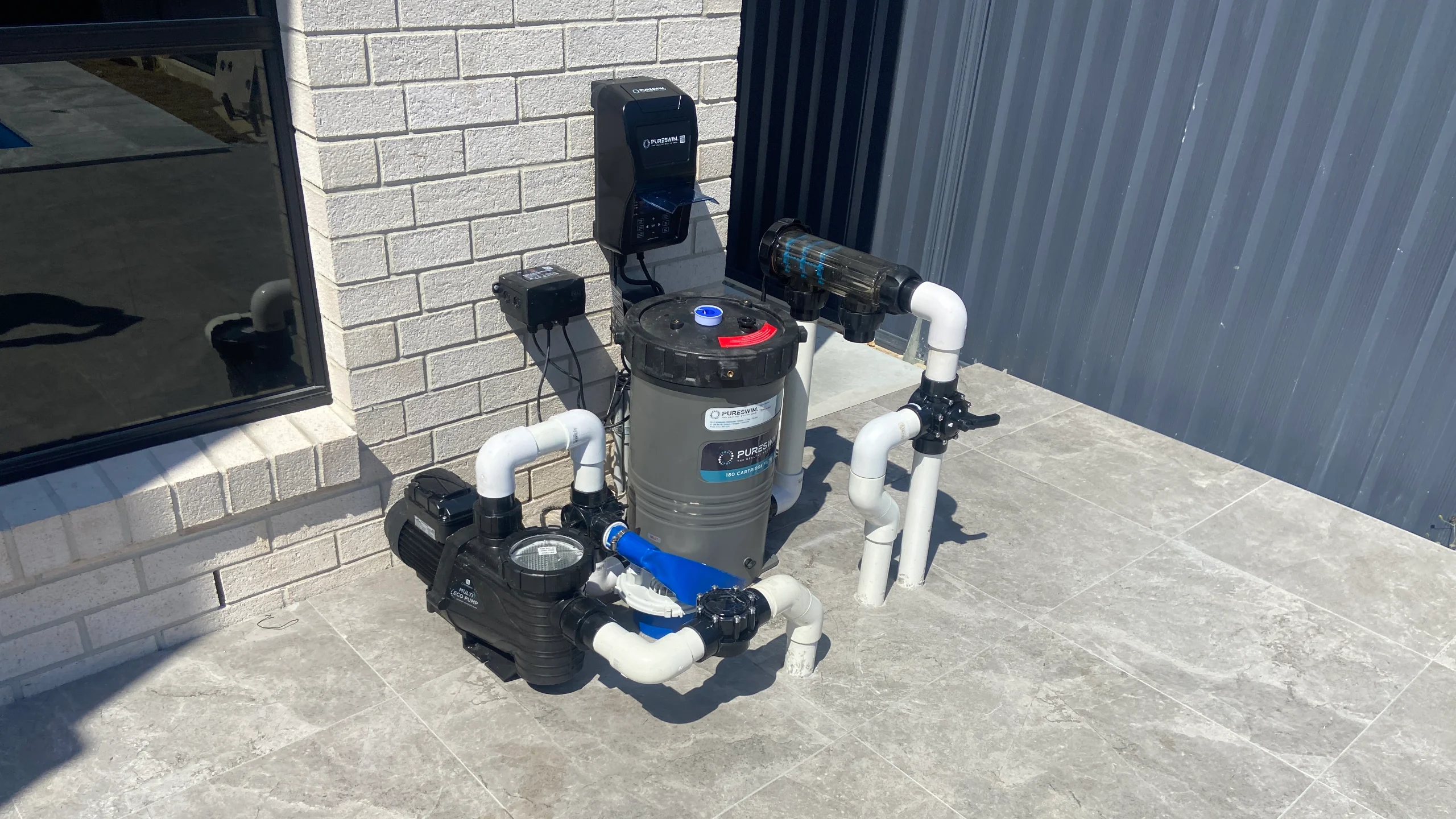
Domestic fibreglass pools in Australia generally use one of two filter types:
- Cartridge filters: A tank containing a pleated filter element.
- Media filters: A larger tank containing sand or glass filter media.
Both types are suitable for fibreglass pools. They differ in cleaning method, cleaning time, and replacement requirements.
What does the filter do on a fibreglass pool?
The filter removes suspended particles from the pool water. The pump moves water through the filtration system in this sequence:
- Skimmer. The skimmer draws surface water into the system. Its basket catches leaves and larger debris.
- Pump. The pump pulls water through its basket and moves it through the system under pressure.
- Filter. The filter traps fine particles that pass through the skimmer and pump baskets.
- Return. The filtered water returns to the pool through the return fittings.
A fibreglass pool has a smooth, non-porous gelcoat surface. Particles that the filter does not remove remain visible in the water. A concrete pool has a porous interior surface that can retain some particles. Filtration and water balance are therefore important for maintaining clear water in a fibreglass pool.
Which filter type suits a fibreglass pool — sand, glass media or cartridge?
Media and cartridge filters are both suitable for fibreglass pools. They require different cleaning methods. A media filter is cleaned by backwashing. This reverses the flow through the tank and sends dirty water to waste. A cartridge filter cannot be backwashed. The cartridge element must be removed and cleaned by hand.
A media filter tank is often made from fibreglass. The tank is separate from the fibreglass pool shell.
| Cartridge filter | Sand media filter | Glass media filter | |
|---|---|---|---|
| How it is cleaned | Hosed by hand; cannot be backwashed | Backwashed | Backwashed |
| Particle size trapped | About 10–20 microns (Zodiac) | About 20–40 microns (Zodiac) | Not established |
| Cleaning time per clean | 10–30 minutes (Mr Pool Man) | About 2–3 minutes (Mr Pool Man) | About 2–3 minutes (Mr Pool Man) |
| Water used per clean | 200–300 litres of hose water (Mr Pool Man) | Not established | Not established |
| Media or element replacement | Element every 18 months (Poolwerx) to 3–5 years (Zodiac) | Five-year cycle, declining after three or four years (Poolwerx, Mr Pool Man) | Not established |
We fit a PureSwim 180 sq ft cartridge filter as the standard filter across our filtration packages. According to Mr Pool Man, removing and hosing a cartridge element takes 10–30 minutes and uses 200–300 litres of hose water. Backwashing a media filter takes about 2–3 minutes and uses water from the pool.
Sand and glass can be used in the same type of media filter tank. Sand becomes less coarse with use, which reduces filtration performance. It must therefore be replaced periodically as well as cleaned. Available information does not establish how glass media ages.
Glass media is claimed to filter finer particles than sand. However, an equivalent micron figure for glass media is not established. Zodiac gives a range of 10–20 microns for cartridge filters and 20–40 microns for sand filters.
A cartridge filter may be suitable when finer filtration is more important than cleaning time. Zodiac states that cartridge filters perform better at low flow rates. A media filter tank is typically 60–80 cm in diameter, according to Mr Pool Man.
What size filter does a fibreglass pool need?
A pool filter must match the pool’s water volume and pump. There is no standard rule for converting the volume of an Australian fibreglass pool in litres to a filter size. Pool filter product pages list filters by model, not by pool volume.
Our fibreglass pool shells hold between 3,800 and 52,780 litres. The filter and pump are selected for the specific shell volume. Each fibreglass pool size has a different water volume:
| Model | Length × width | Volume |
|---|---|---|
| Bastia (Spa) | 3.20 m × 2.00 m | 3,800 L |
| Allure | 5.00 m × 2.50 m | 12,800 L |
| Bellagio | 7.50 m × 2.50 m | 19,500 L |
| Avellino | 6.00 m × 4.00 m | 27,040 L |
| Bedarra | 7.50 m × 3.80 m | 30,500 L |
| Amalfi | 9.00 m × 3.60 m | 30,600 L |
| Westminster | 9.00 m × 4.00 m | 39,490 L |
| Kensington | 11.00 m × 4.00 m | 51,700 L |
| Saint Azur | 11.48 m × 4.00 m | 52,780 L |
A 50,000-litre pool sits at the top of our range: the 11.00 m Kensington holds 51,700 litres and the 11.48 m Saint Azur holds 52,780 litres.
Filtration is included in the installation quote rather than purchased separately. The quote confirms the filter size and pump after you select the shell and the site is assessed.
How many hours a day should the filter run?
Run the pump long enough each day to circulate the pool’s full water volume through the filter. Set the run time on the pool pump, not the filter.
The required time depends on the pool volume and the pump flow rate. A variable-speed pump can circulate the same volume at a lower speed over a longer period or at a higher speed over a shorter period. There is no single recommended number of hours for every pool.
How do you clean or backwash a pool filter, and how often?
Media filters are cleaned by backwashing. Cartridge filters are cleaned by removing and hosing the filter element. Each filter type has a different cleaning trigger.
Backwash a media filter. Zodiac recommends backwashing when the pressure gauge reads about 8–10 PSI above the clean-filter baseline.
- Turn off the pump before moving the valve.
- Set the valve to backwash.
- Run the pump for about 2–3 minutes, according to Mr Pool Man, or until the waste water runs clear.
- Turn off the pump.
- Return the valve to the filter setting and restart the pump.
- Record the pressure gauge reading. This is the clean-filter baseline for measuring the next 8–10 PSI increase.
- Top up the pool water to replace the water discharged during backwashing.
Clean a cartridge filter. Published cleaning intervals vary. Zodiac recommends hosing the cartridge every 2–3 weeks. Poolwerx recommends cleaning it at least once every one to three months.
- Turn off the pump.
- Open the filter tank and remove the cartridge.
- Hose between the pleats. According to Mr Pool Man, this takes 10–30 minutes and uses 200–300 litres of water.
- Soak the cartridge in filter cleaner about every three months, as recommended by Zodiac.
- Do not use a high-pressure cleaner or brush. Zodiac states that both can damage the cartridge. Use a hose followed by a chemical soak.
- Refit the cartridge, close the tank and restart the pump.
Cartridge cleaning and media-filter backwashing use water differently. This is relevant in South East Queensland, where Seqwater's drought response plan considers water restrictions when combined Water Grid dam storage falls to 50%.
Hosing a cartridge uses 200–300 litres of tap water per clean, according to Mr Pool Man. Backwashing discharges pool water for 2–3 minutes, after which the pool must be topped up. The volume discharged during backwashing is not established, so a direct comparison is not possible.
When does the media or cartridge need replacing, and what does that cost?
Filter media and cartridge elements require periodic replacement. The filter tank does not.
The filter fitted across our filtration packages is the PureSwim Cartridge Filter (180 sq ft). It appears on a customer quote at $883.68, GST inclusive, as at 16 August 2026.
The cartridge filter fitted to our 2026 filtration packages is the PureSwim Cartridge Filter (180 sq ft), which appears on a customer quote at $883.68 (GST inclusive, as at 15 August 2026).
| Consumable | Published replacement interval | Source |
|---|---|---|
| Sand media | Five-year cycle, with filtration declining after three or four years | Poolwerx, Mr Pool Man |
| Glass media | Not established | |
| Cartridge element | Every 18 months | Poolwerx |
| Cartridge element | Every 3–5 years | Zodiac |
Sand media wears down with use. As the grains lose coarseness, filtration performance declines. After several years, old sand may filter less effectively than new sand, even after backwashing.
Published replacement intervals for cartridge elements vary. Poolwerx specifies 18 months, while Zodiac specifies three to five years. This difference can affect whether a cartridge or media filter costs less over 10 years. When comparing total costs, treat cartridge life as a variable. Zodiac recommends replacing a cartridge if it has broken bands, cracked end caps, or torn pleats.
Replacement costs vary by product and filter size. For sand and glass media, the cost also depends on the amount of media the tank requires.
What are the signs a pool filter is not doing its job?
Three symptoms can indicate a filter problem rather than a water chemistry problem.
- Cloudy water with balanced chemistry. If the water remains cloudy while the sanitiser and pH are at the correct levels, the filter may not be removing fine particles. Compare the pressure gauge reading with the clean baseline. For a media filter, Zodiac recommends backwashing when the pressure is 8–10 PSI above the baseline.
- Pressure remains above the clean baseline after cleaning. If the pressure does not return to the baseline after backwashing or rinsing with a hose, the filter media or element may need replacement. Check its age against the recommended replacement interval.
- Weak flow at the returns. Low flow from the return fittings can indicate a restriction in the system. Check the skimmer basket, pump basket, and filter pressure. A suction cleaner sends debris to the pump basket and filter, which can cause both to fill faster. A robotic cleaner uses its own motor and filter.
FAQs
Are pool filters fibreglass?
Media filter tanks are commonly made of fibreglass. They are pressure vessels, typically 60–80 cm in diameter (Mr Pool Man). The filter housing is separate from the pool shell, even when both are made of fibreglass.
What is the best type of pool filter for an inground pool?
Both filter types work for inground pools. Choose based on filtration level and cleaning time.
- Cartridge filters capture particles of about 10–20 microns. Manual cleaning takes about 10–30 minutes.
- Sand media filters capture particles of about 20–40 microns. Backwashing takes about 2–3 minutes.
These figures are from Zodiac and Mr Pool Man.
What size sand filter do I need for a 50,000 litre pool?
There is no standard rule for matching pool volume to sand filter size for Australian fibreglass pools. Sand filters are sold by model and must be selected to work with the pool pump.
A 50,000 litre pool sits at the top of our range: the Kensington holds 51,700 litres and the Saint Azur holds 52,780 litres. Both are fitted with a filter and pump selected for that volume as part of the build.
Which is better, a sand filter or a cartridge filter for a swimming pool?
The better option depends on your requirements.
- Sand filter: Takes about 2–3 minutes to clean by backwashing. Backwashing uses pool water, but the number of litres sent to waste is not established. It filters particles of about 20–40 microns (Zodiac).
- Cartridge filter: Filters finer particles of about 10–20 microns and performs better at slow flow rates. Cleaning takes 10–30 minutes and uses 200–300 litres of hose water.
How do I know what size filter I need for my inground pool?
Choose the filter size based on the pool volume in litres and the pump flow rate. Determine the pool volume first. A 5.00 m × 2.50 m shell holds 12,800 litres, while a 9.00 m × 3.60 m shell holds 30,600 litres. Specify the filter and pump together.