Pool Equipment Siting: Placement, Covers & Enclosures
Where the pump, filter and chlorinator sit on a fibreglass pool build, how far they can be from the water, and how to cover them safely.
Written by Tehbyn Nova, Head of Operations & Growth · Technically reviewed by Caleb Druhan, General Manager (QBCC licence 15087383) on
Published · Updated
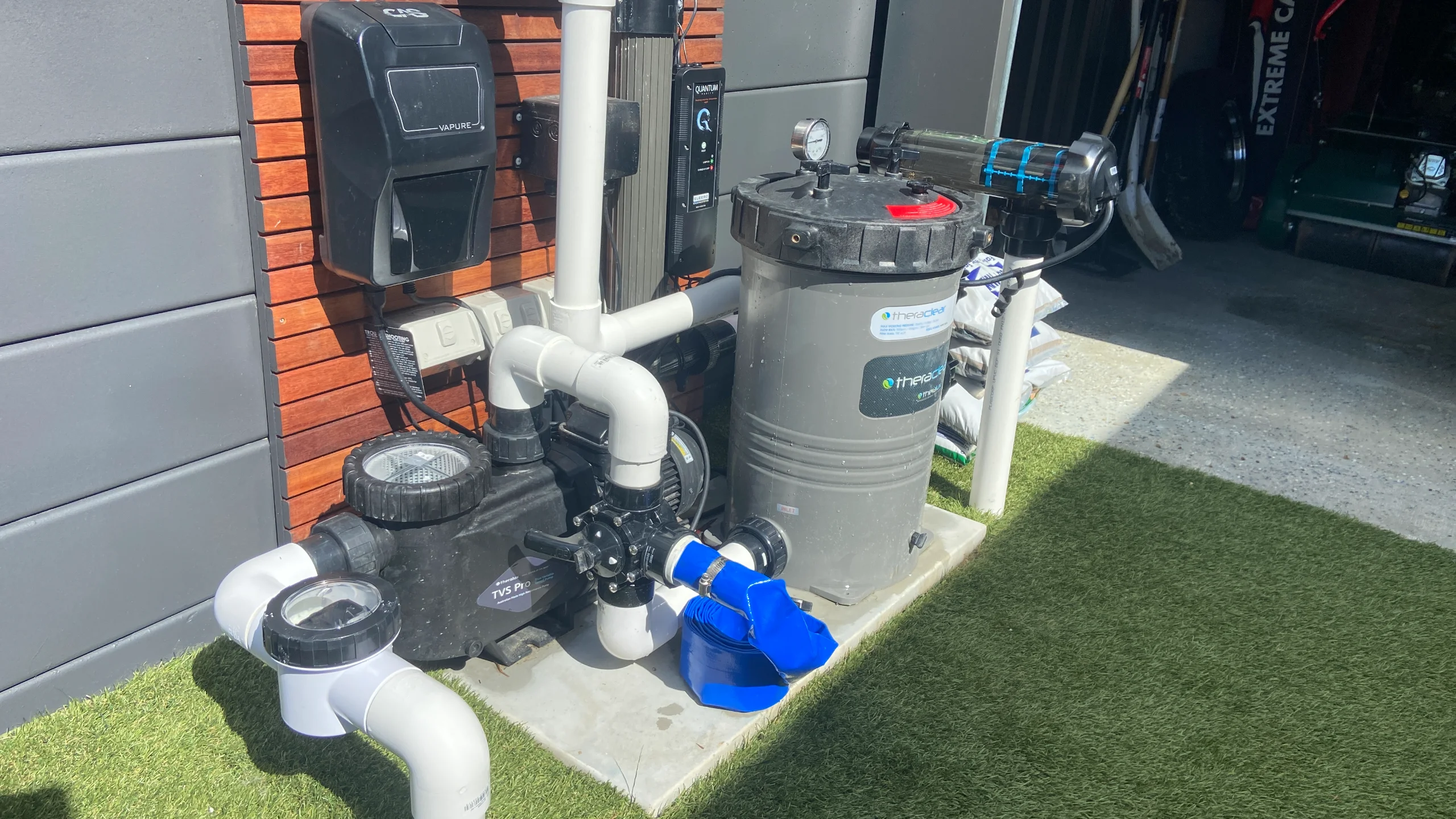
Where does the equipment go on a fibreglass pool build?
The pool pump, filter, and chlorinator are installed together on a level equipment pad set back from the fibreglass pool. Two buried pipes connect the pad to the pool. An electrical conduit connects the equipment to the switchboard.
The equipment pad location, plumbing routes, and electrical conduit route are set before the pool is backfilled and the surrounds are installed. The location depends on four requirements:
- Plumbing run length back to the pool. A suction line and return line connect the equipment pad to the pool. Both lines are buried before backfilling, so their routes and lengths must be set while the pool is being installed. The pipes can be extended to reach another pad location, provided the pump can still pull water through the suction line.
- Power and conduit access. The pool pump, chlorinator, and any heat pump use a circuit connected to the switchboard through buried conduit. The conduit is installed during the same trenching work as the pipes. A pad farther from the switchboard requires a longer trench, which may cross areas that will be paved or turfed. A location near the switchboard generally requires less trenching.
- Drainage away from the pad. Rainwater and hose water must drain away from the equipment pad. The pad must be high enough and have sufficient fall to prevent water from collecting around the pump and filter. Do not place the pad in a low area that receives runoff from the yard.
- Clearance to service and swap gear. The filter is usually the largest item on the pad. Mr Pool Man typically installs media filter tanks with a diameter of 60 to 80 cm. This is an indicative footprint, not a specification for every tank. Technicians need enough space to service the pump, filter, and chlorinator and to remove and replace failed equipment. The pad must provide standing and working space around each unit.
How far from the pool can the equipment sit?
Pool equipment can be installed as far from the pool as the pump can pull water through the suction line. There is no fixed maximum distance. Longer pipes and additional bends increase head loss. Pool pumps for a fibreglass pool are sized based on the pipe run and the required water turnover.
If the pipe run creates more head loss than the pump can handle, increase the pipe diameter or use a larger pump. A larger pipe diameter reduces resistance at the same flow rate.
The available distance depends on:
- Pipe diameter
- Number of bends
- Pump specification
We confirm the pipe run from the equipment pad to the pool on site when we set the pool.
Do not place the equipment pad in the splash zone. Salt water and salt residue can corrode metal fittings and equipment. The fibreglass shell is not affected. On a salt-chlorinated pool, metal fittings near the water typically corrode before the shell shows any effect. Setting the pad back behind the coping reduces exposure.
Equipment against the house. Pool equipment can be installed against a house wall. Check which room is on the other side. A pump mounted next to a bedroom or study can transmit motor noise and vibration into the room. A garage, laundry, or hallway wall is usually less disruptive. The pad must also fall away from the building so drainage does not run toward the house.
Equipment near the boundary. Equipment near a fence line can increase pump noise for neighbours. It must also remain clear of the pool fence. A filter tank, pump shed, or enclosure lid can become a climbable object if placed beside the barrier.
Does a pool pump need to be covered or enclosed?
A pool pump does not generally need a cover or enclosure. Suppliers state that covers protect equipment from weather and may extend its service life. They do not cite an Australian regulation that requires a cover. These are supplier claims, not independent findings. Pumps, filters, and chlorinators are commonly installed outdoors on well-drained pads.
If you use an enclosure, provide enough internal space and airflow.
Size the enclosure based on its internal dimensions. Aluminium Screening recommends at least 100 mm of additional width and 50 mm of additional depth and height beyond the equipment dimensions. Its internal dimensions are about 50 mm smaller than the stated external dimensions. Daisy Pool Covers offers backless enclosures for equipment installed within 50 mm of a wall. Removing the rear panel provides 50 mm of additional usable depth.
A pump motor generates heat during operation. A sealed enclosure retains this heat and increases the motor temperature. Enclosure suppliers do not specify a required ventilation area. Keep the enclosure ventilated and do not block the motor’s air intake.
In Queensland, electrical work on pool pumps and pool lights must be performed by a licensed electrician. The electrician terminates the equipment. The enclosure should allow access to the wiring and isolator without requiring removal. Restricted access increases the time needed for installation and servicing.
What enclosure options are there — box, shed, screen or planting?
There are four common options for a pool equipment pad:
- Custom aluminium slat enclosure
- Off-the-shelf steel pump shed
- Open screen or batten panel
- Planting
Compare the options based on ventilation, noise reduction, service access, and price.
| Option | Ventilation | Noise | Service access | Typical price |
|---|---|---|---|---|
| Aluminium slat enclosure | Gaps between the slats ventilate each wall | Little reduction because sound passes through the gaps | Depends on the clearances specified for the custom enclosure | About $1,855 for roughly 1500 × 1400 × 1100 mm |
| Steel pump shed | Airflow is limited to the supplied vents | Solid panels provide some reduction, but the shed is not an acoustic enclosure | Hinged roof and front door provide access from above and the front | About $757 to $857, depending on finish |
| Open screen or batten panel | Unrestricted because the equipment remains in open air | None; the panel only screens the equipment from view | Full because the panel does not surround the equipment | No set price |
| Planting | Unrestricted | None | Full if plants are kept clear of the pad | No set price |
Aluminium screening suppliers price an enclosure about 1500 mm wide, 1400 mm high, and 1100 mm deep at about $1,855. This is roughly $271 per square metre of slat wall. The price depends on the enclosure wall area. A taller enclosure costs more than a lower enclosure with the same footprint.
Absco lists a steel pool-pump shed about 1.52 m wide, 1.52 m deep, and 1.49 m high for about $757 to $857, depending on the finish. It includes a hinged roof and a front door.
Open screens and planting do not have set prices. The cost of a batten panel depends on its size and materials. The cost of planting depends on the selected plants.
You can also build a timber or fibre-cement box. Make it large enough to maintain the required clearances, provide ventilation, and allow access to the wiring without removing the box.
How do you quieten pool equipment?
Use these measures, in order of expected noise reduction:
- Run a variable-speed pump at lower RPM. A pump produces less noise at lower speeds. To maintain turnover, run the pump longer at a lower speed instead of running it briefly at full speed. Variable-speed pumps cost more than single-speed pumps but cost less to operate at reduced speeds.
- Isolate the mounts and the pad. Pumps fixed directly to a slab or house wall can transmit vibration into the structure. This vibration may be heard indoors as a hum. Install the pump on a separate pad that does not contact the house wall. Isolation costs little during the site-set stage. Retrofitting requires the equipment to be fixed again.
- Add an acoustic enclosure last. Daisy Pool Covers claims that its steel acoustic pump enclosure reduces equipment noise by up to 80 per cent. The manufacturer does not publish an independent baseline for this figure. The enclosure requires 45 mm of clearance above it so the lid can open. It also requires a slab that extends 10 to 20 mm beyond the enclosure on every side. The enclosure adds to the installation cost and does not reduce pump operating costs. Keep the motor’s airflow clear of the acoustic lining.
What has to be decided before the pool goes in, and what can change later?
Four items must be completed before the pool is backfilled. Other items can be added later. During the site-set stage of a fibreglass pool installation, we set the equipment pad position, plumbing runs, and electrical conduit. Backfill closes the trenches, and the surrounds cover them.
Fixed at the site-set stage:
- The pad position. Moving the pad after backfill requires new suction and return plumbing and new conduit trenches. If the surrounds are already installed, paving must also be lifted.
- The plumbing route and pipe size. The suction and return lines are buried under the backfill and surrounds. Changing the route or increasing the pipe diameter requires reopening the ground.
- The electrical conduit and power. The conduit is installed from the switchboard during the same works as the pipes. Adding a circuit later requires work across finished ground.
Changeable after installation:
- The enclosure. It can be bought or built to fit the installed equipment.
- Screening and batten panels. These stand away from the pad and do not connect to the equipment.
- Planting. Plants must be kept clear of the pad.
- Mount isolation and acoustic treatment. These can be installed without changing the pipework.
These later changes do not require the ground to be reopened. The enclosure can be added later, but the pad position must be decided before backfilling.
FAQs
Can pool equipment be next to the house?
Yes. Before placing an equipment pad next to the house, check the room on the other side of the wall and the ground slope. Do not place a pump against a bedroom wall or attach it directly to the house. Both setups can transfer noise and vibration into the house. Ensure the ground slopes away from the building.
What ruins a pool pump?
Pump-enclosure sellers identify three causes of pump damage: weather exposure, a restricted suction line, and a blocked strainer basket. Absco cites weather exposure as a reason to cover the pump. These sources also sell pump covers, so they are not independent. The other two causes relate to plumbing and maintenance. A restricted suction line limits water flow to the pump. A blocked strainer basket can have the same effect.
Is it okay to run a pool filter with a cover on?
Yes. Use a ventilated cover and keep the pump motor’s air intake clear. The filter tank does not have a motor, but the adjacent pump motor generates heat while running. Enclosure manufacturers do not specify the ventilation area required for an enclosed pump.
Can you leave a pool filter out in the rain?
Yes. Pool filters, pumps, and chlorinators are designed for outdoor installation on an equipment pad. Covers can provide additional protection from weather, but no cited Australian regulation requires one. The equipment pad must drain properly so rainwater and hose water do not collect beneath the pump or filter.
Can I build a pool pump enclosure myself?
Yes, if it meets the same requirements as a purchased enclosure. Make it at least 100 mm wider and 50 mm deeper and higher than the equipment. Provide ventilation and ensure the wiring and isolator remain accessible to a licensed electrician. Keep the enclosure away from the pool fence so it cannot be used for climbing.