Council Approval for a Fibreglass Pool: Process Guide
What approval a fibreglass pool needs in Queensland, who lodges it, what it costs inside the quote, how long it takes and what closes it out.
Written by Tehbyn Nova, Head of Operations & Growth · Technically reviewed by Caleb Druhan, General Manager (QBCC licence 15087383) on
Published · Updated
Direct answer
In Queensland, a fibreglass pool requires building approval. A private certifier assesses the application and issues the approval on behalf of the council. Queensland pool safety law separately applies to the barrier around the completed pool.
Do you need council approval for a fibreglass pool?
Yes. All new pools in Australia require building approval before excavation, including factory-moulded fibreglass pools.
In Queensland, pool safety laws apply to structures that can hold more than 300mm of water. Fibreglass pools must meet building approval and pool barrier requirements.
A private certifier assesses the design against building regulations and issues approval on behalf of the council. Homeowners do not need to apply directly to the council.
MFP Easy lodges the building approval as the licensed builder under QBCC Licence #15472089. This occurs after the site assessment and before excavation in the installation process. The certifier’s decision determines when excavation can legally begin.
Which approvals does a fibreglass pool actually need?
A fibreglass pool in Queensland requires four types of approval. Three apply to every installation:
- Building approval
- Plumbing approval
- Barrier compliance under the Queensland pool safety standard
Development approval is required only when a planning provision applies to the property.
| Approval | Who issues it | What it consumes |
|---|---|---|
| Building approval | A private certifier, assessing on the council's behalf | The site plan, the engineering design, and a Form 15 design compliance certificate |
| Development approval | The council, and only where a planning provision is triggered | The same site plan, assessed against the planning provision that applies to the block, such as an overland flow path |
| Plumbing approval | Licensed plumbing work, whoever manages the project | The pool's water and waste connections, signed off separately from the building approval |
| Barrier compliance | The certifier, at the final inspection | The fence, gates and non-climbable zones, assessed against Queensland's modified AS 1926-2007 and the state-wide QDC MP 3.4 |
An MFP Easy contract includes two items required for building approval:
- The council/approval fee
- The Form 15 design compliance certificate
These items appear on every quote. The contract price covers the documents assessed by the certifier. The quote confirms the amount after the property address is available.
Three Australian Standards apply to the assessment:
- AS 1838-2021 covers the design and fabrication of pre-moulded fibre-reinforced plastic pool shells.
- AS 1839-2021 covers installation, including excavation, bedding, the bond beam and backfill.
- The AS 1926 series covers pool barriers.
Queensland applies a modified AS 1926-2007 with the state-wide QDC MP 3.4. Other states apply AS 1926-2012 through the Building Code of Australia.
What rules restrict where a fibreglass pool can go on a block?
Five main restrictions affect where a fibreglass pool can be installed.
| Constraint | Typical rule | Who confirms it |
|---|---|---|
| Boundary and house setbacks | The pool and bond beam must meet the minimum distances from boundary fences and house footings specified in the approval and engineering design | The private certifier, using the site plan and engineer's design |
| Easements and sewer alignment | A pool located over or near a council sewer, stormwater or power easement requires build-over consent before approval | The council as asset owner, through a build-over-asset assessment |
| Overland flow | A block with an overland flow path must be assessed under the relevant planning provision. This may change the pool location or add approval conditions | The council, through development assessment |
| Covenants and body-corporate rules | A registered covenant or body-corporate by-law may restrict the pool location, fence type or both, regardless of council approval | The title documents, and the body corporate for a unit or townhouse |
| The barrier envelope | The pool barrier must maintain its required non-climbable zones. The fence line can therefore limit the usable pool footprint | The certifier, at the final inspection |
There is no universal setback distance. The minimum distance from a boundary fence, house footing or sewer depends on the approval and engineering requirements for the specific block. A builder cannot confirm a fixed setback without this information.
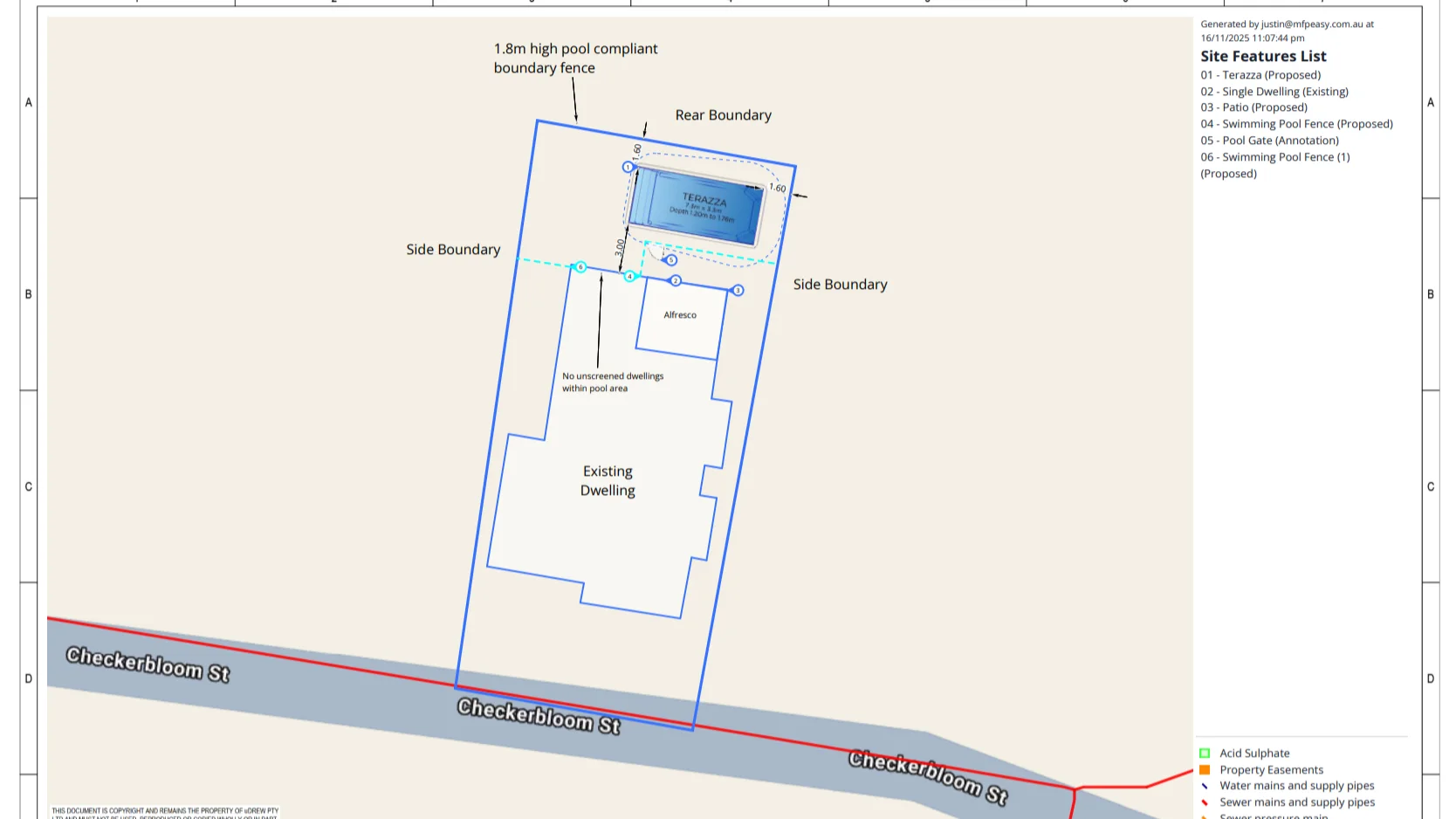
Buried services must be located before excavation. Before You Dig Australia provides free service plans. Locating buried water, sewer, power and telecommunications services before digging is a legal requirement. These setbacks and the pool site access requirements for the excavator and pool shell are shown on the same site plan.
Who lodges the pool approval, you or the installer?
MFP Easy lodges the building approval through a private certifier. This work is included in the contract.
As the licensed builder, we submit the application. The certifier assesses it. The homeowner signs the owner's consent and receives copies of all submitted documents. The owner's consent is the only approval document the homeowner signs.
We quote and lodge approvals in ten south-east Queensland council areas:
- Brisbane
- Gold Coast
- Ipswich
- Logan
- Moreton Bay
- Redlands
- Sunshine Coast
- Noosa
- Lockyer Valley
- Somerset
The quote includes an approval fee for the property address. The quote confirms the amount.
Check the exclusions when comparing pool quotes. If a quote excludes approval, the homeowner is responsible for:
- Council and approval fees
- The Form 15 design compliance certificate
- Lodgement work
- Liability for an unapproved pool
The certifier and council communicate with the party named on the approval.
The same Queensland requirements apply to owner-builders. These include building approval, engineering certification and barrier compliance. Plumbing and electrical connections must still be completed by licensed trades.
How long does pool approval take, and what delays it?
For MFP Easy jobs, the median time from signed contract to excavation is 41 days. The approval process occurs during this period.
Buildcert, a Queensland private certifier, states that its review takes 3 to 5 business days after engagement when all required documents are complete.
Norfolk Pools estimates that building approval takes about 2 weeks after engineering documents are received. This is part of an estimated 4 to 6 week paperwork process. It estimates that engineering plans take 2 to 6 weeks.
These timeframes are estimates for the builder’s and certifier’s own processes. They are not statutory limits.
The following issues can delay approval:
- Engineering not yet issued. The certifier cannot assess the design until the engineering documents are complete.
- An incomplete site plan. If the site plan does not show services, levels, boundaries, or the barrier line, the certifier may request more information before starting the assessment.
- Referral agencies. If a referral agency must be consulted, the assessment depends on that agency’s response.
- An easement discovered late. An easement identified after the site plan is complete may require changes to the pool location.
- Build-over-asset consent. If the pool is near council sewer or stormwater assets, Norfolk Pools estimates that consent can add 4 to 8 weeks or more.
- Resubmission after a condition. If a condition requires a design change, the drawings must be amended and submitted again.
What inspections and certificates finish a fibreglass pool?
A fibreglass pool requires five inspections and certificates before lawful use:
- Certifier inspections during construction. The private certifier who issued the building approval completes the inspections listed in the approval. These inspections verify that construction follows the approved plans.
- Electrical compliance certificate. A licensed electrician must complete all electrical work to AS/NZS 3000 and issue a compliance certificate. The electrical work required before sign-off includes equipotential bonding. This work must be completed before components are buried. It connects metal around the pool, including reinforcing steel in the bond beam and fixtures within 1.25m of the pool edge. Bonding is licensed electrical work.
- Plumbing sign-off. A licensed plumber must complete and approve the pool’s water and waste connections. Plumbing sign-off is separate from building approval.
- Permanent barrier inspection. The fence, gates, and non-climbable zones are inspected after the permanent barrier is installed. Temporary fencing does not satisfy this requirement.
- Final inspection. A certifier completes the final inspection after the permanent barrier is installed. The pool cannot be used lawfully until it passes this inspection. Landscaping is not required for certification.
For a sleeper build, where work pauses after shell installation, the council requires a temporary fence inspection. This inspection is not required for a continuous build. We confirm the applicable requirement with the council.
Queensland pool fence regulations specify the required barrier dimensions. The QBCC publishes these requirements.
| Barrier element | What the QBCC requires |
|---|---|
| Fence height | Minimum 1200mm, taken from the finished ground level up to the fence's top edge |
| Ground gap | The barrier's underside sits no more than 100mm above finished ground level |
| Gaps in the barrier | No hole or gap anywhere exceeds 100mm, measured in any direction; vertical elements may be spaced as much as 100mm apart |
| Non-climbable zone, outside | A continuous 900mm zone, with every object held 900mm or further clear of the fence's outer face |
| Non-climbable zone, inside | Every object held 300mm or further clear of the fence's inner face |
| The 1800mm alternative | Where no outside non-climbable zone is achievable, a fence of 1800mm or greater, with its non-climbable zone measured downward from the top on the inside face. An alternative arrangement, not a general fence height |
| Rail spacing | Rails need at least one clear gap of 900mm or wider between them |
| Gates | Gates close by themselves and latch securely with no push required, and are never propped open |
Fence pricing is based on the fence type and length:
| Installed price | 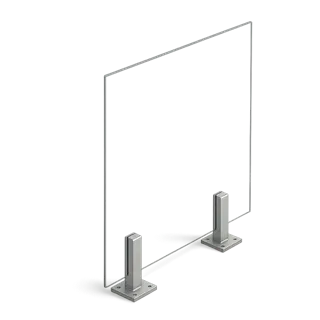 Frameless glass Frameless glass | 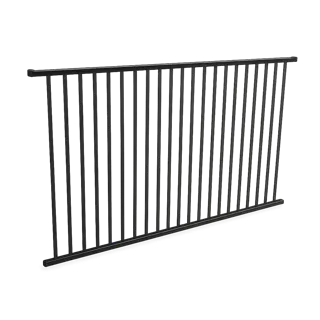 Flat-top metal Flat-top metal |
|---|---|---|
| Fencing, per metre | $462 | $198 |
| Self-closing gate, per unit | $495 | $330 |
| Panels on a retaining wall, per metre | $297 – $737 | $385 – $605 |
| Earthing (where required) | $40/m | $150 per job |
| Timber post upgrade, per metre | — | $66 |
| Typical pool: 20m fence + 1 gate | $9,735 | $4,290 |
Live rates from our quoting system — glass and metal fencing installed to QLD pool-barrier standards alongside your pool build.
Two requirements apply after completion:
- All residential pools and outdoor spas in Queensland must be registered with the QBCC.
- A pool safety certificate is required when a property is sold or leased. The certificate is valid for 2 years for a non-shared pool and 1 year for a shared pool. Owners who are not selling or leasing do not need to renew it on a fixed schedule.
What happens if a pool is built without approval?
A pool built without approval can have five consequences:
-
Council enforcement: If a council becomes aware of unapproved building work, it can issue a show-cause notice requiring the owner to explain the work. It can then issue an enforcement notice requiring the owner to make the work compliant or remove it.
-
Retrospective approval: The owner may need to obtain engineering, certification and assessment after construction. The pool remains in place while the assessment is completed.
-
Registration penalties: Queensland pools must be registered with the QBCC. The Queensland Government states that an owner may be penalised if a pool or spa is not on the register. An on-the-spot penalty may apply, with a higher penalty if the matter goes to court.
-
Insurance exposure: An unapproved pool is undeclared building work on the property. This creates insurance exposure in addition to council enforcement risk.
-
Sale or lease requirements: A sale or lease triggers the requirement for a pool safety certificate. A pool that was not approved or certified cannot provide this certificate when required by the contract.
FAQs
Do you need council approval for a pool in NSW?
Yes. New South Wales requires approval for a new pool before excavation begins. Approval requirements and assessment processes differ from those in Queensland. Consult a New South Wales certifier to confirm the applicable process.
MFP Easy lodges approvals only in the ten south-east Queensland council areas where it builds.
What is the Australian standard for installing fibreglass pools?
AS 1839-2021 covers the installation of pre-moulded fibre-reinforced plastic pools. AS 1838-2021 covers the design and fabrication of the pool shell.
The AS 1926 series covers pool barriers. Queensland uses a modified version of AS 1926-2007 with QDC MP 3.4. Other states use AS 1926-2012.
Pool electrical work must comply with AS/NZS 3000.
Can you put in your own fibreglass pool?
You can install a fibreglass pool yourself. In Queensland, owner-builders must meet the same requirements as licensed builders. These requirements include building approval, engineering certification and pool barrier compliance.
Licensed tradespeople must complete the plumbing and electrical connections. The owner is responsible for document lodgement, working with the certifier and project liability.
How much does pool approval cost in Queensland?
The quoted price for an MFP Easy contract includes pool approval costs. Each quote lists the council or approval fee and the Form 15 design compliance certificate fee. Homeowners do not need to arrange or pay these fees separately. We confirm the amount after receiving the property address and site plan.
How long is a pool safety certificate valid for?
A pool safety certificate is valid for:
- 2 years for a non-shared pool
- 1 year for a shared pool
The QBCC sets these validity periods. A certificate is required when a property is sold or leased. Owners who are not selling or leasing do not need to renew the certificate on a schedule.