Calcium Scale on a Fibreglass Pool: Removal & Prevention
Calcium scale on a fibreglass pool: how to tell carbonate from silicate, remove it without damaging the gelcoat, and the water balance that stops it.
Written by Tehbyn Nova, Head of Operations & Growth · Technically reviewed by Caleb Druhan, General Manager (QBCC licence 15087383) on
Published · Updated
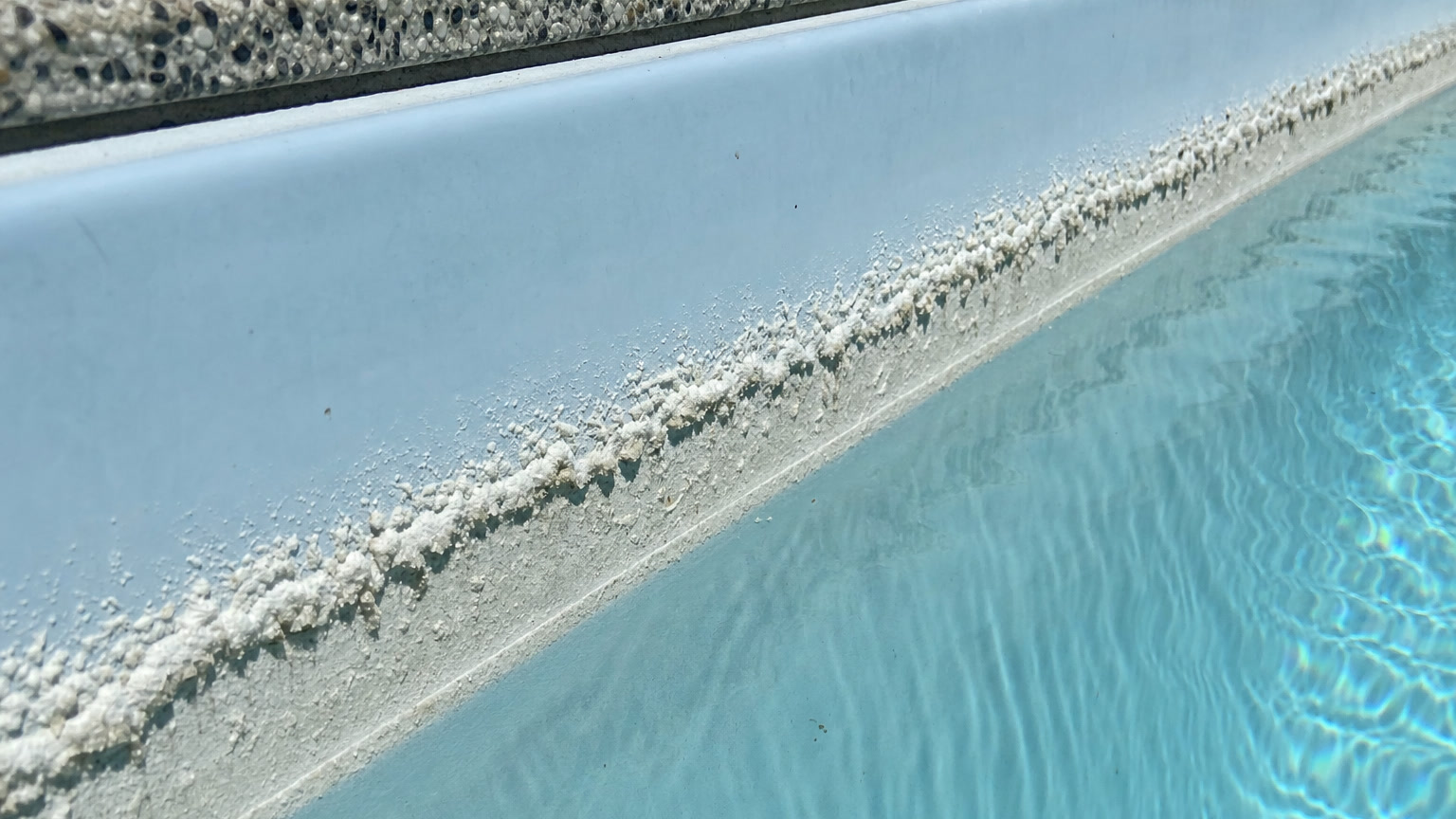
Calcium scale on a fibreglass pool is a hard white deposit. It consists of one of two minerals, each requiring a different removal method:
- Calcium carbonate is white, flaky, and relatively easy to remove.
- Calcium silicate is white-grey, hard, and difficult to remove.
To identify the deposit, apply a drop of diluted acid with a rag. Calcium carbonate reacts and foams. Calcium silicate does not react.
A fibreglass pool has a gelcoat swimming surface. Abrasive tools used on tile and concrete can scratch this finish. Calcium carbonate can be treated chemically while the pool remains full. Hardened calcium silicate on gelcoat requires a pool professional. Do not drain a fibreglass pool to treat calcium scale.
What is the hard white build-up on a fibreglass pool?
Hard white build-up on a fibreglass pool is usually one of these materials:
- Calcium carbonate: White, flaky, and relatively easy to remove with the correct product.
- Calcium silicate: White-grey, hard, and difficult to remove.
- Gelcoat chalking: A dull white area within the surface. It is not a mineral deposit, so scale remover does not remove it.
To identify the material, perform an acid drop test on a small area:
- Apply diluted acid to a rag.
- Hold the rag against the white area.
- Check for a reaction.
The results indicate the following:
- Calcium carbonate reacts and foams.
- Calcium silicate does not react.
- Gelcoat chalking does not react and does not have a mineral layer to remove.
Use acid only for this test. Do not apply it directly to the gelcoat as a cleaning treatment.
Coloured or metallic marks are not calcium deposits. See metal and organic discolouration for the appropriate treatment.
Calcium silicate forms more slowly than calcium carbonate. If calcium silicate is present on the pool walls, scale is usually also present in the pipework.
Why does calcium scale form on a fibreglass pool?
Calcium scale forms when pool water contains more dissolved calcium than it can keep in solution. The excess calcium deposits on pool surfaces. Four factors increase the risk of scale: calcium hardness, pH, evaporation, and heat.
- Calcium hardness. Calcium hardness measures the amount of dissolved calcium in the water. Above 600 ppm, calcium can settle on the pool walls and floor. Hard mains water and bore water can give a pool a high initial reading. Bore water can also contain dissolved metals, which require separate treatment. A sequestrant binds the metals so they remain in solution and can be removed by the filter. It is the standard preventive treatment for a bore-water fill.
- pH. pH has a larger effect on scaling than the calcium hardness reading. Above pH 7.8, calcium can leave the water and deposit on the gelcoat. Keep pH between 7.2 and 7.6 to help calcium remain dissolved.
- Evaporation. Evaporation removes water but leaves dissolved calcium behind. This increases the calcium concentration and can create a white band at the waterline. A pool cover reduces evaporation and calcium concentration at the waterline.
- Heat. Heat increases evaporation. Heated pools and pools exposed to hot weather can become concentrated faster than unheated pools in mild weather.
Calcium-based granular chlorine, also called cal-hypo, contains calcium. Using it increases calcium hardness while chlorinating the pool. Pools sanitised with cal-hypo require regular calcium hardness testing. Excessive calcium chloride dosing can also increase calcium hardness above 600 ppm.
Salt water fibreglass pools have an additional scaling factor. Salt chlorination increases pH, so regular acid dosing is required to keep pH within the operating range. If pH is not controlled, flaky white mineral scale can form on the chlorinator cell plates.
Calcium deposits can collect dirt, algae, and debris as they grow. This makes the scale both a cosmetic issue and a cleaning problem.
Pool volume affects how much evaporation changes the calcium hardness reading. In a smaller pool, the same amount of evaporation concentrates the dissolved calcium into less water. The smallest shell in our range holds 3,800 litres, and the largest holds 52,780 litres. One week of January heat therefore changes the calcium hardness reading more in the smallest shell than in the largest.
What calcium hardness should a fibreglass pool run at?
SPASA Australia recommends calcium hardness of 200 to 400 mg/L for residential and commercial pools. This is equivalent to 200 to 400 ppm.
Recommended ranges vary between sources. Follow the range in the shell manufacturer’s care document supplied with the pool.
The Victorian Department of Health’s Better Health Channel does not publish a recommended range. It states: “Low calcium levels will deteriorate pool surfaces, while high calcium levels will leave a ‘scum’ or scale on surfaces and equipment.”
| Reading | What it does to the water | What it does to the surface |
|---|---|---|
| Calcium hardness below the band | Water short of dissolved calcium | Pool surfaces deteriorate |
| Calcium hardness 200 to 400 mg/L (SPASA Australia) | Calcium stays dissolved in the water | Neither deteriorating nor scaling |
| Calcium hardness above 600 ppm | More dissolved calcium than the water can hold | Calcium settles on the walls and floor |
| pH below 7.0 | Sanitiser is consumed faster | Water etches and corrodes gelcoat, pool equipment and PVC |
| pH 7.2 to 7.6 (the operating band to hold) | Chlorine keeps its effectiveness and calcium stays dissolved | No etching, no plating |
| pH above 7.8 | Water cannot keep its dissolved calcium in solution | Calcium plates out onto the gelcoat |
Keep pH between 7.2 and 7.6. Above pH 7.6, chlorine becomes less effective, scaling risk increases, the water can become cloudy, and the heater must work harder. Above pH 7.8, calcium can deposit on the gelcoat.
Calcium hardness must be managed with pH, total alkalinity, and sanitiser levels. The fibreglass pool chemicals used to adjust these levels also affect whether calcium remains dissolved.
Many home test strips do not measure calcium hardness. A pool shop water test can provide this reading. If balancing the water does not reduce a high reading, contact the pool builder or a pool professional.
How do you remove calcium from a fibreglass pool safely?
Use the drop test result to identify the deposit. Choose a removal method that is safe for the gelcoat.
For calcium carbonate, use one of the following:
- A stain eraser
- A scale remover
- A fibreglass-safe scaling treatment
Treatments added to the pool water dissolve deposits over several weeks. They do not remove the deposit in a single treatment. During treatment, keep the pH between 7.2 and 7.6. Above pH 7.8, calcium can continue to form on the gelcoat.
Calcium silicate requires professional removal. Pumice stone can remove hardened silicate from tile and concrete, but it scratches gelcoat. Chemical treatment is safe for gelcoat, but it works more slowly on silicate than on carbonate.
Treat calcium carbonate with the pool full. Do not drain a fibreglass pool to treat calcium scale, regardless of the deposit depth or size. Contact a pool professional if a dosed treatment does not remove the deposit.
Read the product label before adding any treatment to the water. Some professional-strength descalers are only suitable for use above the waterline and must not be poured into the pool.
The Quote Yard's published Queensland pricing for 2026 puts professional calcium removal at $500 to $1,500. The typical time on site is half a day. The deposit can return unless calcium hardness, pH and total alkalinity are brought back into the correct ranges.
Treatment quantities and professional quotes depend on pool volume. Check your pool's capacity in litres before requesting a quote. Our 37 shell models range from 3,800 litres to 52,780 litres. The volume is published for each model.
| Model | Size (m) | Volume |
|---|---|---|
| Bastia (Spa) | 3.2 x 2.0 | 3,800 litres |
| Allure | 5.00 x 2.50 | 12,800 litres |
| Bellagio | 7.50 x 2.50 | 19,500 litres |
| Bedarra | 7.50 x 3.80 | 30,500 litres |
| Hayman | 8.50 x 3.80 | 34,500 litres |
| Westminster | 9.00 x 4.00 | 39,490 litres |
| Kensington | 11.00 x 4.00 | 51,700 litres |
| Saint Azur | 11.48 x 4.45 | 52,780 litres |
“One advantage of fibreglass over concrete is that calcium scale is far less common, because the shell surface doesn't feed it the way cement does. The pattern I do see is at the waterline: splash gets up into the tile grout, and the grout slowly leaches calcium back down the face of the shell in drip lines. Keep your calcium hardness in the right band and it largely stays away, and for the light waterline marks a very diluted acid solution on a soft cloth, worked gently and rinsed off, is usually all it takes. Anything heavier than that on gelcoat, leave to a professional.”

Which scale removers and descalers are safe on gelcoat?
Most standard scale-removal methods are not safe for a fibreglass pool's gelcoat. Abrasive methods can scratch the gelcoat. Acid washing can erode the finish and leave permanent marks, according to Okeanos Pools.
| Method | Safe on gelcoat? | Why |
|---|---|---|
| Pumice stone | No | Pumice is intended for tile and concrete. It can scratch gelcoat. |
| Abrasive block or scouring pad | No | Abrasion can scratch gelcoat. |
| Wire or stiff-bristled brush | No | These tools can scour the gelcoat during removal. |
| Acid washing the surface | No | Okeanos Pools reports that acid washing can erode the finish and leave permanent marks. |
| Granular chlorine rubbed onto a mark | No | Okeanos Pools includes granular chlorine among the harsh chemicals that can erode the finish. |
| Household calcium, lime and rust remover | Not recommended | No published composition qualifies a household descaler for use on gelcoat or in pool water. |
| Soft brush with a descaler rated for fibreglass pools | Yes | The descaler dissolves the deposit without abrading the surface. |
| Attended professional removal | Yes | Use this method for hardened calcium silicate, which has no safe do-it-yourself removal method. |
Okeanos Pools states: "Harsh chemicals, granular chlorine, or acid washing can erode the blue finish and leave permanent marks." It recommends applying a calcium-dissolving compound to the deposit. This chemical method also works on carbonate scale.
Do not assume that a household calcium, lime and rust remover is safe for gelcoat. No manufacturer or independent source publishes a composition that qualifies a household descaler for use on gelcoat or in pool water. Use a descaler sold specifically for fibreglass pools, or have a pool professional remove the scale.
FAQs
Does baking soda raise calcium hardness?
No. Baking soda is sodium bicarbonate. It raises total alkalinity but does not change calcium hardness.
Calcium-based products, such as calcium chloride and calcium-based granular chlorine, raise calcium hardness.
Dissolve baking soda in a bucket of water before adding it to the pool. Undissolved powder can leave a white film on the surface.
Does WD-40 remove calcium deposits?
Do not use WD-40 to remove calcium deposits from a fibreglass pool. It is not a pool descaler, and no manufacturer or independent source provides composition data that confirms it is safe for gelcoat or pool water.
Remove calcium carbonate with a stain eraser, a scale remover, or a scaling treatment made for fibreglass pools. Contact a pool professional to remove hardened calcium silicate.
Can you remove calcium build-up while the pool is full?
Yes. Treat calcium scale in a fibreglass pool while the pool is full. Add a gelcoat-safe treatment to the water. The treatment dissolves the deposit over several weeks.
Do not drain a fibreglass pool to remove calcium scale. The water helps hold the shell in the ground. This is why the shell should stay full during treatment. Draining is a structural decision for the builder, not part of the cleaning process.
If the deposit remains, contact a pool professional. Keep the pool full.
Does a salt water fibreglass pool get more calcium scale?
The salt itself does not cause calcium scale. Salt chlorination raises the pool’s pH. When the pH exceeds 7.8, calcium can deposit on the gelcoat. Regular acid dosing helps control the pH and prevent scaling.
The same pH increase can also cause flaky white mineral build-up on the chlorinator cell plates.
Will calcium scale damage the gelcoat on a fibreglass pool?
Calcium scale does not directly damage gelcoat. However, incorrect removal methods can damage the surface. Okeanos Pools reports that harsh chemicals, granular chlorine, and acid washing can erode the finish and cause permanent marks. Pumice stones can scratch gelcoat.
Calcium scale can also trap dirt, algae, and debris as it builds up. Water with a pH below 7.0 can etch gelcoat, pool equipment, and PVC.