Emptying a Fibreglass Pool: Risks, Limits & Refilling
A fibreglass pool is held down by the water in it. What emptying does to the shell, how far the level can safely drop, and who should do it.
Written by Tehbyn Nova, Head of Operations & Growth
Published · Updated
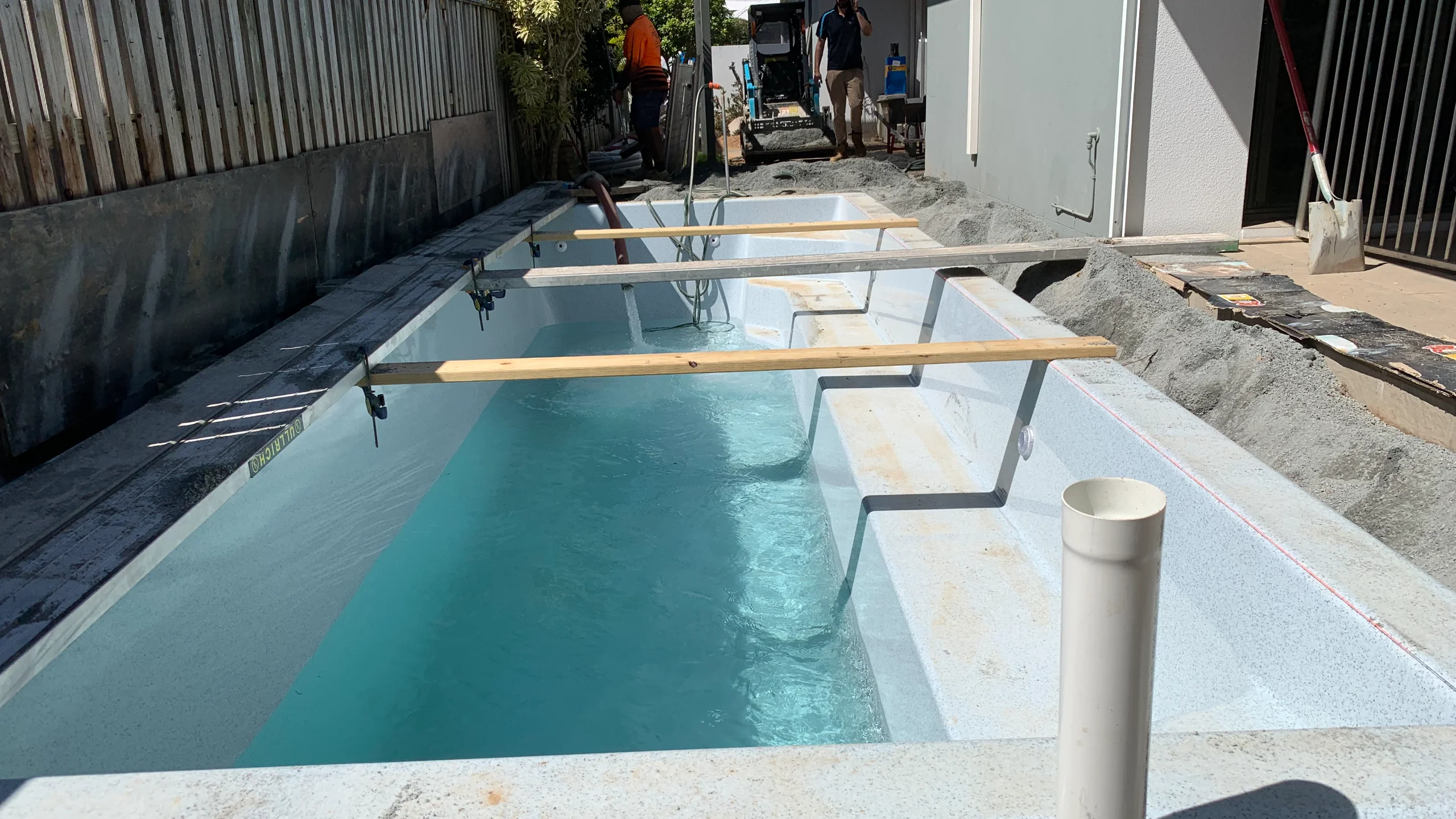
Emptying a fibreglass pool is a controlled operation for a pool builder, not a routine maintenance task. The water in the pool holds the shell down against groundwater pressure. If the pool is empty, groundwater can push against the floor and walls. This can cause the shell to shift, lift, come out of the ground, bow inwards or crack.
There is no published safe drainage depth or period for leaving a fibreglass pool empty. The safe limit depends on the water table and how saturated the ground is at the time.
A controlled emptying process includes pumping groundwater away from the shell and bracing the walls to the specification for that pool. Where possible, refill the pool on the same day.
Most work only requires lowering the water to the skimmer or return outlets. This keeps most of the water in the pool as a counterweight. Fully drain the pool only when repairing or refinishing the interior, replacing water that cannot be corrected chemically, or removing the pool.
Refill the pool from the top with clean water while gradually reducing groundwater pumping. Remove the bracing last. Set the final water level to the middle of the skimmer throat.
Can you empty a fibreglass pool?
A fibreglass pool can be emptied, but the process must be managed by a pool builder. Groundwater outside the shell must be controlled before the pool water is removed.
The water inside a fibreglass pool helps keep the shell in position and maintain its shape. If the pool is emptied, soil and groundwater continue to apply pressure from outside, with no internal water pressure to counteract them. This can cause the shell to shift, lift or come out of the ground.
Our pool catalogue lists the dry shell weight and water volume for 34 fibreglass pool models. The shells weigh between 341 kg and 1,286 kg and hold between 3,800 L and 52,780 L of water. One litre of water weighs one kilogram. Depending on the model, the pool water weighs 11 to 43 times as much as the shell. The median is 30 times.
| Pool model | Size | Shell dry weight | Water it holds | Water vs shell |
|---|---|---|---|---|
| Allure | 5.0 m × 2.5 m | 477 kg | 12,800 L (12.8 tonnes) | 27× |
| Bedarra | 7.5 m × 3.8 m | 838 kg | 30,500 L (30.5 tonnes) | 36× |
| Westminster | 9.0 m × 4.0 m | 988 kg | 39,490 L (39.5 tonnes) | 40× |
| Kensington | 11.0 m × 4.0 m | 1,223 kg | 51,700 L (51.7 tonnes) | 42× |
Emptying a Kensington removes 51.7 tonnes of water from a 1,223 kg shell. Before the pool is drained, groundwater outside and below the shell must be pumped down to reduce pressure on it.
“One rule I'll put my name on after 15 years in this game: never drain a fibreglass pool. The water is what holds the shell in the ground. I've seen what happens when someone empties one to give it a good scrub and it's not a cheap fix.”

What happens if you empty a fibreglass pool, and will it pop or crack?
Groundwater pressure is the main risk when emptying a fibreglass pool. Water inside the pool helps balance pressure from the surrounding ground. If the pool is empty, groundwater pressure can cause the shell to shift, lift, crack or pop out of the ground.
Groundwater applies pressure to the pool floor and walls. This is called hydrostatic pressure. When the pool is full, the water inside balances some of this external pressure. When the pool is empty, the shell must resist the external pressure without that support.
Groundwater pressure can damage an empty pool in several ways:
- The walls can bow inwards.
- The shell can become distorted. Fibreglass pool wall bulging is one type of distortion.
- Hairline cracks can form and widen.
- The pool floor can be pushed upwards.
The risk depends on the water table and the amount of water in the surrounding ground. If the groundwater level outside the pool is higher than the water level inside it, the pool shell is subject to unbalanced pressure.
A hydrostatic valve is a pressure-relief valve in the pool floor. It remains closed while the pool is full. If groundwater pressure below the pool exceeds the downward pressure of the pool water, the valve opens. Groundwater enters the pool and reduces pressure below the floor.
A hydrostatic valve does not remove groundwater or secure the pool shell. Professionals use it as part of a controlled emptying process that also includes sump pumps and monitoring the groundwater beside the pool. A pool should not be emptied without these controls just because it has a hydrostatic valve.
How far can you drain a fibreglass pool safely?
There is no published safe drain depth for a fibreglass pool. The safe level depends on site conditions, particularly the groundwater level beside the shell when the water is removed.
Pool depth also varies by model. Across the fibreglass pools in our range, shallow-end depths range from 0.90 m to 1.37 m, and deep-end depths range from 1.47 m to 2.00 m. Draining a pool halfway removes a different volume of water from each model and leaves a different amount of water weight in the shell.
Partial draining is generally safer and more practical. Most maintenance work requires lowering the water only to the skimmer or returns. This leaves most of the water in the pool as a counterweight and reduces hydrostatic risk.
Full draining is generally limited to interior repairs or refinishing. The required drain level and the site's groundwater conditions must be assessed separately. On a saturated block with a high water table, consult the pool builder before partially draining the pool.
How do professionals drain a fibreglass pool?
Professionals plan the draining process based on the groundwater level outside the pool shell. During installation, the shell is craned into the hole, placed on a gravel bed and backfilled with gravel as the pool fills with water. The water supports the inside of the shell, while the gravel supports the outside.
Draining removes the internal support. If groundwater pressure causes the shell to lift out of position, a crane is required to reposition it.
A controlled draining process includes:
- Monitoring and pumping down groundwater beside the shell before and during draining.
- Checking the shell for movement as the water level falls.
- Confirming the discharge location with the local council before starting.
When does a fibreglass pool have to be braced before it is emptied?
An engineer must assess whether a fibreglass pool needs bracing before it is emptied. This assessment depends on the water table and ground conditions at the site. No Australian source specifies a groundwater level at which bracing is required.
The engineer must specify the bracing for the individual pool and site. A method used for another pool, country or water table is not a suitable specification.
Bracing and dewatering are separate requirements. Bracing supports the pool walls from inside to resist pressure from the surrounding soil. Dewatering lowers the groundwater beside and below the shell to reduce pressure under the pool floor.
Bracing does not control groundwater under the floor. Dewatering does not support the walls against soil pressure.
How long can a fibreglass pool stay empty?
There is no published safe period for leaving a fibreglass pool empty. This applies to both braced and dewatered shells and unbraced shells. Damage can occur while the shell remains empty. Professionals generally refill the pool on the same day where possible to reduce this period. Same-day refilling is standard working practice, not a published rule.
An empty shell can sustain structural and surface damage. Without water inside the pool, the shell must resist ground pressure on its own. The absence of water also exposes the laminate to greater temperature changes. This can cause more expansion and contraction during seasonal temperature changes.
The gelcoat is the decorative and protective layer on the water-facing side of the laminate. When the pool is empty, the gelcoat is directly exposed to UV radiation and heat. This can cause fading or cracking that requires repair.
Older fibreglass shells may be less able to tolerate being empty. The stress can cause significant damage, including wall collapse. Keep the period that an older pool remains empty as short as possible.
How do you clean a fibreglass pool while it is empty?
Use cleaning methods that do not damage the gelcoat lining the pool shell. Avoid acid washing, abrasive pads and pressure washing. These methods remove surface material, which can damage the thin gelcoat layer.
Limit the time the pool remains empty. An empty fibreglass pool is subject to ground pressure throughout the cleaning process.
Most cleaning does not require emptying the pool. Fibreglass gelcoat is smooth and non-porous, which helps resist algae, cracking and staining. Fibreglass pools also require fewer chemicals than other main pool types to maintain water balance and pH.
How do you refill a fibreglass pool, and what water level should it sit at?
Refill a fibreglass pool from the top with clean water while removing the groundwater control. Remove the bracing last. Keep the props in place until the water inside the pool is supporting the load.
Where a property does not have an available hydrant, MFP Easy orders a water truck to fill the pool.
The correct standing water level is the middle of the skimmer throat. MFP Easy leaves the water at this level at handover and returns it to this level after any work.
Lowering the water level for winter is a United States practice. It does not apply in South East Queensland. Fibreglass pools in this region remain at their operating level throughout the year.
What happens if a fibreglass pool overflows or gets too full?
Overflow does not damage the structure of a fibreglass pool. However, heavy rain can dilute the pool chemicals and carry debris into the water. If the water rises above the skimmer opening, the skimmer cannot draw water from the surface effectively.
After the weather clears:
- Remove debris.
- Run the filtration system.
- Test and rebalance the water.
Queensland Health advises that a conventional filter alone should not be used to restore water quality after flood contamination. Filtration is only one part of the recovery process.
Return the water to the correct operating level at the skimmer opening. Australian builder and industry guides place this level between the midpoint and about three-quarters of the way up the opening.
Pump excess water to waste only when conditions are safe. Queensland Health advises against emptying a pool while the surrounding ground is saturated because this can cause structural damage. Industry guidance also recommends waiting until the ground has dried before draining a fibreglass pool, as hydrostatic pressure can lift the shell.
Before forecast heavy rain, lower the water level slightly.
Do you actually need to empty your fibreglass pool?
A fibreglass pool may need to be emptied in four situations:
- Structural repair. The water level must be lowered below the damaged area. A full drain may not be required.
- Resurfacing or refinishing the interior. Recoating the entire interior surface requires a full drain.
- Severe chemical failure. The water may need to be replaced if testing, chemical treatment and filtration cannot restore the correct balance. If the imbalance can be corrected, the pool does not need to be drained.
- Relocation or removal. The pool must be emptied before it is taken out of the ground. Removing the water is the first step in fibreglass pool removal and is quoted separately from demolition.
Most other issues can be treated without draining the pool. Chlorine shock treatment can kill bacteria, restore clarity and correct the water balance. Testing and adjusting pH, alkalinity and calcium hardness helps keep the water safe and protect the gelcoat. Longer pump and filter cycles can remove particles that cause cloudy water and prevent stagnation.
Stains and water chemistry problems are common reasons for considering drainage. Both are fibreglass pool maintenance tasks that can usually be completed while the pool is full.
Pool lights can typically be replaced without draining the pool because there is enough cable behind the fitting.
FAQs
Can a fibreglass pool be left empty?
No. A fibreglass pool can be emptied under controlled conditions, but it should not remain empty. While empty, the shell is exposed to ground pressure, and the gelcoat is exposed to UV and heat without water to regulate the laminate temperature. There is no published safe duration. Professionals plan to refill the pool on the same day.
Can you completely drain a fibreglass pool?
Yes, but only under controlled conditions. Groundwater around the shell must be pumped down and monitored. The pool walls must be braced to the pool’s specifications. The refill must also be planned before draining starts.
Complete draining is generally limited to interior repairs or refinishing. For other work, partially lower the water level or leave the water in the pool.
How is a fibreglass pool emptied?
A fibreglass pool is emptied using a pump. The water is pumped out under supervision. At the same time, groundwater around the pool shell is pumped down.
The hydrostatic relief valve in the pool floor opens to let groundwater into the pool and reduce pressure beneath the shell. It does not drain water from the pool.
Does a hydrostatic valve make it safe to drain a fibreglass pool?
No. A hydrostatic valve only relieves pressure under the pool floor. When the water level inside the pool drops, the valve allows groundwater to enter the shell.
It does not lower the water table, dry the ground around the pool or hold the shell in place. Professionals use hydrostatic valves with sump pumps and groundwater monitoring, not by themselves.
Does draining a fibreglass pool yourself void the warranty?
Draining a fibreglass pool yourself can void the manufacturer’s warranty. Most manufacturers require an authorised dealer to complete the work.
Draining the pool yourself also increases the risk of structural damage. Repairing a shifted or cracked shell can cost more than hiring an authorised dealer.