Fibreglass Pool Stain Removal: Causes & Treatment Guide
Identify the stain on your fibreglass pool: organic, metal, scale or gelcoat fade. Treatments that work with the pool full, plus a diagnosis table.
Written by Tehbyn Nova, Head of Operations & Growth · Technically reviewed by Caleb Druhan, General Manager (QBCC licence 15087383) on
Published · Updated
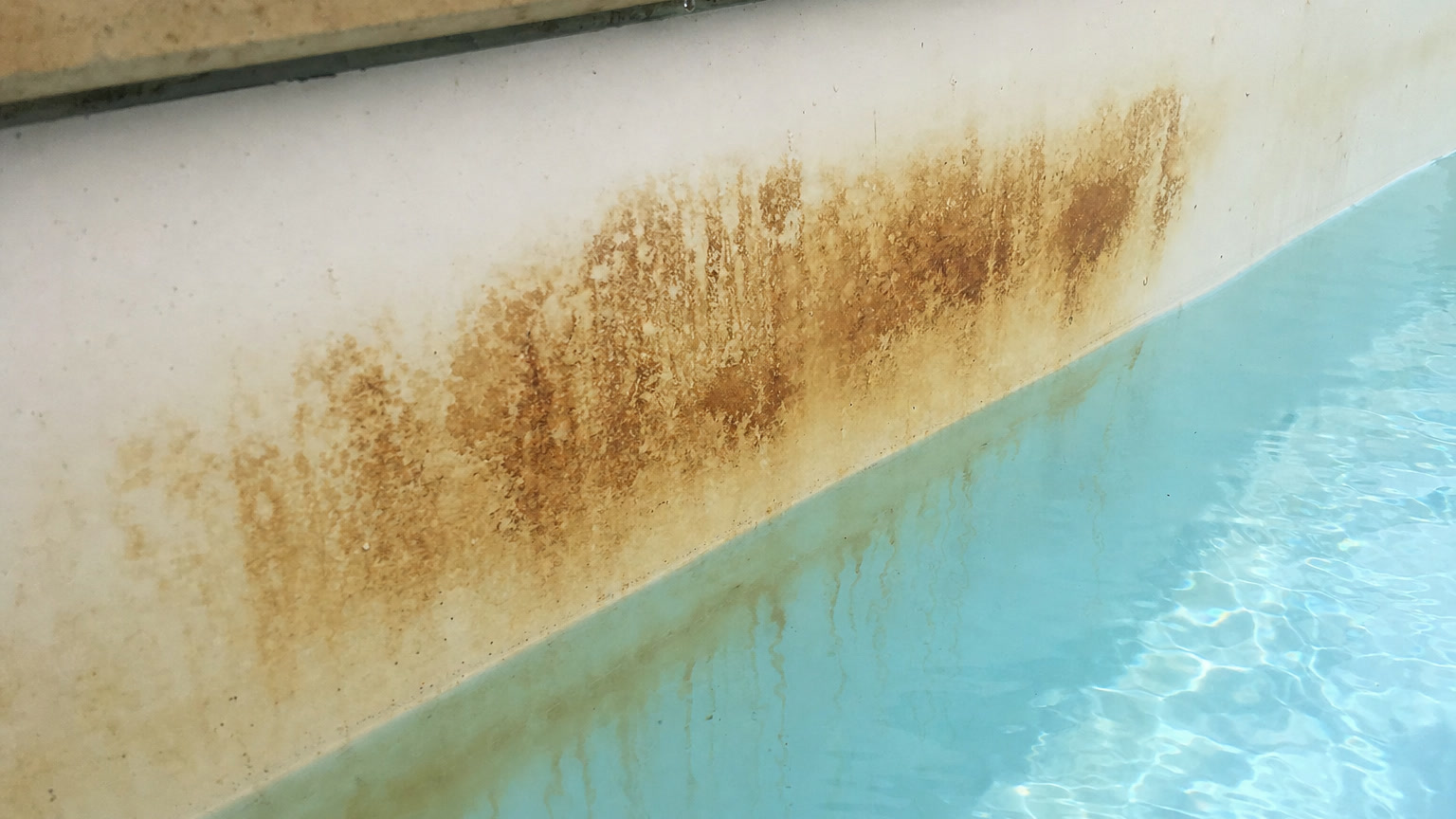
Fibreglass pool stain removal starts by identifying the mark. Four common problems can look like stains, but only three are stains.
- Organic stains result from leaves, berries, and other plant matter breaking down on the pool surface.
- Metal stains result from iron, copper, or manganese in the water.
- Mineral scale is a hard calcium carbonate deposit on the surface.
- Gelcoat fade and chalking occur when the surface of a fibreglass pool (spelled fiberglass in the US) weathers. Stain treatments do not remove them.
Use the colour of the mark to identify possible causes, then perform a two-part spot test. Rub a plain, uncoated vitamin C tablet on the mark. If the mark lifts, it is a metal stain. If the mark softens under a brush and responds to chlorine, it is an organic stain.
Stains can form when pool water is clear and balanced. Perform all treatments while the pool is full.
What is the stain on your fibreglass pool?
Identify a mark by its colour, location on the pool shell, and response to two spot tests.
Colour indicates the likely cause:
- Iron marks are orange, brown, tan, or reddish-brown.
- Copper marks are green or blue. In pools filled from a bore or dam, they may be blue-green-black.
- Manganese marks are brown, black, or purple.
- Organic marks are greenish-brown.
- Berry marks are reddish-blue.
Use two spot tests to distinguish metal stains from organic stains:
- Rub a plain, uncoated vitamin C tablet on the mark. If the mark becomes noticeably lighter, it is likely a metal stain. Ascorbic acid reacts with the metal and removes it from the gelcoat.
- Brush the mark and apply chlorine. If the mark softens with brushing and responds to chlorine, it is likely organic.
Organic stains respond more strongly to chlorine. Metal stains respond more strongly to ascorbic acid.
| What you see | Where it usually sits | Likely cause | The test that confirms it |
|---|---|---|---|
| Orange, brown, tan or reddish-brown | Anywhere the water reaches, not shaped by debris | Iron, usually from the fill water | A vitamin C tablet lightens the mark |
| Green or blue, or blue-green-black | Anywhere the water reaches, common on bore and dam fills | Copper | A vitamin C tablet lightens it and there is no plant debris nearby |
| Brown, black or purple | Anywhere the water reaches | Manganese | A vitamin C tablet lightens the mark |
| Greenish-brown shadows | Exactly where leaves or debris sat | Organic, from leaves and plant matter | Softens with brushing and responds to chlorine |
| Reddish-blue marks | Where fallen fruit sat on the surface | Berries | Softens with brushing and responds to chlorine |
| Hard white crust | At and above the waterline | Calcium scale | Diluted acid on a rag dissolves it and it wipes off |
| Dull powdery white that rubs off | Flatter surfaces, less on the edges of steps and benches | Gelcoat chalking, not a stain | No reaction to diluted acid at all |
Fibreglass pool stains can appear when the water is clear and balanced. Test-kit readings do not identify the stain or its cause. Identify the stain before treatment because organic and metal stains require different chemicals.
What causes the brown stains on a fibreglass pool?
Brown stains on a fibreglass pool usually have one of two causes:
- Tannins from decomposing leaves and other plant matter
- Metals, such as iron or manganese, in the pool water
These causes require different treatments.
Leaves, berries, and other plant matter release tannins as they decompose. The tannins can adhere to the gelcoat. Organic stains are usually brown or greenish-brown and may match the shape of the debris. They often appear on the pool floor, steps, and corners where leaves collect. Removing the debris does not remove tannins that have already adhered to the surface.
Iron can enter the pool dissolved in fill or top-up water. If the pool water becomes unbalanced, the iron can deposit on the gelcoat. Iron stains may appear orange, brown, tan, or reddish-brown. Unlike organic stains, they do not match the shape of debris.
Bore and dam water can contain iron, copper, and manganese. Town water can also contain manganese. Manganese stains may appear brown, black, or purple. A brown stain is therefore not always caused by iron.
Use these tests to identify the cause:
- Hold a vitamin C tablet on the stain. If the stain becomes lighter, it is likely caused by iron or manganese.
- Apply chlorine and use a soft brush. If the stain becomes lighter, it is likely caused by tannins.
How do you get rust and other metal stains off a fibreglass pool?
Remove rust and other metal stains from a full fibreglass pool with ascorbic acid. Then add a sequestrant to keep the released metal in solution and prevent it from settling on the gelcoat again.
Metal usually enters the pool through fill water. Bore and dam water can contain iron, copper and manganese. Town water is treated for manganese but may still contain it. Other sources include corroded fittings, screws, rust flakes from nearby metalwork and corroded copper drinking-water pipes. This is relevant across South East Queensland, including Brisbane, Logan, Ipswich, the Lockyer Valley and Somerset, where many properties outside reticulated town water use bore water.
Ascorbic acid products specify doses by water volume. Calculate the pool volume before using the product.
| Model | Size | Volume |
|---|---|---|
| Bastia (Spa) | 3.2 m × 2.0 m | 3,800 L |
| Malta | 4.0 m × 2.0 m | 6,900 L |
| Allure | 5.00 m × 2.50 m | 12,800 L |
| Empire | 6.00 m × 3.00 m | 18,700 L |
| Bellino | 6.50 m × 3.60 m | 22,300 L |
| Oxford | 7.00 m × 3.00 m | 26,230 L |
| Hayman | 8.50 m × 3.80 m | 34,500 L |
| Saint Azur | 11.48 m × 4.45 m | 52,780 L |
Our fibreglass pools range from 3,800 litres to 52,780 litres. Use the volume for your pool model when calculating the dose.
- Reduce free chlorine to zero and adjust pH to about 7.2. Complete both adjustments before adding ascorbic acid.
- Add ascorbic acid according to the product label and pool volume. Published doses vary by a factor of two to five between vendors and between imperial and metric conversions. Use the instructions on the product.
- Circulate the water for 24 hours. Run the filtration system continuously during this period.
- Rebalance the water. Adjust pH to 7.2–7.6 and free chlorine to 1.5–3.0 ppm.
- Add a sequestrant. This binds the metal particles, keeps them in solution and allows them to leave through the filter. Without a sequestrant, the metal can settle on the gelcoat again.
“Being a construction company, most of the staining I actually get called about is rust, and nine times out of ten it's a tradie working near the pool. Roof shavings or a handful of screws go in the water, the metal sits on the floor and leaves a small rust mark. The good news is it looks worse than it is. It doesn't hurt the shell, and a Magic Eraser from the pool shop stuck on the end of your pool pole and rubbed gently over the spot will lift the vast majority of stains I've come across. One of the best value products in the game.”

How do you remove organic, leaf and algae stains from a fibreglass pool?
Remove organic stains, leaf stains, and algae marks from a full fibreglass pool by using chlorine and a soft brush.
Organic stains often match the shape of the leaves, berries, or other debris that caused them. Tannins from decomposing debris can adhere to the gelcoat beneath it. The shape can identify an organic stain regardless of its colour.
- Remove the debris. Skim and vacuum leaves, fruit, and other organic matter from the pool. Otherwise, the debris consumes the added chlorine.
- Raise the chlorine level overnight. For a stubborn organic stain, pool shops and product vendors recommend approximately twice the normal daily chlorine dose. Apply it after dark to reduce chlorine loss from daylight UV.
- Brush the stain with a soft brush. Brushing brings chlorinated water into contact with the tannin. Use a soft brush to avoid damaging the gelcoat.
Organic stains can continue to fade for several weeks after treatment. Wait a few weeks before repeating the dose.
Do not place granular chlorine directly on the pool surface. Concentrated chlorine can bleach the gelcoat and leave a permanent pale patch.
What are the white marks and salt stains on a fibreglass pool?
White marks on a fibreglass pool usually have one of three causes: calcium scale, dried salt residue, or gelcoat chalking. Each cause requires a different test and treatment.
Calcium scale is a hard, crusty white deposit that forms at or above the waterline. Diluted acid dissolves the carbonate scale, allowing it to be wiped away. Stain treatments do not remove it.
Salt residue is a dry white powder that forms above the waterline on salt-chlorinated pools. It can be removed with fresh water. Calcium scale and gelcoat chalking do not rinse away with a hose.
Gelcoat chalking appears dull, powdery, and rough. The powder transfers to your hand when wiped and does not react to acid. Chalking occurs when the gelcoat surface breaks down. It is not a deposit on the surface.
Use an acid-on-a-rag test to distinguish calcium scale from gelcoat chalking. Wipe diluted acid over the white mark. If the mark dissolves and wipes away, it is calcium carbonate scale and requires descaling. If the acid has no effect, it is gelcoat chalking. Acid, chlorine, and stain remover cannot restore degraded gelcoat.
How do you get stains off fibreglass pool steps?
Remove stains from fibreglass pool steps using the same treatments used for the pool walls and floor. Apply the treatment by hand while the pool is full.
Steps, benches, and swim-outs collect debris because they are horizontal surfaces. Organic stains come from leaves, fruit, and other plant matter. Metal stains come from iron, copper, or manganese.
To test for a metal stain, hold a plain, uncoated vitamin C tablet against the spot and check whether it lightens. For an organic stain, raise the chlorine level and scrub the area with a soft brush or soft pad on a pole.
You can reach most steps from the pool edge with a pole. Do not lower the water or drain the fibreglass pool to treat a step stain.
On older pools, a dull white patch on a step may be chalked gelcoat rather than a stain. Step and bench edges may show less chalking than the surrounding flat surfaces. Use the acid-on-a-rag test to identify the issue.
What stain remover is safe on a fibreglass pool?
Use products labelled as safe for fibreglass surfaces. The appropriate product depends on the type of stain.
- Acid-blend stain-remover powders. Ascorbic acid and blends containing oxalic or citric acid remove metal stains from the gelcoat. These products are available from pool shops and hardware chains in Australia. They have little effect on organic stains.
- Sequestrants and stain-and-scale liquids. Sequestrants bind dissolved metals so they remain in solution and can pass through the filter. They help prevent metal stains but do not remove existing stains. Use them for bore-water fills and after metal-stain treatment.
- Melamine eraser pads. Industry guidance varies. Some sources recommend them for stubborn marks. Others advise against them because they can scratch fibreglass surfaces.
- Chlorine. Raised chlorine levels combined with brushing can remove organic stains, including tannin marks. Chlorine has little effect on iron, copper, or manganese stains.
Sodium metabisulphite is used for a separate problem: osmotic black spots.
One Australian stain-removal specialist charges $245 to $345 for treatment kits, including GST and delivery. Pricing is based on three pool-volume bands: up to 40,000 litres, up to 65,000 litres, and above 65,000 litres. Another independent operator states that professional treatment for minor stains starts at "a few hundred dollars".
Do not use wire brushes, steel wool, scouring pads, or abrasive cleaners. These products can cut into the gelcoat. The gelcoat is less than half the thickness of a credit card and protects the shell from water intrusion, algae, and chemical attack. Damage that penetrates the gelcoat is irreversible.
Why has the colour faded on a fibreglass pool, and is that a stain at all?
Fading on a fibreglass pool is not a stain. Fading and chalking occur when the gelcoat weathers. Stain removers do not correct these conditions.
Use touch and appearance to distinguish these surface conditions:
- A stain is a deposit on top of the gelcoat. It may feel rough or gritty. The colour is in the deposit.
- A faded or bleached gelcoat feels smooth. The colour loss is permanent because there is no surface deposit to remove.
- A chalked gelcoat looks dull and feels powdery or rough. This occurs when the surface resin breaks down and forms a powder.
UV exposure, high chlorine levels, and unbalanced pool water can cause gelcoat weathering and discolouration. Weathering occurs faster in pools exposed to full sun than in pools that are shaded for part of the day.
Assess fading against the pool's original colour and finish, not against another pool. Fibreglass shells are available in different gelcoat colours and finishes. A dark interior that has become lighter differs from a pale interior that has become chalky, although both conditions may be described as fading.
Can a faded or chalky fibreglass pool be brought back?
A faded or chalky fibreglass pool can be improved. However, treatment cannot return bleached gelcoat to its original colour.
There are three treatment levels:
- Polish and buff. Light chalking can be cut back and polished to restore gloss.
- Professional gelcoat restoration. A professional prepares the surface and applies a new coating. One method uses an acid wash followed by buffing. The pool must be drained for this work.
- Resurfacing the shell. The entire interior surface is renewed. This is used when the gelcoat is too degraded for restoration.
There is no industry agreement on whether chalked gelcoat can be restored. The main positions are:
- Acid washing, buffing, and applying a new coating can restore the surface. However, acid weakens the remaining gelcoat, and a coating may not bond to a badly degraded surface.
- Chalking cannot be removed by cleaning. The surface must be physically refurbished.
- Acid washing does not produce a lasting change on fibreglass. Sanding also reduces the remaining life of the gelcoat.
These treatments have two limitations:
- Permanently bleached gelcoat cannot be returned to its original colour.
- Polishing does not remove calcium carbonate scale. Acid is required to dissolve it.
Professional restoration and resurfacing require an empty pool. Confirm the diagnosis before draining the pool. A fibreglass pool should only be emptied after considering the structural requirements. Do not drain it only to treat a stain.
If the gelcoat cannot be restored, a new shell provides a new surface instead of repairing the existing one.
How do you stop a fibreglass pool staining again?
Use these four practices to prevent fibreglass pool stains:
- Keep the water chemistry within the recommended range. Balanced pool water chemistry helps prevent metal stains and mineral scale. Monitor pH, total alkalinity and sanitiser levels.
- Use a sequestrant and hose filter. Add a sequestrant when filling with bore water and after metal treatment. It keeps iron, copper and manganese in solution so the filter can remove them. A hose filter reduces the amount of metal entering the pool.
- Remove metal objects and corroding fittings. Rust flakes, screws, corroding fittings and nearby metal furniture can cause iron stains.
- Remove leaves and fruit promptly. Decomposing plant matter releases tannins that can stain the pool surface.
Regularly skim, brush and vacuum the pool. A fibreglass pool maintenance routine provides a schedule for cleaning and water testing.
FAQs
Why is my fibreglass pool getting brown stains?
Brown stains on a fibreglass pool usually come from tannins or iron. Tannins come from decomposing leaves and leave marks that match the shape of the debris. Iron enters with the water and does not leave a debris-shaped mark.
To test the stain, rub it with a plain, uncoated vitamin C tablet. Vitamin C lightens iron stains but has little effect on tannin stains.
Can you remove pool stains without draining a fibreglass pool?
Yes. Treat stains while the pool is full:
- For metal stains, add ascorbic acid to the water.
- For organic stains, raise the chlorine level and brush the surface.
- For calcium scale at the waterline, apply diluted acid with a rag.
Do not drain a fibreglass pool to remove surface stains.
Can you use a magic eraser on a fibreglass pool?
Recommendations vary. Some sources suggest using a melamine eraser pad on stubborn marks. Others classify eraser pads as abrasives that can scratch fibreglass surfaces. Treat the stain with chemicals first. If you use an eraser pad, test it in an inconspicuous area and scrub gently.
Does high chlorine bleach a fibreglass pool gelcoat?
Chlorine can bleach fibreglass pool gelcoat when it remains concentrated on the surface. This can occur when granular chlorine settles on the gelcoat or a chlorine tablet is left on a step. Chlorine dissolved in balanced pool water is less likely to cause bleaching.
Pool-care operators report bleaching when multiple water readings are outside the recommended range. They do not provide a specific chlorine threshold.
Will a stain damage the fibreglass shell?
No. A stain is a deposit on the gelcoat and does not affect the laminate below it.
Damage can occur during stain removal. The gelcoat is thinner than half a credit card and protects the shell from water, algae, and chemical damage. Abrasive scrubbing removes part of the gelcoat permanently.