Fibreglass Pool Fading: Causes, Fixes & Costs
Why fibreglass pool gelcoat fades and chalks, how long it lasts, what accelerates it, and what a cut and polish or re-gelcoat costs in Australia.
Written by Tehbyn Nova, Head of Operations & Growth · Technically reviewed by Caleb Druhan, General Manager (QBCC licence 15087383) on
Published
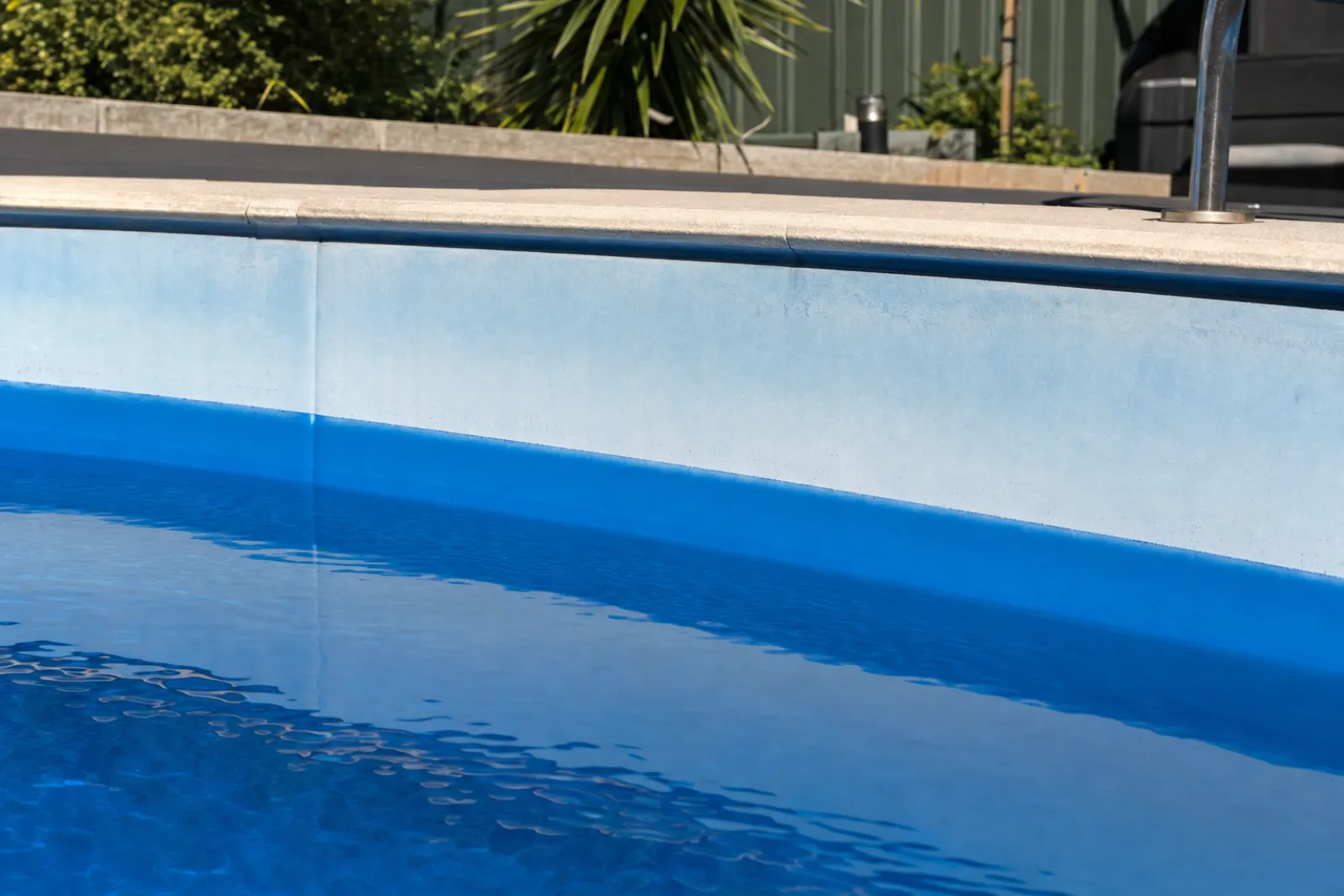
There are three repair options for fibreglass pool fading:
- Cut and polish the existing gelcoat.
- Apply a new gelcoat.
- Apply an epoxy coating over the existing surface.
A cut and polish is suitable only when the gelcoat is thick enough to be cut back. If the gelcoat has worn through and exposed the fibreglass, the pool interior must be recoated.
Before choosing a repair, rub the faded area. If a fine powder comes off on your hand, the surface is chalking. This helps distinguish weathered gelcoat from calcium scale or metal staining.
Why is a fibreglass pool fading or going chalky?
A fibreglass pool fades when its gelcoat weathers. Gelcoat is the coloured surface layer of the shell. It is sprayed into the mould before the structural glass and resin are added behind it.
Ultraviolet light can fade the colour and reduce gloss above the waterline. Over-chlorination can cause fading below the waterline. Oxidation can make the weathered surface chalky. Chalking leaves a fine powder on your hand when you touch the surface.
Over time, weathering can thin the gelcoat and expose the raw fibreglass. The exposed surface may appear grey or brown. This is not staining. Fading, chalking and loss of gloss are forms of surface wear. They do not affect the laminate behind the gelcoat.
The following surface conditions can look similar:
- Chalking. Chalking leaves a fine powder on your hand. The powder is degraded gelcoat, not a deposit on the surface.
- Calcium carbonate scale. Carbonate scale is white or grey, flaky and reactive to acid. It is a mineral deposit from the pool water.
- Calcium silicate scale. Silicate scale is harder than carbonate scale and more difficult to remove.
- Metal staining. The colour depends on the metal. Iron stains are orange, brown or tan. Copper stains are green or blue. Manganese stains are brown, black or purple.
Fading is one of the fibreglass pool problems that affects the surface rather than the structure. Other surface problems include stains, scale and gelcoat crazing.
We order every shell we install from Aqua Technics. Each shell arrives pre-cured and is craned into the excavation in one piece. It does not have replaceable panels. The visible colour is part of the shell surface, not a separate finish applied over it.
How long does the gelcoat on a fibreglass pool last before it fades?
There is no published service life for gelcoat colour. Fade rates depend on pool water management and ultraviolet exposure, not only on the age of the pool.
A well-made, correctly installed and maintained fibreglass shell can have a structural life of 30 years or more. Complete Fibreglass Pool Kits estimates a service life of 25 to 40 years. Aqua Technics shells comply with Australian Standard AS 1838:2021 and hold Building Materials Product certificate BMP 520101.
The shells we install include a vinyl-ester barrier behind the gelcoat to resist water absorption, graphene reinforcement in the laminate, and a ColourGuard surface. They do not have a scheduled resurfacing interval.
After 25 years of correct operation, a fibreglass pool can remain structurally sound. The gelcoat may have reduced gloss and colour depth, but this does not indicate reduced shell strength. Available evidence does not support a specific gelcoat colour life.
What makes a fibreglass pool fade faster?
Gelcoat fades faster when water chemistry is outside the published operating ranges. Ultraviolet light also fades the part of the shell above the waterline. The main factors are five water chemistry readings, sun exposure, and the type of cleaning brush used.
Thursday Pools, a fibreglass pool manufacturer, publishes limits for free chlorine, calcium hardness, total alkalinity, and cyanuric acid. We publish a pH range of 7.2 to 7.8 for fibreglass pools.
| What accelerates fade | What it does to the gelcoat | The band to hold |
|---|---|---|
| Free chlorine | Over-chlorination fades the gelcoat below the waterline. Thursday Pools states that levels above 5 ppm can damage the surface | 1 to 3 ppm |
| pH | Levels above the range can cause discolouration and deposits. This damage is often not reversible | 7.2 to 7.8, the band we publish |
| Calcium hardness | High calcium can increase pH and cause white deposits and discolouration | Below 120 ppm |
| Total alkalinity | Thursday Pools publishes this range as an operating limit for fibreglass surfaces | 80 to 120 ppm |
| Cyanuric acid | Chlorine becomes less effective when cyanuric acid is above 100 ppm | 20 to 50 ppm |
| Ultraviolet light | Fades the colour and gloss of the shell above the waterline | Not a chemistry setting; the exposed area remains subject to ultraviolet light |
| Cleaning tools | Stainless steel brushes, wire brushes, rough tools, and aggressive scrubbing can scratch or gouge the gelcoat | Nylon brush only |
Source water may already be outside the calcium hardness range. Thursday Pools states that source water is often above 120 ppm calcium, so the pool may exceed the limit when it is filled. Calcium hardness and pH above their ranges can cause irreversible gelcoat damage.
Correcting the water chemistry does not restore faded colour. It stops further damage caused by incorrect chemistry. It also does not prevent ultraviolet light from fading the shell above the waterline.
Water chemistry affects the surface of a fibreglass pool, not the underlying laminate. It can fade, chalk, or stain the gelcoat. It does not crack the laminate or cause osmosis. Surface crazing in the gelcoat is also cosmetic. A crack that passes through the laminate or leaks water is structural and requires an on-site assessment.
Can a faded fibreglass pool be brought back without resurfacing?
Yes, if the gelcoat is oxidised but still has enough thickness. A cut and polish removes the oxidised surface layer and restores the gloss underneath. This treatment is suitable for gelcoat that is dull and chalky but has not worn through.
If the raw fibreglass is visible as a grey or brown surface, the gelcoat has worn through. A cut and polish will not restore it. The pool interior must be recoated.
A cut and polish is not permanent. It removes weathered gelcoat but does not add new gelcoat. The surface will become dull again and may need another polish. The timing depends on water conditions and sun exposure.
To limit further oxidation, keep free chlorine between 1 and 3 ppm and pH between 7.2 and 7.8. Use a nylon brush. Do not use a stainless steel or wire brush. Proper water conditions reduce oxidation caused by excess chlorine, but ultraviolet light will continue to weather the gelcoat.
Can a fibreglass pool be re-gelcoated?
Yes. Resurfacing a fibreglass pool replaces the interior finish. Options include a new gelcoat, an epoxy or polymer coating, or a new fibreglass layer. The colour pigment is applied in the final fill coat.
A new gelcoat is the most common and least expensive option. Replacing the full fibreglass layer is the most expensive and longest-lasting option. The work takes 5 to 10 days on site.
Re-gelcoating is not scheduled maintenance. Current Aqua Technics shells do not have a scheduled resurfacing interval. The gelcoat is cured into the shell at the factory, so there is no separate finish layer that must be replaced on a set cycle.
A US resurfacing contractor gives an average resurfacing interval of 15 to 30 years for fibreglass pools. This figure applies to older shells and shells built to lower specifications. It is not a maintenance schedule for the range we install.
Concrete and vinyl pools have regular resurfacing or replacement cycles. A concrete pool is typically drained and resurfaced every 10 to 15 years. A vinyl liner is replaced every 5 to 12 years at a cost of $3,000 to $7,000 each time.
Fibreglass pools do not follow either cycle. Re-gelcoating is performed when repairs are required, not according to a fixed schedule.
What does it cost to re-gelcoat a fibreglass pool in Australia?
Published Australian prices range from about $700 for colour restoration to more than $20,000 for a full interior resurface. The three Australian sources provide different estimates, so the figures should be treated as separate examples rather than a single price range.
| Job | Quoted range | Source |
|---|---|---|
| Localised patch repair | $800 to $3,000 | Fibreglass Pool Check |
| Full interior resurface | $5,000 to $20,000 or more | Fibreglass Pool Check |
| Full resurface, 6 × 2.5 m pool (15 m²) | $2,100 to $3,200 | hipages |
| Full resurface, 9 × 4 m pool (36 m²) | $5,100 to $7,700 | hipages |
| Gelcoat replacement or repaint | $800 to $1,800 | hipages |
| Colour restoration | Around $700 | hipages |
| Resurfacing in Brisbane | From $8,000 to $15,000 or more | Rod Cameron Pools |
The estimates differ most for a pool of about 36 m². hipages estimates $5,100 to $7,700 for resurfacing a 9 × 4 m pool. Rod Cameron Pools quotes $8,000 to $15,000 or more for resurfacing in Brisbane. Fibreglass Pool Check quotes $5,000 to $20,000 or more for a full interior resurface. The sources do not explain the differences, so these figures should not be averaged.
Several factors affect the final quote. Fibreglass Pool Check lists labour rates of $60 to $90 an hour in South East Queensland and $80 to $120 an hour in Sydney. It also lists a travel premium of $500 to $1,500 for regional Queensland and an additional $1,000 to $2,000 for difficult access.
Queensland licensing requirements may also apply. Pool repair work valued above $3,300 must be completed by a QBCC-licensed contractor. Licensed work includes QBCC home warranty insurance. The cover lasts for 6 years and 6 months from the earliest of the contract date, premium payment or start of work. It remains with the property after a sale and covers defective or incomplete work and subsidence or settlement beneath the pool up to $200,000.
We do not provide resurfacing or re-gelcoating services and do not publish a price for this work. A licensed pool repairer can provide a quote after inspecting the pool shell.
Should a faded fibreglass pool be painted instead of re-gelcoated?
Choose re-gelcoating rather than painting when both options are available. Re-gelcoating replaces the shell’s interior finish. Epoxy pool paint adds a coating over the existing gelcoat. The surface must first be dulled and cleaned so the paint can bond.
| Approach | What is applied | Known failure mode | Who does it |
|---|---|---|---|
| Epoxy pool paint | A coating applied over the existing gelcoat, once the surface has been dulled and cleaned so the epoxy can bond | Peeling from inadequate sanding, wax or residue left on the surface, or an unsuitable coating; blistering and bubbling where moisture is trapped under the film; early failure where coats go on too heavily or too thin; softening and peeling where the coating is submerged before it has cured | A pool painting contractor |
| Re-gelcoat or resurface | A replacement interior finish layer: a new gelcoat, an epoxy or polymer coating, or a full new fibreglass layer, with the colour pigment in the final fill coat | A replacement gelcoat weathers the way the original did: ultraviolet light fades the colour and gloss above the waterline and over-chlorination fades it below | A licensed pool repairer; in Queensland, work valued above $3,300 must be licensed |
Poor surface preparation is the main cause of pool paint peeling. On fibreglass shells, common causes include inadequate sanding, wax or residue on the gelcoat, and coatings that are not suitable for fibreglass. Epoxy also fails if the surface is not prepared correctly.
Epoxy coatings are suitable for concrete and fibreglass pools. They resist Australian ultraviolet light, chemicals and wear. These benefits do not remove the preparation and application risks.
The reviewed sources do not state how long epoxy paint lasts on a fibreglass shell before recoating is required. Re-gelcoating replaces the finish layer. Painting applies a coating over the existing finish.
Is fading covered by a fibreglass pool warranty, and does colour choice change how fast it fades?
A fibreglass pool may have separate structural, surface and installation warranties. The pools we install include a Lifetime Interior Surface Guarantee from Aqua Technics, subject to its conditions. We provide a seven-year workmanship warranty for the installation. The manufacturer provides written structural and surface warranties with the pool. Coverage for fading depends on the terms and conditions in those warranties.
A warranty repair may still involve costs for the owner. Most manufacturers require the owner to pay for draining, bracing, refilling and rebalancing the pool. Structural warranty claims also depend on the issuing company still trading. The manufacturer’s trading history is therefore relevant when assessing a warranty.
There is no published fade rate for different fibreglass pool colours. There is also no published difference in fade rates between dark and light gelcoat on modern fibreglass shells. Dark interiors show marks and surface flaws more clearly than light interiors. This can make the same level of weathering appear more noticeable on a dark shell. Consider this when choosing a fibreglass pool colour, but it does not rule out choosing a dark interior.
FAQs
What is the average lifespan of a fibreglass pool?
A well-made, correctly installed, and maintained fibreglass pool shell can last 30 years or more. Complete Fibreglass Pool Kits estimates a lifespan of 25 to 40 years. This estimate applies to the shell’s structure, not its colour. Fibreglass shells do not require scheduled resurfacing during this period, unlike concrete or vinyl-liner pools.
What happens to a fibreglass pool after 25 years?
A properly maintained fibreglass pool can remain structurally sound after 25 years. The main changes affect the surface. The gelcoat may lose gloss and colour depth. Oxidation may also cause chalking. If calcium and pH levels remain above the published chemistry ranges, the shell may develop permanent discolouration.
What are common problems with fibreglass pools?
Common surface problems include:
- Gelcoat fading and chalking
- Calcium carbonate and calcium silicate scale
- Staining from iron, copper, or manganese
- Scratches and gouges caused by stainless steel or wire brushes
- Surface crazing
Surface crazing is cosmetic. A crack that extends through the laminate or leaks water is structural and requires an on-site assessment.
Is a white chalky film on a fibreglass pool fading or calcium scale?
Rub the film with your hand. If it comes off as a fine powder, it is chalking caused by gelcoat breakdown. Calcium carbonate scale is white or grey, flaky, and reacts to acid. Calcium silicate scale is harder and more difficult to remove.
Identify the material before treatment. Scale is a deposit on the surface. Chalking is deterioration of the surface itself.
Do dark fibreglass pool colours fade faster than light ones?
No published data shows a difference in fade rate between dark and light gelcoat on modern fibreglass pools. Dark interiors make marks and surface flaws more visible, which can make weathering appear worse. Ultraviolet light causes fading above the waterline, while over-chlorination causes fading below it.