Fibreglass Pool Problems: Faults, Causes & Severity
The faults a fibreglass pool can develop, which are cosmetic and which are structural, what causes each, and what to check first.
Written by Tehbyn Nova, Head of Operations & Growth · Technically reviewed by Caleb Druhan, General Manager (QBCC licence 15087383) on
Published
What are the common problems with fibreglass pools?
A fibreglass pool can develop surface faults in the gelcoat or movement faults caused by the ground around the shell.
The pool is made as a single glass-fibre-and-resin laminate. The gelcoat is sprayed into the mould first. Structural glass and resin are then added behind it. The finished shell is cured before delivery and lowered into the excavation in one piece. It does not have replaceable panels or a separate plaster or render finish.
We order shells from Aqua Technics. They are built to Australian Standard AS 1838:2021 and hold Building Materials Product certificate BMP 520101. The range includes 37 models from 3.0 m to 11.48 m long.
Eight common faults can occur:
- Gelcoat damage. Chips, scratches and crazing affect the coloured surface layer. They can result from contact with metal, glass or a stiff brush. They can also result from pressure that the gelcoat cannot absorb.
- Structural cracks. Cracks in a fibreglass pool can be gelcoat crazing, hairline spider cracks or cracks that extend into the glass-and-resin laminate. Only cracks that enter the laminate are structural and cause water loss.
- Leaks. Fibreglass pool leaks commonly occur at connections between different materials. These include the skimmer box, return fittings, main drain, light and buried pipework between the pool and its equipment.
- Fading, chalking and gelcoat wear. Fibreglass pool fading and chalking results from gelcoat weathering rather than staining. Ultraviolet light reduces colour and gloss above the waterline. Over-chlorination can fade the surface below the waterline. Oxidation can make the surface chalky. Continued wear can thin the gelcoat and expose grey or brown material behind it.
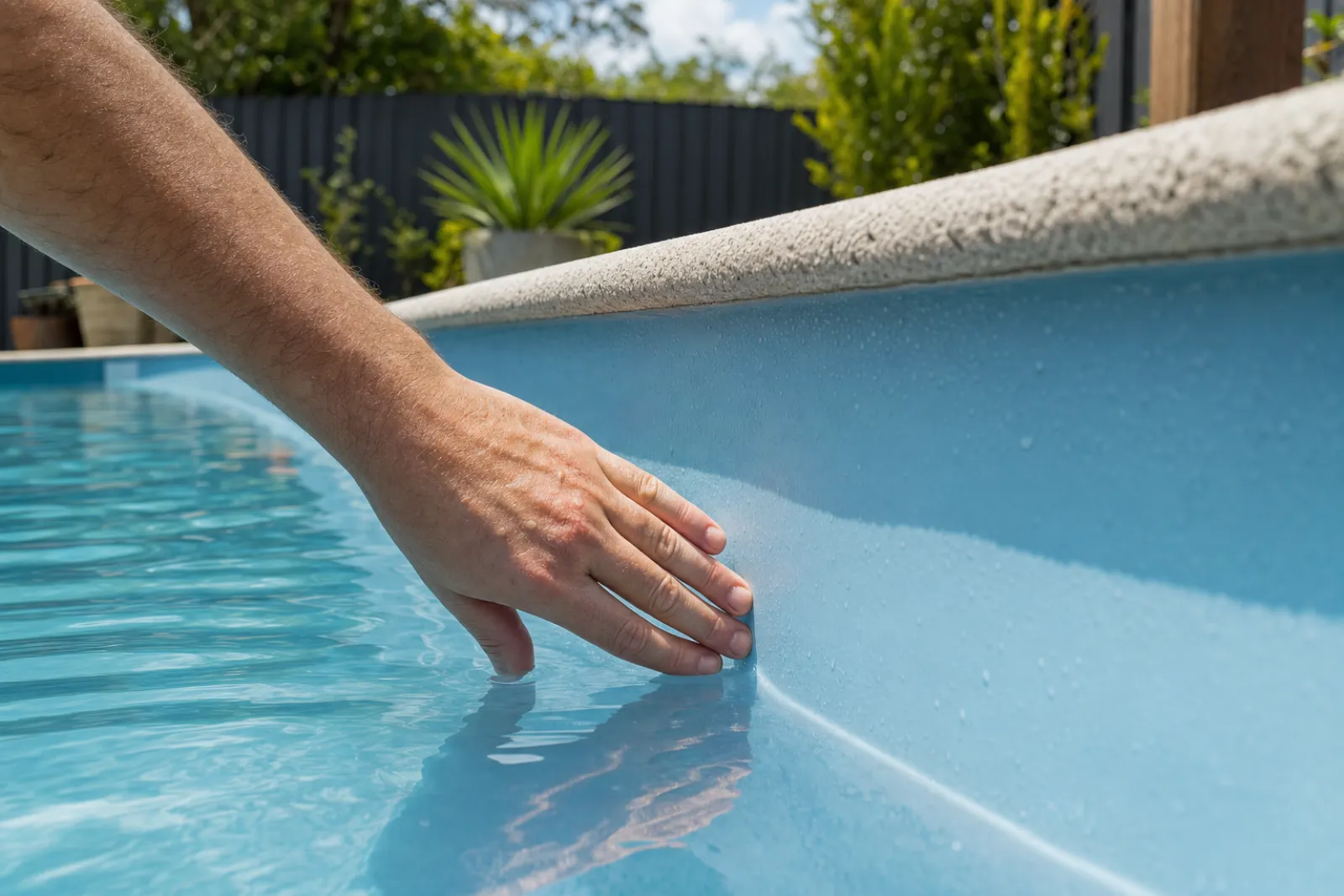
- Osmotic blistering. Water can pass through the gelcoat, react with the resin and form a blister between the layers. Touch can distinguish osmotic blistering and black spotting. A blister is raised, catches a fingernail and does not change when brushed with a nylon brush.
- Black spotting. Black spot algae can grow on walls, floors and steps. It often starts in shaded areas with low water flow. On a gelcoat shell, it remains on the surface. In concrete or plaster finishes, it can enter the porous material.
- Wall bulging and floor movement. Ground or bedding movement can push a wall inward, lift part of the floor, create a hollow area under the floor, leave the pool out of level or lift the shell from the ground. These are installation-ground movement faults, not laminate faults.
- Staining. Metals and organic matter can stain the gelcoat. The stain colour can indicate its source.
Which fibreglass pool problems are cosmetic and which are structural?
Damage confined to the gelcoat is cosmetic. This includes crazing, spider cracks, chalking, fading, and staining. These faults affect only the coloured surface layer. They do not reach the structural laminate or shorten the pool's life.
Damage that reaches the laminate is structural. Ground movement can also cause structural faults without the shell itself failing. Structural faults include cracks that leak water and movement problems such as wall bulging, floor movement and lifting. In extreme cases, the shell can rise out of the ground.
You can check the pool's water level to help classify the damage. The normal operating level is inside the skimmer throat, between one-third and halfway up the opening. The position of the skimmer box determines this level.
If the pool holds its normal water level, the damage is limited to the gelcoat. If the water level drops, a fault is allowing water to escape. Surface crazing is cosmetic. A crack that penetrates the laminate or leaks water is structural and requires an on-site assessment.
Cosmetic faults can be repaired when convenient. Structural faults require an on-site assessment before further movement occurs.
| Fault | What it is | Cosmetic or structural | Urgency | Who resolves it |
|---|---|---|---|---|
| Gelcoat chips and scratches | Damage to the coloured surface layer from metal, glass or a stiff brush | Cosmetic | Not urgent | Shallow marks may buff out in routine care; deeper ones, a gelcoat repairer |
| Surface crazing | Fine cracking confined to the gelcoat | Cosmetic | Not urgent | A gelcoat repairer |
| Spider cracks | Hairline gelcoat cracks where a point of pressure exceeded what the gelcoat can flex to absorb | Cosmetic | Monitor | A gelcoat repairer |
| A crack that weeps water | A crack that has reached the glass-and-resin laminate behind the gelcoat | Structural | Call us | Us, on site |
| A leak at a fitting or in the plumbing | Water escaping at the skimmer, a return, the main drain, the light or the buried pipework | Neither: a plumbing fault, not shell damage | Call us | Us, on site |
| Fading and chalking | The gelcoat weathering under ultraviolet light and oxidation | Cosmetic | Not urgent | Routine care slows it; a gelcoat repairer restores it |
| Osmotic blistering | Water that has crossed the gelcoat and reacted with the resin, raising a blister between the layers | Structural: it is in the laminate | Have it assessed | A fibreglass repairer |
| Staining | Metal or organic marking that sits flush with the gelcoat | Cosmetic | Not urgent | Your own routine care |
| Wall bulging | A wall pushed inward where backfill pressure exceeded the water pressure inside | Structural | Call us | Us, on site |
| Floor movement or a hollow patch | Bedding washed out from under the floor, leaving that section unsupported | Structural | Call us | Us, on site |
| The pool sitting out of level | The support beneath the shell has moved, so the waterline reads high on one wall and low on another | Structural | Call us | Us, on site |
How often do fibreglass pool problems actually happen?
Reliable published data on fibreglass pool faults is not available. Builders, manufacturers, and regulators do not maintain defect records for installed pools. Reported rates of cracking, blistering, and lifting are therefore estimates.
Lifting, wall bulging, and uneven settling are uncommon when a pool is installed correctly and remains full. These faults are generally related to installation quality and water level rather than the shell material.
Our installation process reduces these risks in three ways.
First, we use 7mm blue stone pebble aggregate as backfill. Its angular pieces lock together and allow drainage. Saturated sand can wash out or liquefy. This can create more pressure outside the pool wall than the water creates inside it, causing the wall to bulge. Angular aggregate reduces this risk.
| Washed sand | 7mm blue stone aggregate (what we use) | |
|---|---|---|
| Particle shape | Fine, rounded grains | Angular pebble |
| Interlock | Grains do not lock together | Pieces lock together, the same way rail ballast holds under load |
| Drainage | Free-draining when clean | Free-draining |
| When saturated | Can wash out or liquefy, pressing on the pool wall | Properties do not change when wet |
| Compaction and settling | Difficult to compact fully; can continue settling after installation | Compacts during placement |
Crusher dust and crushed rock are also commonly used as pool backfill in Australia. We use 7mm blue stone aggregate for every installation.
Second, we remove water from the excavation during construction. We fill the pool while installing the backfill. This balances pressure on both sides of the pool walls.
Third, pool shells arrive with only the standard plumbing holes. We cut and pre-plumb jets, lights, and other fittings at our yard. Staff prepare the plumbing for the following week’s pools in one location. This process helps identify leaks and malfunctions before delivery.
A well-made fibreglass shell can have a structural life of 30 years or more when it is correctly installed and maintained. The bedding, backfill, and drainage must remain effective for the same period.
What damages a fibreglass pool?
Five factors can damage a fibreglass pool: bedding and backfill, ground movement, groundwater, water chemistry, and physical contact with the gelcoat.
- Poor bedding, backfill, or site drainage can cause wall bulges, cracks, and leaks in buried pipework. Saturated sand backfill can liquefy and press against the pool wall with more force than the pool water exerts from inside. Sand is also difficult to compact fully and can continue settling after installation. This movement can pull down pipework connected to skimmers and returns until the connections leak. Angular 7mm blue stone pebble aggregate compacts during placement, drains freely, and does not change properties when wet. This is why we use it for backfill. Bedding, backfill, and drainage cannot be inspected after installation, but they affect the pool’s long-term performance.
- Ground and soil movement can cause cracks and bulges. Causes include soil settlement, nearby excavation, and uneven pressure from shifting ground. Improper installation is the most commonly identified cause of cracking and spider cracking. Bulging is also often linked to incorrect installation rather than groundwater alone. Damage may take years to appear.
- Groundwater when the pool is empty can cause floor movement, wall bulging, and lifting of the shell. Groundwater in saturated soil applies inward and upward pressure from outside the pool. Water in a full pool applies outward pressure and provides weight that holds the shell on its bedding. When the pool is empty, groundwater can push the walls inward, lift unsupported floor sections, or lift the entire shell. The hydrostatic valve manages this pressure. It is a one-way pressure-relief valve installed in the pool floor. When pressure builds below the pool, the valve opens and allows groundwater to enter instead of lifting the shell. SPASA states that builders fit a valve at the lowest point of a new pool and advises caution where groundwater is about 1.5 to 1.8 m below the surface. Owners should not drain a fibreglass pool or lower the water level to access a fitting. We drain a pool only when required for repairs and after managing the groundwater.
- Water chemistry can cause surface staining, scaling, chalking, and gelcoat deterioration. Incorrect water chemistry affects the gelcoat only. It cannot crack the laminate or cause osmosis. Published operating limits are 1 to 3 ppm chlorine and a pH of 7.2 to 7.8. Chlorine levels above 5 ppm can damage the surface. Calcium hardness should remain below 120 ppm, total alkalinity between 80 and 120 ppm, and cyanuric acid between 20 and 50 ppm. Chlorine becomes less effective when cyanuric acid exceeds 100 ppm. Source water often contains more than 120 ppm calcium. A stain and scale control product can manage this.
- Physical contact can scratch or gouge the gelcoat. Metal, glass, and other sharp objects can cause scratches when dragged across the surface. Wire brushes, stiff bristles, and metal scrapers can cause gouges. Use only a nylon brush in a fibreglass pool. Shallow scratches may be removed by buffing. Deeper damage requires a gelcoat repair.
Do fibreglass pools have more problems than concrete or vinyl-liner pools?
Fibreglass, concrete, and vinyl-liner pools have different types of problems and maintenance requirements.
- Fibreglass pools: The shell is a single moulded piece. Problems usually occur around penetrations, buried plumbing, or ground movement. Current Aqua Technics shells use a factory-cured gelcoat and do not have a separate finish layer that requires scheduled resurfacing. These pools should only be emptied for major repairs.
- Concrete pools: The finish is a separate porous layer over the structure and can crack. The pool is typically drained and resurfaced every 10 to 15 years.
- Vinyl-liner pools: The liner can tear and requires replacement every 5 to 12 years. The pool must be emptied for each replacement.
Fibreglass shells are designed to flex slightly with ground movement. Concrete shells are rigid and may crack under movement. Any inground pool can float or lift if it is installed or maintained incorrectly, regardless of the shell material.
Osmosis affects specific shells rather than all fibreglass pools. Aqua Technics shells with graphene reinforcement and the ColourGuard surface do not develop osmosis under normal operating conditions and do not require scheduled resurfacing. Osmosis is associated with older shells and shells made to older specifications by other manufacturers.
Pool construction type and fault diagnosis are separate considerations. The fibreglass pools we install start at $47,233 installed.
| Pool size | Length | Depth | Installed from |
|---|---|---|---|
| 3m to 4m | 1.45m level | $45,896 | |
| 4m to 5.5m | 1.0m to 1.78m | $45,660 | |
| 6m to 7m | 1.0m to 1.88m | $54,454 | |
| 7.2m to 8m | 0.98m to 1.96m | $60,385 | |
| 8.5m to 11m | 1.0m to 2.0m | $72,546 |
Live all-inclusive installed pricing for standard site conditions in South East Queensland — updated straight from our quoting system.
What should you do first when something looks wrong with a fibreglass pool?
Complete these five steps in order before starting any repairs.
- Record and monitor the water level. The normal operating level is one-third to halfway up the skimmer throat. Mark the current level and check it over the next few days. A falling water level can help distinguish a structural fault from a gelcoat fault.
- Photograph the fault with an object for scale. Place a coin, tape measure or hand next to the crack, blister or stain so the repairer can assess its size.
- Check the fittings and equipment before checking the shell. Inspect the skimmer, return fittings, main drain, light and buried pipework for leaks.
- Tap the floor if it appears damaged or uneven. A hollow sound indicates that the shell has lost contact with its bedding at that point. This is a support issue, not a shell failure.
- Do not drain the pool, even partially. The water helps hold the shell in the ground.
Cosmetic surface faults may require routine care or a gelcoat repair. Contact a builder if the issue involves water loss, wall or floor movement, or lifting around the pool. The builder will need to inspect the site, open the surround and measure the movement. Photographs alone are not sufficient for an assessment.
Fibreglass pool repair is regulated work in Queensland. The QBCC requires repairs valued above $3,300 to be completed by a licensed contractor. This work is covered by the QBCC home warranty insurance for 6 years and 6 months, up to $200,000. The insurance covers defective or incomplete work and subsidence or settlement beneath the pool.
For pools we build, we provide a 7-year workmanship warranty and remain responsible for the installation. The shell manufacturer provides written structural and surface warranties with the pool.
If the pool is losing water, contact the builder who installed it.
FAQs
What are the downsides to a fibreglass pool?
Fibreglass pools are manufactured in moulds, so buyers must choose from the available shapes and sizes. We install 37 models ranging from 3.0 m to 11.48 m long.
The surface has a gelcoat finish. Deep scratches or gouges require repair by a gelcoat specialist.
Owners should not drain the pool. The water provides ballast that helps hold the shell in the ground.
What is the average lifespan of a fibreglass pool?
A well-made fibreglass pool shell can last 30 years or more when it is correctly installed and maintained. Pumps, chlorinators, and heaters typically require replacement during this period without affecting the shell. The pool’s lifespan also depends on correct bedding, backfill, and drainage, which help prevent ground movement.
What happens to a fibreglass pool after 25 years?
A 25-year-old fibreglass pool remains within its structural life. By this age, the gelcoat may show signs of ageing. These signs usually appear above the waterline first. Ultraviolet light can reduce colour and gloss, while oxidation can make the surface chalky.
A current Aqua Technics shell does not have a scheduled resurfacing requirement. In comparison, a concrete pool may require resurfacing every 10 to 15 years and could have been resurfaced two or three times by age 25.
Is salt water bad for fibreglass pools?
No. A salt-chlorinated fibreglass pool has the same operating limits as other fibreglass pools. Keep chlorine between 1 and 3 ppm. Levels above 5 ppm can damage the surface. Monitor the chlorine level rather than the salt level.
Salt water can affect metal fittings around the pool. Galvanised anchors typically fail after three or four years in a salt-chlorinated pool. Use brass anchors instead.
What causes brown stains on my fibreglass pool?
Metals in the water can cause brown stains. The stain colour can indicate the type of metal:
- Iron: orange, brown, or tan
- Manganese: brown, black, or purple
- Copper: green or blue
Organic material, including leaves, dirt, berries, and other decaying matter, can also stain the pool surface.
A stain sits flush with the gelcoat. An osmotic blister is raised and catches a fingernail.