Fibreglass Pool Hydrostatic Valve: Leaks & Replacement
What a hydrostatic valve does in a fibreglass pool, how a leaking or seized valve behaves, and what replacement costs in Australia.
Written by Tehbyn Nova, Head of Operations & Growth · Technically reviewed by Caleb Druhan, General Manager (QBCC licence 15087383) on
Published
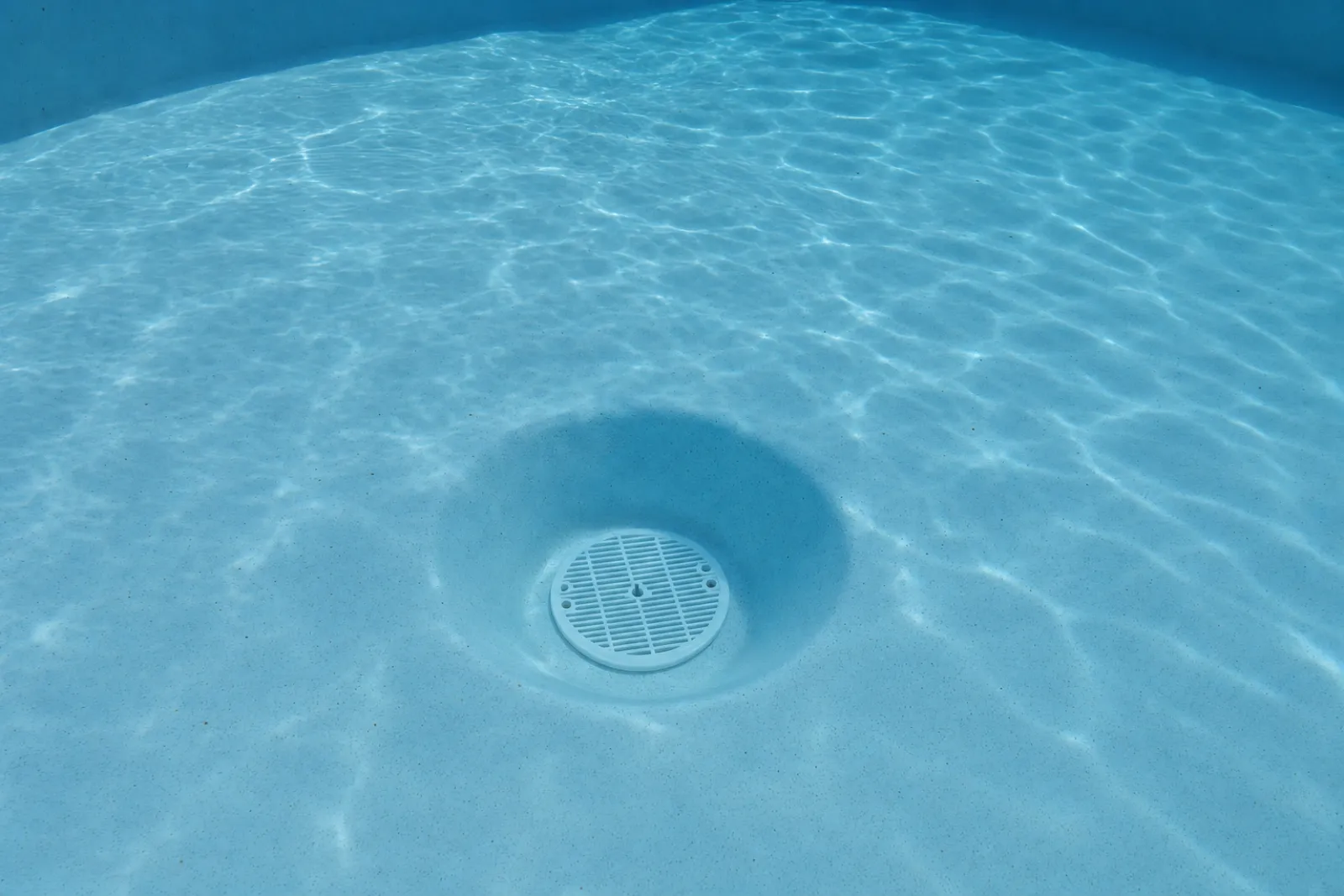
A fibreglass pool hydrostatic valve is a one-way pressure-relief valve installed in the pool floor. It is also called a hydrostatic relief valve. The valve is located near the lowest point of the pool, inside the shallow well that contains the main drain, and faces the ground below the shell.
When groundwater pressure builds below the pool, the valve opens and allows groundwater to enter the pool. This reduces pressure against the outside of the shell. Water flows through the valve only from the ground into the pool.
The hydrostatic valve is separate from the main drain and does not empty the pool. It protects the shell from pressure caused by saturated soil against the pool walls and floor. Excessive pressure can bulge a wall, push the floor upward, crack the shell, or lift the pool out of the ground. Hydrostatic valves are standard in Australian fibreglass pools.
What is the hydrostatic valve in a fibreglass pool?
A fibreglass pool shell has four main types of fittings. The hydrostatic valve is the only fitting connected to the ground below the pool instead of the filtration system.
- The skimmer box. The skimmer box draws water from the pool surface and sends it to the pump. It also sets the normal operating water level. This level is usually between one-third and halfway up the skimmer opening.
- The return fittings. The return fittings send filtered water back into the pool.
- The main drain or floor sump. The main drain is a suction fitting at the lowest point of the pool floor. It connects to the pump and draws water from the bottom of the pool.
- The hydrostatic valve. The hydrostatic valve opens when groundwater pressure rises below the pool. It allows groundwater to enter the pool and does not connect to the filtration system.
The floor slopes toward a shallow well at its deepest point. The main drain and hydrostatic valve are both installed in this well. The main drain is the suction fitting. The hydrostatic valve is installed inside the main drain assembly and faces down into the bedding and ground below the pool.
Main drain assemblies are supplied with a hydrostatic valve, so the two fittings are often confused. The hydrostatic valve is not the main drain. It does not connect to the pump or empty the pool.
Australian hydrostatic valves are made from impact-resistant ABS thermoplastic. They are available in 40 mm and 50 mm sizes and in white or grey. They include a shell adapter for installation in the pool floor and a dedicated removal tool.
Our shells are supplied with the standard plumbing holes already installed. Staff cut and pre-plumb jets, lights, and additional fittings at our yard instead of on site. All pools scheduled for the coming week are plumbed in one location. This provides better visibility over the work and helps prevent leaks and malfunctions after installation.
What is hydrostatic pressure under a swimming pool?
Hydrostatic pressure is the force that still water applies to a container. The pressure increases with depth, so it is greatest at the deepest part of a pool shell. Groundwater in saturated soil applies pressure to the outside walls and underside of the pool floor. A high water table means that groundwater is closer to the surface than normal.
When a pool is full, the water inside balances the external groundwater pressure. It pushes outward against the walls and floor, while its weight holds the shell against its bedding. A 5.00 m by 2.50 m Allure holds 12,800 litres of water and has a dry shell weight of 477 kg. The water provides about 12.8 tonnes of ballast. A 9.00 m by 4.00 m Westminster holds 39,490 litres and has a dry shell weight of 988 kg. Its water provides about 39.5 tonnes of ballast. The largest shell we install holds 52,780 litres, or about 52.8 tonnes of water. A pool at its normal operating level has no buoyancy. When the pool is drained, only the external groundwater pressure remains. For this reason, pools that rise out of the ground are rarely full.
Groundwater conditions depend on the site, not the pool. Risk is higher in low-lying areas, valleys, coastal zones, clay-heavy soils, and former wetlands. Groundwater pressure can be present even when no surface water is visible. Soil type affects how long water remains around the shell. Sand is the most permeable soil, while clay is the least permeable. A pool on a hill has a lower risk of groundwater movement than the same pool at the bottom of a valley. SPASA recommends caution when groundwater is about 1.5 to 1.8 metres below the surface.
Does a fibreglass pool need a hydrostatic valve?
Yes. New Australian fibreglass pools include a hydrostatic valve in the matched kit or main drain assembly. The valve is installed in the pool floor. SPASA states that builders should install it at the lowest point of a new pool.
Some existing pools do not have a hydrostatic valve. Some concrete pools were built without a main drain or valve. In other pools, the fitting may have been removed or sealed during previous work.
Older pools may use a hydro-plug. This is a rendered plastic rim about the size of a dinner plate, with a pop-up section that lifts under pressure. Some pools have a copper fitting inside the main drain. These fittings can oxidise, seize, and stop working. However, most pools have some form of pressure relief.
Four components help keep a fibreglass shell in place:
- The water. The water provides ballast and presses the shell onto its bedding.
- The backfill. The backfill supports the walls and limits sideways movement.
- The bond beam. The bond beam secures the top edge of the shell and prevents it from rising.
- The hydrostatic valve. The valve allows groundwater to enter the pool instead of building pressure beneath it.
We use pea gravel for backfill. Its irregular pieces interlock, providing more stability and drainage than sand. This helps prevent the shell from tipping, bulging, or rising.
During construction, a standpipe or well removes water from the excavation. The pool is filled as the backfill is added to balance pressure on both sides of the walls.
What damage does hydrostatic pressure do to a pool?
Groundwater pressure can damage an inground pool in four ways:
- Wall bulging. Groundwater in saturated backfill presses against the outside of the pool wall. If this pressure exceeds the water pressure inside the pool, the wall moves inward and the laminate deforms.
- Floor movement. Bedding can wash away and leave a void under the pool base. Groundwater collects in the void and pushes the unsupported floor section upward. A hollow sound when you tap the floor indicates that the shell has lost contact with its bedding. This is a loss of support, not a shell failure.
- Shell distortion and cracking. A shell without even support carries uneven loads. The laminate can crack where movement is concentrated. A rising water table can cause cracking, movement, and lifting.
- Pool lifting. Sufficient groundwater pressure can lift the entire pool out of the ground.
Shell movement can also affect the surrounding area. Coping can separate from the pool edge, and paving can rise or fall with the shell. Groundwater pressure causes several common problems with fibreglass pools, including cracking, movement out of level, and unexplained water loss.
A pool that has floated out of the ground requires shell replacement. A crane may be needed to lift the shell over the house or fence. A shell that has moved without floating may not need replacement. A fibreglass pool bulging or popping can sometimes be removed, re-bedded, reset, and re-levelled. This decision requires an on-site inspection. The surround must be opened and the movement measured. Photographs are not sufficient.
Lifting, wall bulging, and settling out of level are uncommon when the pool is installed correctly and kept full.
Shell material does not determine whether a pool lifts. Any inground pool can float or lift if it is installed or maintained incorrectly. A concrete pool is steel-reinforced and heavier than a fibreglass shell. It is more likely to crack under hydrostatic pressure than to lift, although sufficient pressure can float it. In a vinyl-liner pool, hydrostatic pressure can cause the liner to bubble or float inside the pool. Frost heave can lift pools where the ground freezes in winter. This mechanism does not apply in Australia.
Insurance coverage for hydrostatic damage depends on the policy wording. Australian determinations have reached different outcomes.
In AFCA determination 872465, dated 6 December 2022, AFCA allowed Allianz to decline a claim for an emptied in-ground fibreglass pool damaged by storm rainwater. The insurer’s product disclosure statement used an emptied fibreglass pool in heavy rain as an example of the exclusion.
A 2024 AFCA determination reached a different outcome. Heavy rain pushed a pool out of position. The hydrostatic-pressure exclusion did not apply because the policy defined hydrostatic pressure as pressure exerted by a fluid due to gravity, while the pool had been forced upward. The result depended on that policy’s definition.
Other insurers use different exclusions. QBE’s product disclosure statement excludes pool damage caused by hydrostatic pressure. Suncorp excludes water seeping or running down the sides of, or underneath, swimming pools or spas. Read your product disclosure statement before assuming that insurance will cover a hydrostatic damage claim.
What happens if the hydrostatic valve leaks or fails?
A hydrostatic valve can fail in two ways. One causes water loss. The other can damage the pool.
If the valve allows pool water to flow out, the cause may be worn seals, trapped debris, or valve damage. This is a common cause of unexplained water loss in older pools. The water loss occurs around the main drain because the valve is in the main drain well. Replace the valve to fix the leak.
If the valve cannot open, groundwater pressure cannot escape. Sediment, calcium build-up, corrosion, or perished seals can seize or block the valve. A seized valve may look intact from the pool floor. The resulting pressure can crack, move, or lift the shell. The risk is highest when the pool is refilled after being empty because pressure may have built up under the shell.
Some water movement is normal. Minor seepage, slightly dirty water after heavy rain, or a small temporary change in the water level can indicate that the valve is releasing groundwater pressure as intended.
Owners can perform a bucket test. Run the test twice: once with the pump running and once with the pump off. Dye testing at a suspected fitting should be performed by a repairer. If the test confirms water loss, arrange professional leak detection. The inspection should include the hydrostatic valve, skimmer, main drain, return fittings, tile line, shell cracks, lights, and buried filtration pipework.
First, check whether the pool is maintaining its operating water level. Water loss helps distinguish a structural fault from a surface issue. Do not drain the pool. Ask a builder to open the surround and measure the movement. Photographs alone are not sufficient for an assessment.
Can a hydrostatic valve be replaced without draining the pool, and what does it cost?
A hydrostatic valve can sometimes be tested or replaced while the pool is full. This depends on the fitting and site conditions. If access is suitable, an underwater pool diver can complete the work. Otherwise, the water level must be lowered to reach the floor of the shell. In a fibreglass pool, lowering the water level is builder work.
Customers must not remove a hydrostatic valve or plug themselves. A builder must assess the pool, select the appropriate method, and use the required removal and refitting tools. If the pool is already empty for other work, the old valve can be removed and a new valve must be installed before refilling.
Local Pool Renovations publishes a price range of $500 to $800 to replace an accessible swimming pool hydrostatic valve. It is the only firm we have found that publishes a price. This is not an MFP Easy price. MFP Easy does not publish a standard price for hydrostatic valve replacement. The price for a specific pool is confirmed after inspection.
Underwater replacement costs more than replacement in a pool that is already empty. Seized fittings, a damaged housing, a new main drain, or structural repairs to the pool floor can increase the final price.
The commonly published service interval for a hydrostatic valve is approximately 5 to 7 years. Local Pool Renovations recommends replacement on average every 6 to 7 years. Sweet Acres states a lifespan of approximately 5 to 7 years, with deterioration beginning after about five years. Aqualine Pool Resurfacing recommends replacement every five years. A separate estimate of 15 to 20 years is also in circulation.
No valve manufacturer or Australian Standard publishes a required replacement interval. Waterco supplies a commonly used ABS valve in the Australian market. It specifies impact-resistant ABS thermoplastic and a one-year warranty but does not publish a replacement schedule. The 5 to 7 year interval is a trade convention published by businesses that provide replacement services. The usual failure is degradation of the rubber sealing O-ring from exposure to pool chemicals, rather than failure of the ABS body.
How do you relieve hydrostatic pressure before draining a fibreglass pool?
A builder relieves hydrostatic pressure in the following order:
“There is no job where an owner should pull a hydrostatic valve or plug. If a pool ever needs draining, we relieve the pressure first — that one step is what keeps a shell in the ground.”

- Read the groundwater level. Measure the groundwater level before draining the pool. This determines whether the pool can be drained safely. Some fibreglass pools have an inspection standpipe near the pool edge, covered by a grate. Insert a dowel or stiff wire into the standpipe and measure the wet section.
- Dewater the ground around and under the shell. Pump groundwater through a standpipe or well until it reaches a safe level. This reduces pressure under the shell.
- Confirm the hydrostatic valve is working. Check the valve before lowering the pool water. A seized valve cannot release pressure.
- Use the correct relief point. This is normally the hydrostatic valve or plug at the deepest part of the pool floor, where pressure is highest.
- Brace the walls. Bracing supports the walls against backfill pressure when the water inside the pool no longer provides support.
- Keep the pool full during groundwater removal. The pool water provides ballast. Do not lower it until dewatering has reduced the groundwater level.
Do not drain the pool during extended heavy rain or shortly before or after a storm. Rain increases groundwater pressure and can push the pool out of the ground. Direct discharged water downhill and well away from the pool so it cannot return to the ground beneath the shell. Disposal to sewer or stormwater must comply with council rules, which vary by state.
Pool owners should not perform this work. Some United States procedures tell homeowners to locate hydrostatic plugs along the pool bottom, break the plaster around the centre plug with a hammer and chisel, and remove the plug with large straight pliers. This procedure applies to plastered concrete pools. It is not suitable for owner use on any pool we install.
Draining a fibreglass pool without professional supervision can cause the shell to crack, crease, bulge or shift. It may also void the warranty. Do not lower the water level to access a fitting. The water holds the shell in the ground. emptying a fibreglass pool is a structural procedure that must be managed by the builder.
FAQs
Can a pool leak through a hydrostatic valve?
Yes. Worn seals, trapped debris, or valve damage can allow pool water to leak through a hydrostatic valve. This is a common cause of unexplained water loss in older pools.
Because the valve is in the main drain well, signs of water loss may appear around the main drain. A professional leak-detection inspection checks the hydrostatic valve, skimmer, return fittings, tile line, shell cracks, lights, and buried filtration pipes.
How often should a hydrostatic valve be replaced?
The common replacement interval is 5 to 7 years. Local Pool Renovations recommends 6 to 7 years, Sweet Acres recommends 5 to 7 years, and Aqualine Pool Resurfacing recommends 5 years. Some sources recommend 15 to 20 years.
Valve manufacturers and Australian Standards do not specify a replacement interval. Waterco identifies the valve material and provides a one-year warranty but does not publish a replacement schedule.
Pool chemicals degrade the rubber sealing O-ring rather than the ABS body.
How long does it take for hydrostatic pressure to go down?
Hydrostatic pressure decreases as groundwater is removed from around and under the shell. There is no fixed timeframe. A standpipe or well is used for dewatering. The time required depends on the soil. Sand is the most permeable and drains fastest. Clay is the least permeable and drains slowest. Rain adds groundwater, so do not take down a pool during extended heavy rain or shortly before or after a storm.
Will my pool pop out of the ground if I drain it?
A fibreglass pool can lift out of the ground when drained. Do not drain the pool without professional supervision.
At its normal operating level, the weight of the water holds the shell on its bedding. When the pool is empty, groundwater pressure can push the shell upward. This can cause cracking, creasing, bulging, or shifting and may void the warranty.
Can a concrete pool pop out of the ground?
Yes. Sufficient hydrostatic pressure can lift a concrete pool, but cracking is more common because concrete pools are steel-reinforced and heavier than fibreglass shells. In vinyl-liner pools, hydrostatic pressure can cause the liner to bubble and float inside the pool. Any inground pool can lift or float if it is installed or maintained incorrectly.