Fibreglass Pool Bulging & Popping: Causes and Fixes
A fibreglass pool can lift, bulge or go out of level. One cause explains all three: ground water pressure. What is urgent, and what to do next.
Published · Updated
Direct answer
A fibreglass pool can lift, develop a wall bulge, or become uneven. Fibreglass pool bulging and popping occur when groundwater pressure outside the shell exceeds the pressure from the pool water and surrounding support.
Can a fibreglass pool pop out of the ground?
Yes. A fibreglass pool can lift when the shell is empty or partly empty and the surrounding ground is saturated.
A pool filled to its normal operating level, with the water between one-third and halfway up the skimmer opening, has no buoyancy. The weight of the water holds the shell in place. Pool lifting requires two conditions:
- The pool is empty or the water level is low.
- The surrounding ground is saturated.
This issue is not specific to fibreglass pools. Any inground pool can float or lift if it is installed or maintained incorrectly, including concrete and vinyl-liner pools.
Groundwater pressure causes lifting, bulging walls and an out-of-level waterline. It acts against the water inside the pool and the support material around the shell.
What causes a pool to pop out of the ground?
A pool can rise out of the ground when groundwater pressure outside the pool exceeds the downward pressure from the water inside it. Groundwater can collect in the backfill around the shell and beneath the floor. Water pressure increases with depth, so the greatest pressure occurs at the deepest part of the shell. This pressure pushes up on the floor and inward on the walls. If the pressure outside exceeds the weight inside, the shell can become buoyant and move.
Three site conditions can cause groundwater to build up:
- A high water table. Groundwater is already close to the surface, so the soil around the shell may be wet before it rains.
- Ground that drains poorly. If rain falls faster than the ground can drain it, water remains on the site. Backfill can hold this water against the shell.
- Flood-prone ground. Flooding can place a large volume of water around and beneath the shell.
The water level inside the pool is also a factor. An empty or partially empty pool weighs less than a full pool. If the surrounding ground is saturated, the reduced weight can allow the shell to rise. This commonly occurs after heavy rain on poorly drained ground. Pools that rise are rarely full.
How is a fibreglass pool held down?
Four components hold a fibreglass pool shell in place:
- Water in the pool. Water provides ballast and presses the shell onto the bedding. Draining the pool removes this restraint.
- Backfill and the bond beam. Backfill supports the pool walls and limits sideways movement. The bond beam secures the top edge of the shell and prevents it from rising.
- The hydrostatic valve. This one-way valve is installed in the pool floor. It allows groundwater to enter the pool rather than build pressure below the shell. Other fittings — the skimmer box, returns, and main drain — are cut into the shell after it leaves the mould.
- Dewatering during construction. Groundwater is pumped out of the excavation before the pool is full. A dewatering standpipe or well prevents water from collecting below the shell during installation.
During backfilling, the pool is filled with water to balance pressure on both sides of the walls.
Do not drain a fibreglass pool for maintenance. Fibreglass pools do not require the resurfacing used for concrete pools or the relining used for vinyl-liner pools. Do not drain the pool to address a bulge, stain, cloudy water, or another issue. Water provides structural ballast, so what happens when the water level drops must be assessed by the builder. The owner should not decide to drain the pool.
Why are my fibreglass pool walls bulging or bowing?
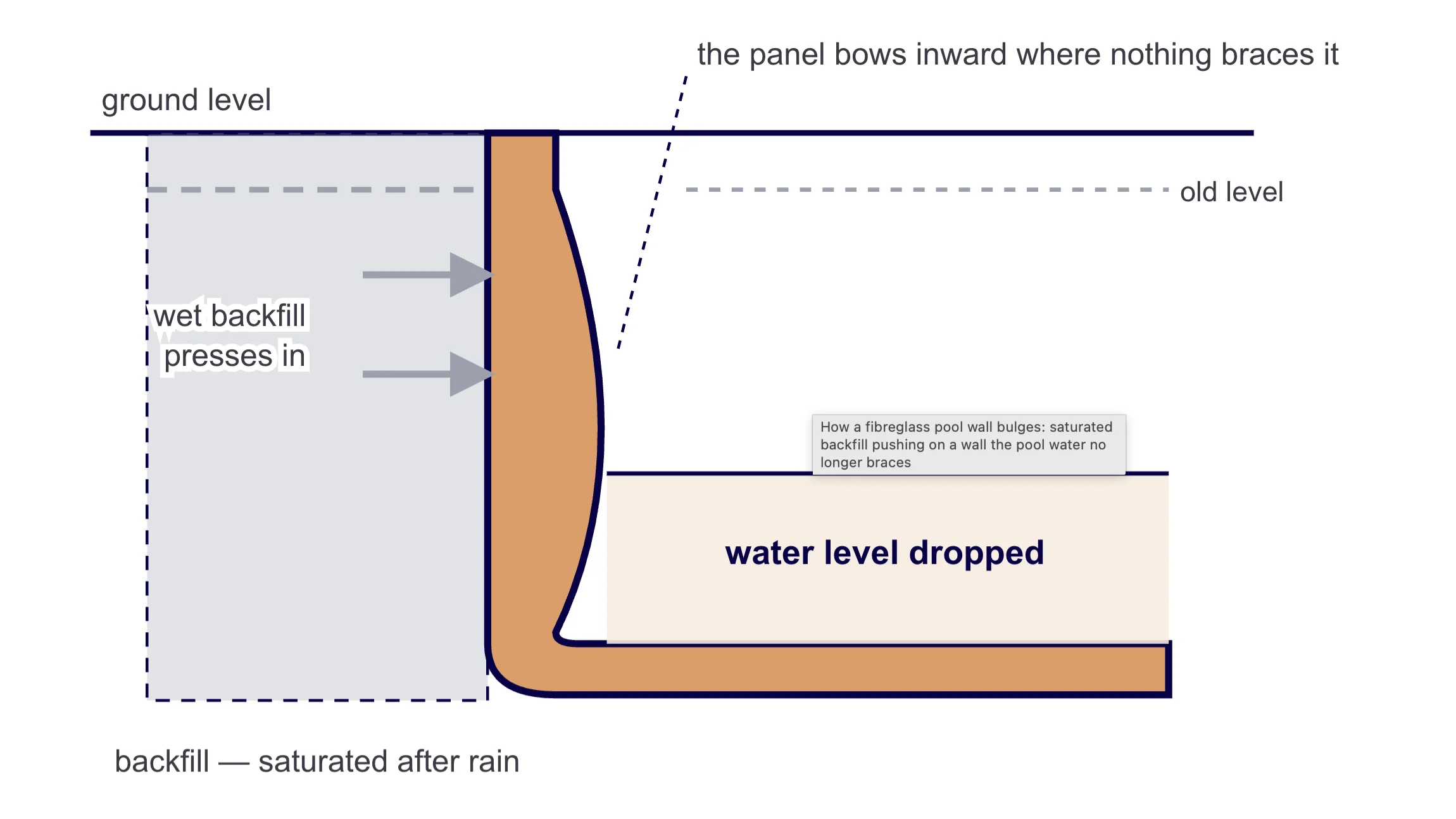
A bulge in a fibreglass pool wall usually indicates a problem with the backfill behind the wall, not the pool shell. Backfill supports the wall. If it becomes saturated and loses its structure, it can press against the wall. When this external pressure exceeds the water pressure inside the pool, the wall moves inward.
Bulging walls and lifting shells have the same cause. If groundwater pressure exceeds the pressure from the pool water, it can lift the floor or push a wall inward.
To check whether a bulge is still moving:
- Mark the edge of the bulge.
- Mark the pool water level.
- Check both marks after the next week of rain.
If either mark changes, the wall is still moving. Contact a repairer that week. If the bulge does not change after a wet week, plan a repair, but it is not an emergency.
Settling backfill can also pull down buried pipework, including pipes connected to the skimmer and returns. This movement stresses the pipes and connections and can cause leaks. A bulged wall and a wet patch in the same area of the yard may have the same cause. The leak will continue to waste water until it is repaired.
Why is the floor of my fibreglass pool bulging or sounding hollow?
A bulge or hollow patch in the floor of a fibreglass pool usually indicates a problem with the bedding under the base, not the fill beside the walls. The pool shell rests on a prepared bedding layer. If the bedding washes away, it leaves a void under the floor. Ground water can then collect under the shell and push the unsupported section upward.
You can check the floor with a tap test:
- Tap or press across the pool floor.
- Compare the response in different areas.
- Identify areas that sound hollow rather than solid.
A hollow sound indicates that the shell is no longer in contact with the bedding in that area. It identifies a loss of support, not a failure of the shell.
How is a bulging fibreglass pool fixed?
Repairing a bulging fibreglass pool usually involves three steps:
- Reduce water pressure around and under the shell. The repairer removes groundwater from around the pool before starting other repairs. The pool remains full during this work.
- Restore support. The repairer replaces or repairs the backfill behind the wall or the bedding under the floor. This supports the shell and reduces further movement.
- Repair the shell surface. The repairer completes the gelcoat repair after stabilising the ground and shell. Repairing the surface earlier may result in further cracking.
If the shell has moved too far to repair in place, the repairer must remove it. They then re-bed the base and reset the shell. This takes longer and costs more than a wall repair.
Use the visible signs to determine when to contact a repairer.
| What you can see | How urgent | Who to call |
|---|---|---|
| The shell has visibly lifted, or the water level has dropped below the skimmer opening | This week | The builder who installed the pool |
| A wall bulge that is still moving against your marks | This week | The builder who installed the pool |
| A wall bulge that has not changed since you marked it | At the next service | A pool repairer |
| A hollow or drummy patch in the floor | At the next service | A pool repairer |
| A waterline that sits higher against one end | Monitor and re-check after heavy rain | The builder who installed the pool, if it changes |
| Hairline cracking in the gelcoat surface | Not urgent: cosmetic rather than structural | A pool repairer, at the next service |
For either of the first two issues, contact the builder who installed the pool. These issues relate to the ground around or under the pool. We provide warranty and remedial work for pools we build.
If the shell has moved, assessing movement-related shell damage must occur before gelcoat repair. The ground must be stable before surface repairs begin.
Why is my fibreglass pool not level?
A fibreglass pool becomes unlevel when the support beneath the shell moves. The water surface remains level even when the shell moves. If part of the shell drops, the waterline appears higher on the pool wall. If part of the shell rises, the waterline appears lower. Compare the distance between the waterline and the top of the pool at each end to measure the difference.
Common causes include:
- Ground settlement under one side of the pool
- Bedding washed out from under one end
- Movement within the site
These issues affect the support beneath the shell rather than the shape of the shell. Frost heave can lift pools in climates where the ground freezes during winter, but it is not relevant in Australia.
Can a fibreglass pool be re-levelled, and what happens to the surround when the shell moves?
A fibreglass pool shell can be lifted, re-bedded, and re-levelled instead of replaced. A builder must inspect the pool on site, open the surround, and measure the movement before deciding whether to reset or replace the shell. Photos are not sufficient for this assessment.
Shell movement affects the joint between the shell and the surrounding materials. The coping around the rim can separate, and the paving behind it can lift or drop. Re-leveling the shell requires removing and relaying the affected coping and paving. This work must be included in the project cost and schedule.
How often does any of this actually happen?
Lifting, wall bulging, and settling out of level are uncommon when a fibreglass pool is installed correctly and kept full. Fibreglass laminates can flex with ground movement. In comparison, rigid concrete shells can crack.
Installation quality is the main variable. Poor bedding, backfill, or site drainage can cause bulges, cracks, and leaks.
Inspect the pool once a year:
- Keep the water at its normal operating level throughout the year, including winter and periods when the pool is not in use.
- After the wet season, check the coping joint for new gaps.
- Check for changes in the coping joint, the waterline at either end, and the feel of the floor underfoot.
FAQs
Can a drained pool pop out of the ground?
Yes. An empty or partially empty pool can lift when the surrounding ground is wet. Draining the pool removes the weight that holds the shell down, while groundwater continues to apply pressure outside the shell. The backfill, bond beam, and hydrostatic valve must then hold the shell in place without support from the water inside the pool.
The owner must not drain the pool to any depth for any reason.
How do you drain a fibreglass pool without cracking it?
Do not drain a fibreglass pool yourself. A pool builder or repairer should drain it only when required for a repair and after managing groundwater around and under the shell. The repairer is responsible for draining the pool. Owners should not lower or remove the water.
What is the downside of a fibreglass pool?
A fibreglass pool, spelled fiberglass in the United States, requires correct installation. Poor installation is the most common cause of spider cracking, which appears as hairline cracks in the gelcoat. Long-term performance depends on the bedding, backfill, and site drainage. These components cannot be inspected after installation. The pool must also remain full of water to keep it in place.
Is a fibreglass or concrete pool more likely to pop out of the ground?
The shell material does not determine whether a pool will lift. Any inground pool can lift when the groundwater pressure outside the pool is greater than the weight of the water inside it.
The risk increases when the pool is empty. Concrete pools are drained for resurfacing, and vinyl-liner pools are drained for relining. Fibreglass pools are not emptied for maintenance.
What is the average lifespan of a fibreglass pool?
A fibreglass pool shell has a long lifespan. Lifting, bulging, and settling usually result from problems with the ground around or under the shell, not from the shell itself. A builder can assess a pool that has moved and determine whether to lift, re-bed, and reset it instead of replacing it. Hairline cracks in the gelcoat are cosmetic, not structural, and do not reduce the pool’s lifespan.