Fibreglass Pool Removal: Options, Process & Costs
Fibreglass pool removal explained: full removal, partial removal and fill-in, what each costs in Australia, council rules and the backfill spec.
Written by Tehbyn Nova, Head of Operations & Growth · Technically reviewed by Caleb Druhan, General Manager (QBCC licence 15087383) on
Published · Updated
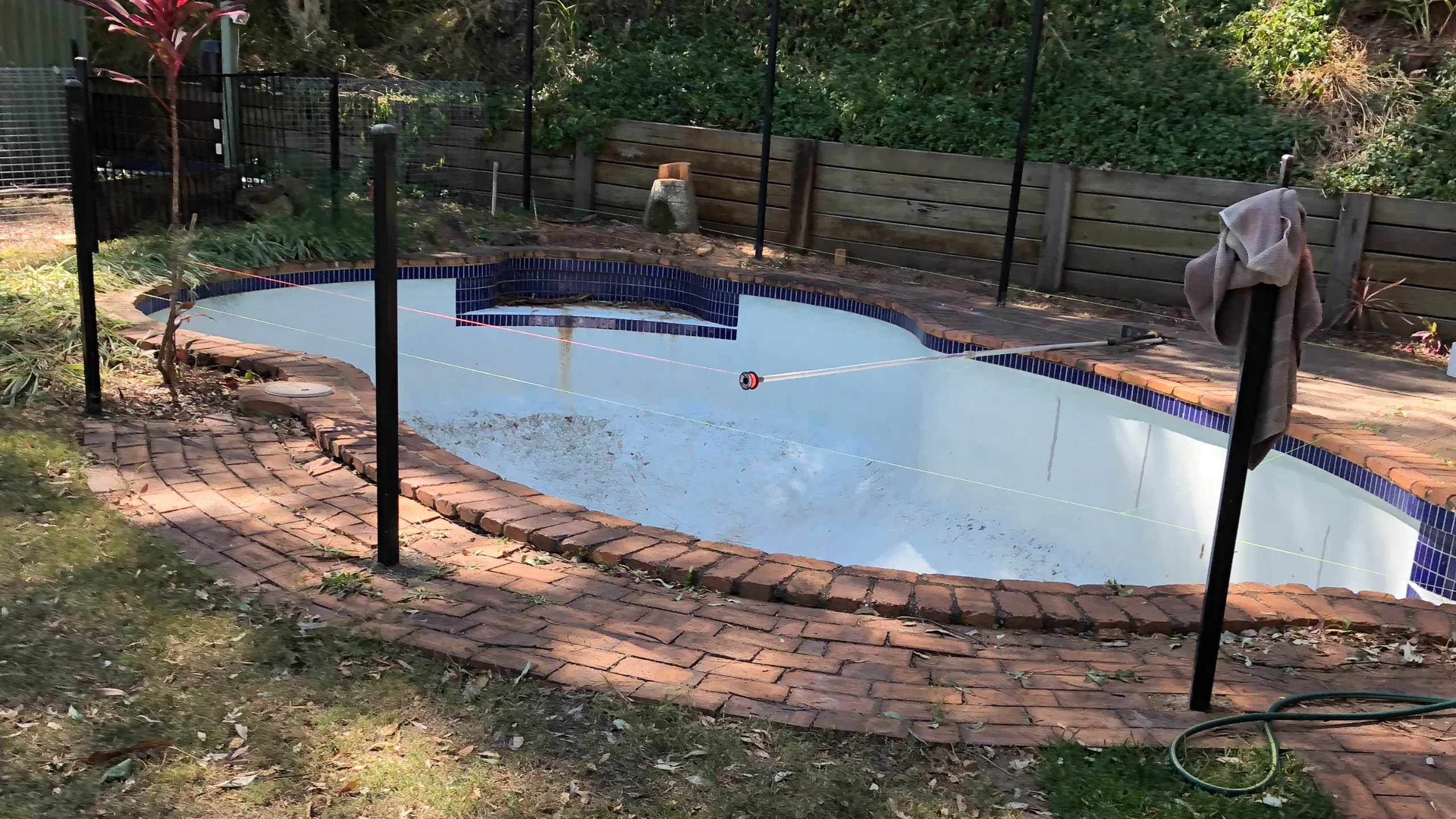
Can a fibreglass pool be removed?
Yes. A fibreglass pool can be fully or partially removed.
Full removal involves excavating and removing the shell, plumbing, and equipment. The remaining void is filled with clean fill.
Partial removal is also called decommissioning or filling in. The contractor cuts drainage holes in the base, removes the top sections of the walls, and backfills the pool. The remaining shell stays in the ground.
A fibreglass shell is a single moulded unit. It is usually lifted out whole or cut into sections. For example:
- The Allure is 5.00 m long and 2.50 m wide. It weighs 477 kg dry and holds 12,800 L of water.
- The Amalfi is 9.00 m long and 3.60 m wide. It weighs 926 kg dry and holds 30,600 L of water.
We build and install fibreglass pools across South East Queensland. We do not offer pool removal as a standalone service.
The water inside a fibreglass pool helps balance external soil and groundwater pressure. Because the shell is lightweight, draining the pool can affect its shape and position. The water must therefore be managed before removal begins.
Fibreglass pool removal is available from specialist contractors in Australia. Pool Removal Perth in Western Australia, Reverse Pools in Melbourne, and Pool Removal Pro Brisbane in Queensland advertise this service. Pool Removal Pro Brisbane states that it removes the shell and leaves the site level. Contractors use machinery because a one-piece shell set in a concrete collar cannot be removed by hand.
What are your options for getting rid of a fibreglass pool?
There are two methods for removing a fibreglass pool:
- Full removal: The shell, plumbing and pool equipment are removed from the property.
- Partial removal: The shell base is holed for drainage, the walls are cut down and the remaining shell is backfilled. This is also called decommissioning or filling in.
A third method would leave the shell intact under the fill. No Australian contractor publishes this as an available option for fibreglass pools.
Full removal creates a compacted area with no shell, plumbing or pool equipment remaining. Pool Removal Perth provides pricing for full fibreglass pool removal. It offers in-place decommissioning only for concrete and liner pools, subject to council consent.
Partial removal leaves part of the shell underground. Pool Removal Perth states that this area is not buildable, cannot support additions or dwellings and must be disclosed to future buyers. It also states that partial removal limits how the area can be used.
| Route | What happens to the shell | What the ground can carry afterwards | Cost source |
|---|---|---|---|
| Full removal | The shell is cut into panels or lifted out whole. The shell, plumbing and equipment are removed, and the void is filled with clean fill sand. | Compacted footprint. A compaction or engineer's certificate can be obtained. Pool Removal Perth states that this certificate is required before a building permit. | Pool Advisor: $7,200–$18,000 for complete removal of a 50,000 L in-ground pool on an easy-access site. Pool Removal Perth: from $3,000 +GST, with full fibreglass removal priced at $3,000–$4,000 +GST. |
| Partial removal (fill-in) | The base is holed for drainage, the top of the walls is removed and the remaining shell is backfilled. | Pool Removal Perth states that the area is not buildable, cannot support additions or dwellings, must be disclosed to future buyers and limits how the yard can be used. | Pool Advisor: $6,300–$18,000 for partial removal of a 75,000 L in-ground pool on an easy-access site. hipages: $5,000–$8,000 to remove and backfill an average pool. |
| Leave the shell intact under fill | No Australian contractor publishes this as an available option for fibreglass pools. Pool Removal Perth limits in-place decommissioning to concrete and liner pools with council consent. | No published source establishes what the ground can carry. | No published price. |
How is a fibreglass pool cut up and lifted out?
Fibreglass pool removal has eight stages. The contractor drains the pool, disconnects services, removes the concrete collar, and then removes the shell.
- Drain the pool. Draining the shell before demolition is quoted separately from demolition. Water supports the shell while it is in the ground, so draining can affect the shell structure. A pool builder or removal contractor should perform this work.
- Disconnect and cap services. The contractor cuts and caps the skimmer, suction, and return lines. They remove the pump, filter, and chlorinator and isolate the electrical supply to the pool equipment.
- Remove the concrete collar and bond beam. These components secure the shell in the ground. The contractor removes them with a saw and breaker, then disposes of the broken concrete as spoil.
- Remove the shell. If the site has sufficient crane access, the contractor can lift out the shell in one piece. Otherwise, they cut it into panels that an excavator can lift. The method depends on the available crane setup area and the distance from the pool to the truck.
- Remove panels and spoil. The contractor moves the shell panels, broken concrete, and surplus soil to a truck or skip. Restricted backyard access increases the required machine time.
- Backfill the excavation. The contractor fills the excavation with clean fill.
- Compact the fill. Compaction is a separate stage. For narrow-access jobs, Pool Removal Perth uses a 90 kg plate compactor that fits through the available opening.
- Restore the surface. The contractor levels the ground with the surrounding yard and restores the surface finish. The removal method determines what the filled area can support. The surface finish does not affect load capacity.
Access width determines which machinery can reach the pool. Contractors select excavation equipment based on the width from the kerb to the pool excavation:
- Below 1.38 m: Only a mini machine fits.
- From 1.38 m to 1.57 m: A mini excavator and standard bobcat can access the site.
- At least 1.57 m: Full-size equipment can access the site.
Pool Removal Perth’s standard removal machine is a general bobcat that measures 1.9 m wide and 2.0 m tall. For smaller openings, the contractor uses narrower machines that fit through gaps as narrow as 800 mm. Each contractor compares the measured access width with its machine dimensions.
The distance from the pool to the truck also affects equipment requirements and cost. Pool Removal Perth uses distance brackets of 0 to 5 m, 0 to 20 m, 20 to 40 m, and 40 to 60 m. Longer distances require more machine time because each load travels farther.
Published project durations vary by scope. Reverse Pools, a Melbourne removal contractor, states that filling in or removing a fibreglass pool takes 2 to 5 days. Pool Removal Perth states that a full fibreglass removal can take one day on site. The same page provides a general duration of days or weeks for full removal. Actual duration depends on access width, the surrounding area, and the distance required to remove materials.
What does it cost to remove a fibreglass pool in Australia?
Pool removal prices may refer to either the complete project cost or the removal work only.
Pool Advisor, an Australian pool-advice publisher, estimates that complete removal of a 50,000 L in-ground pool on an easy-access site costs $7,200 to $18,000. The trades marketplace hipages states that in-ground pool removal can cost more than $10,000.
Contractors may publish lower starting prices that cover removal work only. These prices can exclude GST, drainage, access modifications and a compaction certificate. Pool Removal Perth lists fibreglass pool removal from $3,000 plus GST and full fibreglass removal at $3,000 to $4,000 plus GST.
| What is priced | Figure | Scope | Source |
|---|---|---|---|
| Complete removal, 50,000 L in-ground pool, easy access | $7,200–$18,000 | Whole project | Pool Advisor |
| Partial removal (fill-in), 75,000 L in-ground pool, easy access | $6,300–$18,000 | Whole project | Pool Advisor |
| In-ground pool removal | more than $10,000 | Whole project | hipages |
| Partial removal and backfill, average pool | $5,000–$8,000 | Whole project | hipages |
| Fibreglass pool removal, starting price | from $3,000 +GST | Removal work only, WA | Pool Removal Perth |
| Full removal of a fibreglass pool | $3,000–$4,000 +GST | Removal work only, WA | Pool Removal Perth |
| Liner and concrete pool removal, starting price | from $3,500 +GST | Removal work only, WA | Pool Removal Perth |
| Draining the pool water | from $250 +GST | Billed separately, WA | Pool Removal Perth |
Pool Removal Perth lists different starting prices by pool material. Fibreglass pool removal starts at $3,000 plus GST. Liner and concrete pool removal starts at $3,500 plus GST. These are the contractor’s entry prices for Western Australia. They do not establish a general rule that concrete pools cost more to remove than fibreglass pools. No second Australian source provides the same price comparison.
Five factors can increase the removal price:
-
Site access. Narrow access may require a smaller machine. Smaller machines carry less material per load and take longer to complete the work. Pool Removal Perth charges about $1,000 plus GST for restricted-access work using a smaller machine. It also lists fence panel removal from $150 plus GST and garage door removal and reinstatement from about $350 plus GST. Based on these rates, modifying the access may cost less than the small-machine surcharge. Access should be measured before pricing a removal or installation.
-
Distance to the truck. The distance between the truck and the pool affects machine time. For our installations, access that is 3 m wide with the truck within 5 m of the hole allows material to move directly from the hole into the truck. Longer distances add machine time for each load.
-
Surrounding concrete. Concrete around the pool must be cut, broken up, loaded and removed. A pool with a narrow paved apron requires less work than the same pool within a large concrete entertaining area.
-
Water removal. Draining the pool is quoted separately. A full pool therefore adds a cost before removal work starts.
-
Compaction or engineer’s certificate. Pool Removal Perth bills this certificate separately. Under the contractor’s Western Australian guidance, the certificate is required before applying for a building permit on the former pool footprint. This cost applies when a structure will be built in that location.
“Customers often think pulling out an old pool is a massive job, but it's simpler than it looks, especially with fibreglass. It's really just a shell sitting in the ground, so once the water's out a demolition contractor saws it up, it gets stacked into a skip, and a quick demo of the surrounding concrete and paving finishes the job. If a new pool is going in, the dig usually costs a bit less because the hole is already there, but you spend some of that saving on road base and piering to properly support the new shell around any voids. All up it's an effective process and more affordable than most people expect.”

What is the hole backfilled with, and what can you build on the ground afterwards?
Pool Removal Perth specifies clean fill sand for the void left after removing a fibreglass pool.
Compaction is a separate scheduled stage. Incorrectly compacted fill can sink, swell, or drain poorly.
After a full removal, a compaction or engineer's certificate is available for the pool footprint. Pool Removal Perth states that this certificate is required before applying for a building permit. A certified footprint can support subdivisions, additions, or dwellings.
The contractor prices the certificate from $350 to $1,000. It states that the certificate remains valid for 4 to 8 weeks because weather can affect the recorded compaction. These figures are guidance from one Western Australian contractor. There is no national rule for either the price or validity period.
A partial removal or fill-in leaves a footprint that cannot be built on. Pool Removal Perth also states that the work must be disclosed to future buyers. Choose the removal method based on the intended future use of the site.
On our excavations, material is removed in 10 m³ tipper loads, with tip charges applied per load. Cartage is therefore calculated by load. The cart-out distance and area of the concrete surround both affect the quote. Longer distances increase machine time for each load. Larger concrete surrounds require more material to be broken out and can increase the number of loads.
Can a fibreglass pool be recycled, or does the shell go to landfill?
No Australian publisher confirms that cut-up fibreglass pool shells are recycled in Australia or identifies their waste classification. Assume the shell will go to landfill unless the contractor provides the name of a facility that accepts it for recycling.
Pool Removal Pro Brisbane states that it sorts materials for disposal and handles them in an environmentally friendly manner. This statement describes the company’s disposal process. It does not confirm that glass-reinforced plastic pool shells are recycled in Australia.
Disposal is a separate cost. Skip or bin hire and landfill tipping fees are added to demolition labour costs. These charges depend on the amount of material removed. A full removal includes the shell, concrete collar and surrounding material. A partial removal leaves most of this material in the hole.
Do you need council approval to remove a pool?
Removing a pool in Queensland may require building approval. Check the requirements with your local council before starting work.
You must also email a written request to poolsafety@qbcc.qld.gov.au to remove the pool from the Queensland Building and Construction Commission pool safety register. QBCC will send a confirmation email after removing the record. The pool remains registered until the owner submits this request.
QBCC requires the pool to be decommissioned lawfully. It must also be unable to hold water deeper than 300 millimetres after decommissioning.
Local requirements vary. We build across ten South East Queensland councils: Brisbane, Gold Coast, Ipswich, Logan, Moreton Bay, Noosa, Redlands, Sunshine Coast, Lockyer Valley and Somerset. Confirm the requirements for the property’s council area.
Pool barrier requirements are separate from pool registration. Ask the local council or the private certifier handling the work when the barrier can be removed and who must approve its removal. Confirm this before booking excavation.
Can a fibreglass pool be removed and reinstalled somewhere else?
A fibreglass pool can be removed and reinstalled at another address if:
- The shell can be removed without cutting or damaging it.
- A crane can access both addresses.
- The destination is prepared with a new excavation, bedding and services.
Relocation reuses only the pool shell. All site work at the destination must be completed as part of the installation.
On our installations, we use cranes to lift shells over houses. The lift price depends on the distance between the truck and the pool hole. Crane sizes range from a 20-tonne Franna for shorter distances to an 80 to 120 tonne large slew for holes located 36 to 48 m from the truck.
Contractors do not publish prices for relocating fibreglass pool shells. As a result, there is no standard relocation price to compare with the cost of a new pool.
Can you remove a fibreglass pool yourself?
You can complete some preparation work yourself. This includes:
- Clearing access
- Removing pool surrounds and landscaping
- Removing fence panels
- Arranging skips
Complete this work before the removal crew arrives.
A licensed pool builder or removal contractor should drain the pool. The water helps hold the fibreglass shell in the ground. Incorrect draining can affect the structure.
Licensed contractors should also handle:
- Plumbing and electrical disconnection
- Excavator and bobcat operation
- Work near buried services
- Waste classification at the disposal site
Pool Removal Pro Brisbane states that pool removal requires licensed and insured contractors. The work involves heavy equipment, site hazards, possible asbestos in older pool surrounds, and knowledge of different pool types.
Is removing a fibreglass pool worth it, and what does it do to property value?
Whether fibreglass pool removal is worth it depends on the removal method.
A full removal with a compaction certificate allows the former pool area to be included in a building permit application. A partial removal or fill-in means the area cannot be built on and must be disclosed when the property is sold. Pool Removal Perth states that both options are permanent.
No published Australian source provides a figure for how pool removal affects sale prices. Common resale percentages come from one United States contractor discussing one American county. They do not apply to the Australian market.
Base the decision on the documented differences in buildability and disclosure requirements.
Should you remove the pool, or replace it with a new fibreglass pool?
Remove the pool if you need the space for a lawn, garden, shed or extension.
Replace the pool if the existing shell has reached the end of its life and the site remains suitable. Replacement may reuse the existing excavation, services, surrounds and crane access.
Replacement involves installing a new shell in the existing excavation. The existing pool can be fibreglass, concrete or vinyl-lined.
There is no published cost threshold for choosing between removal and replacement. The appropriate option depends on the reason for removing the existing pool.
A replacement is priced as an installed pool.
| Pool size | Length | Depth | Installed from |
|---|---|---|---|
| 3m to 4m | 1.45m level | $45,847 | |
| 4m to 5.5m | 1.0m to 1.78m | $45,613 | |
| 6m to 7m | 1.0m to 1.88m | $54,443 | |
| 7.2m to 8m | 0.98m to 1.96m | $60,374 | |
| 8.5m to 11m | 1.0m to 2.0m | $72,535 |
Live all-inclusive installed pricing for standard site conditions in South East Queensland — updated straight from our quoting system.
FAQs
How much does it cost to remove an inground pool in Australia?
The trades marketplace hipages says inground pool removal can cost more than $10,000. Pool Advisor estimates that complete removal of a 50,000 L inground pool on an easy-access site costs between $7,200 and $18,000. For fibreglass pools, Pool Removal Perth charges from $3,000 plus GST for removal work. Drainage and access work cost extra.
What is the cheapest way to get rid of an inground pool?
Partial removal, also called filling in, is the cheapest upfront option. hipages estimates that partial removal and backfilling of an average pool costs $5,000 to $8,000. According to Pool Removal Perth, the filled-in area cannot be built on and must be disclosed to future buyers. This may affect the property after the work is complete.
Do you need council approval to remove a pool in NSW?
Approval requirements vary by council. The City of Wollongong requires permission and council approval to build or remove a swimming pool. It also requires new pools to be added to the NSW Swimming Pool Register.
Check your local council’s requirements and confirm your pool’s details on the state register.
What can I do with an inground pool I don't want anymore?
You have four options:
- Full removal: Removes the shell, plumbing, and equipment. The remaining area can be compacted.
- Partial removal or filling in: Creates holes in the base and backfills over the shell. This costs less, but the area cannot be built on.
- Replacement: Installs a new pool in the existing hole.
- No action: Keeps the pool on the pool safety register and requires the barrier to remain in place.
Can I fill in my pool myself?
You can complete some preparation work yourself, including:
- Clearing access
- Removing surrounding materials and landscaping
- Removing fence panels
- Arranging skips
Licensed contractors must drain the pool, disconnect plumbing and electrical services, operate machinery, and classify waste. Pool water helps hold the shell in the ground, so do not drain the pool yourself.
You must also submit a written request to QBCC to remove the pool from the pool safety register.