Fibreglass Pool Replacement: Costs, Options & Process
When a fibreglass pool needs replacing, what a new shell in the same hole costs, and how concrete and vinyl-liner pools convert. Australian prices.
Written by Tehbyn Nova, Head of Operations & Growth · Technically reviewed by Caleb Druhan, General Manager (QBCC licence 15087383) on
Published · Updated
Direct answer
For a fibreglass pool replacement, the existing pool must be removed before installation. Converting a concrete or vinyl-liner pool to fibreglass follows the same process but requires additional removal of the existing structure. MFP Easy does not offer pool removal as a standalone service.
Can you replace a fibreglass pool?
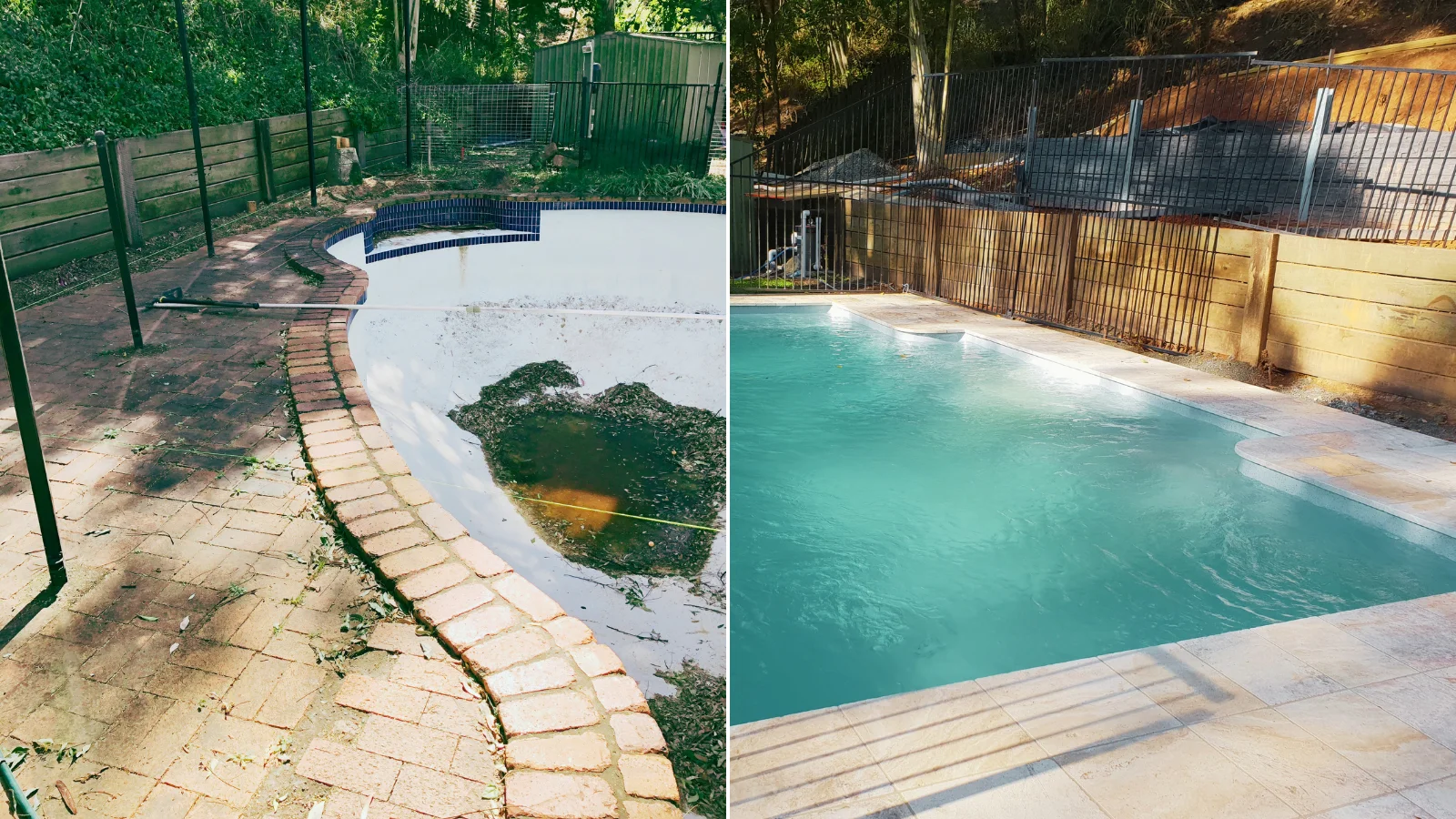
Yes. Replacing a fibreglass pool involves removing the existing shell and installing a new shell in the same excavation.
A fibreglass shell is a single moulded piece of glass reinforcement set in resin. It is delivered and installed as one unit. If access permits, a crane can remove the old shell whole. If access is limited, a demolition contractor cuts the shell into sections and removes each section separately.
Shells in our range weigh from 379 kg for the 4.00 m x 2.50 m Serenity, with a capacity of 9,500 L, to 1,286 kg for the 11.48 m x 4.45 m Saint Azur, with a capacity of 52,780 L.
The existing excavation, service trenches and areas outside the works usually remain in place. The old shell and any filtration equipment at the end of its service life are removed. Paving may also need to be removed to provide equipment access.
Access is a main factor in the replacement process. Every shell we install is craned into position. The site must therefore provide suitable crane access for the new shell.
Access may have changed since the original pool was installed. Trees, decks, sheds or a second dwelling can increase the required lifting distance. Crane pricing is based on this distance. Each quote includes a $900 crane allowance, which increases when a longer lift is required.
How long does a fibreglass pool last before it needs replacing?
Published estimates vary. American Fiberglass Pools states 25 to 50 years or more with minimal repairs and surface restoration. Latham states up to 50 to 60 years or more with proper care. Both are manufacturer estimates, and neither separates the service life of the shell from that of the surface.
A fibreglass pool has two main components:
- Structural shell: The laminate that holds the water.
- Gelcoat: The decorative and protective interior surface. It is exposed to UV, wear and chemicals.
The structural shell generally lasts longer than the gelcoat. At 25 years, a fibreglass pool is usually still structurally sound but may have a worn gelcoat. In that case, the pool may require resurfacing rather than replacement.
How do you know when a fibreglass pool needs replacing rather than repairing?
The type of fault determines whether a fibreglass pool needs resurfacing or replacement. Age alone does not determine the required work. Gelcoat faults require resurfacing. Structural shell faults require replacement. A fibreglass pool is replaced as a complete unit rather than repaired in sections.
| Symptom | What it is | Verdict |
|---|---|---|
| Gelcoat chalking | Surface wear | Resurface |
| Crazing | Surface wear | Resurface |
| Blistering | Surface wear | Resurface |
| Structural cracking | Structural fault | Replace |
| Delamination | Structural fault | Replace |
| A shell that has moved, or a failed floor | Structural fault | Replace |
Gelcoat chalking, crazing, and blistering affect the surface rather than the structure. A pool with these faults still holds water. Resurfacing rebuilds the surface while leaving the existing shell in place.
Structural cracking, delamination, and shell movement affect the laminate or the position of the shell. Structural cracks pass through the shell and can cause leaks. Delamination occurs when the laminate layers separate and the surface is no longer bonded to the supporting structure. If the shell has moved or the floor has failed, resurfacing will not correct its position. Fibreglass pools do not crack easily, so a crack through the laminate is more serious than crazing in the gelcoat.
Compare the repair quote with the replacement quote. hipages lists gelcoat restoration at $800 to $1,800 and replastering from $2,000. Replacement cost is the installed price of a new pool. There is no fixed price at which repair is no longer practical. Repair costs depend on the fault. Replacement costs depend on the shell and site.
Replacement is not the only option. Some owners choose to remove the pool and use the yard for another purpose. Removing a fibreglass pool permanently requires decisions about how much of the shell to remove and what material to use to fill the hole.
Does a fibreglass pool have a liner that needs replacing?
No. A fibreglass pool does not have a separate liner. Its interior surface is part of the structure. The gelcoat is the outer layer of the laminate that holds the water. It is bonded to the shell.
A vinyl-liner pool has a sheet liner fitted inside a frame. This liner is replaced as a unit. A fibreglass pool does not have this layer.
For a fibreglass pool, the equivalent process is resurfacing. This process rebuilds the surface on the existing shell. Aussie Pool Renovations uses six bonded layers:
- Vinyl-ester primer and anti-corrosion barrier
- Fibreglass laminate
- Reinforced vinyl-ester coat resistant to chemicals, water and osmosis
- Reinforced undercoat
- Decorative fillercoat
- Gelcoat
Each layer is applied directly to the pool. For this reason, “relining” a fibreglass pool refers to resurfacing rather than replacing a liner.
The term “liner” is sometimes used for any pool interior. In North America, it can also refer to the fibreglass surface itself.
What does it cost to replace a fibreglass pool?
The cost of replacing a fibreglass pool includes:
- The new pool and installation
- Removal and disposal of the existing pool
These services are quoted separately. We quote and install the new pool. A demolition contractor quotes the removal of the existing shell, including breaking it up, lifting it out and transporting it away. Pool removal is not included in our quote.
We confirm our costs after measuring the existing hole, site access and surrounding area.
Installed price ranges for the pools we install:
| Pool size | Length | Depth | Installed from |
|---|---|---|---|
| 3m to 4m | 1.45m level | $45,847 | |
| 4m to 5.5m | 1.0m to 1.78m | $45,613 | |
| 6m to 7m | 1.0m to 1.88m | $54,443 | |
| 7.2m to 8m | 0.98m to 1.96m | $60,374 | |
| 8.5m to 11m | 1.0m to 2.0m | $72,535 |
Live all-inclusive installed pricing for standard site conditions in South East Queensland — updated straight from our quoting system.
A replacement quote includes the same site-work items as a new installation. Access width and the distance between the truck and the hole determine the equipment required.
- Access of 3 m or more, with the truck within 5 m of the hole: The truck can reach the hole, so no carting equipment is required.
- Access under 1.38 m: A mini excavator is required.
- Access under 1.57 m: A mini excavator and small bobcat are required.
- Access of 1.57 m or more without truck access: The bobcat method is used.
The distance from the hole to the truck is priced in three ranges: 0 to 20 m, 20 to 40 m and 40 to 60 m. Excavators, bobcats and tippers are charged by the hour. Longer distances increase the operating hours for this equipment.
| Line item | Rate |
|---|---|
| Crane allowance, Franna Crane-S20T-L1 | $900 each |
| Crane upgrade, 0 to 15 m lift, small slew 13T to 16T | $1,500 each |
| Crane upgrade, 15 to 20 m lift, medium slew 40T | $1,500 each |
| Crane upgrade, 20 to 30 m lift, standard slew 55T/60T no counterweight | $2,000 each |
| Crane upgrade, 30 to 36 m lift, standard slew with counterweight 60T | $2,800 each |
| Crane upgrade, 36 to 48 m lift, large slew 80T to 120T | $3,200 each |
| Concrete slab or paving removal, not the pool shell | $170 per m² |
| Earthmoving | $50 per m³ |
| Excavator, 3.5t to 6t | $176 per hour |
| Mini excavator, 1.7t | $165 per hour |
| Bobcat | $165 per hour |
| Mini bobcat | $143 per hour |
| 10m tipper | $132 per hour |
| Mini tipper | $88 per hour |
| Dump fee | $110 per load |
| Traffic control, level 1, StopGo one lane | $1,600 |
| Traffic control, level 2, standard road closure | $3,100 |
| Traffic control, level 3, large road closure | $3,800 |
| Traffic control, level 4, all-day road closure | $5,300 |
| Pre-construction fixed fees | $1,871.10 |
| Installation materials kit | $1,110.27 |
Replacing an existing pool does not reduce the price of the new pool. The shell, crane, installation materials kit, pre-construction fees, filtration and electrical work are quoted in the same way as they are for an installation on an empty block. See What a fibreglass pool costs to install in Australia for the standard installation costs.
The excavation cost is adjusted after we measure the existing hole. A hole made for the old pool may not match the required dimensions or profile of the new shell. It may be shallower, narrower, longer or graded differently.
“The excavation line on a replacement gets adjusted once the old shell is out for a simple reason: until we can measure the actual hole, it's very hard to know exactly what the trim dig involves and what materials we'll need to bring in. But it's rarely as bad as people fear. What you save on digging, because most of the hole already exists, tends to get spent on road base and support materials to set the new shell properly, so it usually averages out around the same. The takeaway is that replacing a tired old pool with a new fibreglass shell is a far more affordable project than most people assume.”

Can you replace a concrete pool with a fibreglass pool?
Yes. The existing concrete shell must be removed or modified before installing the fibreglass pool.
A demolition contractor can remove and dispose of the entire shell. Alternatively, they can perforate the floor and cut down the walls. This prevents the remaining structure from holding or trapping water.
The existing excavation must suit the shape and depth of a standard fibreglass shell. Fibreglass shells have fixed dimensions. Available sizes range from the 4.00 m x 2.50 m Serenity to the 11.48 m x 4.45 m Saint Azur. The excavation must also allow space for bedding and backfill. If the concrete pool has a custom shape, the excavation will usually need to be re-cut.
Prices are live all-inclusive installed prices (pool, standard installation, filtration and handover) for standard site conditions in South East Queensland.
The demolition contractor sets the price for removing and disposing of the concrete shell. Our plant and disposal rates apply only to re-cutting the excavation for the new shell and removing the resulting spoil.
Earthmoving costs $50 per m³. A 10m tipper costs $132 per hour, and a 3.5t to 6t excavator costs $176 per hour. The dump fee is $110 per load. Removing an existing concrete slab or paving to provide plant access costs $170 per m². This rate does not cover demolition of a concrete pool shell.
Replacing a fibreglass pool with a concrete pool requires building a new pool in the existing excavation. The fibreglass shell is removed, the excavation is re-cut and formed, and the concrete pool is reinforced, cured, and finished on site. This process takes longer than installing a moulded fibreglass shell in a prepared excavation.
Can you replace a vinyl-liner pool with a fibreglass pool?
Yes. The process starts by removing the steel or polymer wall panels and the sand base that support the vinyl liner. The excavation is then reshaped to match the fibreglass shell. This changes the pool profile from a flat sand base with vertical panels to a graded, moulded outline. Pricing depends on the existing excavation and is confirmed after measurement.
A vinyl liner typically requires replacement every 5 to 10 years, according to Aussie Pool Renovations. This replacement cost continues for the life of the pool. A fibreglass surface is part of the shell and does not require replacement on the same cycle. It is resurfaced when the gelcoat wears out.
A hard fibreglass interior cannot be applied over a vinyl-lined panel pool. Abgal states that these pools cannot support a hard interior finish. When the liner reaches the end of its life, it must be replaced unless the pool is converted to a different type.
Vinyl-liner pools are uncommon in Australia. Most Australian pool replacements involve replacing a fibreglass or concrete pool with a fibreglass pool.
What happens to the old pool and the site while the new fibreglass pool goes in?
The old pool must be removed before excavation for the new pool begins. A demolition contractor completes the removal separately from the installation. The yard remains a construction site until handover.
A fibreglass pool replacement takes at least eleven weeks from contract signing to swimming. It follows the same stages as a new installation:
- Pre-construction. This stage includes council lodgement, shell ordering, soil testing, fire ant treatment, a site audit, filtration call-up and traffic control assessment. You also make your 3D selection. Fire ant treatment is standard for South East Queensland jobs.
- Pre-plumb and markout. The pool position is marked, and the plumbing is pre-run.
- Fence removal and excavation. The existing fence is removed. The area is excavated and graded for the new shell. Gravel is added, and a temporary fence is installed around the excavation.
- Installation. A crane places the shell in the excavation. Electrical work is completed. A skip bin and water truck are brought to the site. The pool is backfilled, and the filtration system is installed and started.
- Concreting and paving. The pool surround is concreted. Paving is delivered and installed. The area is cleaned.
- Second pour. The remaining concrete work is completed.
- Fencing and equipment reinstatement. The permanent fence is reinstalled. If included in the project, the water feature, handrail, drainage and heat pump are also reinstated.
- Handover. The pool is handed over. Site visits continue after handover.
Before work starts, the owner must decide:
- Which shell will replace the old pool
- Whether to reinstate or rebuild the surrounds
- Where to reinstall the fencing
These decisions affect the concreting, paving and fencing stages.
The temporary fence is installed during excavation and remains in place until the permanent fence is reinstated. Machines and deliveries require access to the yard. If paving must be removed to provide access, it is priced as slab removal.
Water helps hold the shell in the ground. Owners should not drain the pool before work starts to inspect it. See why owners should not drain the existing shell. Only the builder should decide whether to empty the pool. If you suspect cracking, movement or floor failure, keep the pool full until a builder has inspected it.
FAQs
Can a fibreglass pool be removed and reinstalled?
Yes, if the shell is in good condition. A crane removes the shell. The hole is then re-cut and re-bedded to match the shell’s profile. A crane reinstalls the shell.
Cracked or delaminated shells cannot be reinstalled. The site must provide crane access for both removal and reinstallation.
What is the downside of fibreglass pools?
Fibreglass pools are available in fixed shapes, sizes, and depths. The gelcoat surface wears over time and may require resurfacing before the shell needs replacement. Installation requires a crane, so site access and crane capacity may limit the pool options.
Can I resurface my fibreglass pool myself?
No. Fibreglass resurfacing uses a six-layer bonded system, from the vinyl-ester primer to the gelcoat. Each layer must bond correctly to the layer below it. Aussie Pool Renovations estimates that the work takes 5 to 8 days. The pool must remain empty during this time, which creates a structural risk that requires professional management.
Which pool is better, concrete or fibreglass?
The better option depends on your requirements. A fibreglass pool is a single moulded shell. Models in our range weigh 379 kg to 1,286 kg. The complete shell is delivered and craned into a prepared hole.
A concrete pool is poured on site around steel reinforcement and finished in place. Installation takes longer, but the pool is not limited to moulded shapes.
What is the cheapest way to resurface a pool?
A gel coat re-do is the cheapest option. hipages estimates the cost at $800 to $1,800, compared with $2,000 or more for replastering.
A gel coat has a shorter warranty. Aussie Pool Renovations provides a 1-year warranty for a gel coat and a 5-year warranty for a six-layer full resurface. Crazing and blistering can indicate that resurfacing is required.