Fibreglass Pool Paint: Types, Prep, Cost & Lifespan
Two-pack epoxy is the paint that bonds to a fibreglass pool's gelcoat. What sticks, how the shell is prepared, what it costs and how long it lasts.
Written by Tehbyn Nova, Head of Operations & Growth · Technically reviewed by Caleb Druhan, General Manager (QBCC licence 15087383) on
Published · Updated
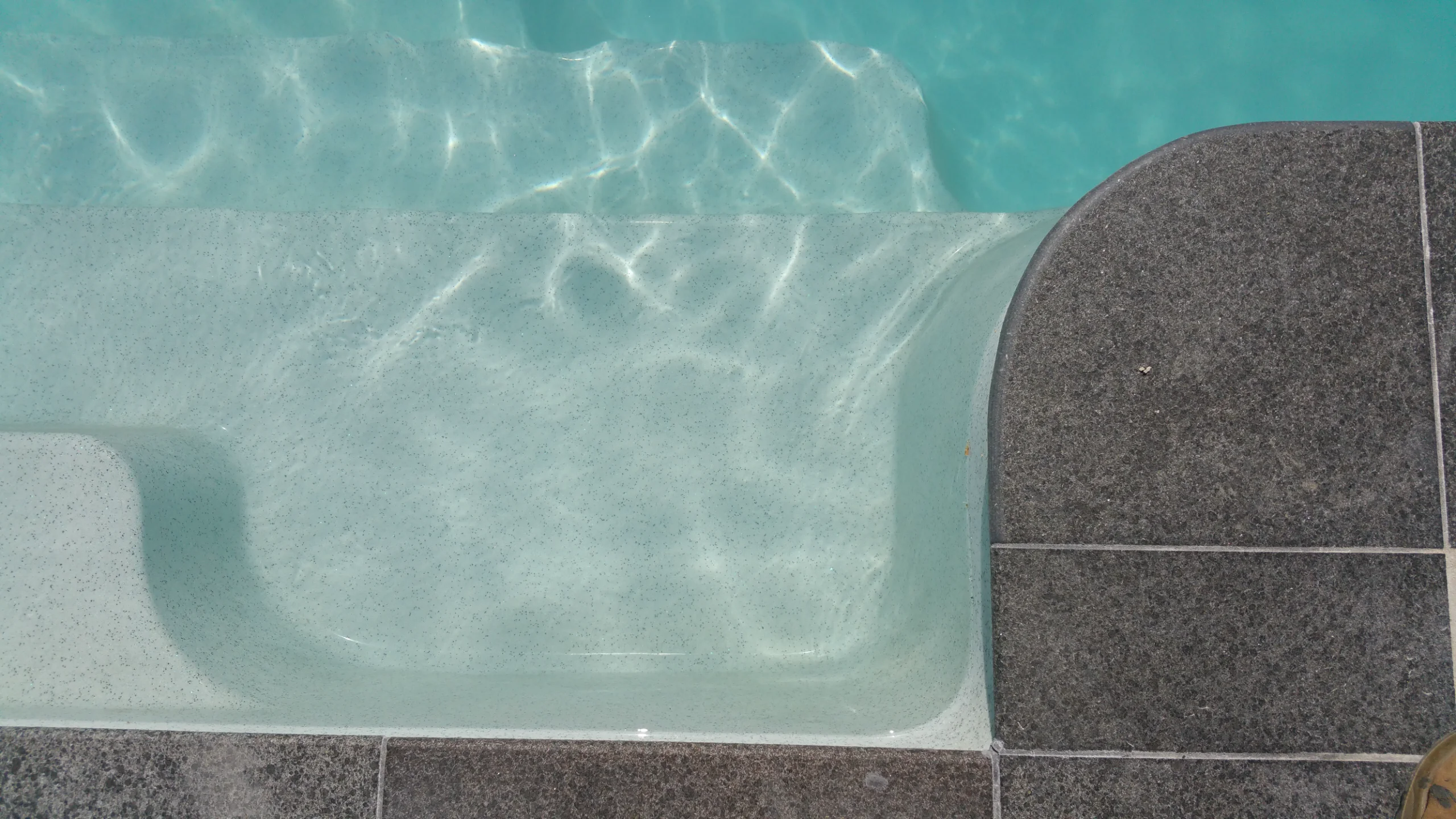
Can you paint a fibreglass pool?
Yes. You can paint a fibreglass pool with two-pack epoxy paint.
Before painting:
- Abrade the gelcoat until the gloss is removed.
- Degrease the surface.
- Apply the paint to the prepared surface.
This preparation helps the paint bond to the smooth, non-porous gelcoat.
Painting permanently changes the pool’s finish. The paint becomes the finished surface, and the factory gelcoat remains underneath. Before future resurfacing, the existing paint must be addressed.
During manufacturing, gelcoat is sprayed into the mould to create the original colour and finish. Glass and resin layers are then applied behind it. You can repaint a painted shell, but you cannot restore its factory finish on site.
MFP Easy builds and installs fibreglass pools across South East Queensland. We do not paint pools or sell pool paint. Painting is the cheapest and shortest-lived option for renewing a pool interior. The complete surface-renewal process renews a worn interior without replacing the pool.
“Paint has its place, but in my view that place is an old concrete pool, not a fibreglass shell. A fibreglass pool comes out of the factory with a gelcoat that's engineered to seal and protect the shell for its whole life, and that surface is the reason these pools last the way they do. Grinding the gloss off it to lay paint over the top means trading a factory-applied finish for a site-applied one, and once it's done it can't be undone. If your gelcoat is genuinely finished, put the money toward a proper long-term answer rather than a coating you'll be redoing.”

What kind of paint sticks to a fibreglass pool?
Two-pack epoxy paint bonds to a fibreglass pool’s gelcoat when the surface is prepared correctly. Paint World describes one Australian product as a high-build gloss epoxy for bare concrete and fibreglass pools. The two components must be mixed on the day of application.
| Paint type | Bonds to gelcoat | Published life | Recoatable with | Source |
|---|---|---|---|---|
| Two-pack epoxy | Yes, once the gelcoat is abraded and degreased | 7–14 years for one maker's own hi-build epoxy, published on a fibreglass page; 7–10 years and 6–8 years for epoxy pool paint generally | Not published; identify what is already on the pool before buying, since an existing coating is typically epoxy or chlorinated rubber | Hitchins Technologies; PoolPaintOnline; Service.com.au; Bunnings Workshop |
| Chlorinated rubber | Not published; sold as a pool paint | No more than 5–6 years for average, often rubber-based, pool paint | Not published; the same identification applies before recoating | Barrier Reef Pools Perth; Bunnings Workshop |
| Acrylic or general-purpose exterior paint | No pool-immersion bond published for it | Not published | Not published | — |
A Bunnings Workshop community thread explains how to distinguish epoxy from chlorinated rubber paint. Apply acetone to a rag and rub it over the existing paint.
Sources provide different advice about whether paint bonds to gelcoat. ecoFINISH, a United States coatings manufacturer, states that ordinary pool paints were not formulated for fibreglass gelcoat and may not adhere to its smooth surface. Australian paint suppliers and pool painters state that two-pack epoxy bonds to fibreglass after the gelcoat is abraded.
These sources refer to different products. ecoFINISH discusses traditional pool paint and does not specifically mention two-pack epoxy. The Australian products are two-pack epoxy systems specified for fibreglass.
How do you prepare a fibreglass pool before painting it?
Prepare a fibreglass pool for painting as follows:
- Drain the pool.
- Abrade the gelcoat to remove the gloss.
- Degrease the abraded surface.
Pool water helps hold the fibreglass shell in the ground. The builder, not the painter, should manage preparing an empty shell for coating.
Gelcoat is smooth and non-porous, so paint does not adhere to it without preparation. Abrade the gelcoat, then degrease the surface to remove grime, body oils, and fats.
Follow the preparation instructions for the substrate and paint system. AquaGuard 5000 uses different methods for concrete and fibreglass:
- Prepare concrete by acid etching and neutralising, or by pressure washing. Concrete and plaster also require a sealer or primer.
- Prepare fibreglass by grinding the gelcoat with a coarse disc. Check the paint system instructions to determine whether the abraded fibreglass requires a primer.
Inspect the empty shell for cracks, chips, and leaks. Complete any fixing cracks before coating. A coating can conceal a crack, but it does not repair the shell.
Painting can affect the gelcoat warranty. Check the warranty terms with the shell supplier before painting the pool.
How do you paint a fibreglass pool, step by step?
Apply two-pack epoxy to the prepared pool shell in two or three coats. Mix the epoxy in small batches, then apply it with a roller or sprayer. Allow the coating to cure before refilling the pool. Apply epoxy in dry weather and avoid the midday sun.
- Mix the two components. Two-pack epoxy becomes usable paint when its two components are mixed. The mixed paint has a limited pot life and cannot be stored for the next session. Mix only the amount that can be applied while it remains workable.
- Roll or spray the first coat. Barrier Reef Pools Perth specifies a first-coat drying time of four to eight hours in Perth conditions.
- Apply the remaining coats. Hitchins Technologies applies its high-build epoxy coating in two to three coats. PoolPaintOnline, the Australian LUXAPOOL distributor, specifies a minimum of two coats in its coverage guidance.
- Cure the coating in the empty shell. Hitchins Technologies specifies a curing time of five to seven days.
- Refill the pool. Barrier Reef Pools Perth recommends waiting about one week before refilling. Paint World, an Australian paint retailer, specifies a wait of up to ten days.
The Australian sources specify different refill times. Keep the pool empty for the period required by the selected product. Barrier Reef Pools Perth also states that a pool can be painted in about two days and that the complete job takes no more than one week. The same page recommends waiting one week before refilling, but does not state whether this curing period is included in the total job time. Schedule the draining, curing and refilling as one continuous period.
What colours can a fibreglass pool be painted?
Pool paint is available in a fixed range of factory colours. Common options include blues, greys, sands, greens and black. Paint World lists Nutech NuPool epoxy in 13 standard colours, including black, Pacific Blue, Beach Sand, Natural Grey, Adriatic Blue, Resort Cream, Pale Blue, Mid Blue, Pond Green, Resort Grey and Blue Bell B41.
Colours outside the standard range are made to order. Paint World specifies a minimum four-week lead time for Nutech made-to-order colours.
Paint and gelcoat colours with the same name can look different underwater. Pool paint forms a coloured layer over the shell. Gelcoat is sprayed into the mould and cured as part of the laminate. Our gelcoat colour range shows how factory gelcoat colours look underwater. It does not show how paint with the same colour name will look.
What does it cost to paint a fibreglass pool?
Service.com.au lists the national average cost to paint a pool as $480 to $650. The page was updated on 14 April 2026. The cost varies by pool area and the materials required. The estimate does not specify a pool type.
Service.com.au, PoolPaintOnline and hipages.com.au do not publish a finished-job price for applying two-pack epoxy paint to a fibreglass pool.
| Item | Published figure | Scope | Source |
|---|---|---|---|
| National average cost to paint a pool | $480 to $650 | National average, pool type not specified, varies with pool area and materials | Service.com.au, page updated 14 April 2026 |
| DIY materials, two-pack epoxy paint and primer | $270 | Materials only, cement pool of around 20–25 m² | Service.com.au, page updated 14 April 2026 |
| DIY materials, rubber paint | $110 | Materials only, cement pool of around 20–25 m² | Service.com.au, page updated 14 April 2026 |
| Epoxy coverage rate | 20–25 m² per 3.5 L kit per coat, minimum of 2 coats recommended | Per kit, per coat | PoolPaintOnline (LUXAPOOL distributor) |
| Kits for an 8 × 4 m pool | Approximately 6 × 3.5 L kits (2 coats) | 8 × 4 m pool | PoolPaintOnline |
| Listed kit prices | Standard colours 3.5 L kits $259.95; designer colours 3.5 L kits $391.35; 1 L kits $113.00 | Listed prices at one retailer on 12 August 2026 | PoolPaintOnline |
The published figures cover different jobs. Service.com.au’s $270 estimate covers materials for a cement pool of around 20 to 25 square metres. PoolPaintOnline estimates that an 8 by 4 metre pool requires approximately six 3.5 litre kits for two coats. This estimate is based on coverage of 20 to 25 square metres per kit, per coat.
Colour also affects the material cost. On 12 August 2026, PoolPaintOnline listed standard-colour 3.5 litre kits at $259.95 and designer-colour kits of the same size at $391.35.
hipages lists prices for two fibreglass services. A gel coat repaint and replacement costs $800 to $1,800, depending on size. A fibreglass resurface costs $2,100 to $7,700. The source does not explain the difference in scope between these services. Ask contractors to quote for each service by name.
How long does paint last on a fibreglass pool, and why does it come off?
Published service-life estimates for two-pack epoxy pool paint are generally between six and ten years. Some sources publish shorter or longer estimates. Consider whether the publisher sells pool paint or an alternative coating when comparing these figures.
- Hitchins Technologies, a paint manufacturer: 7 to 14 years. Its fibreglass-specific page states that its hi-build epoxy is a hard-wearing coating with a service life of 7 to 14 years. This is a manufacturer’s claim about its own product. The upper estimate is not typical of the other published figures.
- PoolPaintOnline, the Australian LUXAPOOL distributor: 7 to 10 years. It states that epoxy pool paint lasts 7 to 10 years with correct surface preparation and maintenance. This estimate applies to epoxy paint generally, not only to fibreglass. The same page recommends epoxy for bare concrete, fibreglass, pebblecrete and marblesheen interiors.
- Service.com.au, a trade-quoting marketplace: 6 to 8 years. It gives epoxy the longest service life among pool paints, at approximately 6 to 8 years. This estimate also applies to epoxy paint generally.
- Barrier Reef Pools Perth, an Australian pool builder: 6 to 7 years. It estimates that epoxy paint lasts six to seven years in Perth. It states that average pool paint, which is often rubber-based, lasts no more than five to six years.
- ecoFINISH: 2 to 3 years. Mr Fibreglass: 1 to 3 years. Both businesses sell alternatives to pool paint. ecoFINISH states that traditional pool paint requires reapplication every two to three years. Mr Fibreglass, an Australian resurfacer, gives paint a service life of one to three years. It compares this with twenty years for fibreglass and ten to fifteen years for pebblecrete.
The estimates from Hitchins Technologies, PoolPaintOnline and Service.com.au overlap at seven to eight years. The shortest estimates are from businesses that sell alternatives to paint. The longest estimate is from a paint manufacturer.
Paint can come off a fibreglass shell through four mechanisms identified by ecoFINISH, which sells a competing coating:
- Sunlight: Sunlight degrades the coating and can reduce its colour within one or two seasons.
- Pool chemicals: Chlorine, bromine, pH adjusters, shock treatments and other chemicals used to sanitise or balance the water wear away the coating.
- Moisture: Moisture that passes through the coating can remain against the gel coat. Repeated wetting and drying can then lift the coating from the shell.
- Surface breakdown: The coating can break down at the surface and form a white powder.
Water chemistry and cleaning practices affect how quickly these processes occur.
Where do you buy fibreglass pool paint in Australia?
Buy two-pack epoxy pool paint from coatings suppliers or specialist paint retailers. It is supplied as a kit containing both components.
Products available for Australian pools include:
- LUXAPOOL
- Poolkote
- BG Coatings
- Nutech NuPool
PoolPaintOnline distributes LUXAPOOL, and Paint World lists Nutech NuPool. On 12 August 2026, Google Shopping AU listed Nutech NuPool Epoxy 4 L for $217 from Epoxy Warehouse and a BG Pool Paint kit for $214 from BG Coatings.
Before ordering, calculate the number of kits required. You need:
- the pool’s interior surface area
- the coverage of one kit for one coat
- the required number of coats
PoolPaintOnline publishes coverage information and a worked example for an 8 by 4 metre pool. Multiply the kit requirement per coat by the number of coats. Kits are sold as whole units, so round the result up to the next full kit. For made-to-order colours, allow for the lead time before draining the pool.
Check that the product label states that the paint is a two-pack epoxy formulated for pool immersion. Do not use single-pack paint, general-purpose exterior paint or rubber-based pool paint as a substitute.
Is painting the right call, or should you re-gelcoat?
Painting may suit owners who plan to keep the pool for only a few more years and have a limited budget. Re-gelcoating or resurfacing may be more suitable for a pool that will be kept long term. Compare the cost with the expected service life of each option.
Service.com.au lists the national average cost to paint a pool as $480 to $650. hipages.com.au lists gel coat repainting and replacement at $800 to $1,800, and fibreglass resurfacing at $2,100 to $7,700.
Pool paint needs to be reapplied every six to ten years. Service.com.au gives a service life of 6 to 8 years. PoolPaintOnline, the Australian LUXAPOOL distributor, gives 7 to 10 years. The named sources do not publish a service life for gel coat repainting or resurfacing, so a direct long-term cost comparison is not available.
Consider two factors when choosing between painting and re-gelcoating:
- the current condition of the gelcoat
- how long you intend to keep the pool
How long you plan to keep the pool is particularly important because an on-site paint application cannot be reversed.
FAQs
What kind of paint do you use on a fibreglass pool?
Use a two-pack epoxy formulated for pool immersion. Before application, abrade the gelcoat until no gloss remains, then degrease it. Products sold for Australian pools include LUXAPOOL, Poolkote, BG Coatings and Nutech NuPool.
Can you paint directly over fibreglass?
Do not paint directly over factory gelcoat. Gelcoat is smooth and non-porous. Abrade and degrease the surface before applying a coating. Check the paint system instructions to determine whether a primer is required.
Does Bunnings sell swimming pool paint?
Check the product specifications rather than the retailer. Pool paint must be a two-pack epoxy formulated for pool immersion.
Australian pool paint systems include LUXAPOOL, Poolkote, BG Coatings and Nutech NuPool. These products are sold as two-component kits through coatings suppliers and specialist paint retailers.
How much does it cost to repaint a fibreglass pool?
Service.com.au estimates the national average cost of painting a pool at $480 to $650. For a cement pool of about 20 to 25 square metres, it estimates DIY materials at $270 for two-pack epoxy paint and primer. hipages.com.au estimates the cost of repainting and replacing the gel coat on a fibreglass pool at $800 to $1,800.
Can you paint fibreglass pool steps?
Yes. Fibreglass pool steps are part of the pool shell and have the same gelcoat as the walls and floor. Before coating, remove the gloss by abrading the surface, then degrease it. Apply the same two-pack epoxy used for the rest of the pool.