Mineral Pool Salt: Composition, Dosing & Testing
Understand mineral blends, magnesium and potassium chloride, product-specific dosing, testing and top-ups for a mineral swimming pool.
Written by Tehbyn Nova, Head of Operations & Growth
Published · Updated
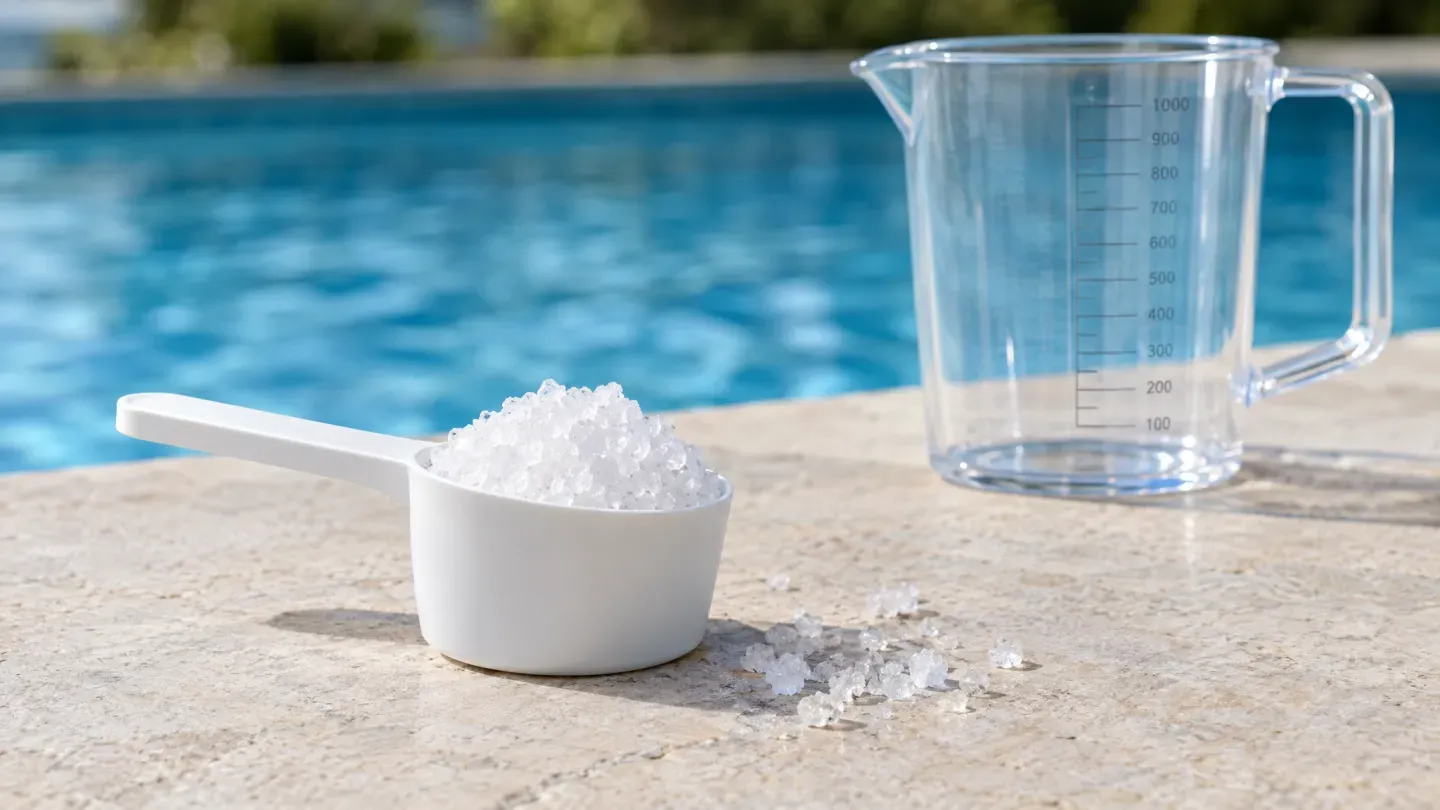
Mineral pool salt is a blend of chloride salts rather than the sodium chloride sold as ordinary pool salt. Zodiac Australia states that MagnaPool Minerals contains 30% magnesium chloride and 70% potassium chloride.
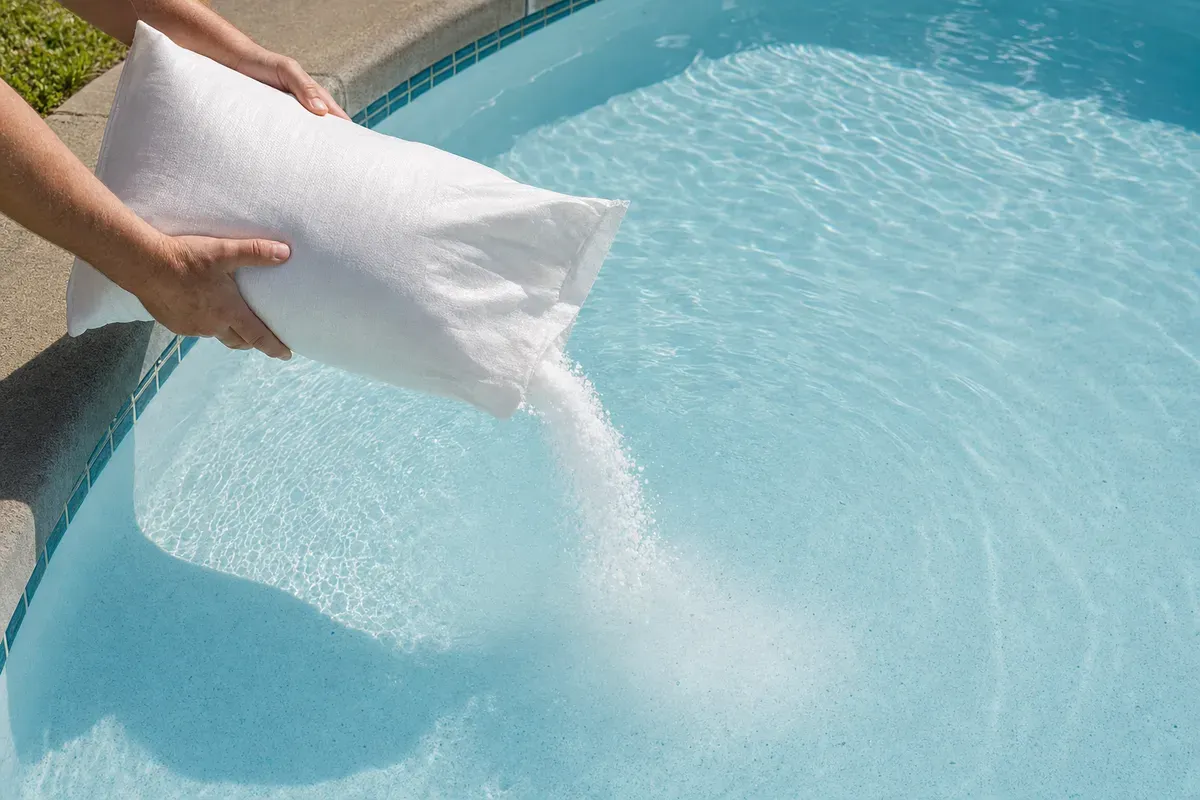
Manufacturers specify mineral pool salt doses by water volume. Zodiac's MagnaPool setup procedure specifies six bags per 10,000 litres, equivalent to 6 kg per 1,000 litres, for the initial fill. This dose produces a starting salinity of 5,000 to 5,500 ppm.
For any product, add the published dose, measure the water with a test kit or the chlorinator display, and add more product after rain, backwashing, or splash-out dilutes the pool water. Target levels depend on the product. Mr Pool Man's Water TechniX listing specifies a magnesium hardness target of 600 to 800 ppm for a pool with a primary salinity of 4,000 ppm.
What are pool minerals made of?
Pool minerals consist primarily of magnesium chloride and potassium chloride salts that dissolve in pool water. Zodiac Australia publishes the composition of MagnaPool Minerals as 30% magnesium chloride and 70% potassium chloride by weight. The product name refers to magnesium, although potassium chloride accounts for 70% of the bag’s weight.
Sodium chloride content depends on the product class. The published MagnaPool composition lists only magnesium chloride and potassium chloride. Mr Pool Man’s listing for Water TechniX Magnesium Mineral Salt describes a magnesium product added to a pool with a primary salinity of 4,000 ppm. In this configuration, conventional salt provides the primary salinity, and the magnesium product is added separately.
Magnesium chloride and potassium chloride dissolve completely in pool water and remain as ions. These dissolved salts support a mineral pool system, and the chlorinator cell uses the chloride ions that they supply. Every pool MFP Easy builds includes a mineral chlorinator as standard equipment.
Is mineral pool salt the same as ordinary pool salt?
No. Mineral pool salt is a chloride blend that contains magnesium chloride, while ordinary pool salt consists of sodium chloride. Zodiac Australia lists MagnaPool Minerals as 30% magnesium chloride and 70% potassium chloride, with no sodium chloride listed in the composition. These products introduce different ions and require different concentrations in the pool water.
A magnesium product does not always replace sodium chloride. Mr Pool Man lists a Water TechniX Magnesium Mineral Salt dose for pools with a primary salinity of 4,000 ppm. The dose produces magnesium hardness between 600 and 800 ppm, while the sodium chloride remains in the water.
A chlorinator cell is rated for a specific salinity range and manufacturer-specified product class. Replacing one product with another changes the water composition and salinity that the cell operates in and reads. Before buying either product, check the chlorinator’s rated salinity and specified product class.
What types of pool minerals are available, and which should you use?
Pool minerals are available in three product classes, defined by the composition stated on the product label.
- Granular mineral blends. Granular blends contain crystalline magnesium chloride and potassium chloride salts. The standard retail bag is 10 kg. Clark Rubber lists MagnaPool Pool Minerals in a 10 kg bag, and Maytronics Australia lists Mineral Swim Dead Sea Minerals in a 10 kg bag. Granular blends supply the pool’s total mineral concentration, so dosage is based on the target salinity.
- Liquid magnesium products. Liquid products contain magnesium in solution and are dosed by volume. Use the published magnesium content to compare liquid products with each other or with granular blends.
- Single-salt magnesium chloride. Single-salt products contain magnesium chloride in flake or granular form and do not list a potassium chloride proportion on the label. They can be added to pools that already contain conventional salt. Mr Pool Man publishes this method for Water TechniX Magnesium Mineral Salt: add 10 kg per 10,000 litres at start-up to a pool with a primary salinity of 4,000 ppm.
Compare the published composition percentages before comparing prices. Zodiac Australia publishes a composition of 30% magnesium chloride and 70% potassium chloride, providing one example based on a manufacturer’s composition statement. Products that do not publish these percentages cannot be compared by magnesium content. MFP Easy builds fibreglass pools and does not retail minerals or pool salt. Published percentages provide more useful information for comparisons across brands than a brand ranking.
How much mineral salt do you add, and how often?
Mineral salt is dosed per 10,000 litres of pool water to reach the published target level. The dose and target depend on the product class. Three product lines publish figures.
| Product class | Published first-fill dose | Published top-up dose | Published target level | Source |
|---|---|---|---|---|
| Granular mineral blend (MagnaPool Minerals) | 6 bags per 10,000 L, equal to 6 kg per 1,000 L | Not published | Salinity of 5,000 to 5,500 ppm at start | Zodiac's MagnaPool setup procedure, with the 10 kg bag size from Clark Rubber. Zodiac's own product page carries the composition and nothing else |
| Granular mineral blend (Mineral Swim) | Not published as a total | 15 kg in 10,000 L lifts the reading 1,000 ppm, so 1.5 kg in 1,000 L for each 1,000 ppm of lift | Operating range of 3,500 to 4,500 ppm | Poolside, a Mineral Swim stockist. Maytronics Australia's own page carries the 10 kg bag size and a price, without a dose rate or a target |
| Magnesium mineral salt added to a salted pool (Water TechniX) | 10 kg in 10,000 L at start-up, equal to 1 kg in 1,000 L | 6 kg per 10,000 L every 2-3 months | Magnesium hardness of 600 to 800 ppm, over a primary salinity of 4,000 ppm | Mr Pool Man's Water TechniX Magnesium Mineral Salt 10kg listing |
The product class determines whether the pool also requires ordinary pool salt. Zodiac's MagnaPool setup procedure uses the mineral blend to provide the pool's total salinity, with a target reading of 5,000 to 5,500 ppm. Mr Pool Man's Water TechniX listing adds magnesium minerals to a pool with a primary salinity of 4,000 ppm. In this arrangement, sodium chloride and magnesium are maintained as separate readings.
Zodiac's setup procedure specifies six bags per 10,000 litres and a starting salinity target of 5,000 to 5,500 ppm, but it does not explain the relationship between the dose and the target. Follow the product instructions for the specific pool, then confirm that the reading is within the target range.
After the first fill, add mineral salt according to the measured level unless the product specifies a schedule. Rain dilutes the mineral concentration. Backwashing and splash-out remove pool water containing minerals, and replacement with fresh water further reduces the concentration. Mr Pool Man's Water TechniX listing instead specifies a scheduled dose of 6kg per 10,000L every 2-3 months.
Can you put too much magnesium in a pool?
Yes. A pool can contain too much magnesium. Magnesium chloride and potassium chloride dissolve in pool water and are not removed through evaporation or chlorination.
Signs of excess mineral include total hardness outside the recommended range, scale on the waterline or inside the chlorinator cell, cloudy water, and a chlorinator reading outside its rated range. Zodiac's MagnaPool setup procedure specifies a range of 500 to 1000 for a mineral pool and identifies this measurement as total hardness, not calcium hardness alone.
To reduce the mineral concentration, partially drain the pool and refill it with fresh water. Test the water before adding further treatment chemicals or minerals.
Do not fully empty a fibreglass pool to correct water chemistry, regardless of its depth. The water keeps the shell in the ground. Fully emptying the pool is a structural procedure that must be managed by the builder, not a water-treatment procedure.
After refilling, rebalance the water as part of standard magnesium pool maintenance. Test the mineral level again before adding more minerals.
How do you test the mineral level in a pool?
Mineral-level testing uses a test strip, a drop kit or a mineral chlorinator’s display. Compare the result with the target published for the product in the pool. Every pool we build includes a 4-in-1 minerals test kit and a sample bottle, so use this kit for the first test.
A test strip measures the pool water directly. A drop kit or pool shop test measures a water sample collected in the bottle. A mineral chlorinator’s display reports the cell’s measurement as water passes through it.
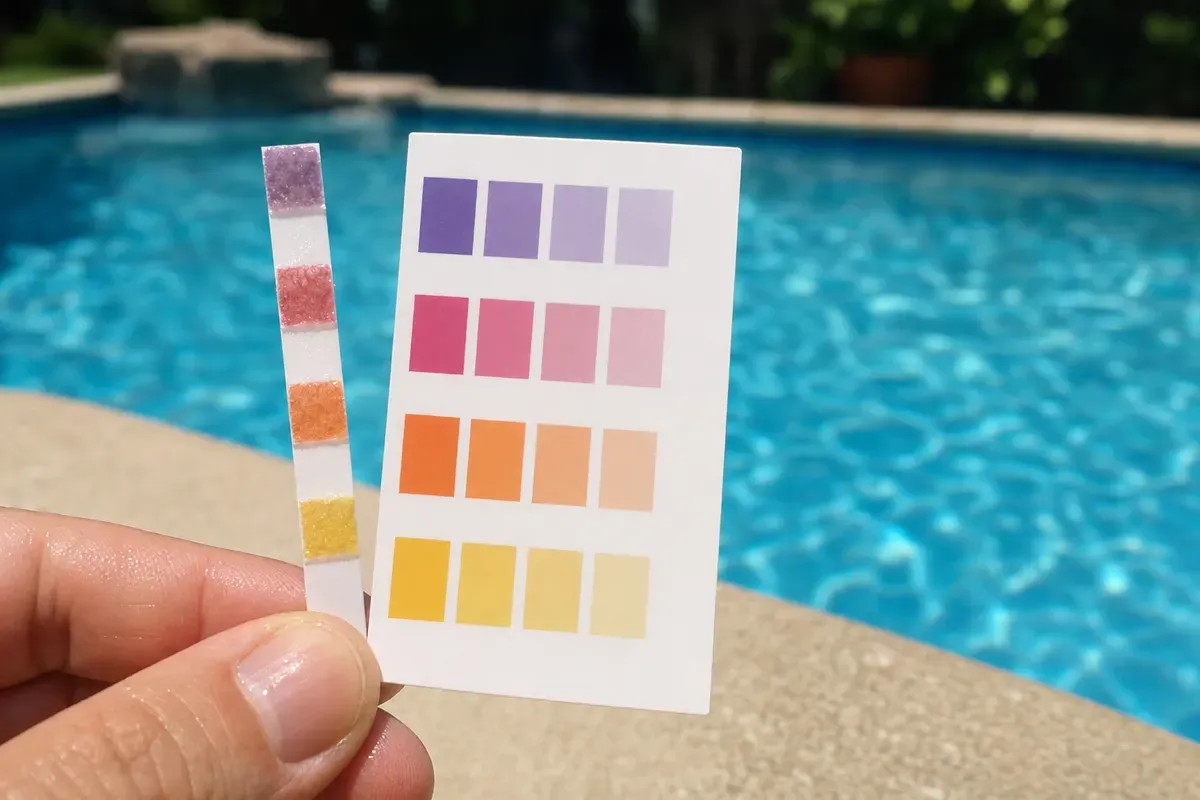
If the test strip and chlorinator show different results, collect a fresh sample and test it before adding minerals. Minerals added based on an incorrect result must be removed by dilution. Zodiac’s MagnaPool procedure specifies salinity of 5,000 to 5,500 ppm at start-up. Mr Pool Man’s Water TechniX listing specifies magnesium hardness of 600 to 800 ppm with primary salinity of 4,000 ppm.
Test after rain, backwashing or topping up because these events can change the mineral level.
What chlorine and pH levels should a mineral pool hold?
A mineral pool has the same chlorine and pH targets as other chlorinated pools. Each published target applies to a specific pool type. NSW Health guidance applies to public pools and spas. The Better Health Channel and Zodiac's MagnaPool setup procedure provide guidance for domestic pools.
| Parameter | Published range or minimum | Source | Scope |
|---|---|---|---|
| Free available chlorine | Outdoor pool, minimum 1.0 mg/L. With cyanuric acid present, minimum 3.0 mg/L. Indoors, minimum 2.0 mg/L. Spa, minimum 2.0 mg/L. Add 1.0 mg/L to the minimum wherever pH runs above 7.6 | NSW Health advisory document | Public pools and spas, read as DPD No 1 |
| Free available chlorine | 1 to 3 ppm, marked "After 2 weeks" | Zodiac's MagnaPool setup procedure | Domestic mineral pool, manufacturer guide |
| pH | Range of 7.0 to 7.8. Maintained band of 7.2 to 7.6. Ceiling of 7.8 | NSW Health advisory document | Public pools |
| pH | Aim for 7 to 7.6 | Better Health Channel, Victorian Government | Domestic pools |
| pH | Concrete 7.4 to 7.6. Fibreglass 7.0 to 7.2 | Zodiac's MagnaPool setup procedure | Domestic mineral pool, by shell type |
| Total alkalinity | 80 to 200 mg/L, with 80 to 100 ppm marked ideal for high pH disinfectants | NSW Health advisory document | Public pools |
| Total alkalinity | 80 to 120 | Zodiac's MagnaPool setup procedure | Domestic mineral pool |
| Cyanuric acid | Maximum 50 mg/L, and only in outdoor pools, never spas | NSW Health advisory document | Public pools |
| Cyanuric acid | Less than 50 | Zodiac's MagnaPool setup procedure | Domestic mineral pool |
| Combined chlorine | Maximum 1.0 mg/L, with total chlorine capped at 10.0 mg/L | NSW Health advisory document | Public pools |
| Mineral or salinity level | MagnaPool, 5,000 to 5,500 ppm at start. Mineral Swim, an operating range of 3,500 to 4,500 ppm. Water TechniX, 600 to 800 ppm magnesium hardness over a 4,000 ppm primary salinity | Zodiac's setup procedure; a Mineral Swim stockist; Mr Pool Man | Domestic, by product |
pH requirements vary by source, pool use, and shell type. Free chlorine loses most of its potency when pH exceeds 7.8.
MFP Easy installs fibreglass shells, so the applicable Zodiac range is 7.0 to 7.2.
Total alkalinity ranges also differ by source. All three published ranges have a lower bound of 80.
Free available chlorine guidance differs in format and scope. NSW Health specifies minimum concentrations for public pools and spas, while Zodiac specifies a range of 1 to 3 ppm for domestic mineral pools after two weeks. Neither NSW Health nor the Better Health Channel publishes the 1 to 3 ppm range.
What happens if magnesium and chlorine mix?
In a mineral pool, magnesium and chlorine remain in the same water during normal operation. Magnesium chloride dissolves into magnesium ions and chloride ions when added to the water. The chlorinator cell uses the dissolved chloride to generate chlorine, while the magnesium remains in solution.
The violent reactions associated with magnesium involve magnesium metal, which reacts with water and hydrochloric acid. Magnesium metal is an element, whereas the magnesium chloride in the bag is a salt that dissolves in the pool.
What do pool minerals cost, and how often do you re-buy them?
In Australia, a 10 kg bag of pool minerals was displayed at approximately $60 to $80 across three listings recorded on 20 September 2026. None of the listings stated whether the displayed price includes GST.
| Product | Displayed price | Pack size | Seller |
|---|---|---|---|
| Mineral Swim Dead Sea Minerals | $60.67 | 10 kg bag | Maytronics Australia, manufacturer direct |
| MagnaPool Pool Minerals 10kg | $61.95, regular price, in stock | 10 kg bag | Clark Rubber |
| Water TechniX Magnesium Mineral Salt 10kg | $79.99, displayed as a sale price | 10 kg bag | Mr Pool Man |
A new pool requires multiple bags for its initial fill. Zodiac's MagnaPool setup procedure specifies 24 bags for a 40,000 litre pool. At the first two recorded bag prices, this quantity costs approximately $1,460 to $1,490 before the pool is used. The required quantity increases with pool volume:
- 20,000 litres: 12 bags
- 30,000 litres: 18 bags
- 40,000 litres: 24 bags
- 50,000 litres: 30 bags
- 70,000 litres: 42 bags
The quantity required for each subsequent purchase depends on the measured mineral level and how far it has fallen since the previous top-up. A pool may require more minerals after a wet fortnight and a backwash than a pool that has not experienced those conditions.
For a new MFP Easy build, the first year's mineral supply is included, so the first-fill cost is $0 in year one. This includes the 24 bags required for a 40,000 litre pool. After the first year, replacement minerals become a recurring item within the cost of a mineral pool.
FAQs
Does pool salt have magnesium?
Pool salt is sodium chloride and does not increase a pool's magnesium level. Magnesium comes from a separate mineral product. Zodiac Australia states that MagnaPool Minerals contains 30% magnesium chloride and 70% potassium chloride. Mr Pool Man lists Water TechniX Magnesium Mineral Salt as a magnesium product for dosing into a pool maintained at a primary salinity of 4,000 ppm.
Are mineral salts and epsom salts the same thing?
No. Epsom salt is magnesium sulfate, whereas published granular pool mineral products contain magnesium chloride blended with potassium chloride. A chlorinator generates its sanitiser from chloride dissolved in the water. Magnesium sulfate contains sulfate instead of chloride, so it supplies magnesium but not the chloride used by the chlorinator cell.
Which salt has the highest magnesium?
The salt with the highest published magnesium chloride percentage has the highest stated magnesium content. This percentage is the only direct basis for comparison across brands. Zodiac Australia states that MagnaPool Minerals contains 30% magnesium chloride and 70% potassium chloride. If a product does not publish its composition, its magnesium content cannot be compared based on the product name.
Can you do a magnesium test at home?
Yes. An at-home magnesium test can use a test strip dipped directly into the pool, a drop kit applied to a water sample, or the mineral chlorinator’s display, which reports measurements from water passing through the cell. Compare the result with the product’s published target, such as the 5,000 to 5,500 ppm starting salinity specified in Zodiac’s MagnaPool setup procedure.
Does a mineral pool need salt?
A mineral pool may require ordinary pool salt, depending on the product. Zodiac's MagnaPool setup uses the mineral blend to provide all salinity, with an initial target of 5,000 to 5,500 ppm and no separate pool salt. In comparison, Mr Pool Man's Water TechniX listing specifies 4,000 ppm of conventional salt, plus 600 to 800 ppm of magnesium minerals.