Magnesium Pool Maintenance: Routine, Targets & Fixes
A practical magnesium pool maintenance routine: water testing, manufacturer-specific targets, mineral top-ups, chlorinator care and troubleshooting.
Written by Tehbyn Nova, Head of Operations & Growth · Technically reviewed by Caleb Druhan, General Manager (QBCC licence 15087383) on
Published · Updated
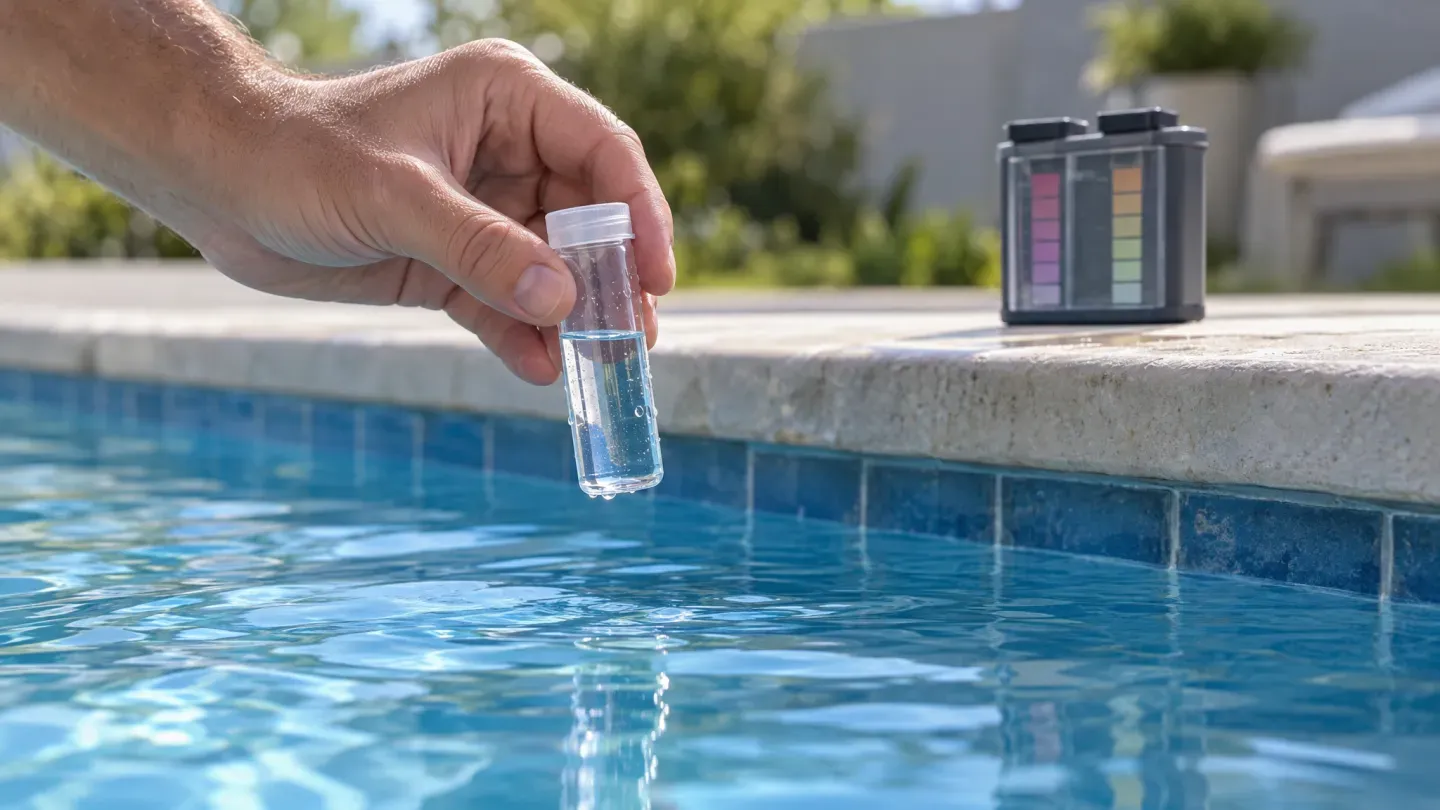
Magnesium pool maintenance consists of weekly water testing and skimming, monthly equipment checks and seasonal filter servicing. Compared with chlorine pool maintenance, it also requires testing the mineral level and adding minerals when the level falls below the chlorinator’s requirement, plus a monthly inspection of the chlorinator cell.
Each pool built by MFP Easy includes a mineral chlorinator, an oversized cartridge filter, one year’s supply of minerals and a 4-in-1 minerals test kit with a sample bottle.
A magnesium pool can develop cloudy or filmy water after dosing, green water after a mineral top-up, or yellow or brown discolouration on the shell floor. Each fault has a distinct cause and a test to confirm it, and each can be corrected without draining the pool.
What does looking after a mineral pool involve?
Mineral pool maintenance includes the weekly skimming, brushing, vacuuming and water testing required for any chlorinated pool. It also includes checking and topping up the mineral level, inspecting the chlorinator cell monthly and servicing the filter cartridge seasonally. MFP Easy installs more than 250 pools each year across South East Queensland and provides every owner with the same maintenance routine during handover:
| Task | Frequency |
|---|---|
| Skim the surface, empty the skimmer basket and the pump basket | Weekly |
| Brush the waterline and the shell floor | Weekly |
| Vacuum the floor or run the pool cleaner | Weekly |
| Test the water with the 4-in-1 minerals test kit | Weekly |
| Read the mineral level and top up if it sits below the level the chlorinator requires | Monthly, and again after heavy rain |
| Test total alkalinity and hardness | Monthly |
| Inspect the chlorinator cell | Monthly |
| Lift out the filter cartridge, rinse it and refit it | Monthly |
| Take the sample bottle to a pool shop for a full water test | Seasonally |
| Full cartridge service: remove, rinse and refit the cartridge | Entering and leaving swimming season |
| Recheck the mineral level after the South East Queensland storm season | Seasonally |
Two tasks in this routine have no equivalent in a chlorine pool maintenance routine.
The first task is checking the mineral level. A mineral chlorinator uses minerals dissolved in the water to generate chlorine. Topping up a mineral pool supplies the chlorinator cell with the required minerals. Heavy rain increases the water volume and dilutes the mineral concentration, so owners should check the level after heavy rain and after the South East Queensland storm season. If the test result is below the chlorinator manufacturer’s specified level, the owner adds minerals.
The second task is inspecting the chlorinator cell. The cell generates the pool’s chlorine during normal operation, so the monthly inspection checks both the equipment and chlorine production. If the cell stops generating chlorine, the free chlorine reading falls before the water changes colour.
Filter cleaning is not specific to magnesium pools. An MFP Easy pool has an oversized cartridge filter. Cleaning requires removing the cartridge, rinsing it and refitting it. Cartridge filters do not have a backwash cycle; backwashing is used to clean sand filters.
How is mineral pool care different from a salt or chlorine pool?
Mineral pool care includes routine water maintenance and operation of the mineral chlorinator. Its requirements differ from salt or chlorine pool care as follows:
| Same as a salt or chlorine pool | Different | New on a mineral pool |
|---|---|---|
| Skimming, brushing and vacuuming, on the same weekly rhythm | What you buy and add: a magnesium and potassium mineral blend in place of pool salt or bagged chlorine | The mineral level, tracked as a number in its own right and corrected by a top-up |
| pH correction, on the same logic and against the same published targets | What a hardness reading means: magnesium registers in a total hardness test, so the reading runs high by design | A low conductivity fault on the chlorinator, which halts chlorine generation before the water looks wrong |
| Filter cleaning, on whichever filter the pool has | Where free chlorine comes from: the cell converting dissolved minerals | Calcium hardness, which has to be worked out from two readings |
Every MFP Easy build includes a mineral chlorinator as standard. The unit is configured to convert a magnesium and potassium blend based on magnesium chloride instead of sodium chloride. The chlorinator configuration is selected before the pool is filled when choosing between salt water vs magnesium vs chlorine.
“There's a bit of mystique sold around magnesium pools, but the honest answer is they run almost exactly like a salt chlorinated pool. It's the same style of chlorinator, just converting a magnesium and potassium blend instead of ordinary pool salt, and that blend is what gives the water the softer feel on your skin and eyes.”

What should the water test at in a magnesium pool?
A magnesium pool uses the same published water-balance targets as other Australian pools, but testing also includes the mineral level and a corrected hardness calculation. A pH of 7.2 to 7.6 is within every general pool range cited below. Total alkalinity of 80 to 120 ppm is within both cited alkalinity ranges.
| Parameter | Target | Notes |
|---|---|---|
| pH, any pool | 7.2 to 7.8 | Queensland Health, in its water quality guidelines for public aquatic facilities; corrected as in any chlorinated pool |
| pH, fibreglass shells | 7.2 to 7.4, inside a general band of 7.0 to 7.8 and a safe band of 7.2 to 7.6 | SPASA Australia; set by shell material, not sanitiser type |
| pH, fibreglass, before minerals go in | 7.0 to 7.2, with the shell manufacturer's recommendations taking precedence | Zodiac's MagnaPool Hydroxinator owner's manual; depends on the stage of the fill |
| Free chlorine | 1.0 mg/L minimum with no cyanuric acid; 2.0 mg/L minimum outdoors with cyanuric acid; 3.0 mg/L minimum in a spa | Queensland Health, for public aquatic facilities: a minimum, not a domestic target range; set by cell output, which stops when the mineral level falls too low |
| Free chlorine, private pools | 1 to 3 ppm | Australian Standard AS 3633, read from a published summary; set by cell output |
| Total alkalinity | 80 to 200 mg/L | Queensland Health, for public aquatic facilities; corrected as in any chlorinated pool |
| Total alkalinity, private pools | 60 to 200 ppm | Australian Standard AS 3633, published summary; corrected as in any chlorinated pool |
| Combined chlorine | 1.0 mg/L maximum, ideally under 0.2 mg/L | Queensland Health, for public aquatic facilities; tested alongside free chlorine |
| Calcium hardness | No numeric criterion; balance assessed through the Langelier Saturation Index | Queensland Health; moved by fill water hardness |
| Calcium hardness, by shell type | Under 100 for a fibreglass pool; 150 to 400 ppm for concrete, before minerals | Zodiac's MagnaPool Hydroxinator owner's manual; set by shell material |
| Calcium hardness, Australian band | 100 to 500ppm, given as the AU standard | Zodiac's MagnaPool magnesium user guide; moved by fill water hardness |
| Total hardness, once minerals are in | 500 to 1000, flagged in the manual as total hardness and not calcium hardness | Zodiac's MagnaPool Hydroxinator owner's manual; magnesium dosing registers as hardness |
| Total hardness, ideal | 700 to 1100 ppm; no less than 300 in a fibreglass pool | Zodiac's MagnaPool magnesium user guide; moved by magnesium dosing and shell material |
| Salinity at start-up | 5,000 to 5,500 | Zodiac's MagnaPool Hydroxinator owner's manual; moved by rain dilution and top-up water |
| Salinity, ideal | 4,000 to 4,500 ppm, with a seasonal check between 4000 and 5000ppm | Zodiac's MagnaPool magnesium user guide; moved by rain dilution and top-up water |
| Mineral level the cell requires | 4000 ppm, an equipment minimum rather than a water balance target | Zodiac's MagnaPool Hydroxinator owner's manual; below it, the cell reports a low conductivity fault |
| Mineral level, Mineral Swim systems | 3,500-4,500ppm | an authorised Maytronics dealer; Maytronics' own pages carry no figure; a Dead Sea mineral blend, not comparable with MagnaPool figures |
Hardness requires different interpretation in a magnesium pool. Taylor Technologies defines hardness as the combined concentration of calcium and magnesium ions, reported in parts per million as calcium carbonate. Its EDTA titration "reacts with both calcium and magnesium ions". Because a magnesium pool intentionally contains magnesium, its total hardness result is high by design. Taylor Technologies states that only the calcium component of total hardness is used in the water-balance calculation for a pool or spa.
Calcium hardness must therefore be calculated separately. Taylor Technologies expresses the relationship as TH minus CH equals MH: subtracting calcium hardness from total hardness gives magnesium hardness, recorded in ppm as calcium carbonate. Zodiac's MagnaPool magnesium user guide applies the same relationship in reverse. Test total hardness, measure magnesium hardness with a magnesium test strip, and subtract magnesium hardness from total hardness to calculate calcium hardness.
The guide states that magnesium affects a total hardness test, so the mineral level must be correct before the result can be interpreted. It also gives an example for an ideal salinity of 4,000 to 4,500 ppm: total hardness is approximately 800ppm, consisting of 30% calcium hardness at 240ppm and 70% magnesium hardness at 560ppm. These proportions are a MagnaPool rule of thumb, not a general water-chemistry ratio.
The mineral level is estimated rather than measured by direct titration. An owner can obtain a mineral-level reading with a magnesium test strip, a salinity or TDS meter, or a total hardness test with the magnesium portion subtracted. Zodiac's MagnaPool magnesium user guide instructs the user to dip the strip, shake it, wait 10 secs, and compare the colours. The power pack also has an "add minerals light".
The published figures differ in six relevant ways and should not be averaged. First, Zodiac's two documents specify different salinity and total hardness ranges. Second, the cell's 4000 ppm requirement is an equipment minimum, not the total hardness target used for water balance. Third, Queensland Health specifies no numeric calcium hardness criterion. Its water quality guidelines instead require enough calcium to prevent damage to concrete surfaces or tile grout, but not enough to form scale. Other published calcium hardness ranges extend from under 100 for a fibreglass shell to 500 ppm.
Fourth, Queensland Health specifies minimum free chlorine levels for public aquatic facilities, whereas the published summary of Australian Standard AS 3633 gives a range for private swimming pools. Fifth, SPASA Australia and Zodiac specify different pH values for fibreglass shells. Sixth, Mineral Swim specifies a Dead Sea mineral concentration. That range is not comparable with MagnaPool's magnesium concentration, which contributes to both hardness and salinity readings.
The applicable targets depend on a mineral pool's system and equipment, because the cell manufacturer specifies the required mineral level. Every MFP Easy build includes a 4-in-1 minerals test kit and a sample bottle. Use the kit for weekly testing at the pool and the sample bottle for seasonal testing at a pool shop.
Why is the water cloudy or filmy after adding minerals?
Water that becomes cloudy immediately after a mineral dose contains undissolved mineral in suspension. Filtration removes the mineral and clears the water. A recurring white film at the waterline is scale, which circulation does not remove.
Run the filtration, then inspect the water again. Suspended mineral is removed as the water clears. Scale remains or reappears as a hard white band at the waterline after the rest of the water has cleared. Do not add an algaecide or clarifier before completing this test because the pool may not need those chemicals.
Froth or white surface foam that appears after a top-up with the mineral dose and clears during circulation is part of the cloudiness. If the foam remains after the water has cleared, undissolved mineral does not explain it. The next step is a full water test from the sample bottle.
On an MFP Easy build, the filter performs the clearing step. Every build includes an oversized cartridge filter. The cartridge captures mineral removed from suspension. Lift out the cartridge, rinse it, and refit it to remove the captured mineral. For scale at the waterline, correct the water balance by returning calcium hardness and pH to the published bands for a fibreglass shell, then clean the band again.
Why has the pool gone green after adding magnesium salt?
A magnesium pool can turn green after a mineral top-up if the mineral concentration remains below the chlorinator cell's required level. The cell then reports a low-conductivity fault and stops generating chlorine. Free chlorine decreases, allowing algae to grow. The minerals do not turn the water green; the reduced chlorine concentration allows algae growth.
Under LOW CONDUCTIVITY, Zodiac's MagnaPool Hydroxinator owner's manual instructs: "Measure the mineral concentration in the pool water using a mineral tester or a test strip, then add minerals to the pool to keep the level at 4000 ppm". Zodiac's MagnaPool magnesium user guide also describes an "add minerals light", which indicates the same condition.
You do not need to drain the pool:
- Test the free chlorine and mineral concentration before adding chemicals.
- Add minerals until the concentration meets the chlorinator cell's manual specification.
- Shock the pool using the dose specified on the product label.
- Run the filtration system continuously until the water clears. Remove and rinse the cartridge as debris accumulates.
- Retest the free chlorine, pH, and mineral concentration. Adjust the pH to between 7.2 and 7.6 before anyone swims.
Test the mineral concentration monthly and after rain. During the South East Queensland storm season, rain can increase the pool's water volume and dilute its mineral concentration. If the concentration remains below the cell's requirement, chlorine generation can stop and algae can grow.
Does a magnesium pool stain the shell?
A magnesium pool can leave two types of mineral marks on a fibreglass shell. Yellow or brown discolouration can appear on the shell floor after minerals are added. White scale can form at the waterline when the fill water is hard. Both can be treated while the pool remains full.
A fibreglass shell has a non-porous gelcoat, so mineral discolouration remains on the surface rather than soaking into the shell. Brush the floor and run the filtration system so the cartridge collects the removed material. If brushing removes the discolouration, it was a surface deposit. If brushing does not remove it, perform a full water test before trying another treatment.
Recurring white scale at the waterline indicates a water-balance issue. Check the calcium hardness and pH. Zodiac's MagnaPool Hydroxinator owner's manual specifies "<100 Fibreglass", compared with 150–400 ppm for a concrete pool. These calcium hardness figures apply to the fill water before minerals are added.
Staining caused by iron, copper, or manganese in the fill water requires a different treatment. Adjusting the mineral level does not remove this type of metal staining.
Why does a magnesium pool smell or taste different, and when should you call someone?
A magnesium pool is chlorinated water, so it smells and tastes like other chlorinated pools. The mineral chlorinator generates chlorine from dissolved minerals. This chlorine is the same sanitiser used in salt and chlorine pools. The dissolved magnesium and potassium make the water feel softer on the skin and eyes.
Use test results and physical symptoms to assess the water:
- Normal: Free chlorine is within the published range, and pH is between 7.2 and 7.6.
- Not normal: Free chlorine is zero, regardless of the water’s appearance.
- Normal: The water feels softer on the skin and eyes than water in a chlorine pool.
- Not normal: The water stings the eyes or has a strong smell. Run a full water test before changing any product. For public aquatic facilities, Queensland Health limits combined chlorine to 1.0 mg/L, recommends an ideal level below 0.2 mg/L, and specifies a pH range of 7.2 to 7.8.
Stop making corrections and call a pool professional if:
- The chlorinator cell does not resume operation after a mineral top-up and a full filter cycle.
- Free chlorine remains at zero after correcting the mineral level and water balance.
- Green water returns after a completed recovery.
FAQs
Are magnesium pools easy to maintain?
Yes. A magnesium pool requires the same weekly maintenance as a salt pool: skimming, brushing, vacuuming, pH correction, and filter cleaning. It also requires tracking the mineral level and checking the chlorinator cell monthly. Every MFP Easy build includes the mineral chlorinator, oversized cartridge filter, and 4-in-1 minerals test kit used for this maintenance routine.
How often should I test my mineral pool water?
Test mineral pool water weekly at the pool with the 4-in-1 minerals test kit. Test total alkalinity, hardness, and mineral level monthly and again after heavy rain. Seasonally, take the sample bottle to a pool shop for a full water test. Prioritize testing after a wet week because rainwater dilutes the mineral level that the chlorinator depends on.
Do you add salt to a magnesium pool?
No. A magnesium pool contains a blend of magnesium and potassium minerals instead of the sodium chloride used in a salt pool. Its mineral chlorinator is configured for this blend. Add minerals when the concentration falls below the manufacturer’s specified level. The Zodiac MagnaPool Hydroxinator owner’s manual specifies 4000 ppm.
How often should I add minerals to my pool?
Add minerals when the measured mineral level is below the chlorinator manufacturer’s required range, rather than on a fixed schedule. Measure the level with a magnesium test strip, a salinity or TDS meter, or a total hardness test with the magnesium portion subtracted.
Zodiac’s MagnaPool Hydroxinator owner’s manual specifies 4000 ppm. An authorised Maytronics dealer publishes a Mineral Swim range of 3,500–4,500 ppm.
Do you need to shock a mineral pool?
Yes. A mineral pool contains chlorinated water and requires shocking when the water turns green or free chlorine does not maintain a measurable level. Apply the dose specified on the product label, run the filtration system until the water clears, and retest the free chlorine, pH, and mineral levels before swimming.