Fibreglass Pool Excavation: Steps, Depths and Costs
What a fibreglass pool dig involves in South East Queensland: the sequence, dig depth and width, clay and rock, spoil, and what it costs.
Written by Tehbyn Nova, Head of Operations & Growth · Technically reviewed by Caleb Druhan, General Manager (QBCC licence 15087383) on
Published · Updated
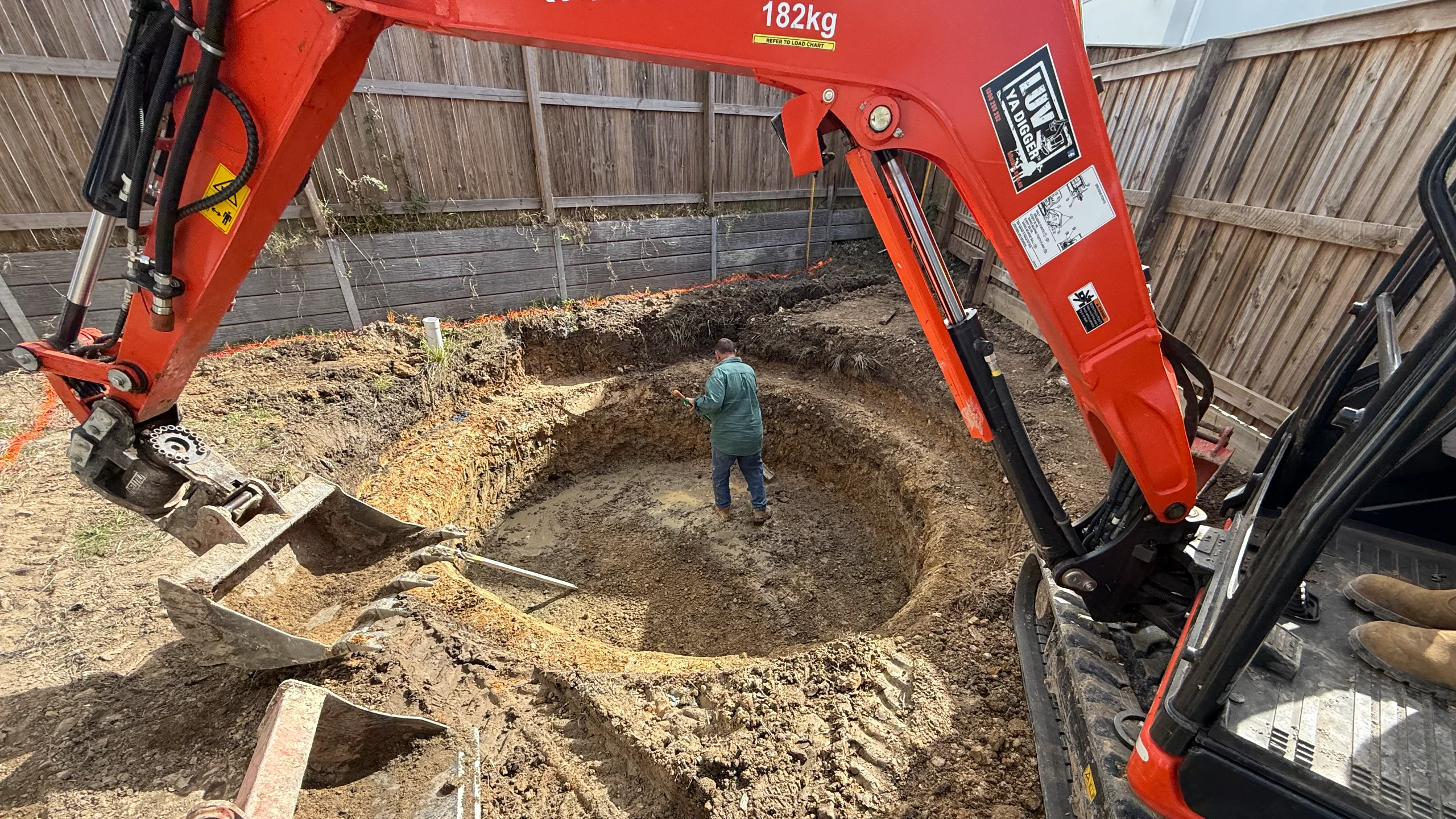
How is the hole for a fibreglass pool dug?
Excavation for a fibreglass pool usually takes one machine day. The shell is normally installed within two days of excavation.
The excavation process has five steps:
- Locate and mark underground water, sewer, power and telecommunications services.
- Mark the pool outline using the shell manufacturer’s dig sheet.
- Remove the turf and excavate the main hole. Load the spoil directly into a tipper truck.
- Trim the excavation to match the shell profile, including the entry steps, bench and deep end.
- Screed the base to the level set by a laser.
Each dig sheet applies to a specific shell model. It shows the plan dimensions, the positions of the steps and bench, and the floor depth at each point. These measurements are marked on the ground as hash lines. The operator excavates to the marked lines. The excavation must match the fixed factory shape of the fibreglass pool shell.
Equipment varies according to site access. Open blocks can accommodate a standard excavator. A mini excavator can use narrow side access. A skid steer can operate in a confined yard. A tipper truck removes the excavated material.
Rock, groundwater or restricted access can extend excavation into a second day. This can occur when spoil must be moved in stages. Excavation and shell placement are scheduled as one block of work.
The standard quote lists excavation as separate charges for the excavator, tipper truck and dump fee. The client does not need to arrange excavation or manage a separate excavation contract.
Excavation is the first machine stage in the stages that take a shell from delivery to swim-ready. It starts after building approval, which is the approval required before the machine starts. The remaining stages are shell placement, plumbing, backfill, the concrete surround and handover.
How deep and how wide does the hole have to be?
The excavation is wider and longer than the fibreglass pool shell. It is also deeper than the pool’s finished floor. Australian dig sheets specify 100 mm to 300 mm of clearance around the shell, depending on the model. They also specify an excavation depth 75 mm to 100 mm below the finished floor level. This additional depth provides space for the bedding layer. Use the shell manufacturer’s dig sheet for the model being installed.
| Hole dimension | Allowance over the shell | What the allowance does |
|---|---|---|
| Length and width | 100 mm to 300 mm of clearance all round, per the dig sheet | Gives the crew room to guide the shell down, reach the wall fittings and place backfill against it |
| Depth | 75 mm to 100 mm below finished floor level, per the dig sheet | Holds the screeded granular bed the shell is set on |
| Floor level | Cut and screeded to a laser-set elevation | Fixes the finished height of the pool, because the base decides the shell's level |
The excavation depth follows the shell’s floor profile. It therefore varies along the pool.
| Shell model | Plan size | Floor depth, shallow to deep |
|---|---|---|
| Allure | 5.00 m × 2.50 m | 1.10 m to 1.60 m |
| Bedarra | 7.50 m × 3.80 m | 1.30 m to 1.80 m |
| Amalfi | 9.00 m × 3.60 m | 0.90 m to 2.00 m |
For each model, excavate 75 mm to 100 mm below the floor depths shown in the table. Set out the excavation 100 mm to 300 mm larger than the plan size.
The Allure floor ranges from 1.10 m at the shallow end to 1.60 m at the deep end. The Amalfi floor ranges from 0.90 m to 2.00 m across a 9.00 m × 3.60 m plan. Its 2.00 m deep end requires the deepest excavation of the three models.
Set the excavation floor to a laser-measured elevation. The base level determines the finished heights of the waterline, coping and paving.
What does the soil do to a fibreglass pool dig?
Soil type affects the excavation equipment, digging method, wall batter angle, and cost. A geotechnical soil test identifies the soil classification, bearing capacity, groundwater level, and expected movement as moisture levels change. This information determines the excavation method and equipment.
In South East Queensland, reactive clay requires planning for expansion when wet and shrinkage when dry. Sandstone can require a hydraulic hammer or rock saw.
| Ground type | What changes in the dig | What it adds to the quote |
|---|---|---|
| Sand | Excavation is usually quick. The soil type determines the batter angle of the excavation walls. | Nothing beyond the standard excavator, tipper truck, and dump fees |
| Reactive clay | The excavation is planned around the moisture level because the ground expands when wet and shrinks when dry. | No rock charge. Wet ground can extend the excavation into a second day. |
| Rock, typically sandstone | The excavator bucket is replaced with a hydraulic hammer, or a rock saw is used. Broken rock is loaded and removed separately. | $250 per cubic metre of rock removed, with a $750 minimum, charged as a variation |
| Fill or made ground | The floor is excavated to firm ground and replaced with imported granular material. A pool shell placed on fill or organic material can settle. | On-site earthmoving at $50 per cubic metre, plus $170 per square metre if a concrete slab must be removed from the pool footprint |
AS 1839-2021 covers the installation of pre-moulded fibre-reinforced plastic pools in Australia. It requires specific consideration for reactive clay. Movement caused by changing moisture levels can shift the pool and damage surrounding structures. AS 1838-2021 covers the design and fabrication of the pool shell.
If groundwater is present at excavation depth, it is pumped out while the excavation remains open. Dewatering pumps operate from a sump below floor level. If the ground does not drain naturally, subsoil drainage is installed around the pool. A stormwater line that crosses the pool footprint must be diverted. This adds $600 to the quote.
What happens if the dig hits rock?
Rock excavation is charged as a variation at $250 per cubic metre, with a $750 minimum. None of the 279 sampled quote variations included a rock excavation charge. A standard rock allowance would therefore charge most buyers for work they do not require.
Rock can occur in South East Queensland, particularly in sandstone areas. Before excavation, the geotechnical soil test may identify the rock horizon and its depth. Exposed sandstone on neighbouring sites can also indicate local ground conditions. These checks are not conclusive. Rock is confirmed when the excavator reaches it.
When the excavator reaches rock, digging stops and the operator changes tools. A hydraulic hammer breaks the rock into pieces that can be removed. A rock saw cuts a clean face. Tool selection depends on the hardness of the rock and the space available for the machine.
Rock excavation can extend a one-day dig into a second day. The broken rock must also be loaded and removed with the other spoil.
Can you dig the hole for a fibreglass pool yourself?
No. Fibreglass pool excavation requires professional equipment and precise site preparation for four reasons.
- The excavation must match the shell. The fibreglass shell is moulded off site and delivered as a complete unit. The excavation must match the dimensions in the dig sheet, including the steps, bench and deep end.
- Over-excavation requires additional material. Soil removed below or outside the dig sheet lines cannot be replaced as fill. Imported granular base material must be added and levelled. This increases material and labour costs.
- The base requires accurate elevation. A site laser is used to set the excavation floor. The base elevation determines the finished height of the waterline and paving.
- Underground services must be located. Buried water, sewer, power and telecommunications services must be identified before excavation. This is a legal requirement. Before You Dig Australia provides the plans at no cost.
Before excavation, the owner can prepare the area above ground. Remove furniture, pots, stored materials, plants and structures from the pool footprint and access route. Measure side access at its narrowest point. This preparation reduces machine time on the day.
Where does the dirt from a pool dig go?
Excavated soil is managed in one of three ways:
- Removed by tipper truck and taken to a tip or fill site.
- Kept on site and levelled across the block.
- Used to raise the area around the pool.
Spoil removal pricing depends on:
- The access width for excavation equipment.
- The distance from the excavation to the truck.
We measure both during the site inspection. The measurements determine the required equipment and spoil-handling method.
If access is at least 3 m wide and the truck can park within 5 m of the excavation, the excavator can load soil directly into the truck. Otherwise, the truck remains on the street and machines move the soil in stages.
Cart-out pricing uses the following distance bands:
- 0 m to 20 m
- 20 m to 40 m
- 40 m to 60 m
We measure the distance from the excavation to the truck.
Excavation equipment has the following minimum access requirements:
- The narrowest machine requires 1.38 m of clear access.
- The next size requires 1.57 m of clear access.
Excavation equipment cannot access the backyard if the available width is less than 1.38 m.
Access width is one of the pool site access requirements measured before preparing a quote. We measure the narrowest point on the access route.
Side access width does not determine the crane type. Every quote includes an allowance for a Franna crane. If the installation requires a slew crane, the upgrade price is based on the lift distance from the crane’s standing position to the pool.
Access width determines the excavation equipment and spoil-handling method. Lift distance determines the crane type.
Soil can remain on site. Moving and levelling spoil across the block costs $50 per cubic metre. This option may be suitable for a sloping yard that requires a raised pool surround due to excavation and support requirements. It is not suitable for a flat block without enough space for the soil.
What happens to the hole before the shell goes in?
After excavation, the crew prepares the bed that supports the pool shell. Preparing the ground explains the base and backfill materials in detail.
A fibreglass pool shell sits on a free-draining bed of crusher dust or fine aggregate. Australian dig sheets specify a maximum particle size of 6 mm to 7 mm. The bed accounts for the additional 75 mm to 100 mm of excavation depth. The shell is not installed on undisturbed clay, organic material or a concrete slab. The crew screeds the bed level but does not compact it like a slab sub-base.
The shell is usually installed within two days of excavation. Rain can soften the trimmed floor and delay work. If the excavation remains open during wet weather, the crew must reassess it before installing the shell.
The quoted installed price includes excavation, spoil removal, base preparation and the crane allowance. Rock volume, cart-out distance, on-site earthmoving, slab removal and stormwater diversion can affect the final price.
After installing and levelling the shell, the crew pours the bond beam and collar around its top. The screeded bed, bond beam and packed backfill are what supports the shell after excavation. The crew adds backfill at the same rate as the pool fills with water. This process prevents uneven loading on the shell.
From excavation, a project typically takes about three weeks to reach paving and six to seven weeks to reach handover.
What do the excavation lines cost on a real quote?
The excavation sits on the quote as three lines: the excavator, the tipper truck, and the dump fees. The amounts scale with the shell. These are the standard-quote excavation lines for three shells across the size range, Brisbane recipe, GST inclusive, priced 14 August 2026.
| Excavation line | Malta (small) | Amalfi (mid-size) | Saint Azur (large) |
|---|---|---|---|
| Excavator (3.5–6 t) | $985 | $2,212 | $2,954 |
| 10 m tipper truck | $1,292 | $3,134 | $4,246 |
| Dump fees | $462 | $1,229 | $1,846 |
| Excavation total | $2,738 | $6,575 | $9,046 |
Rock is the one addition: $250 per cubic metre with a $750 minimum, charged as a variation only when the dig hits it.
FAQs
Can you dig your own hole for an inground pool?
No. Excavation for an inground fibreglass pool must match the factory-moulded shell dimensions and depths specified on the dig sheet. The floor must be excavated to a laser-set elevation. Any excavation below or outside the specified lines must be corrected with imported granular material. Buried services must also be located before excavation, as required by law.
How deep do you need to dig for a pool?
Excavate to the shell floor depth, plus 75 mm to 100 mm for the granular bed. The Allure floor depth ranges from 1.10 m to 1.60 m. The Amalfi floor depth ranges from 0.90 m to 2.00 m. Use the shell manufacturer's dig sheet for the exact excavation depth.
How long does it take to dig a pool?
Excavating a standard residential pool on workable ground takes about one day. Rock, groundwater, or limited access can extend excavation to a second day. The shell is installed within two days of excavation.
What is a pool dig sheet?
A pool dig sheet is an excavation drawing from the shell manufacturer for a specific pool model. It shows the plan dimensions, step and bench locations, floor depths, and required working clearance around the shell. Use the sheet to mark the pool layout on the ground.
How much does pool excavation cost?
Pool excavation is included in the pool installation price. The cost includes an excavator, a tipper truck, and dump fees. Site conditions affect the final price.
Rock excavation costs $250 per cubic metre, with a minimum charge of $750. On-site earthmoving costs $69.93 per cubic metre. Spoil handling costs depend on the cart-out distance band.
Do you have to locate services before digging?
Yes. You must locate buried water, sewer, power, and telecommunications services before digging. Before You Dig Australia provides free plans showing where these services cross the property.
| Pool size | Length | Depth | Installed from |
|---|---|---|---|
| 3m to 4m | 1.45m level | $45,847 | |
| 4m to 5.5m | 1.0m to 1.78m | $45,613 | |
| 6m to 7m | 1.0m to 1.88m | $54,443 | |
| 7.2m to 8m | 0.98m to 1.96m | $60,374 | |
| 8.5m to 11m | 1.0m to 2.0m | $72,535 |
Live all-inclusive installed pricing for standard site conditions in South East Queensland — updated straight from our quoting system.