Fibreglass Pool Equipment: Inclusions, Costs & Upgrades
The pump, filter, chlorinator and lights a fibreglass pool runs on, which parts an MFP Easy quote includes, what is an upgrade, and what each costs.
Written by Tehbyn Nova, Head of Operations & Growth · Technically reviewed by Caleb Druhan, General Manager (QBCC licence 15087383) on
Published · Updated
Direct answer
Pool equipment suppliers in Australia offer a large product range. Pool & Spa Warehouse lists more than 5,000 product lines, including 1,350 items in one category. A fibreglass pool requires a smaller core equipment set. Buyers then choose any additional equipment and upgrades.
What equipment does a fibreglass pool need to run?
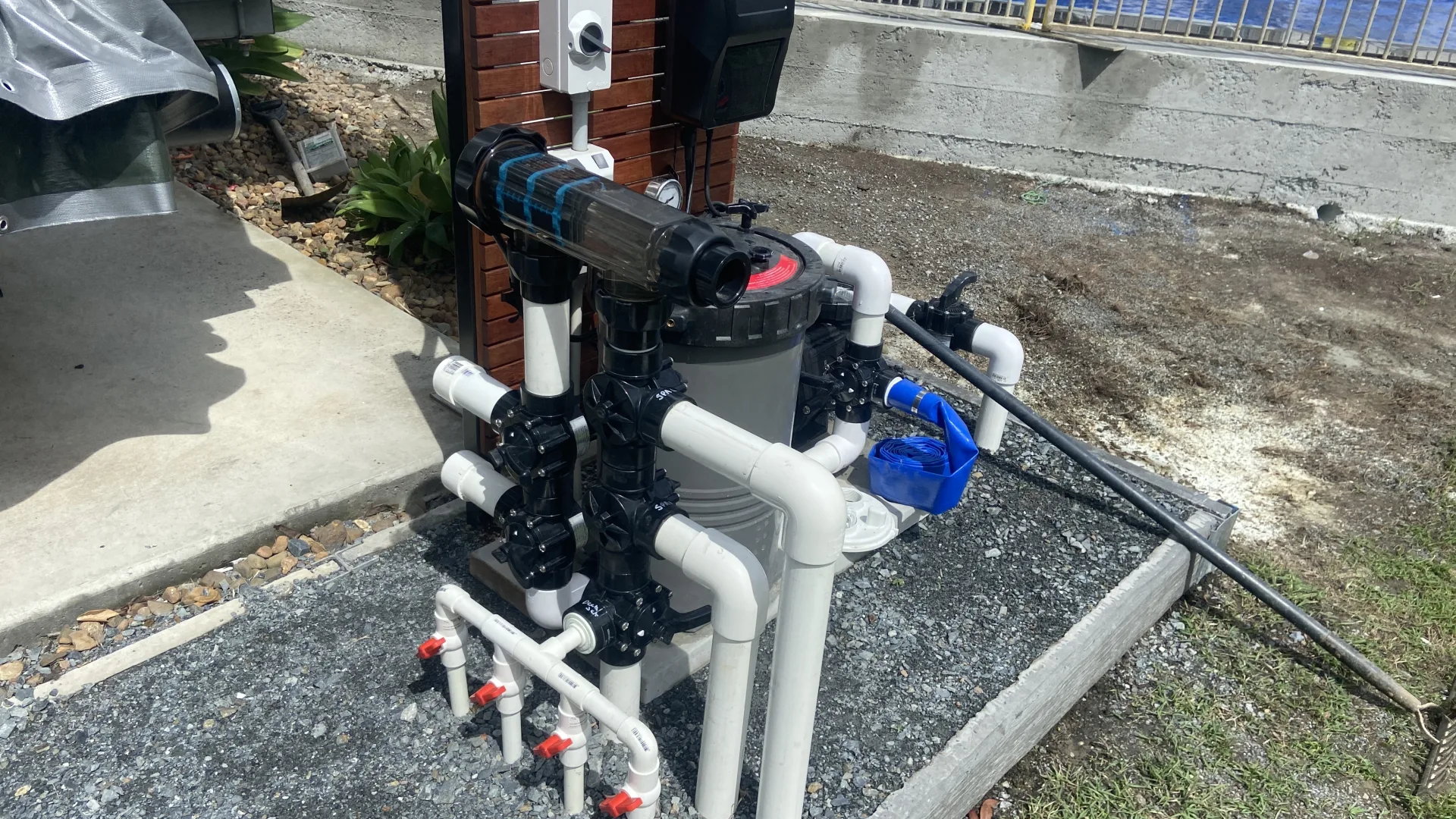
A fibreglass pool requires a pool pump, filter, sanitiser, and skimmer box and drains with return fittings. The skimmer box and return fittings are fitted to the pool shell at the factory.
Most fibreglass pools use a salt chlorinator as the sanitiser. Pool water passes through an electrolytic cell in the filtration line. A low electrical current converts chloride from dissolved salt into sanitiser. Salt pools still use chlorine.
Heating, pool cleaners, covers, and lighting beyond what the pool package includes are optional. The pool can operate without them. Every pool we install uses the same equipment configuration. Only the filtration class changes based on shell size.
Required plant
- Pool pump. Circulates water through the filtration line and returns it to the pool through the return fittings. The filter and chlorinator only treat water while the pump is moving it through the system.
- Filter. Removes debris from the circulating water. Domestic pools in Australia generally use either cartridge or media filters. A cartridge filter contains a pleated element. A media filter contains sand or glass media.
- Sanitiser. Maintains the disinfectant level in the water. A salt chlorinator operates while the pump runs and uses salt dissolved in the pool. It does not require separate dosing equipment.
- Skimmer box and return fittings. The skimmer box draws surface water and floating debris into the filtration line. The return fittings send treated water back to the pool. Both are factory-fitted to the shell after it leaves the mould, so they are not separate purchases or upgrades.
Optional additions
- Heating. A heat pump is an optional cost and is not included in the pool package. The pool can filter and sanitise without a heater.
- Extra lighting. Lighting beyond what the pool package includes is optional. It affects night-time use but is not required for operation.
- A pool cleaner. Collects debris from the pool floor and walls between filter cycles. Without one, the pool can be brushed and vacuumed by hand.
- A cover. A thermal blanket with a stainless roller is optional. An automatic cover requires its housing and track to be installed in the coping and surround before the shell is set. A cover does not change how the plant operates.
Which equipment is included in the price of a fibreglass pool, and which is an upgrade?
An MFP Easy pool package includes the pump, filter, mineral chlorinator, pool light, and a handover kit of hand tools. The filtration packages define the included equipment and available automation. Optional equipment includes a heat pump, thermal blanket and roller, robotic cleaner, and additional lighting.
| Part | Included in the pool price, or priced as an option |
|---|---|
| Pool pump | Included. It circulates the pool water and is required for the other plant equipment to operate. |
| Filter | Included. The filter class depends on the shell size. This is the only equipment specification that changes across the range. |
| Salt chlorinator | Included. It uses salt dissolved in the pool to sanitise the water while the pump is running. |
| Pool light | Included. Pool lighting is part of the pool package. |
| Skimmer box and return fittings | Included in the shell. They are factory-fitted to it and are not separate purchases. |
| Hand tools | Included. A hand tool kit is provided at handover. |
| Heat pump | Optional. Prices start at $4,125 supplied and installed for a 9 kW unit on shells up to 6.5 m. |
| Thermal blanket with stainless roller | Optional. Prices start at $2,190 supplied and installed for shells from 3–6.5 m. |
| Robotic cleaner | Optional and purchased separately. Robotic cleaners are listed at $995 to $3,295. CHOICE's testing covers models from $419 to $2,749 and advises buyers to expect to pay more than $1,000. |
| Additional pool lights | Optional. Lighting beyond the light included in the pool package is priced separately. |
Heat pump and thermal blanket prices depend on shell length. Heat pump prices range from $4,125 supplied and installed for a 9 kW unit to $10,550 for a 24 kW unit on an 11 m shell. A thermal blanket with a stainless roller ranges from $2,190 to $3,140 for an 11 m shell. These costs are added to the installed fibreglass pool price, which includes the pump, filter, chlorinator, and light.
Additional lighting is priced separately. Pool lights and cabling are installed during construction. Installation requires licensed electrical work, so lights must be planned before the pool is completed.
What does a fibreglass pool's equipment cost to run each year?
A fibreglass pool’s annual running cost mainly depends on the pump and, if installed, the heater. The filter, chlorinator, light, and cleaner use little or no additional electricity.
| Part | How much it runs | Does it affect the annual bill? |
|---|---|---|
| Pool pump | Runs every day during the configured filtration cycle. | Yes. The pump and heater are the main contributors to running costs. |
| Heat pump | Runs while heating the water to the set temperature and maintaining that temperature. | Yes, if installed. |
| Filter | Runs with the pump and has no motor of its own. | No. It does not draw power separately. |
| Salt chlorinator | Runs while the pump circulates water through the cell. | Very little. The cell converts chloride using a low current. |
| Pool light | Runs when switched on, usually during the evening. | No. |
| Robotic cleaner | Runs for one cleaning cycle at a time using its own motor. | No. |
The annual cost depends on the electricity tariff and the number of hours the pump runs each day. The electricity retailer sets the tariff, while pool pump sizing and run hours determine how long the pump uses power each day.
A pool automation controller can manage the light, pump, heater, and valves from an app or touchscreen. This allows the filtration cycle and heating schedule to be configured in one place. Austpools prices basic timer and smart-switch hardware for pool equipment in the tens of dollars. Integrated automation controllers cost more.
Where does the equipment go, and who connects it?
Pool equipment is installed on a pad away from the pool. Plumbing connects the equipment to the skimmer box and return fittings.
A licensed electrician must complete all electrical connections. Since 1 April 2025, Queensland's Electrical Safety Regulation 2013 has classified pool lights as prescribed electrical equipment. Installing pool lights during construction requires an unrestricted electrical contractor licence. A licensed electrician must also replace pool lights.
Licensing requirements also apply to pool pumps and other electrical equipment on the equipment pad. Owners must not wire this equipment.
Salt water and salt residue can corrode nearby metal fittings and equipment. They do not affect the fibreglass shell. Locate the equipment pad away from the waterline to limit exposure. Pump covers and enclosures can provide additional protection and extend equipment service life.
Planning the equipment-pad location occurs during construction, along with planning for plumbing runs and electrical conduit.
How long does each piece of equipment last, and what fails first?
The chlorinator cell is usually the first part of a fibreglass pool plant set that requires replacement. The other equipment generally lasts longer.
| Part | Typical service life | What shortens it | Replacement cost |
|---|---|---|---|
| Salt chlorinator cell | The first consumable in the plant set to require replacement. Its rated life depends on the manufacturer of the installed chlorinator | Use. The cell produces chlorine only while the pump circulates water through it | Roughly $575 to $1,375 for a genuine cell (Aquaneo, Pool Assist). Cell internals cost less than complete cells |
| Salt chlorinator, complete unit | Lasts longer than the cells used with it | The cell is the wearing part and can be replaced separately | Roughly $1,299 to $3,675 (Pool Assist, Clark Rubber). Connected Wi-Fi models are at the top of this range |
| Filter body | Five to ten years for non-wearing parts (Mr Pool Man) | The media or element inside the filter is a consumable with a separate replacement cycle | The tank, valve and internals remain in service while the media is replaced |
| Filter media (sand) | Poolwerx replaces sand media on a five-year cycle and reports that filtration performance declines after three or four years. Mr Pool Man specifies one to three years, "depending on usage conditions" | Usage conditions. Replacement intervals depend on load rather than a fixed schedule | Purchased as media rather than as a complete filter |
| Pool pump | Lasts longer than the chlorinator cell | Salt water and salt residue can corrode metal fittings and nearby equipment | From about $439 for a single-speed 0.75 HP unit to about $1,899 for a variable-speed model. Three-speed units cost around $899 (Clark Rubber, AstralPool) |
| LED pool light fitting | Depends on the manufacturer of the installed fitting | Replacement requires a licence. In Queensland, only a licensed electrician may replace a pool light | From about $150 for generic brands and $270 to $650 for premium brands. Named Australian units cost $330 to $389 including GST (Fusion Lighting, Pool & Spa Warehouse) |
A pool filter has two parts with different service lives. The tank, valve and internals are durable components. The media or element is a consumable that is replaced while the filter body remains in service. The type of consumable and its replacement interval depend on which filter a fibreglass pool runs.
Published replacement intervals for sand media vary. Mr Pool Man links the shorter interval to usage conditions. The five-year cycle is an outer limit rather than a fixed schedule. The appropriate interval depends on the filter load and operating conditions.
What should you buy with the pool, and what can wait until later?
Specify anything built into the pool's plumbing, electrical system, coping or surround before construction. Items that plug in or sit on the water can be purchased later.
Specify at build
- The plumbing runs and the equipment pad. The plumbing runs and equipment pad are installed during construction. Their locations determine where future equipment connects. Pumps and chlorinators added later will use the existing pad.
- Conduit and a dedicated circuit for a heater. A heat pump requires a dedicated circuit and conduit to the equipment pad. These must be installed before the surround is laid. Use What pool heating costs to run to decide whether to include a heater. Adding the required electrical work later may require opening the finished surround.
- An automatic cover. The housing and track for an automatic cover are installed in the coping and surround before the shell is set. Retrofitting one requires changes to the finished coping and paving. Use Which pool cover to use to compare options. A thermal blanket does not require built-in components and can be purchased later.
- Extra light positions. Pool light fittings and cables are installed during construction by a licensed electrical worker. Specify any additional light positions as part of the build.
Buy any time
- A robotic cleaner. A robotic cleaner plugs in and does not require built-in components. It collects debris in its own bag or cartridge, reducing the load on the pool's filtration system. We use and recommend Maytronics robotic cleaners. You can choose Which pool cleaner to run after observing what debris enters the pool.
- A thermal blanket and roller. We supply and install a thermal blanket with a stainless roller from $2,190 for shells 3–6.5 m long. It can be added later because it does not require changes to the shell or surround.
- Hand tools and consumables beyond the handover kit. The pool handover includes a kit of hand tools. Pool shops stock additional brushes, test kits and replacement consumables. These items do not affect the pool build.
FAQs
What are the top 3 pool equipment brands?
We do not rank pool equipment by brand. For fibreglass pools, we specify equipment by class and rating. The equipment build is consistent across our range, while the filtration class varies by shell size. We use and recommend Maytronics robotic cleaners.
Where is the best place to buy pool equipment?
Buy the plant equipment with the pool package. This includes the pump, filter, salt chlorinator, and pool light. A licensed electrician connects this equipment during construction.
Buy equipment that is not built in from any pool shop. This includes robotic cleaners, thermal blankets and rollers, brushes, test kits, and consumables.
Choose equipment that affects the plumbing, electrical system, or coping before construction. Equipment with a plug can be purchased later.
What is the best pool equipment?
There is no single best equipment set for every pool. Equipment is sized for the pool shell. The standard build is consistent across our range, while the filtration class changes based on shell size. Buyers only need to select any additional equipment.
Can a pool run on less equipment than this?
A pool requires a pump, filter and sanitiser to circulate, clean and disinfect the water. The skimmer box and return fittings are also required and are factory-fitted to the shell after it leaves the mould.
Heating, additional lighting, a cleaner and a cover are optional.
Is second-hand pool equipment worth buying?
In Queensland, installing and connecting pool equipment requires a licensed electrician, regardless of the equipment’s price or source. This requirement also applies to second-hand pumps and chlorinators.
Ongoing costs generally relate to consumable components. A genuine replacement cell costs $575 to $1,375. Filter media also requires replacement based on its own maintenance cycle, regardless of the tank’s age.