Pool Pumps for a Fibreglass Pool: Sizing & Running Costs
Which pump size a fibreglass pool needs, how variable speed compares to single speed, how many hours to run it, and what it costs.
Written by Tehbyn Nova, Head of Operations & Growth · Technically reviewed by Caleb Druhan, General Manager (QBCC licence 15087383) on
Published · Updated
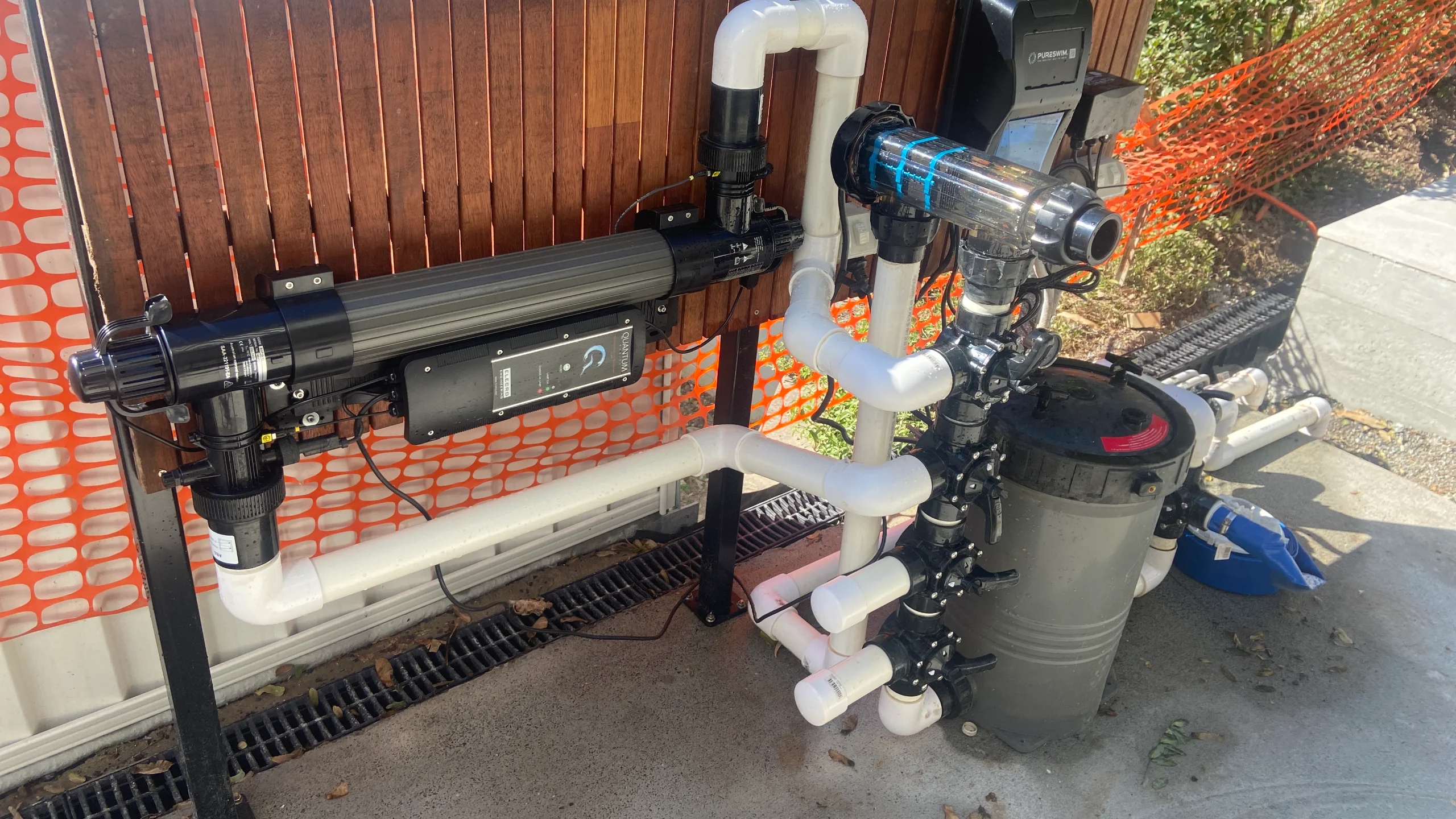
What does a pool pump do, and which pump comes with a fibreglass pool?
A pool pump circulates water through the filtration system. It draws water from the skimmer box, sends it through the filter, and returns the filtered water to the pool through the return outlets.
MFP Easy includes the filtration pump and filter in the quoted fibreglass pool build. We supply, install, plumb, and commission them as one filtration package. The pump is selected to match the water volume of the pool shell, so you do not need to purchase it separately after handover. The pump fitted across our 2026 filtration packages is the PureSwim MULTI-ECO 1.25 HP, which appears on a customer quote at $1,339.78, GST inclusive, as at 16 August 2026.
The pump operates from the equipment pad alongside the filter and salt chlorinator. It is connected between the suction line and the filter inlet. A strainer basket on the suction side collects leaves and debris before they enter the pump.
Other pool equipment depends on the pump for water circulation. The salt chlorinator produces sanitiser at its configured output while the pump is running. A pool heater transfers heat only while water is flowing through it. Filtration, sanitisation, and heating therefore operate during the pump’s scheduled running hours.
What size pump does a fibreglass pool need?
Size a pool pump by turnover rate. The pump must move the pool’s full water volume through the filter during its scheduled run time. Use the pool volume and the filter’s rated flow to select the pump. Do not size the pump by horsepower alone.
Every pool filter has a rated flow in litres per hour. The pump must not exceed this rating. For this reason, filtration for a fibreglass pool uses a matched pump and filter pair. Calculate the required flow from the pool volume:
| Pool water volume | One turnover moves | Flow the pump must deliver |
|---|---|---|
| 40,000 litres | 40,000 litres through the filter | 40,000 divided by the hours the pump is set to run, in litres per hour |
| 50,000 litres | 50,000 litres through the filter | 50,000 divided by the hours the pump is set to run |
| 60,000 litres | 60,000 litres through the filter | 60,000 divided by the hours the pump is set to run |
The required flow must be equal to or lower than the filter’s rated flow. Shorter run times require a higher flow rate. Longer run times require a lower flow rate. Select the pump and operating schedule together to keep the flow within the filter’s rating.
An oversized pump can reduce filtration performance and increase electricity use. If the flow exceeds the filter’s rating, water passes through the filter medium too quickly to capture suspended material effectively. A larger motor also uses more power during each scheduled hour.
An oversized filter has different effects. A filter with more medium requires less frequent cleaning and reduces the pressure against which the pump operates. However, a pump that delivers more flow than the filter can handle does not improve filtration and increases electricity use.
Is a variable-speed pool pump worth it on a fibreglass pool?
A variable-speed pool pump costs more to buy but less to operate. The federal Energy Rating program estimates that a 6-star variable-speed pump costs more than $260 less per year to run than a 1.5-star single-speed pump. According to energy.gov.au, the savings come from operating at lower speeds. A motor uses less power at a lower speed, and the pump can achieve the same water turnover by running longer.
Actual savings depend on operating hours and electricity tariffs. Identical pools can therefore have different running costs.
| Pump type | How it runs | Control | Australian retail price |
|---|---|---|---|
| Single-speed | One fixed speed whenever power reaches it | Switched on and off only, by a timer or the chlorinator's outlet | From about $439 for a 0.75 HP unit |
| Three-speed | Three fixed speeds, one selected for the task | Speed selected at the pump, switched by a timer | Around $899 |
| Variable-speed | Any speed across its range, on a schedule the owner sets | Bluetooth or app control with user-set speed schedules | Up to about $1,899 |
Clark Rubber lists these Australian retail prices. The variable-speed price is for a pump at the top of the AstralPool range. These prices cover pump hardware only and do not include installation.
Variable-speed pumps have two main disadvantages compared with single-speed pumps. First, the purchase price can be up to about $1,899, while a single-speed 0.75 HP pump starts from about $439. Operating-cost savings must recover this price difference before the variable-speed pump provides a net saving.
Second, a variable-speed pump includes a speed controller and other control electronics. A single-speed motor does not include these components. This adds hardware that can fail.
Lower pump speeds also reduce the pressure of water passing through the cartridge filter. This can extend the life of the filter element.
How many hours a day should a pool pump run?
A pool pump should run long enough to move the pool’s full volume through the filter once. The required run time depends on the pool’s volume and the pump’s flow rate. Pools of the same size may require different schedules if they use different pumps.
- A single-speed pool pump runs at one flow rate for the time required to complete one turnover.
- A three-speed pool pump can run longer at a low or medium speed, or for less time at high speed, to complete one turnover.
- A variable-speed pool pump typically runs longer at a lower speed to complete the same turnover.
Adjust the baseline schedule for the following factors:
- Season: A pool in South East Queensland may require a different schedule in summer than in July.
- Bather load: A pool used every afternoon has more debris and organic load than one used only on weekends.
- Control device: A chlorinator commonly provides the pump’s power outlet and timer. In this setup, the chlorinator and pump use one schedule configured on the same device.
Set the pump schedule to complete one turnover. Additional run time is not required for that turnover and increases motor operating time. A variable-speed pool pump does not need to run 24 hours a day to move the pool’s volume through the filter.
We set the run schedule at handover based on the pool’s volume and equipment. There is no single run time that applies to every pool. To calculate the schedule, use the pool’s volume and the pump’s flow rate.
What does it cost to run a pool pump?
To calculate the annual cost of running a pool pump, use this formula:
Pump draw in kW × operating hours per day × 365 × electricity tariff in dollars per kWh = annual cost.
The motor plate lists the pump draw. The timer or chlorinator schedule shows the operating hours. The electricity bill lists the usage tariff.
The pump is the largest continuous electrical load added by a pool. It draws its full load during scheduled operating hours. Other equipment for a fibreglass pool operates for shorter periods. The chlorinator cell operates only while the pump is running. A heater draws power only while heating. A pool cover does not draw power.
| Pump type | Motor draw to use | Hours per day to use | Tariff | Annual cost |
|---|---|---|---|---|
| Single-speed | The rated input in kW on the motor plate | The block that completes one turnover at that pump's flow | The household usage rate in cents per kWh | kW × hours × 365 × tariff |
| Three-speed | The rated input at the speed actually run | Longer hours at low or medium speed for the same turnover | The same usage rate | Run the calculation for each speed setting and add the results |
| Variable-speed | The input at each scheduled speed, lower at lower speeds | The longest hours of the three, at the lowest speed | The same usage rate | Run the calculation for each scheduled speed and add the results |
The calculation in the last column assumes the same schedule applies every day of the year. If the schedule changes in winter, calculate each schedule for the number of days it applies. Add the two results.
An annual cost estimate requires the pump rating, operating schedule, and electricity tariff. Changing any of these inputs changes the result.
The installed price of a fibreglass pool includes the filtration pump, filter, chlorinator, and the rest of the build. This is a one-off cost. Pump electricity is an ongoing cost.
| Pool size | Length | Depth | Installed from |
|---|---|---|---|
| 3m to 4m | 1.45m level | $45,847 | |
| 4m to 5.5m | 1.0m to 1.78m | $45,613 | |
| 6m to 7m | 1.0m to 1.88m | $54,443 | |
| 7.2m to 8m | 0.98m to 1.96m | $60,374 | |
| 8.5m to 11m | 1.0m to 2.0m | $72,535 |
Live all-inclusive installed pricing for standard site conditions in South East Queensland — updated straight from our quoting system.
Can a pool pump run on solar?
Yes. There are two common options:
- A dedicated DC solar pool pump connected to its own solar panels.
- A mains pool pump scheduled to run during the day using the home's rooftop solar generation.
These options suit different sites.
A dedicated DC solar pool pump is supplied as a package containing a pump, solar panels and a controller. It runs when the panels receive enough sunlight and stops when they do not. Based on Tuhorse's range, these packages cost about $2,000 to $3,600 in Australia.
Pump operation depends on the weather. Cloud cover can slow or stop the pump during a cycle, which can affect daily water turnover. The solar panels also require a suitable sunny mounting position, regular cleaning and routine checks.
A mains pool pump scheduled to run in daylight hours uses electricity generated by an existing rooftop solar system. The pump remains connected to the mains supply. Its operating hours can be set using the pump timer, chlorinator timer or a smart switch.
This option does not require additional panels or other mounted hardware. The pump continues to run during cloud cover because the grid supplies any electricity not provided by the rooftop solar system. Scheduling the pump for the middle of the day moves the pool's largest continuous electrical load into the period when the rooftop system is generating electricity.
For a mains-connected home in South East Queensland, scheduling the existing mains pump to run during daylight hours is the standard option. A dedicated DC solar pool pump is more suitable when mains power is not available at the equipment pad and the alternative is installing a power supply to that location.
How long does a pool pump last, and what shortens its life?
A pool pump’s service life depends on its installation location and water supply. Exposure to sun and rain can damage the pump. Restricted water flow can cause the pump to run dry.
The following conditions can reduce pump life:
- Weather exposure. Direct sun and rain can damage the motor and electrical components. During the pool build, plan the equipment pad location and cover. Also consider how the pipe run affects pump performance.
- A starved suction line. The pump receives water through the skimmer box. If the water level is below the skimmer opening, or the suction line is blocked or closed, the pump can lose prime and draw air. The pump may then run dry.
- A blocked strainer basket. The strainer basket collects leaves and debris before they enter the pump. A full basket restricts water flow to the pump and filter.
To extend pump life:
- Protect the equipment pad from sun and rain.
- Keep the pool water above the skimmer opening.
- Empty the strainer basket regularly.
FAQs
What size pool pump do I need for a 60,000 litre pool?
The pump must circulate 60,000 litres through the filter during its scheduled runtime. Divide 60,000 by the runtime in hours to calculate the required flow rate in litres per hour. The required flow rate must not exceed the filter’s rated flow.
Do not select a pump based on horsepower alone. Use the flow rate the pump delivers with the pool’s plumbing. For a fibreglass pool, use the known water volume of the shell model to calculate the required flow rate.
Can a pool pump be too powerful for a pool?
Yes. If the pump delivers more flow than the filter is rated for, water passes through the filter medium too quickly. This reduces filtration performance. An oversized motor also uses more power and increases operating costs. Choose a pump based on the filter’s rated flow and the pool’s volume.
How do I prime a pool pump?
Priming fills the suction side of the pool pump with water so the pump does not draw air. Water flows from the skimmer box through the strainer basket to the pump.
If the pump does not hold prime:
- Check that the water level is above the skimmer mouth.
- Remove leaves from the strainer basket.
- Check the lid seal for air leaks.
Switch off the pump if it does not draw water. Running the pump dry can cause pump failure.
Do I need a timer for my pool pump?
A pool pump requires a device that switches it on and off on a schedule. On most salt-chlorinated pools, the chlorinator provides the pump’s power outlet and includes a timer. This lets you set the chlorinator and pump operating hours on one device.
If the pump does not run through a chlorinator, use a standalone time clock or smart switch designed for pool equipment. Based on Austpools’ range, these devices cost tens of dollars in Australia. Integrated automation controllers for the entire equipment pad cost more.
What happens to the water when the pump is off overnight?
When the pump is off, water does not circulate through the filter, chlorinator, or heater. Filtration, sanitiser production, and heating occur only while the pump is running.
Do you run the pool pump when adding salt?
Yes. Run the filtration pump while adding salt. Keep the water circulating until the salt dissolves. This can take up to 24 hours in cold water.
Switch off the cell or pause the chlorinator until the salinity stabilises. The chlorinator produces sanitiser only when the filtration pump is running.