Fibreglass Pool Coping: Options, Install & Price Guide
What coping suits a fibreglass pool, how it is bedded on the bond beam, which adhesives hold it, and what is already in the pool quote.
Written by Tehbyn Nova, Head of Operations & Growth · Technically reviewed by Caleb Druhan, General Manager (QBCC licence 15087383) on
Published · Updated
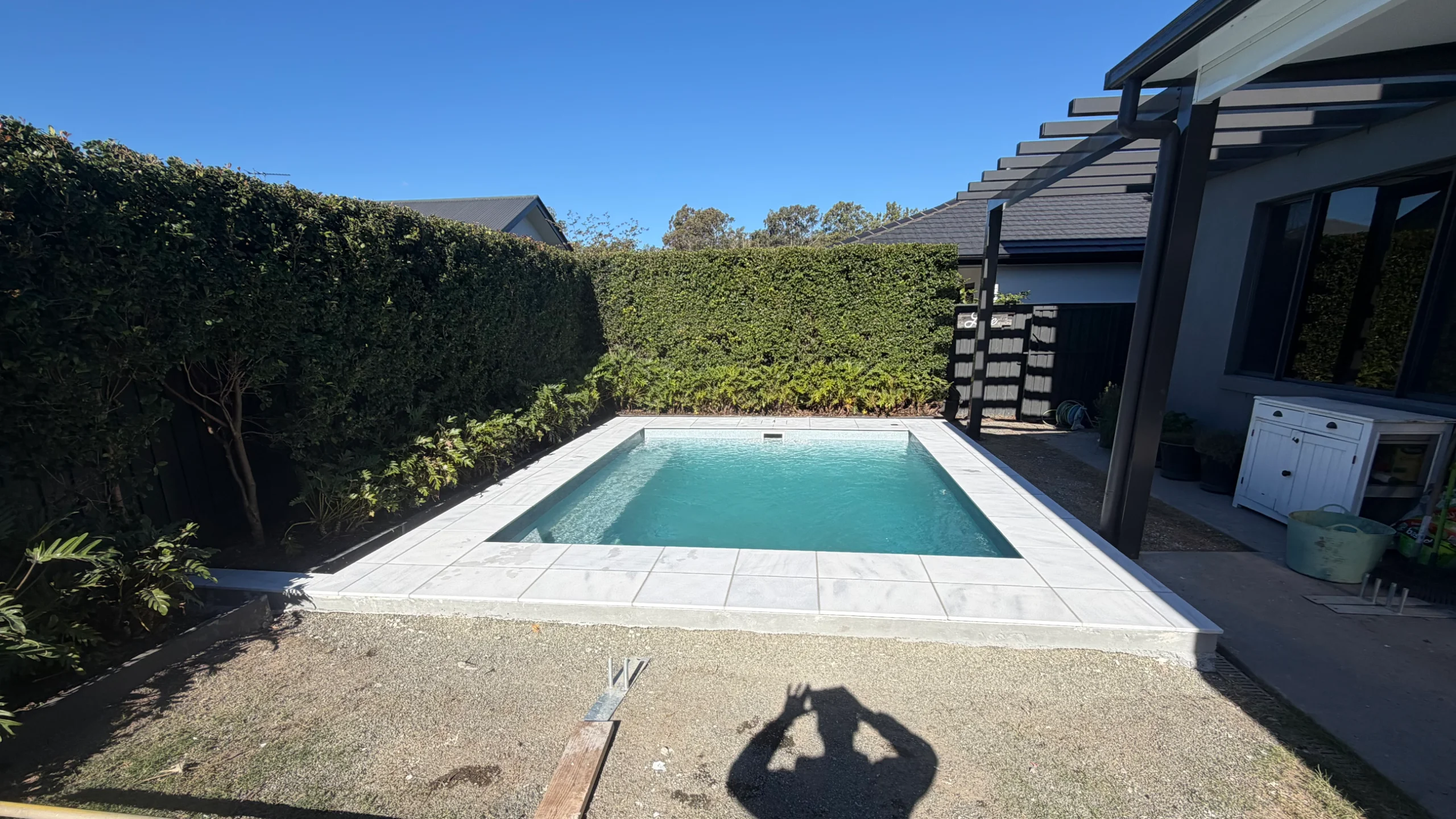
Fibreglass pool coping is the row of pavers or stone units installed along the top of the pool wall. It covers the edge between the pool and the surrounding area.
In Australian pool construction, installers lay the coping on the concrete bond beam around the fibreglass shell. They do not pour it as a concrete edge over the shell.
You need to choose:
- The coping material
- The grout colour
- Whether to install recess drainage in the surrounding area
Does a fibreglass pool need coping?
Yes. Every fibreglass pool requires coping at the top of the pool wall. Coping:
- Caps the reinforced concrete bond beam around the shell.
- Covers the shell’s top flange and raw laminate edge.
- Prevents water from entering behind the shell edge.
- Provides a solid edge for swimmers.
- Reduces the amount of leaves and dirt entering the pool.
Coping units are installed on the bond beam, not on the shell laminate. The bond beam supports the coping and transfers foot traffic away from the shell. The concrete collar beneath the coping must be poured, and the backfill around the shell must be compacted, before installing the coping.
The fibreglass shell can deform slightly under water pressure and vibrate during use. The concrete bond beam holds the pool edge in position and provides a rigid, level base for the coping. It transfers foot traffic from the coping to the bond beam instead of the laminate edge.
Choose the coping after confirming the bond beam’s level, alignment and load path. The coping material determines the colour, texture and edge profile.
Can you have a fibreglass pool without coping?
Yes. Paving can run directly to the pool shell without a separate coping unit. This creates a flush edge with no raised material above the water line. The bond beam is still required and must be covered by the edge finish.
Without coping, the shell’s top flange and the edge of the bond beam become the wearing surface. Foot traffic, furniture and cleaning equipment can contact the laminate lip instead of a stone or porcelain coping unit. The paving joint also meets the pool shell directly. Because the shell moves, rigid mortar or grout may not accommodate that movement.
A flush or zero-edge finish must be planned before the bond beam is poured. The beam height, membrane and paving falls must be designed for this finish. It cannot be added to a completed edge.
Changing the coping material is different from removing coping. Structural porcelain, natural stone and concrete pavers all sit on the bond beam and cover the shell flange.
What coping options work on a fibreglass pool?
Seven coping types are quoted for fibreglass pools in South East Queensland. Six are suitable for a fibreglass shell. Four describe the edge profile. Three describe the unit material. Mitred drop edge is not suitable.
| Coping type | What it is | Suits a fibreglass pool? | Notes |
|---|---|---|---|
| Full-piece drop edge (drop face) | A single stone unit with the top face and front drop cut from one piece | Yes | The drop covers the rounded lip of the shell. There is no glued joint. |
| Bullnose | A tile with a rounded front edge, laid flat on the beam | Yes | Available in stone from 30 mm. The rounded edge provides a grip for swimmers climbing out. |
| Square / pencil edge | A unit with a square or lightly eased front edge | Yes | Available from 30 mm in stone and 20 mm in structural porcelain. It is the flattest edge profile listed. |
| Mitred drop edge | Two pieces glued at a mitred corner to replicate a one-piece drop | No, on Armstone's verdict | A fibreglass shell can vibrate during use, deform slightly under water pressure and have an uneven edge. This can cause the glued joint to open or crack. |
| Structural porcelain | A porcelain paver manufactured at a load-bearing thickness | Yes | Available from 20 mm with pencil-round or bullnose profiles. This is the standard category we fit. |
| Natural stone (granite, travertine, bluestone, sandstone) | Quarried stone cut to coping profiles | Yes | Available from 30 mm. These are upgrade categories on our quotes. Heat and slip properties vary by stone. |
| Concrete paver | A cast concrete unit laid on the beam | Yes | It is laid rather than poured, using the same beam, membrane and bedding sequence. |
Armstone, an Australian stone supplier, specifies minimum thicknesses for coping units. Full-piece natural stone drop edges, pencil-edge stone and bullnose stone tiles start at 30 mm. Structural porcelain with a pencil-round or bullnose profile must be at least 20 mm thick.
Armstone specifies a drop of 60 to 80 mm for a full-piece drop edge. This dimension determines whether the shell’s rounded lip is covered.
We fit porcelain unless the buyer selects natural stone. Natural stone is listed as Cat 1 or Cat 2 on our quotes. The available categories are porcelain, Cat 1 stone and Cat 2 stone.
Natural stones differ in heat and slip properties. Travertine stays cool underfoot and is not slippery when wet. Bluestone has a non-slip surface. Granite is suitable for the Australian climate. Sandstone is a common alternative to granite.
What is cantilevered concrete coping, and does it suit a fibreglass pool?
Cantilevered concrete coping is a concrete edge poured over a fibreglass pool shell using a reusable clip-on form. The concrete forms a rounded, bull-nosed edge that extends toward the water.
This finish is common on fibreglass pools in the United States. It is also the lowest-cost edge option in that market. Leisure Pools USA and River Pools price cantilevered concrete at about USD $6 to $10 per linear foot. The same sources price paver coping at USD $40 to $50 per linear foot and travertine at USD $45 to $55 per linear foot.
In Australia, pool coping is typically a paver or stone unit installed on the bond beam. The Australian Z Poolform distributor lists cantilever form kits at $687.50 and $829.40 including tax. Receiver tracks cost $363.00 and $500.50.
Buying the form does not provide access to an installation crew. Form-hire cantilever pouring is not an established trade in Australia. As a result, Australian coping is not quoted per linear foot of poured edge.
How is coping fixed to a fibreglass pool?
Coping units are bonded to the bond beam, not the pool shell. Installation involves seven steps.
- Pour and level the bond beam from the shell flange. Pour the beam around the pool perimeter against the backfill. Level the finished beam with the top flange of the shell. Australian installation guidance published by Armstone specifies 32 MPa concrete, SL82 mesh, N12 reinforcing bars, and saw-cut control joints every 4 to 5 m. The joints control where the beam cracks. Coping units cannot compensate for an uneven beam.
- Waterproof the concrete. Apply a waterproof membrane over the reinforced concrete before installing the coping. The membrane prevents moisture and efflorescence from rising through the coping and paving.
- Set the fall away from the pool. Install each unit with a slope away from the water. The slope directs rain and rinse water onto what sits beyond the coping edge. It also prevents dirt and leaves from being carried into the pool.
- Provide an overhang and drip edge. Extend each unit beyond the face of the beam. The overhang allows water to drip clear of the beam rather than tracking under the unit and into the joint behind it.
- Cut the units around rounded corners. Fibreglass shells have rounded corners and edges that may not be straight. Cut the coping into several pieces to follow each curve. Do not use mitred corners.
- Grout the joints between units. Grout the joints between coping units in the colour selected during quoting. Do not grout the joint between the coping and the pool shell.
- Seal natural stone. Seal every face of each natural stone unit before installation. Apply a top sealer after grouting. Use a sealer rated for salt and chlorine.
The bond beam must be level with the shell flange. The coping must slope away from the pool. These conditions cannot be adjusted after the coping is bonded. Incorrectly installed units must be lifted and relaid. This requires removing the grout and sealant on both sides.
A missing membrane or incomplete stone sealing may not be visible during installation. Staining may appear later through the finished surround.
Which adhesive holds coping to a fibreglass pool?
Use two types of adhesive because the coping contacts two substrates:
- Apply a construction adhesive rated for gelcoat to the fibreglass shell.
- Apply a polymer-fortified tile adhesive mixed with a reinforcement liquid to the concrete substrate.
Armstone specifies both adhesive types for fibreglass pool coping in Australia.
Do not use a sand-and-cement mortar bed or standard tile adhesive against the shell. The fibreglass shell moves, while the rigid cementitious bed does not. Over time, the adhesive can debond, causing coping units to sound hollow and become loose.
Select the adhesive based on the substrate, not the coping material.
What goes in the joint between the coping and the shell?
Use flexible sealant between the coping and the shell. Do not use grout. The coping is bonded to a rigid concrete beam. The shell is a laminate that can move. The sealant joint accommodates movement between them.
Saw-cut control joints and the sealant joint have different functions. Saw cuts control where the concrete beam cracks. The sealant joint accommodates movement between the coping and the shell.
The buyer selects the grout colour during quoting. Match the sealant colour to the grout colour for a consistent appearance. Do not select colours on site during installation.
Where a waterline tile band is installed, How the tile band meets the coping is important because the tile finishes on the shell directly below the coping course.
Is coping included in the pool price, and what goes wrong with it?
Paved coping is included in the standard pool price for our builds. Each quote includes three coping items:
- Coping supply
- Freight to site
- Coping installation labour
There is no separate coping charge after the quoted pool price. All quoted prices include GST.
Porcelain is the standard coping category. Category 1 and Category 2 natural stone are upgrade options. If you select Category 2, the quote includes a Coping Upgrade line. The base price already includes a completed coping band.
The quote also records the grout colour and recess drainage requirements. We confirm these details during quoting rather than on site.
The included work covers paved coping around the full pool perimeter. It does not include the wider paving and decking around a fibreglass pool outside the coping band. We identify this exclusion during quoting.
On our builds, the work from excavation to paving takes about three weeks. Coping is installed during this period.
Every installed price below includes the coping band.
The three coping lines on a standard quote scale with the shell's perimeter. These are the porcelain-coping lines for three shells across the size range, GST inclusive, priced 14 August 2026.
| Coping line | Malta (small) | Amalfi (mid-size) | Saint Azur (large) |
|---|---|---|---|
| Coping supply (porcelain) | $1,140 | $2,286 | $3,405 |
| Coping freight (first crate) | $192 | $192 | $192 |
| Coping lay (labour) | $1,772 | $3,560 | $4,785 |
| Coping total | $3,104 | $6,038 | $8,382 |
Cat 1 and Cat 2 natural stone are priced from the pool's own coping schedule at quoting, so they carry no flat upgrade figure.
| Pool size | Length | Depth | Installed from |
|---|---|---|---|
| 3m to 4m | 1.45m level | $45,847 | |
| 4m to 5.5m | 1.0m to 1.78m | $45,613 | |
| 6m to 7m | 1.0m to 1.88m | $54,443 | |
| 7.2m to 8m | 0.98m to 1.96m | $60,374 | |
| 8.5m to 11m | 1.0m to 2.0m | $72,535 |
Live all-inclusive installed pricing for standard site conditions in South East Queensland — updated straight from our quoting system.
Four common coping problems can require repairs after the surround is complete:
- Units that lift or sound hollow. Incorrect bedding can leave a unit only partly bonded to the substrate. The unit may sound hollow, begin to move, and require removal and relaying.
- A cracked unit. Replacing a cracked unit requires cutting out the surrounding grout joints. The unit and adjacent joints must then be installed again.
- A failed sealant joint at the shell. This joint allows for movement between the coping and the shell. If the seal fails, water can enter behind the coping edge.
- A stained or slippery unit. Unsealed natural stone can absorb pool water and stain. Some units can also become slippery when wet. This underfoot performance differs between travertine, bluestone, and other stone types.
FAQs
What is the best material to use for pool coping?
The best material depends on the pool surround and how the edge is used. We typically install 20 mm structural porcelain with a pencil-round or bullnose profile. Natural stone is an upgrade option. Travertine stays cool underfoot, bluestone provides a non-slip surface, and granite is durable in the Australian climate.
How much should pool coping cost?
Paved coping is included in the pool price for our builds. Every quote includes coping supply, freight, installation labour, and GST.
Porcelain is the default material. Choosing Cat 2 natural stone adds a Coping Upgrade line to the quote.
What type of adhesive should I use for fibreglass pool coping?
Use two types of adhesive:
- Apply a construction adhesive rated for bonding to gelcoat to the fibreglass shell.
- Apply a polymer-fortified tile adhesive mixed with a reinforcement liquid to the concrete.
Armstone specifies both products. Do not use a sand-and-cement mortar bed or standard tile adhesive against the shell. These materials can debond as the shell moves.
What are the common problems with pool coping?
Common pool coping problems include:
- Loose or hollow-sounding units: This can occur when the bedding method is unsuitable for the substrate.
- Cracked units: Replacement can be difficult because the surrounding units are grouted and sealed.
- Failed sealant joints: A failed joint at the pool shell can allow water behind the edge.
- Stained or slippery units: This can occur when stone is left unsealed or is not selected for wet conditions.
Do pools have to have coping?
Every pool requires a capped top edge. On a fibreglass pool, the coping covers the reinforced concrete bond beam and the shell’s top flange.
Paving can be installed flush with the shell instead of using a separate coping unit. In this design, the laminate lip and beam edge become the wearing surface. This detail must be specified before the bond beam is poured.