Fibreglass Pool Osmosis: Causes, Blisters & Repair
Osmosis in a fibreglass pool is water reaching the laminate behind the gelcoat. What causes blisters, how they progress, and Australian repair costs.
Written by Tehbyn Nova, Head of Operations & Growth · Technically reviewed by Caleb Druhan, General Manager (QBCC licence 15087383) on
Published · Updated
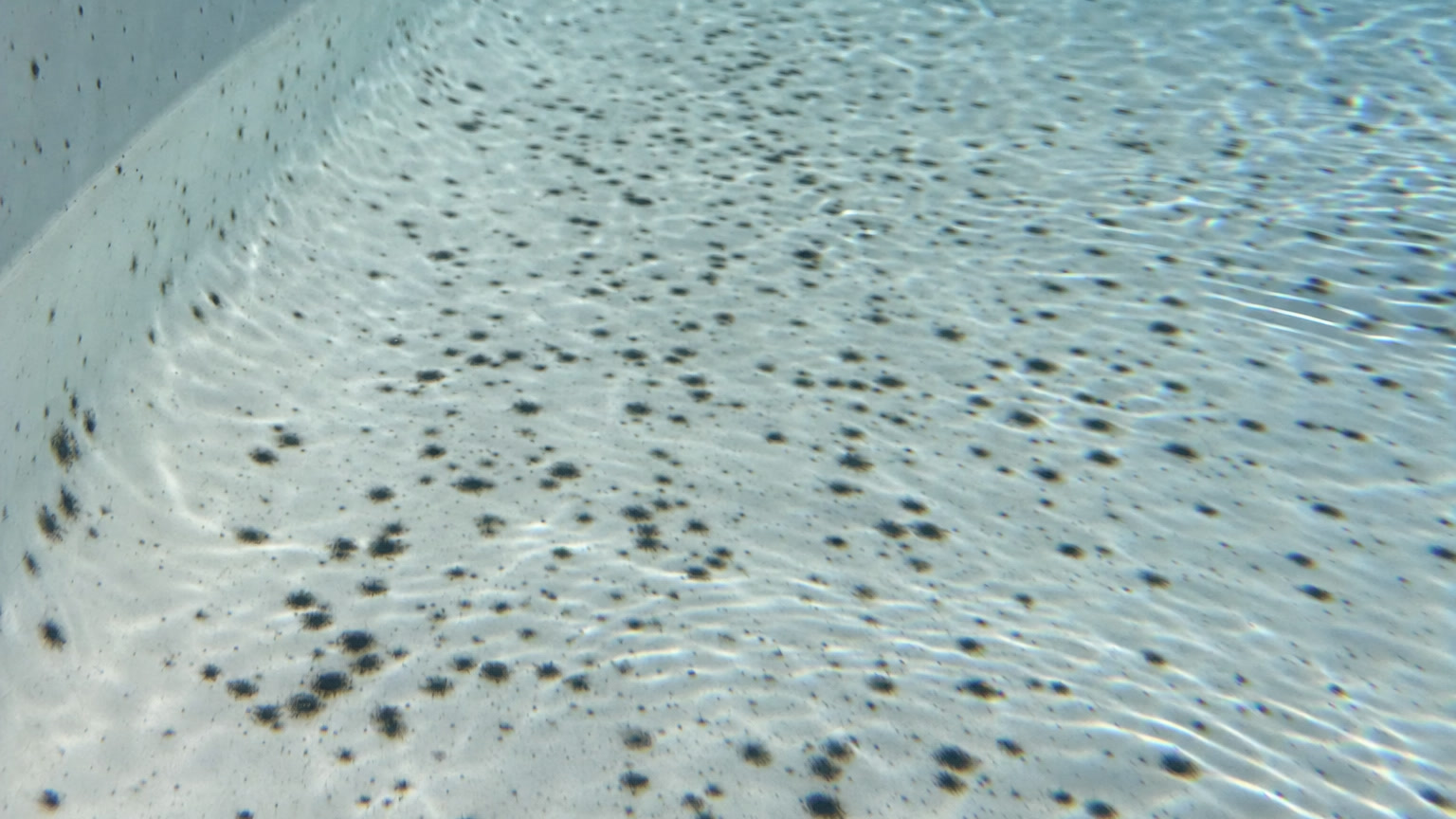
Fibreglass pool osmosis occurs when water passes through the gelcoat into the laminate. The water reacts with the resin and forms fluid-filled blisters that push the gelcoat outward.
Use a fingernail to check the affected area:
- Black-spot algae sits flush with the gelcoat. A fingernail passes over it.
- An osmotic blister is raised. A fingernail catches on it.
Pool-water treatments do not reach osmosis because the water is behind the gelcoat. Chlorine, algaecide, stain remover, brushing, and shock treatment do not remove osmotic blisters.
Osmosis is associated with build quality and shell age. It affects older shells and shells made by other manufacturers to older specifications. Aqua Technics shells installed by MFP Easy do not develop osmosis.
To repair existing blisters, remove the affected material by grinding and rebuild the laminate.
What is osmosis in a fibreglass pool?
Osmosis in a fibreglass pool is a process that affects the pool shell. The gelcoat and the laminate behind it act as a semi-permeable membrane. Water molecules pass through the gelcoat and react with the polyester resin. This reaction creates small cavities. The cavities fill with fluid and expand, pushing the gelcoat outward to form raised blisters.
Pool water does not start this reaction. Adding chemicals to the pool water does not stop it.
A fibreglass pool shell is a single moulded laminate made from glass fibre and resin. During manufacturing, the gelcoat is sprayed into the mould first. The structural glass and resin are then applied behind it. The gelcoat is the visible surface of the structure, not a coating added later.
The shell is pre-cured and installed in the excavation as one piece. It does not have replaceable panels. An osmotic blister is damage to the pool shell, not to a separate lining.
Osmosis is different from the following conditions and services:
- Black-spot algae: A living organism on the gelcoat surface.
- Staining: Surface discolouration caused by metals or organic matter.
- Reverse osmosis: A water-treatment service that removes calcium hardness, total dissolved solids, cyanuric acid, and metals from existing pool water without draining the pool.
Reverse osmosis treats the water. Osmosis affects the pool shell.
What causes osmosis in a fibreglass pool?
Osmosis results from how the pool shell was manufactured. Contributing factors include resin grade, gelcoat quality, and glass mat that was not fully wetted during lay-up. It occurs in older-generation laminates when water reaches the laminate.
Hitchins Technologies, a NSW coatings manufacturer, identifies four contributing factors:
- Poor wetting of the fibres
- Air trapped in the fibre bundles
- Hydrolysis of the sizing
- Hydrolysis of the resin matrix
These factors depend on the manufacturing technique, materials, and operator skill used when the shell was made. They cannot be introduced or removed by the pool owner.
Poor water chemistry does not cause osmosis. Over-chlorination can fade the gelcoat below the waterline. Oxidation can make the finish chalky. Harsh chemicals, rough tools, and aggressive scrubbing can also damage the gelcoat. These effects occur at the surface. Osmosis occurs inside the laminate.
A laminate absorbs water while immersed and dries when it is not immersed. Drying the shell is a standard preparation step before bonding materials during a repair. However, emptying a pool does not protect the laminate. An empty fibreglass shell can float, bow, or crack. Lowering the water level is a structural decision for the pool builder, not a cleaning step.
What do the bubbles, lumps and blisters on a fibreglass pool wall look like?
An osmotic blister is a raised, hard dome that catches on a fingernail. Blisters can appear on the pool walls and floor. Perth Pool Co reports sizes ranging from a match head to a dinner plate. A pool may have a few blisters or hundreds or thousands. These defects are also called bubbles, lumps or bumps.
There are two types of blister. A gelcoat blister forms between the gelcoat and the laminate. An interlaminate blister forms within the laminate when osmotic pressure separates the laminate layers. Hitchins Technologies reports that interlaminate blisters can be up to 200 mm wide and 20 mm high.
Use side lighting to identify shallow delaminated areas. These areas may form a low dome only a few millimetres high and at least 200 mm wide. Hitchins Technologies recommends side lighting because the low height can make the affected area difficult to see from the front.
Use a tap test to identify wet or delaminated laminate. WEST System recommends tapping the surface with a small mallet at regular intervals of about 75 mm. Wet or delaminated areas produce a dull or flat sound. Dry, solid laminate produces a sharp sound. Test in a grid pattern to identify the boundaries of the affected area.
| Osmotic blister | Delaminated area | Chalked or faded gelcoat | |
|---|---|---|---|
| Profile | Raised dome, from match-head size upward | Single low dome, a few mm high | Flush with the surface around it |
| Feel | Catches a fingernail; a nylon brush does not change it | Sounds dull or flat when tapped with a small mallet | A fingernail passes straight over it |
| Footprint | From a small few to hundreds of separate blisters | 200 mm or more across in one area | Broad areas of wall rather than discrete marks |
| Best light to see it | Touch rather than light: the fingernail is the test | Side lighting, which throws the shallow dome into relief | Daylight over a broad area, against gelcoat that has not weathered |
| What it means | Water has reached the laminate behind the gelcoat | The laminate layers have separated | The gelcoat is weathering; the laminate behind it is unaffected |
A chalky, dull or faded gelcoat surface is caused by weathering of the gelcoat. Ultraviolet light can reduce colour and gloss above the waterline. Over-chlorination can cause fading below the waterline. Oxidation causes chalking. Continued exposure can thin the gelcoat until the raw fibreglass appears as a grey or brown surface. A faded area remains flush with the surrounding surface. A blister is raised above it.
What happens to a fibreglass pool once osmosis has started?
Osmosis does not reverse after it starts. It progresses through four documented stages: water uptake, gelcoat blisters, interlaminate blisters, and hydrolysis of the structural laminate. Blister numbers generally increase over time, and existing blisters remain.
- Water uptake, with nothing to see. Water passes through the gelcoat and collects in small voids in the laminate. Marine and Safety Tasmania records almost no loss of mechanical strength at this stage. However, the WEST System blister manual warns that hydrolysis can occur without visible surface blisters. An unmarked surface does not confirm that the laminate is dry.
- Gelcoat blisters. Blisters form between the gelcoat and the laminate. Hitchins Technologies describes these blisters as relatively benign. At this stage, the damage is cosmetic and the underlying structure remains functional.
- Interlaminate blisters. Osmotic pressure separates the fibreglass laminates. This produces large, low blisters up to 200 mm across. Marine and Safety Tasmania identifies this as the stage when treatment is required. It also reports that many boat hulls take 10 to 20 years or longer to reach this stage. This timeframe applies to marine composites, not specifically to pools.
- Hydrolysis of the laminate. The resin matrix breaks down and the laminate layers separate. Structural strength is reduced. Repair requires rebuilding the laminate rather than resurfacing it.
Strength loss occurs in stages 3 and 4, not stage 2. There is no documented case in the public record of a fibreglass pool shell failing structurally because of osmosis.
Documented shell failures are generally hydrostatic. A pool may float, bulge, or crack after it is emptied. This can also happen when a blocked hydrostatic valve allows groundwater to lift the shell. Hydrostatic failure has a different cause from osmosis. Osmosis is therefore one of the slower-developing problems a fibreglass pool can develop, rather than an immediate structural failure.
Osmosis can make a pool unusable without causing structural failure. Blisters can make the surface rough and abrasive. A ruptured blister can release dark residue that stains the exposed fibreglass. Spot repairs are no longer effective after blistering reaches stages 3 and 4. At that point, the main limit described in the available record is the cost of repair rather than structural failure.
According to WEST System, blister fluid is acidic and may be under pressure of up to 200 psi. Pool owners should not open blisters themselves.
Are the black spots on a fibreglass pool algae or osmosis?
Black spots on a fibreglass pool are usually black-spot algae or osmotic blisters. Black-spot algae sits flush with the gelcoat. An osmotic blister is raised. Run a fingernail across the mark to check.
Black-spot algae can be treated with brushing and a raised chlorine level. Pool chemicals cannot remove an osmotic blister.
| Black-spot algae | Osmotic blister | |
|---|---|---|
| Profile | Sits flush with the gelcoat | Raised; a fingernail catches on it |
| Response to a brush | A nylon brush breaks the black cap and the mark changes | A nylon brush changes nothing, because the mark is raised gelcoat rather than material sitting on the surface |
| Spread | Spreads while conditions favour it, and the cap usually regenerates within days if it is only knocked off | Blisters generally increase in number over time, and the existing ones remain |
| Where it appears | Shaded, low-flow areas: corners, steps, under the returns and along the waterline | Anywhere across the walls and floor |
| What it means | A water problem: sanitiser level, circulation or filtration has slipped | A laminate problem: water has reached the resin behind the gelcoat |
Black-spot spores may be present in the pool. They can embed in walls, floors, steps and places where blisters have broken when pool conditions decline. The visible black cap is a protective outer layer. Removing only the cap does not remove the algae, and the cap usually returns within days.
In a fibreglass pool, the algae stays on the gelcoat surface. In a concrete or plaster pool, it can enter the porous finish. Brushing and chlorine can therefore remove it from a fibreglass wall.
Treat black spot in a fibreglass pool as follows:
- Brush the mark with a nylon brush. Do not use a stainless-steel or wire brush. Brushing breaks the outer wall of the algal cells so chlorine can reach them. A metal brush can damage the gelcoat.
- Add an algaecide labelled for black algae. Keep the pool full while the treatment works.
- Raise the free chlorine level. Calculate the dose using the pool’s actual water volume.
- Run the filter and brush the mark again. This helps the raised chlorine level reach the cells below the cap.
- Clean or backwash the filter, then repeat. Continue the brushing and dosing cycle until the mark no longer returns.
Calculate the chemical dose based on pool volume. MFP Easy pools hold between 9,500 and 51,700 litres. A 4.5 m Verona holds 10,300 litres, while a 7.5 m Bedarra holds 30,500 litres. Each pool requires a different amount of chlorine to reach the same target concentration.
Do not lower the water level as part of black-spot treatment. For a fibreglass shell, lowering the water is a structural decision that must be handled by the pool builder.
A burst blister can leave dark residue from the laminate. Chlorine will not remove this residue because it is not organic matter on the gelcoat.
A dark mark that is not algae or a blister is usually one of the fibreglass pool stains caused by iron, copper or manganese. Iron stains are orange, brown or tan. Copper stains are green or blue. Manganese stains are brown, black or purple.
“Black spot and osmosis really aren't anything alike, and it's worth knowing the difference. Black spot is a water problem, usually maintenance slipping, and a proper clean and chemical rebalance through your pool shop will sort it out. Osmosis is a serious structural failure where the laminate layers separate and water sits inside the shell itself, and no chemical touches it. The osmosis cases I've dealt with have typically been older pools from other manufacturers that we've pulled out and replaced, which is exactly why the quality in the shells we install matters. The check is simple: black spot is a flat dot, sometimes you can rub it with a finger, while osmosis is a raised, squishy bubbling in the surface. If your fingernail catches on it, give us a call.”

How is osmosis in a fibreglass pool repaired, and what does it cost?
Repair involves removing the blistered material and rebuilding the laminate. In Australia, costs range from a few thousand dollars for a localised repair to $15,000 to $30,000 or more when delamination also requires repair. MFP Easy installs new shells and does not provide shell resurfacing. The figures below are Australian market ranges published by Fibreglass Pool Check.
The shell should be inspected immediately after the pool is drained. Hitchins Technologies states that blisters can deflate within one or two hours, making them less visible. WEST System also reports that blisters can disappear within hours. The laminate remains damaged even when the blisters are no longer visible. The builder decides whether to drain the pool for inspection. Draining is part of the repair process.
The repair method depends on the extent of the damage:
- Drill, drain and inject, for an isolated interlaminate blister. Hitchins Technologies drills a 3 to 4 mm hole at the top and bottom of the blister to drain the fluid. The cavity is flushed with methylated spirits, dried, and injected with epoxy.
- Grind back and re-laminate, for a larger area confined to the outer layers. The damaged material is removed and replaced with new laminate. WEST System specifies a minimum 12-to-1 bevel around the repair area before applying the new laminate.
- Full strip and re-laminate, for widespread blistering. Perth Pool Co removes all defective gelcoat and applies a vinyl ester primer. It then applies 300 gsm chopped strand fibreglass matting with a secondary layer of vinyl ester resin.
Marine and Safety Tasmania specifies two preparation requirements for these methods. The laminate must be dry before bonding. It must also be cleaned with steam or hot pressure washing to remove hygroscopic contaminants. Drying alone does not remove these contaminants. Applying a new topcoat without treating the blistered laminate can result in recurring blisters.
Applying a coating over failed laminate does not restore structural integrity. The damaged laminate must be rebuilt. We have seen $12,000 resurfacing work fail within two years when it was applied over compromised laminate.
| Repair | Australian range | Scope |
|---|---|---|
| Localised patch repair | $800 – $3,000 | Blistering confined to a patch of the shell |
| Full interior resurface | $8,000 – $15,000+ | The complete interior surface replaced |
| Resurface with delamination repair | $15,000 – $30,000+ | Resurfacing where separated laminate also has to be repaired |
| Osmosis remediation | $4,000 – $8,000 | Charged on top of the resurfacing work |
These Australian ranges are published by Fibreglass Pool Check. In Queensland, repair work valued above $3,300 must be completed by a licensed contractor and carries QBCC home warranty insurance. The cover lasts 6 years and 6 months and is capped at $200,000. Resurfacing and laminate rebuilding exceed the $3,300 threshold, so the licensing and insurance requirements apply.
Do current fibreglass pool shells get osmosis, and what does the warranty say?
Aqua Technics shells installed by MFP Easy do not develop osmosis. The cases we have handled involved older pools from other manufacturers. Those pools were removed and replaced rather than repaired.
Current shells use a vinyl ester barrier layer directly behind the gelcoat. This layer resists water absorption and prevents water from reaching the resin. The industry credits this construction method with preventing blistering in current shells. Aqua Technics shells comply with Australian Standard AS 1838:2021 and hold Building Materials Product certificate BMP 520101.
The commonly quoted 10-to-15-year timeframe applies to older polyester-laminate shells. Hitchins Technologies states that problems tend to appear 10 to 15 years after construction, although they can appear earlier or later. Australian resurfacing companies report a similar timeframe for pools that are at least 10 to 15 years old. Fibreglass Pool Check reports that some pools develop blisters within 5 years, while others remain unaffected for 20 years or more. These figures describe older shells and do not predict the performance of pools built today.
Fibreglass pool warranties can involve more than one party:
- The shell manufacturer provides written structural and surface warranties.
- Aqua Technics shells include the Lifetime Interior Surface Guarantee, subject to conditions.
- MFP Easy provides a 7-year workmanship warranty and is responsible for the installation.
Warranty repairs generally have two important conditions. Most manufacturers require the owner to pay for draining, bracing, refilling and rebalancing the pool. A structural warranty can only be claimed while the company that issued it is still trading.
FAQs
Is delamination in a fibreglass pool fixable?
Yes. The repair method depends on the size and depth of the affected area:
- Use injection for an isolated interlaminate blister.
- Grind back and re-laminate damage limited to the outer layers.
- Strip and re-laminate areas with widespread blistering.
Use a tap test to distinguish delamination from gelcoat blisters. WEST System recommends tapping the surface with a small mallet at intervals of about 75 mm. A dull or flat sound indicates wet or delaminated laminate. A sharp sound indicates solid laminate.
What is the average life expectancy of a fibreglass pool?
A well-made fibreglass pool shell can have a structural life of 30 years or more when installed and maintained correctly. Pumps, chlorinators, and heaters may need replacement during this period.
Published life expectancy usually refers to the condition of the interior surface, as this is the part that shows visible ageing. Aqua Technics shells are built to Australian Standard AS 1838:2021 and hold Building Materials Product certificate BMP 520101. They also include a Lifetime Interior Surface Guarantee. Conditions apply. The shell manufacturer provides the warranty in writing with the pool.
What happens to a fibreglass pool after 25 years?
The pool structure is durable, but the interior surface ages over time. A well-made shell that is correctly installed and maintained can have a structural life of 30 years or more.
The gelcoat may lose colour and gloss above the waterline. Over-chlorination may fade the finish below the waterline, and oxidation may make the surface chalky.
Current Aqua Technics shells do not have a scheduled resurfacing requirement. The 15- to 30-year resurfacing interval often quoted in the industry applies to older shells and shells from other manufacturers. It is not the maintenance schedule for a pool built today.
Is salt water better for a fibreglass pool?
Salt water does not cause osmosis in a fibreglass pool. Osmosis relates to the laminate and resin system behind the gelcoat. Pool water chemistry affects only the gelcoat surface.
Over-chlorination can fade the colour below the waterline. Harsh chemicals, rough tools, and aggressive scrubbing can damage the gelcoat. To protect the surface:
- Keep the water within the published pH range of 7.2 to 7.8.
- Use a nylon brush instead of a stainless-steel or wire brush.
What chlorine level kills black algae?
National Pool Industry News recommends 10 to 30 ppm of free chlorine for shock treatment, depending on the algae type. Black algae may require a dose near the upper end of this range. This guidance applies to a full pool and is not an agreed industry standard.
Calculate the dose using the pool’s measured water volume. MFP Easy pool volumes range from 9,500 to 51,700 litres. Brush the affected areas with a nylon brush before and after treatment so the chlorine can reach the cells beneath the black cap.
Will chlorine remove black spots?
Chlorine at normal maintenance levels will not remove established black spot algae. Brush the area with a nylon brush to break the algae's protective cap. Then raise and maintain the free chlorine level while keeping the pool full.
Chlorine will not remove an osmotic blister. The water that causes the blister is in the laminate behind the gelcoat, where pool water cannot reach it. If the blister bursts, it can leave a dark residue from the laminate. Chlorine will not remove this residue.