Pool Chlorinators: Sizing, Cell Life & Replacement Costs
How a salt chlorinator works on a fibreglass pool, sizing the cell to pool volume, how long a cell lasts, replacement cost, and failure symptoms.
Written by Tehbyn Nova, Head of Operations & Growth · Technically reviewed by Caleb Druhan, General Manager (QBCC licence 15087383) on
Published · Updated
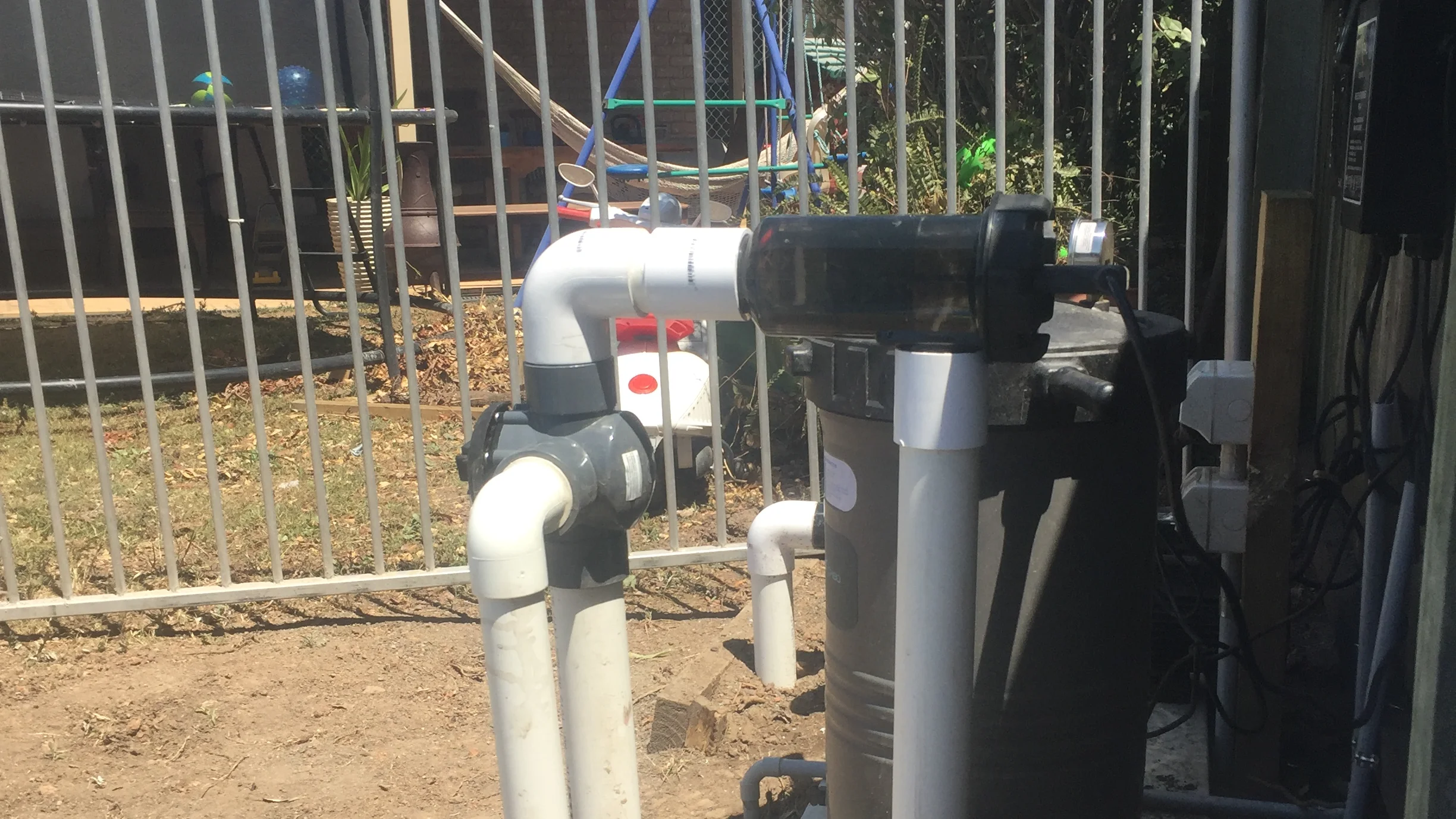
A pool chlorinator sanitises pool water. In a salt water pool, it produces chlorine on site instead of drawing chlorine from a drum.
A salt chlorinator has two components:
- A control box on the equipment pad that controls sanitiser output.
- An electrolytic cell in the filtration line after the pool filter.
The cell is a consumable component. Australian suppliers rate chlorinator cells for about 10,000 operating hours. In an Australian pool, this typically means three to seven years of use. A genuine replacement cell costs about $575 to $1,375.
Suppliers recommend inspecting the cell every three to four months. Calcium scale on the electrode plates can reduce the cell’s operating life. Preventing mineral build-up on the plates is part of routine maintenance.
The cell may be failing if free chlorine decreases while the salt level is within the required range and the control box output is already turned up.
What does a chlorinator do on a fibreglass pool?
A salt chlorinator produces chlorine from dissolved salt in a fibreglass pool. A salt water pool is still a chlorine pool. Pool water passes through an electrolytic cell, where a low electrical current converts chloride into sanitiser. The sanitiser then returns to the pool with the filtered water.
Dissolved salt does not sanitise the water by itself. The electrolytic cell converts the chloride into chlorine. Adding salt without a chlorinator does not sanitise the pool.
A chlorinator has two main components: a control box and an electrolytic cell. These components are sized, priced and replaced separately. The control box is mounted on the equipment pad. It supplies power and controls sanitiser production. The electrolytic cell is installed in the filtration line after the pool filter. This means leaves and grit are removed before the water reaches the electrode plates.
Salt does not affect the fibreglass shell, but it can affect surrounding equipment. Salt water and dried salt residue can corrode metal fittings, fixings and hardware around the pool and equipment pad. For a salt water pool, the choice of fixings and the placement of equipment are important.
Which chlorinator and cell size suits a fibreglass pool?
Select a chlorinator cell based on the pool’s water volume. Allow additional capacity for summer conditions. For a replacement cell, confirm that the brand, model and amperage match the existing chlorinator.
Australian suppliers offer 10 amp and 15 amp cells for small systems and cells up to 50 amp for larger residential pools.
| Cell rating | Typical pool size it is fitted to | Notes |
|---|---|---|
| 10 amp | Small systems | The water volume it covers is the volume its own manufacturer rates it for. |
| 15 amp | Small systems | The second of the two small-system ratings, sized by its manufacturer's litre rating. |
| Up to 50 amp | Larger residential pools | The top of the residential range carried by Australian cell suppliers, sized by its manufacturer's litre rating. |
Our 2026 filtration packages include a PureSwim chlorinator sized for the pool shell. The following GST-inclusive prices are from customer quotes dated 16 August 2026:
| Package size | Chlorinator fitted | Quoted price |
|---|---|---|
| Small | PureSwim Chlorinator (15G) | $1,652.39 |
| Medium | PureSwim Chlorinator (25G) | $1,874.48 |
| Large | PureSwim Chlorinator (35G) | $2,272.34 |
Amperage does not indicate the supported pool volume. For a 50,000-litre pool or any other volume, use the manufacturer’s rating for the specific chlorinator model. Do not convert amperage directly to litres.
Chlorinator cells are available in self-cleaning and manual-cleaning models. A self-cleaning cell reverses polarity on a set cycle to remove calcium scale from the electrode plates. This reduces manual cleaning but does not eliminate it. Remove and inspect self-cleaning cells as required. Inspect and clean manual-cleaning cells regularly.
We install the chlorinator cell in the filtration line with the pump and filter included in the complete filtration package. We configure the chlorinator at handover so that the cell size and output setting match the pool.
How long does a chlorinator cell last, and what does a replacement cost?
Australian suppliers rate salt chlorinator cells for about 10,000 operating hours. In an Australian pool, this usually equals three to seven years, depending on daily filtration hours. A genuine replacement cell costs about $575 to $1,375.
| Replacement item | Price band | Note |
|---|---|---|
| Genuine replacement cell | $575 to $1,375 | Includes the complete cell and housing. It must match the chlorinator's brand, model and amperage. |
| Cell internals only | Below the price of a complete cell | Includes the electrode pack, which is fitted into the existing housing. |
| Complete salt chlorinator unit | $1,299 to $3,675 | Includes the control box and cell. Connected Wi-Fi models are at the top of the price range. |
Australian pool-parts retailers published these GST-inclusive price ranges in 2026. The ranges are retail prices for parts. They do not represent the cost of a chlorinator supplied as part of a pool build. After measuring the site, the pool provider will confirm what the new-pool quote includes.
The following conditions can reduce cell life:
- High calcium hardness. Calcium can form scale on the electrode plates. Scale builds more quickly in harder water. Scale left on the plates can reduce the cell's operating life.
- Unbalanced pH. Water outside the balanced pH range can shorten cell life. Regular pH correction is part of maintaining the water around the cell and helps protect the cell.
- Infrequent cleaning. A cell that is not removed and inspected can retain scale for an entire season. The rated operating hours assume regular inspection and cleaning.
The replacement cell must match the chlorinator's brand, model and amperage. A pool technician or licensed trade should select and install it. Price should not be the only selection criterion.
How do you tell a chlorinator cell is failing?
A chlorinator cell may be failing if free chlorine is low, the salt level is in range, and the control box output is set high. Check these readings together. A single reading is not enough to identify a cell problem.
Use the following checks:
- Free chlorine low with salt in range. Test the free chlorine and check the salt level at the same time. If free chlorine is low and salt is in range, the cell may not be producing enough chlorine.
- Plates scaled, discoloured or flaking. Turn off the filtration system, remove the cell from its housing, and inspect the electrode plates. Heavy white deposits indicate calcium scale and require cleaning. Discoloured or flaking plates indicate electrode wear.
- Low output or a low-salt error on the box with salt confirmed. Have a water sample tested by a lab. If the control box reports low output or low salt but the lab confirms that salt is in range, the cell may not be conducting current correctly.
- Little or no gas bubbling from the returns. Run the chlorinator with the pump on and inspect the return outlet. A working cell produces a fine stream of gas bubbles in the returning water. If there are few or no bubbles while the cell is on and the output is set high, the cell may be producing little or no chlorine.
Complete all four checks before replacing the cell. Low free chlorine can also result from incorrect pH or salt levels. Replacing the cell without checking the water chemistry may not resolve the problem.
How often should the cell be cleaned, and how?
Inspect the chlorinator cell every three to four months. Clean it only if there is scale on the electrode plates.
- Switch off the chlorinator and filtration pump. Wait until the water stops moving before removing the cell from the pressure side of the filtration line.
- Remove and inspect the cell. If the electrode plates are clean, refit the cell. White or grey deposits between the plates indicate calcium scale.
- Soak the cell if it has scale. Follow the acid product directions. Cell suppliers generally specify a solution of about one part hydrochloric acid to ten parts water. Leave the cell in the solution until bubbling stops.
- Rinse and refit the cell. Rinse it with fresh water and refit it in the housing. Restart the pump, then restart the chlorinator.
Do not scrape the electrode plates. Scrapers and blades can remove the electrode coating.
Do not acid-wash a self-cleaning cell unless the manufacturer specifically recommends it. Self-cleaning cells remove most scale during their reverse-polarity cycle. Acid washing can remove the electrode coating and should not be part of routine maintenance.
How many hours a day should a chlorinator run?
A chlorinator produces sanitiser only while the filtration pump is running. Its daily run time is therefore the same as the pump’s run time. Set the operating hours based on the filtration schedule. Adjust the chlorinator’s output percentage based on free chlorine test results.
Reduce the output when you cover the pool. Pool covers can block up to 99 per cent of UV, which reduces the loss of free chlorine. This makes choosing a pool cover relevant to both heating and chemical use. Increase the output again when you remove the cover. Test the free chlorine level after each adjustment.
Increase the output during periods of hot weather and high pool use. More swimmers increase chlorine demand. Reduce the output when pool use decreases. Test the water to confirm that each adjustment is sufficient.
On our builds, the chlorinator commonly includes the pump’s power outlet and a built-in timer. This allows you to configure the pump and chlorinator schedules on one device.
Salt, mineral or manual chlorine — which sanitising system?
Pools can be sanitised with a salt chlorinator, a mineral system, or manually added chlorine.
A salt chlorinator generates chlorine from salt dissolved in the pool. This removes the need to buy, transport, store, and handle chlorine. It also maintains a more consistent sanitiser level than manual dosing because it produces chlorine during each filtration cycle. Manual chlorine is added in separate doses.
The main differences between salt water, magnesium and chlorine pools are water feel and running cost. These are water chemistry considerations rather than hardware differences.
FAQs
How long do salt water chlorinators last?
Australian suppliers rate salt chlorinator cells for about 10,000 operating hours. This typically equals three to seven years of use in an Australian pool.
This rating applies to the cell, not the complete chlorinator. Cell life depends on calcium hardness, pH control, and regular inspection and cleaning.
How much does it cost to replace a salt chlorinator cell?
In 2026, a genuine replacement cell costs approximately $575 to $1,375, including GST, at Australian pool-parts retailers. Replacing only the cell internals, or electrode pack, costs less than replacing the complete cell.
A complete chlorinator replacement, including the control box and cell, costs approximately $1,299 to $3,675. Wi-Fi models are at the upper end of this range.
The replacement must match the existing chlorinator’s brand, model and amperage. It must also be suitable for the pool’s water volume.
Does a salt water pool still use chlorine?
Yes. A salt water pool uses chlorine. As pool water passes through the chlorinator cell, the cell converts chloride from dissolved salt into sanitiser. This replaces the need to add liquid or granular chlorine manually.
When the chlorinator is off, it stops producing chlorine. The free chlorine already in the water then decreases.
What are the signs of low salt in a pool?
The control box may report a low-salt error, chlorine output may decrease, and free chlorine levels may drop even if the settings have not changed. Before adding salt, confirm the salt level with a laboratory water test. A scaled or worn cell can produce the same error when the salt level is within range. The test result indicates whether the pool needs more salt or the cell is not conducting properly.
Is a salt water chlorinator worth it?
A salt chlorinator reduces the need to buy, transport, store, and handle chlorine. It also maintains a more consistent sanitiser level than manual dosing because it operates during each filtration cycle.
The chlorinator cell is a consumable part. Australian suppliers rate cells for about 10,000 operating hours, or approximately three to seven years for an Australian pool. In 2026, genuine replacement cells cost about $575 to $1,375, including GST, from Australian pool-parts retailers. Suppliers recommend inspecting the cell every three to four months.
Water feel and operating costs require a separate comparison with mineral systems and manual chlorine.