Fibreglass Pools: Prices, Sizes, Installation & Care
Fibreglass pool prices, sizes, colours, installation, maintenance and equipment for South East Queensland, with installed prices from $46,176.
Written by Tehbyn Nova, Head of Operations & Growth
Published · Updated
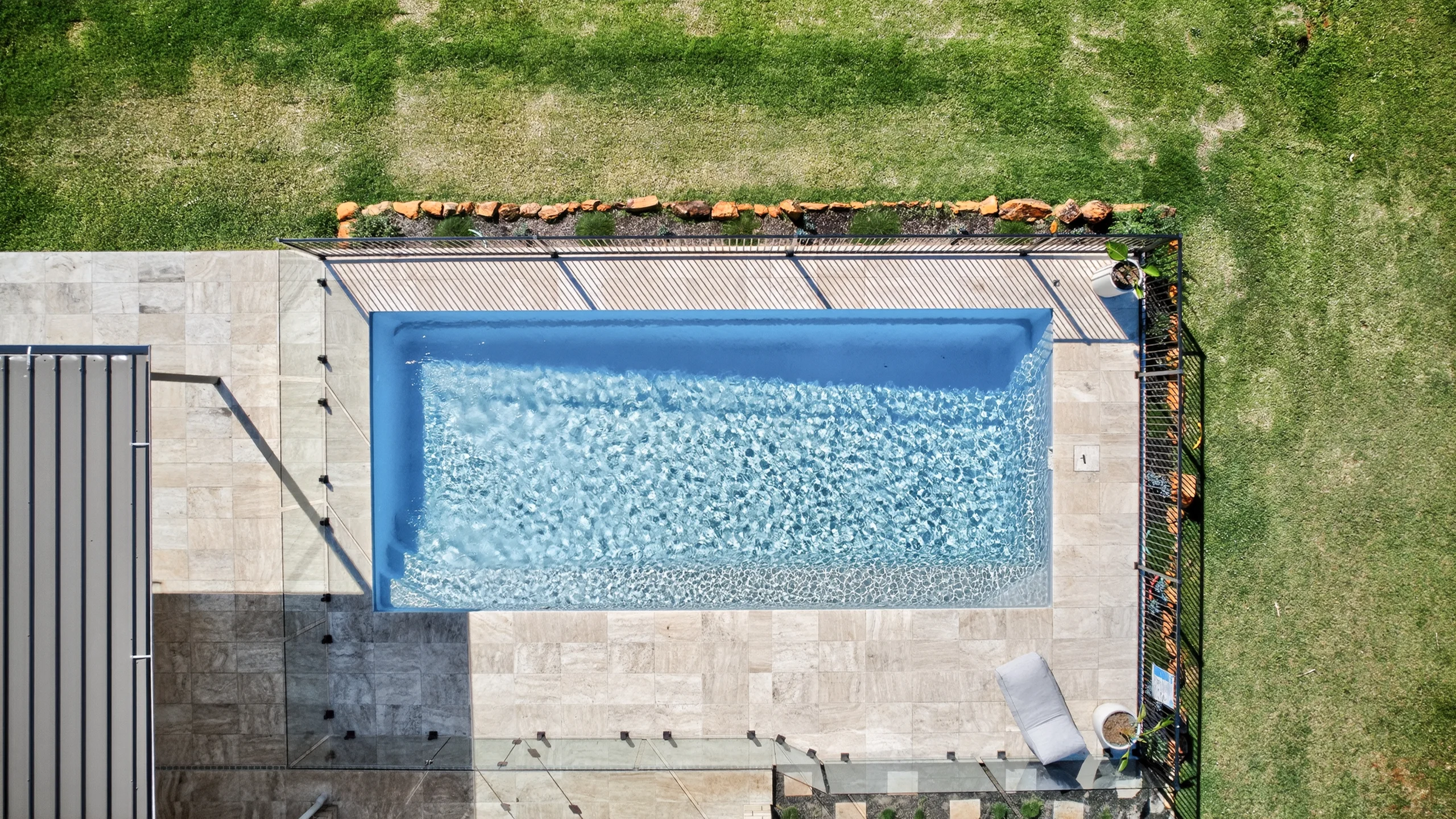
A fibreglass pool is a one-piece swimming pool shell manufactured in a factory from glass reinforcement and resin. It has a coloured gelcoat finish. The gelcoat is sprayed onto the mould face first, creating a smooth, non-porous swimming surface. Behind the gelcoat are a vinyl-ester barrier coat, a structural glass laminate, a core layer and an external seal.
The completed shell is transported to the property and craned into a prepared excavation. AS/NZS 1838:2021 applies to shell design, and AS 1839:2021 applies to installation. Fiberglass pool is the US spelling of the same product.
Fibreglass pools are available in fixed models rather than custom shapes. The range we install includes 40 models, from a 3.0m round pool to an 11.48m lap pool. Models are available in widths up to 4.45m and depths up to 2.00m. They are grouped into five categories: round, small, medium, large and lap.
Road transport limits shell dimensions because each pool must be transported in one piece on a truck. Australian models therefore have deep ends of about 2m or less. The range is available in six gelcoat colours. The colour forms part of the moulded surface and is not applied later as a coating.
As of August 2026, an installed fibreglass pool in South East Queensland costs between $46,176 and $109,590, including GST. The shell accounts for about one-quarter to one-third of the total. Other costs include excavation, crane placement, filtration equipment, licensed plumbing and electrical work, coping, approvals and certification. Site access has the largest effect on site-related costs.
Installation follows this sequence: approval, excavation, crane placement, connection and finishing. A standard project takes 10 to 12 weeks from initial contact to swimming. Construction on site takes about 28 days. The shell is usually placed within several days of excavation starting. Because the shell arrives finished, on-site construction takes months less than construction of a concrete pool.
A fibreglass shell has a service life of more than 30 years. It does not require periodic resurfacing or liner replacement. Concrete pools require resurfacing every 8 to 15 years, while vinyl liners require replacement every 5 to 12 years. Fibreglass buyers must select a fixed model instead of designing a custom outline.
Routine maintenance takes 15 to 20 minutes per week. The non-porous gelcoat prevents algae and grime from penetrating the surface. Standard equipment includes a pump, filter and sanitiser. Heating, covers, lighting and automation are optional.
In Australia, the shell manufacturer and pool installer are usually separate businesses. Each business provides its own warranty and works to its applicable standard. Aqua Technics manufactures the shells we install in Western Australia. MFP Easy installs them across South East Queensland at a rate of more than 250 pools per year.
What is a fibreglass pool?
A fibreglass pool uses a moulded composite shell as both its structure and finish. The shell consists of glass reinforcement saturated with resin and a coloured gelcoat sprayed against the mould face. It is manufactured and cured in a factory before delivery. Openings for the skimmer box, returns, main drain, and hydrostatic valve are formed during production.
We install shells manufactured by Aqua Technics in Jandakot, Western Australia. They are designed to AS/NZS 1838:2021, installed to AS 1839:2021, and produced under manufacturing licence BMP 520101. Installation requires approval from the local building regulator.
The gelcoat surface is smooth and non-porous. Algae has less opportunity to attach, so a fibreglass pool requires fewer chemicals than a rendered concrete pool of the same volume.
The mould determines the pool’s outline, step layout, and depth profile. Buyers select an existing model rather than specifying a custom design. Available lengths range from 3.00 m for the Infinity 3 to 11.48 m for the Saint Azur. The deepest models reach 2.00 m.
The fibreglass laminate can flex as the ground moves. A concrete shell is rigid and can crack under the same conditions. A fibreglass shell can hold water for more than 30 years and does not have a separate finish layer that requires resurfacing. The water provides ballast that holds the shell in place, so the pool must remain full throughout its installed life.
What is a fibreglass pool shell?
A fibreglass pool shell is structurally self-supporting when delivered. Unlike a panel pool or vinyl liner, it is not built on site.
Manufacturing starts by spraying gelcoat into a mould. Glass reinforcement and resin are then applied. After curing, the shell is trimmed, inspected and tested before despatch. This process forms the interior surface first.
Our shells use a Graphene Nano-Tech interior surface system. This system is covered by granted Australian patent AU 2021240305 and a Lifetime Interior Surface Guarantee. Conditions apply.
Dry weights range from 341 kg for the Elba spa to 1,286 kg for the Saint Azur. Two-thirds of our installations use a crane, typically a 20-tonne Franna. The remaining installations use a truck hoist.
The shell has five layers, listed from the water-facing surface outward:
- Gelcoat. The coloured interior surface. It contains the water but carries no structural load.
- Vinyl-ester barrier coat. This layer sits behind the gelcoat. It resists water absorption and helps prevent osmotic blistering.
- Structural glass laminate. This layer consists of multiple plies of resin-saturated glass. It carries loads and resists water and ground pressure.
- Core or reinforcement layer. This layer sits within or behind the structural laminate. It increases stiffness and strength.
- External seal or flow coat. The outermost layer. It seals the laminate against ground moisture.
What are the pros and cons of a fibreglass pool?
The main fibreglass pool pros and cons relate to factory construction and moulded designs.
Benefits include:
- The shell is installed 2 to 7 days after digging begins.
- The non-porous gelcoat does not require resurfacing.
- The structure and finish use one material, so there is no liner to replace.
- Steps and ledges have a moulded non-skid texture.
Limitations include:
- The pool outline, step layout and depth profile are fixed when you select the mould.
- Public road transport limits Australian deep ends to 1.85 m to 2 m.
- Poor installation can cause bulges, cracked gelcoat, leaks and spider cracking.
How long does a fibreglass pool last?
A well-made, correctly installed and maintained fibreglass pool shell lasts more than 30 years. The lifespan of a fibreglass pool refers to the structural laminate. The gelcoat has a shorter service life and a separate warranty.
Fibreglass pools do not require scheduled resurfacing. Concrete pools require resurfacing every 8 to 15 years, starting at $10,000. Vinyl liners require replacement every 5 to 12 years at a cost of $3,000 to $7,000. For a fibreglass pool, a cut and polish every 5 to 10 years can restore colour and gloss.
Pool fittings and equipment require replacement during the life of the shell. These include seals, pumps, chlorinators, heaters and filters. To protect the surface, keep the pH between 7.2 and 7.8 and run one full turnover per day. Our workmanship warranty is seven years.
Can a fibreglass pool pop out of the ground?
Yes. This can happen when the pool is empty or partly empty and the surrounding ground is saturated. At the normal operating level, the water should be between one-third and halfway up the skimmer opening. At this level, the pool has enough water ballast to prevent buoyancy.
A fibreglass pool bulging or popping occurs when groundwater pressure outside the shell exceeds the water pressure inside it. Any inground pool can lift if it is drained while the surrounding ground is wet.
The following components help hold the shell in place:
- Water inside the pool
- Backfill supporting the walls
- The bond beam securing the top edge
- A hydrostatic valve in the floor that relieves groundwater pressure
A wall bulge can indicate saturated backfill. A hollow-sounding area of the floor can indicate washed-out bedding. Repairs should address the ground conditions before the gelcoat.
How much does a fibreglass pool cost?
An installed fibreglass pool costs between $46,176 and $109,590 for the 40 models we build in South East Queensland. Prices include GST and are current as of 18 August 2026.
The price includes:
- Pool shell
- Excavation and spoil removal
- Crane lift
- Filtration package
- Licensed electrical work
- Coping and concrete surround
- Queensland approvals and certification
- Handover
The shell accounts for about one-quarter to one-third of the total cost. The remaining costs relate to installation work on the property. As a result, the installed price does not increase in direct proportion to pool size.
The following costs are similar for a 4 metre pool and an 11 metre pool:
- Crane hire
- Delivery
- Approvals and certification
- Licensed electrical work
- Temporary barrier
- Filtration package
Costs for the shell, excavation, gravel base, bond beam, coping and water increase with pool length.
Site conditions can affect the quote more than the selected pool model. Site access is the largest modelled variable in our quotes. Restricted access can more than triple the excavation cost for the same hole.
The fibreglass pool cost calculator applies site access, slope and existing pool removal costs to a selected shell. It provides an estimate for a specific property before a site visit.
Queensland law requires a compliant barrier before a pool can hold water. A quote that excludes the five mandatory items can be $7,000 to $10,000 lower than a complete quote for the same pool.
| Pool size | Length | Depth | Installed from |
|---|---|---|---|
| 3m to 4m | 1.45m level | $45,847 | |
| 4m to 5.5m | 1.0m to 1.78m | $45,613 | |
| 6m to 7m | 1.0m to 1.88m | $54,443 | |
| 7.2m to 8m | 0.98m to 1.96m | $60,374 | |
| 8.5m to 11m | 1.0m to 2.0m | $72,535 |
Live all-inclusive installed pricing for standard site conditions in South East Queensland — updated straight from our quoting system.
What does a fibreglass pool cost by size and by block?
The fibreglass pool cost is grouped into five size categories: round, small, medium, large and lap. Price ranges overlap. A small pool with additional specifications or difficult site access can cost more than a medium pool.
Most buyers choose a medium pool, with installed prices from $55,003 to $78,273. Fibreglass pools are not priced by area, so a price per square metre is not equivalent to a quote.
Filtration packages use three pool-size classes. Moving to a higher class adds the full cost of that package.
Block conditions also affect the price:
- Site access determines plant time and excavation costs.
- Crane costs depend on reach and are assessed separately.
- Sloping blocks may require drop edge beams and engineered fill.
Payments are made in stages:
- A 10% deposit.
- Progress payments at delivery, excavation, installation and handover.
Mandatory costs include:
- A compliant pool barrier, from about $2,300 for flat-top metal and several times more for frameless glass.
- A licensed electrician, from $1,250 to $1,750.
- Temporary fencing hire at about $500.
- Water fill, from $250 to $700 depending on the council.
- Certification costs from $2,000 to $4,500, typically around $3,000. This covers the certifier, final inspection, soil test, Form 15, council lodgement, fire ant treatment and QBCC home warranty insurance.
What does a fibreglass pool kit cost compared with an installed pool?
A fibreglass pool kit includes the one-piece moulded shell, gelcoat and plumbing fittings. Delivery is often quoted separately.
The buyer is responsible for:
- Excavation
- Crane installation
- Bedding and staged backfill
- Plumbing
- Electrical supply
- Coping and surrounds
- A compliant barrier
- Building approval and certification
- Water fill and handover
The shell sits on a compacted base of sand or crusher dust. During installation, backfill is added in stages while the shell fills with water. An incorrect backfill sequence can damage the shell.
In Queensland, licensed trades must complete the plumbing and electrical work. The pool and barrier must be certified before the pool is filled.
Structural warranty coverage for a non-approved installation depends on the manufacturer. MFP Easy does not sell shell-only kits.
What is the most affordable fibreglass pool?
A small or plunge pool is the most affordable quality inground option. The ranking of affordable pools changes when you compare annual ownership costs instead of the initial price.
Vinyl-liner pools have a lower initial price, but the liners need replacement every few years. Fibreglass pools do not require scheduled resurfacing. A $50,000 fibreglass pool owned for 25 years costs about $2,000 per year before running costs.
Our $45,000 and $80,000 pools use the same laminate, warranties, and equipment. Budget imported pools typically have warranties of 5 to 10 years.
Most optional extras can be added later. Heating is an exception because installation is cheapest during the pool build. A heat pump costs about $4,100 installed. A thermal blanket with a roller costs about $2,200.
What sizes and shapes do fibreglass pools come in?
Fibreglass pools are manufactured in fixed sizes and shapes. You cannot specify custom dimensions. Our range includes 40 shells from 3.0m to 11.48m long and 2.0m to 4.0m wide. Capacities range from 3,800 litres to 52,780 litres. The range is divided into five categories: round, small, medium, large and lap.
A standard Australian backyard pool is 7m to 8m long. This is the most common size range among the 250+ pools we install each year in South East Queensland. Five models are exactly 7.0m long: the Messina, Harmony, Oxford, Palazzo and Imperial.
Length is only one part of fibreglass pool dimensions and sizes. Width also affects capacity and use. The Messina measures 7.0m x 2.0m and holds 14,000 litres. The Valentina measures 8.0m x 4.0m and holds 38,700 litres.
Narrow shells from 2.0m to 2.5m wide suit boundary runs and side returns. A 4.0m-wide shell provides more standing and lounging space beside the swimming area. Each model’s shape is fixed by its mould.
Allow more space than the shell dimensions. A completed pool also requires coping, a compliant safety barrier, and clearance from boundaries and structures. Include the barrier and paving when determining which shell will fit the site.
Prices are live all-inclusive installed prices (pool, standard installation, filtration and handover) for standard site conditions in South East Queensland.
What are the fibreglass pool size categories?
Fibreglass pools are grouped into five size categories: round, small, medium, large, and lap. Each category identifies a length range, not a style.
- Round: 3.0m and 4.0m diameter
- Small: 4.0m to 5.5m long
- Medium: 6.0m to 7.0m long
- Large: 7.2m to 8.5m long
- Lap: 9.0m or longer
The category is fixed for each model because its outline and depth grade are moulded before delivery.
How big is a round fibreglass pool?
Round fibreglass pools are available in 3m and 4m diameters. Both have a level depth of 1.45m, with no shallow or deep end.
The 3m Infinity 3 holds 6,275 litres and starts the round fibreglass pools range at $46,589 installed. The 4m Infinity 4 holds 10,410 litres. The smaller shell has a 400mm-wide bench seat around its perimeter.
These are the only design-certified round fibreglass pools made in Australia.
How big is a small fibreglass pool?
Small fibreglass pools are 4.0m to 5.5m long. This category contains ten shells.
The 4.00m x 2.00m Malta is the shortest and least expensive shell in the range. It costs $46,176 installed, has a graded depth of 1.10m to 1.54m, and holds 6,900 litres.
Small fibreglass pools are available in four shapes: rectangle, slimline rectangle, square, and round. The 4.50m x 3.50m Latina is the deepest shell in this category, with a depth of 1.37m to 1.78m.
How big is a medium fibreglass pool?
Medium fibreglass pools are 6.0m to 7.0m long. This is the size installed most often.
The 6.0m x 3.0m Empire costs $57,788 installed. The 6.0m x 3.2m Positano costs $59,345 installed.
Pools of this length can accommodate two adults and two children swimming at the same time. They can also leave lawn and entertaining space on a standard suburban block. Stroke-and-turn lap swimming requires at least 8m, which is outside this category.
How big is a large fibreglass pool?
Large fibreglass pools are 7.2m to 8.5m long.
The 7.2m x 3.3m Terazza costs $63,404 installed. The 8.5m x 3.8m Hayman costs $77,084 installed.
Width affects the capacity of shells with the same length. The 8.00m x 3.00m Sheffield holds 29,000 litres. The 8.00m x 4.00m Valentina holds 38,700 litres.
Two separate 300mm rules apply to large fibreglass pools: one for a shell installed above natural ground and one for water depth.
How big is a fibreglass lap pool?
Fibreglass lap pools are 9.0m or longer and are defined by their swim corridor.
The fibreglass lap pools in the range include:
- 9.00m x 3.60m Amalfi
- 9.00m x 4.00m Westminster
- 9.5m x 4.0m Saint Louis
- 11.00m x 4.00m Kensington, at $86,942 installed
- 11.48m x 4.0m Saint Azur, at $109,590 installed
One swimmer requires 2.5m of internal width. Two swimmers side by side require at least 4m.
How deep is a fibreglass pool?
Fibreglass pools have shallow-end depths from 0.90m to 1.45m and deep-end depths from 1.00m to 2.00m. Most models have a graded floor, so they list two depths. Fibreglass pool depth is fixed by the model and cannot be specified separately.
Four models have a level floor:
- Infinity 3 and Infinity 4: 1.45m
- Bastia and Elba: 1.00m
The following models reach the maximum depth of 2.00m:
- 9.00m Amalfi
- 9.5m Saint Louis
- 11.00m Kensington
None of the fibreglass pools we install is suitable for diving or accepts a diving board.
What is a fibreglass plunge pool?
A fibreglass plunge pool is a single-piece shell designed for cooling off, floating, and socialising rather than lap swimming. It is an inground, council-approved, certified swimming pool. It is not a spa or portable tub.
The fibreglass plunge pool range includes seven models from 3 metres to 5.5 metres, with installed prices starting at $46,176. The 3m and 4m round shells have a consistent depth of 1.45m. The rectangular shells have graded floors ranging from 1.05m to 1.78m.
A plunge pool holds about one-quarter of the water of a family pool. A 9kW heat pump can maintain a comfortable water temperature in a 3m or 4m shell during a South East Queensland winter.
What is a spool or cocktail pool?
A spool is a small fibreglass pool shell with spa jets and a heater. It can run warm like a spa or cool like a pool. The name combines “spa” and “pool.”
In the US, the terms cocktail pool, dipping pool and soaker pool refer to the same type of pool. In Australia, builders call it a plunge pool. Adding spa jets to a plunge pool makes it a spool.
Our range includes:
- Bastia: 3.2m x 2.0m with a flat 1.0m depth
- Elba: 4.0m x 2.0m with a flat 1.0m depth
- Malta: 4.0m x 2.0m with a graded depth from 1.1m to 1.54m
Spa jets can be added to any other plunge pool shell.
Can you get an L-shaped fibreglass pool?
Our moulded range does not include an L-shaped shell. An L-shaped pool has a long section and a shorter section that meet at one corner. It is also called a corner pool.
Fibreglass shells use fixed moulds, so available shapes are limited to existing designs. A rectangular pool can provide separate shallow and deep zones. For example, the Bellagio measures 7.50m x 2.50m and has a depth range of 1.10m to 1.80m. This provides shallow water for children and deeper water for swimming in one shell.
Consider the following limitations of an L-shaped pool:
- It requires more yard space than a rectangular pool with the same swim length. The second section adds water and paving outside the main swimming area.
- Water moves more slowly around the inside corner. Debris can settle in this area and support algae growth.
- Robotic cleaners can have difficulty navigating the corner.
- Automatic and solar covers operate on a straight track and do not cover the second section.
What size fibreglass pool fits a small backyard?
A small fibreglass pool or plunge pool usually requires a clear area of about 4 metres by 2.5 metres. The usable area depends on boundaries, easements and services, not the total lawn size.
Installation access is also required. A clear side gate about one metre wide or wider may allow an excavator to reach the backyard from the street. If there is no side access, the pool shell may need to be lifted over the roof by crane.
Check the following site requirements:
- The pool shell and barrier must meet the boundary setbacks for the zone.
- The pool cannot be built over a registered easement or sewer main.
- Areas used for overland flow and stormwater may need to remain clear.
- The barrier requires a 900mm non-climbable zone. This applies to nearby air-conditioning units, pots, retaining walls and fences.
Can you get a custom fibreglass pool?
You cannot order a one-off fibreglass pool shape. Each shell is manufactured from a fixed mould, which determines the pool’s outline and depth grade.
Custom fibreglass pools are configured by selecting the model, gelcoat colour, waterline tile, coping, paving surrounds, fencing, filtration package, and heating.
If you need a shape that is not available from an existing mould, choose a concrete pool. Concrete pools are formed on site. The fibreglass shell typically accounts for roughly one-quarter to one-third of the installed price.
What colours do fibreglass pools come in?
The fibreglass pool colour range at MFP Easy includes Hamptons Blue, Silver Mist, Autumn Grey and Moonlight. The gelcoat finish is moulded into the pool shell during manufacture. You must select the colour when ordering because it cannot be changed after installation.
Consider three site conditions when choosing a finish:
- Available light
- Surrounding materials
- Required visibility of the pool floor
Dense vegetation can make the water appear darker and greener. Light paving can increase blue and turquoise tones. Dark decking and fencing can deepen blues and greys. A mid-tone blue or light grey is suitable for most South East Queensland yards.
Light finishes reflect more sunlight. They can make a small pool appear larger and make it easier to see a swimmer on the pool floor. Dark finishes absorb more sunlight. They can make leaves and debris less visible and reduce the contrast between the pool floor and a person lying on it. Households with young children or non-swimmers should consider this when selecting a finish.
A grey gelcoat does not make the water appear grey. When filled, grey-based pools can appear soft blue, teal or light green-blue. For this reason, a dry sample may look different from the finished pool.
Silver Mist is the most popular finish among MFP Easy customers. Of the 323 pools ordered in the 12 months to 10 August 2026, 220 used Silver Mist. This represents 68.1% of accepted projects.
Which colours are in the MFP Easy fibreglass pool colour range?
The MFP Easy fibreglass pool colour range includes four gelcoat finishes:
- Hamptons Blue
- Silver Mist
- Autumn Grey
- Moonlight
Silver Mist is a light neutral finish from the Aquatechnics Colour Guard system. In the same pool shell, a light neutral finish can make the pool appear larger than a darker finish.
Hamptons Blue is the blue finish, and Moonlight is the darkest finish. Hamptons Blue, Autumn Grey, and Moonlight were added to the range on 24 July 2026. We expect Hamptons Blue and Autumn Grey to be the most popular of these three finishes.
How do you choose the best fibreglass pool colour?
To choose the best colour for a fibreglass pool, consider the gelcoat, yard lighting, paving, coping and landscaping. There is no single finish that suits every pool.
No published data identifies the most popular fibreglass pool colour in Australia. The 68.1% figure for Silver Mist is based on our orders in South East Queensland and does not represent national market share.
Water has a faint blue colour. A white shell adds no pigment, so the water appears pale. A blue gelcoat, such as Hamptons Blue, adds pigment and creates a stronger, more saturated colour.
- View the gelcoat wet and in daylight. Printed charts and screens do not reproduce gelcoat colours accurately, and suppliers describe these swatches as indicative only.
- Compare the finish with your selected paving, coping and decking. Choose these materials together with the gelcoat.
- Inspect a completed pool with the same finish and a similar depth. The gelcoat will appear darker in the deep end than in the shallow end.
- Consider floor visibility if young children or children who cannot swim will use the pool.
- Avoid very dark finishes in unshaded, west-facing yards. In these conditions, the gelcoat reflects the sky rather than nearby plants.
How is a fibreglass pool installed?
A fibreglass pool installation follows these steps:
- Excavate the hole according to the shell’s dig sheet.
- Install and level the granular base.
- Lower the factory-moulded shell into the hole using a crane or excavator.
- Connect the plumbing, filtration and electrical systems.
- Fill the pool with water while backfilling around the walls.
- Install the concrete surround, coping and paving.
The shell is installed and filled with water on the same day the hole is excavated.
A Brisbane fibreglass pool installation usually takes 10 to 12 weeks from initial contact to swimming. This includes about 28 days of on-site construction. The remaining time covers design, contract preparation and approvals.
The pre-construction process includes:
- A free site visit.
- A 3D render showing the selected pool in the backyard.
- A contract specifying the model, colour, inclusions, timeline and price.
- Building approval through a private certifier.
- An on-site pre-start walk-through.
The site visit checks access width and ground conditions. A firm side path about 2.5 metres wide or wider may allow machinery to drive into the backyard. Sand, reactive clay, sandstone and made ground can affect the required equipment, installation method and price.
Two checks must be completed before backfilling:
- Confirm that the shell is level.
- Pressure-test the pipework before it is buried.
What are the stages of a fibreglass pool installation?
A fibreglass pool installation includes the following stages:
- A free site visit takes one to two hours. The installer measures the yard, checks access and soil conditions, and provides pricing.
- A 3D render shows the pool in the backyard.
- The contract specifies the pool model, colour, inclusions, timeline, and price.
- A pre-start visit with the Construction Manager takes 1.5 to 2 hours. This visit confirms machine access, shell and equipment positions, and finished levels.
- The excavation and crane are booked.
- On installation day, the hole is excavated according to the dig sheet, the base is levelled, the shell is installed in one piece, services are connected, and the pool is filled with water.
Typical schedule:
- Weeks 1 to 2: design and the 3D render.
- Weeks 2 to 6: council approvals.
- Weeks 6 to 8: pre-start and scheduling.
- Weeks 8 to 9: excavation and installation day.
- Weeks 9 to 10: the concrete surround and paving.
- Weeks 10 to 11: handover and Pool School.
Do you need council approval for a fibreglass pool in Queensland?
A fibreglass pool requires building approval before excavation. In Queensland, a private certifier issues the council approval for a fibreglass pool on behalf of the council. Homeowners do not apply directly at a council office.
Queensland pool safety law applies to structures that can hold more than 300mm of water. Fibreglass pools have the same approval and barrier requirements as other pools.
MFP Easy lodges the building approval as the licensed builder under QBCC Licence #15472089. This service covers ten council areas in south-east Queensland. The homeowner only signs the owner's consent document.
- Every installation requires building approval, plumbing approval and barrier compliance.
- Development approval is required only when triggered by a planning provision, such as an overland flow path.
- Each quote includes two paperwork costs: the council or approval fee and the Form 15 design compliance certificate.
- Completion requires certifier inspections, an electrical compliance certificate, plumbing sign-off, a permanent barrier inspection and a final inspection.
- Temporary fencing does not meet the barrier inspection requirements.
- The pool cannot be used legally until it passes the final inspection.
- The barrier is assessed under Queensland's modified AS 1926-2007 and the state-wide QDC MP 3.4.
- Requirements include a minimum fence height of 1200mm, a maximum ground gap of 100mm and a continuous 900mm non-climbable zone.
How much side access does a fibreglass pool installation need?
Site access affects most South East Queensland pool installations in two ways:
- Excavators and spoil trucks need access to and from the excavation area.
- The pool shell must reach the excavation area in one piece.
The main pool site access requirements are route width, working clearance, overhead clearance and ground firmness. Soft driveways or verges may not support loaded machinery.
Access is checked during the first site visit and again at the pre-start walk-through. Overhanging trees, retaining structures, air-conditioning units and equipment placement can reduce the usable width.
- A drive-in installation generally requires a firm side path at least 2.5 metres wide.
- The preferred access opening is 3 metres. Mini machinery can use an opening as narrow as 1.25 metres.
- Excavation equipment requires 900 millimetres of working clearance at the excavation area. This differs from the travel-route measurement.
- The machinery route requires a minimum width of about 1.6 metres, with clear access at ground level and overhead.
- The 3-metre and 2.5-metre measurements are quoting thresholds. The 900-millimetre and 1.6-metre measurements are common installer practices. They are not regulatory requirements.
- If the site cannot accommodate the machinery, alternatives include using a crane over the house, using mini machinery through a smaller opening, accessing the site through a neighbour's property with consent, or installing the pool in the front yard.
How is the hole for a fibreglass pool dug?
A fibreglass pool excavation usually takes one machine day. The pool shell is normally installed within two days of excavation.
The excavation process is:
- Locate and mark buried water, sewer, power, and telecommunications services.
- Mark the pool outline using the manufacturer’s dig sheet.
- Remove the turf.
- Excavate the main area and load the spoil into a tipper truck.
- Trim the excavation to match the shell profile, including the entry steps, bench, and deep end.
- Screed the base to a laser-set level.
Australian dig sheets specify 100 mm to 300 mm of clearance around the shell. The excavation is 75 mm to 100 mm below the finished floor level to allow for the granular bed.
Site conditions can affect excavation:
- Sand is quick to excavate.
- Reactive clay requires planning based on moisture levels.
- Wet ground can extend excavation into a second day.
- Rock, typically sandstone, requires a hydraulic hammer or rock saw. This is charged as a variation at $250 per cubic metre, with a $750 minimum.
- Made ground is removed down to firm ground and replaced with imported granular material.
- Removing a concrete slab across the pool footprint costs $170 per square metre.
For a standard Brisbane quote, excavator, tipper truck, and dump fees total $2,738 for a Malta, $6,575 for an Amalfi, and $9,046 for a Saint Azur. These prices include GST and were priced on 14 August 2026.
After excavation, the project takes about three weeks to reach paving and six to seven weeks to reach handover.
Can a crane lift a fibreglass pool shell over a house?
Yes. A crane can lift a fibreglass pool shell over a two-storey house and lower it into the excavation. This is a routine lift for crane operators.
The shell is delivered as one prefabricated piece. It can be up to about 11 m long and 4 m wide. Empty shells weigh from about 379 kg to about 1,223 kg, or roughly 100 kg per metre of length. The main constraint is access. A shell of this size usually cannot pass through a standard driveway or narrow side path on a suburban block.
Every quote includes an allowance for a 20 t crane. Crane requirements include:
- A setup position at the street frontage with enough space for the crane, outriggers, and swing.
- Firm, level ground that can support the outrigger loads.
- A flight path clear of overhead wires, tree branches, walls, and the roofline. Frontage powerlines can determine the required crane size.
- A completed excavation before the shell is delivered.
If the lift requires a larger crane, the quote includes a crane upgrade line. If the crane must occupy the road, the quote includes a traffic control line. Both costs are passed through at cost.
If the excavator is already on site and has enough lifting capacity, it can place the shell without a separate crane booking.
Does a fibreglass pool need a bond beam and backfill?
An in-ground fibreglass pool requires three structural elements:
- A screeded granular bed under the shell
- Packed backfill around the outside walls
- A reinforced concrete bond beam under the coping
The shell sits on free-draining sand, crusher dust, or fine gravel. Do not install it on undisturbed clay, topsoil, old fill, or organic material. A concrete base is not required.
The bond beam is poured around the pool perimeter after the shell is installed, levelled, and backfilled. It connects to the underside of the shell’s coping lip to prevent separation between the beam and shell.
Backfill provides structural support. The shell is designed to withstand pressure on both its inside and outside surfaces.
- Add clean granular backfill outside the walls while adding water inside the pool. Raise both in matching stages.
- Do not backfill an empty pool. Unbalanced inward pressure can deform the walls.
- Do not use excavated clay or mixed site fill as backfill. These materials retain water against the shell and settle under their own weight.
- Install a hydrostatic relief valve in a standpipe through the pool floor to release groundwater pressure below the shell.
- Install subsoil drainage while the excavation is open. The area below the shell cannot be accessed later.
- For a standard surround, the concrete and paving phase takes two to five days.
Can a fibreglass pool go on a sloping block?
A fibreglass pool can be installed on a sloping block. The one-piece shell is not modified to match the slope. Instead, the site is prepared to provide a level platform.
Installation can use one or more of these methods:
- Cut into the high side.
- Retain the low side.
- Install part of the shell above the natural ground level with a supporting structure around it.
The fall is measured across the pool footprint, not the entire yard. A level survey confirms the fall.
Cutting into the high side requires more excavation and produces more spoil from the pool hole. Building out on the low side requires less earthmoving but needs retaining or a structural platform.
- A retaining wall retains the ground beside the pool. It does not support the pool.
- The retaining wall has separate footings and drainage. An engineer specifies its height, construction, and distance from the shell for the individual block.
- Retaining walls are quoted separately and are not included in the base installed price.
- The slope affects three cost items: earthmoving at $69.93 per cubic metre, excavator time at $246.15 per hour, and a Franna crane allowance of $1,258.74 for one lift at standard reach.
- These customer rates include GST and were retrieved on 15 August 2026.
- The shell weight does not change because the block slopes.
Does a fibreglass pool need earthing and bonding?
A fibreglass pool requires pool earthing and bonding if its electrical equipment has exposed conductive parts. This includes filtration pumps, underwater lights and chlorinators.
The fibreglass shell is non-conductive and does not contain reinforcing steel, so it is not bonded. Clause 5.6.2.6 of AS/NZS 3000:2018, the Wiring Rules, applies to the electrical equipment.
Bonding connects conductive parts around the pool to keep them at the same electrical potential. Earthing connects the bonded system to the premises main earthing system.
A licensed electrical contractor must complete the work and issue a compliance certificate. Homeowners cannot perform the work. Pool builders cannot approve it as part of the concrete work.
- Bonding includes metal fencing and gates, handrails, ladders, diving-board structures, underwater lights, and pump, filter, heater and chlorinator bodies.
- For a fibreglass pool, the reinforcing steel in the concrete around the shell is bonded.
- Western Australia’s Building and Energy guidance defines arm’s reach as 1.25 m from the pool edge.
- Grounding is the American term for earthing. American wire sizes and burial depths use a different code that does not apply in Australia.
- The bond point and bonding run must be installed and remain accessible before surrounding construction covers them.
- Without bonding, a fault can energise pool equipment. Building and Energy lists possible outcomes including tingling, muscle spasms, paralysis, drowning and fatal heart effects.
How does a fibreglass pool compare with other pools?
A fibreglass pool can be compared with three common alternatives:
- A concrete pool formed on site
- A shipping container pool made from a steel freight container
- An above-ground kit pool with steel walls and a vinyl liner
The construction method affects the price, build time, and maintenance cycle.
A fibreglass pool uses a single shell. The gelcoat is moulded into the laminate and forms the finished surface. A concrete pool uses a sprayed or poured structure with a separate interior finish. The structure and finish have separate service lives.
A shipping container pool uses a steel structure covered by a liner. The steel can corrode when exposed to wet, salty pool conditions. An above-ground kit pool also uses a liner. Its vinyl liner typically requires replacement every 5 to 9 years.
We install a fibreglass shell within two days of starting excavation. The shell is cured in a factory before delivery. A concrete shell is sprayed or poured on site. It must cure before work can continue on the interior finish and paving.
Above-ground kits and shipping container units have the lowest initial prices. These prices do not include fencing, approval, filtration, and surrounds. These items are required to make the pool legal and usable.
Our fibreglass pools have a median installed price of $62,861.11.
What is the difference between a fibreglass pool and a concrete pool?
A concrete pool is built on site. The builder excavates the pool shape, installs a steel reinforcement framework, sprays or pours concrete over the steel, and applies an interior finish after the concrete cures.
The main differences between fibreglass vs concrete pools are cost, installation time, surface, maintenance, lifespan, and design options.
Gunite and shotcrete refer to sprayed concrete. Gunite is the US term, while Australian builders use shotcrete. Pebblecrete, plaster, and tile are finishes applied over the concrete structure.
A fibreglass pool has a cured, non-porous gelcoat. Algae cannot anchor in surface pores. Cement-based interiors are porous and can hold algae. They also raise alkalinity, so regular acid treatment is required to keep the pH stable.
- Concrete pools can be built in any shape, depth, or size. Fibreglass pools are selected from factory moulds.
- Our fibreglass range includes 173 model and colour combinations. The largest model, the Kensington, measures 11.4m x 4.4m.
- Our installed fibreglass pools cost between $46,175.64 and $109,590.30. The median pool cost is $62,861.11, and the median signed contract is about $79,200.
- Crystal Pools lists concrete pools from $75,000 before extras and prices large, fully tiled concrete pools above $200,000. Plungie publishes total project costs of $75,000 to $150,000 and above.
- A standard fibreglass build takes 6 to 7 weeks from excavation to handover. Plungie states that on-site construction takes 8 to 16 weeks. Blue Pools and Spas states that a full concrete project takes about 3 to 6 months.
- Livin Construction Co estimates that a well-maintained pebblecrete interior lasts 15 to 20 years. It lists 2025 resurfacing rates of $180 to $280 per square metre. A 25-year-old gelcoat is maintained rather than replaced.
Is a shipping container pool a cheaper alternative to a fibreglass pool?
A shipping container pool costs $20,000 to $30,000 for the unit. The fully installed cost is typically $50,000 to $85,000 or more after delivery, crane placement, site preparation, decking, compliant fencing, electrical work, plumbing and council approval. This range overlaps with fibreglass pool pricing.
As explained in shipping container pools vs fibreglass, the main benefits of a container pool are installation speed, upfront price and portability. It can be suitable for renters and short stays because it can be relocated by truck. Ongoing maintenance includes rust-proof coatings, refinishing the interior liner or coating about every 8 to 10 years, and repainting the exterior to prevent corrosion.
- A shipping container pool uses a decommissioned 20-foot (6m) or 40-foot (12m) freight container. The top is removed, the interior is waterproofed with a liner or coating, and a pump and filter are installed.
- Each unit is about 2.4m wide, which is the standard width of a shipping container. The flat floor provides a single depth without a shallow end.
- A round container plunge pool has a fixed depth of 1.45m. A small rectangular pool ranges from about 1.1m to 1.6m deep.
- Our round plunge pool starts at $44,805 installed, and our rectangular plunge pool starts at $53,157. Most family pools cost between $58,000 and $70,000 installed. An 11m shell costs up to about $82,000.
- These prices include excavation, crane placement, filtration, a mineral chlorinator, LED lighting and council approvals.
- A container pool has a structural life of 15 to 25 years. A fibreglass shell has a structural life of 30 years or more and includes a lifetime structural warranty.
When to choose an above-ground pool over an in-ground fibreglass pool?
Choose an above-ground pool if you are renting with landlord approval, expect to move within five years, or do not have a $20,000 budget. Kit pools cost $3,000 to $15,000. In Queensland, a compliant steel-wall vinyl pool typically costs $15,000 to $25,000 installed. This includes fencing, building approval, and filtration suitable for Queensland conditions. Fencing costs $2,000 to $8,000.
Queensland fencing laws apply to all options in this in-ground vs above-ground pools comparison. A semi-inground fibreglass pool is an alternative between above-ground and in-ground installation. It costs $50,000 to $75,000 installed.
- An above-ground pool structure lasts 7 to 15 years. The liner requires replacement after 5 to 9 years.
- A code-compliant surrounding deck costs $5,000 to $15,000 or more. A platform at pool-edge height creates a new climbable structure and usually changes the required barrier line.
- Any structure that can hold more than 300mm of water requires building approval and registration on the QLD pool register.
- The barrier must be at least 1200mm high. It must have gaps under 100mm, a 900mm non-climbable zone, and self-closing, self-latching gates that open away from the pool.
- For a semi-inground installation, we excavate to a reduced depth and crane the shell into place. We support the exposed wall section with engineered retaining or blockwork, then backfill the buried section.
- Raising the shell by 400 to 800mm can reduce costs where full-depth excavation requires several days of rock breaking. A raised edge of about 450mm can also provide bench seating.
How do you maintain a fibreglass pool?
Maintain a fibreglass pool by balancing the water, running the filtration system, and lightly brushing the surface. This usually takes 15 to 20 minutes per week, plus a monthly water test.
Follow these fibreglass pool maintenance steps:
- Test the water weekly. Test it again after heavy rain, heavy use, or a large water addition. These events can change the pH and dilute the sanitiser.
- Run the pump for 4 to 8 hours per day. This should turn the water over twice.
- Skim the pool daily during leaf fall.
- Empty the skimmer and pump baskets every few days.
- Vacuum the pool floor about once per week.
- Keep the water level at or above the midpoint of the skimmer opening. A lower level can reduce skimmer suction and cause the pump to run dry.
- Brush the surface lightly as needed.
Fibreglass pools require less sanitiser and brushing than concrete pools because concrete has a porous interior. The fibreglass interior does not require separate upkeep.
For a Brisbane fibreglass pool, chemicals and power cost about $500 to $900 per year. Costs may be lower if rooftop solar powers the pump during daylight hours. A filter cartridge element lasts about two years, while filter media lasts 5 to 10 years.
A fibreglass shell does not require resurfacing or liner replacement. These requirements account for much of the lifetime maintenance difference between pool types.
How do you clean a fibreglass pool?
Clean a fibreglass pool in this order:
- Skim the surface.
- Brush the walls and floor.
- Vacuum settled dirt.
- Empty the baskets.
- Test and balance the water.
This order prevents dirt from returning to cleaned areas. Cleaning a pool made from fibreglass is quicker than cleaning a concrete pool because its non-porous gelcoat prevents grime from entering the surface.
For a green pool, brush all surfaces, adjust the pH to about 7.2, add a chlorine shock treatment, and run the pump for 24 hours. The water usually clears within 24 to 48 hours without an acid wash.
- Skim two to three times a week and daily in summer.
- Brush weekly with a soft-bristle nylon brush. Do not use steel or stainless steel bristles because they permanently scratch gelcoat.
- Clean the filter when the pressure gauge rises about 25 kPa (5 to 7 psi) above its clean baseline, or every 4 to 6 weeks, whichever comes first.
- Lower the water level by 50 to 75 mm before cleaning the waterline ring with a gelcoat-safe cleaner. Refill the pool and check the water balance again.
What chemicals does a fibreglass pool need?
The chemicals a fibreglass pool needs are:
- Sanitiser
- pH adjuster
- Alkalinity buffer
- Stabiliser
- Stain-and-scale control product
Add these products to the water, not directly to the pool surface. Dissolve powders in a bucket of pool water, then disperse them while the pump is running. Do not leave undissolved chemicals on the gelcoat or pour concentrated chemicals directly onto it.
Do not acid-wash a fibreglass pool. Acid washing can damage the coloured, waterproof gelcoat layer. Avoid copper-based algaecides because copper can cause permanent blue-green stains on pale gelcoat.
Salt water systems, magnesium mineral systems and manually dosed chlorine all use chlorine as the sanitiser. The gelcoat is inert to each method.
Use these water chemistry ranges:
- Free chlorine: 1 to 3 ppm.
- pH: 7.2 to 7.6.
- Total alkalinity: 80 to 120 ppm.
- Calcium hardness: 200 to 400 ppm. Measure calcium hardness, but do not dose specifically for the shell because gelcoat does not require calcium.
- Stabiliser (cyanuric acid): 30 to 50 ppm. Ultraviolet light removes unstabilised chlorine from the water.
- Salt: commonly 3,000 to 4,000 ppm. Follow the chlorinator manufacturer’s specification.
Which pool cleaner works on a fibreglass pool?
A fibreglass pool cleaner must be suitable for smooth gelcoat. Use soft nylon bristles only. Wire, stainless-steel, and stiff brushes can create micro-scratches where algae and stains may develop.
Because smooth walls provide limited grip, confirm the wall-climbing performance of each model. Cord length is generally not a constraint for a domestic pool. The longest shell in the range is 11.48 m, so a corded cleaner rated beyond 11.5 m can reach the entire pool.
Four cleaner types are suitable:
- Robotic, $995 to $3,295: Uses its own motor and collects debris in a separate filter bag. Debris does not enter the pool filter.
- Suction, $475 to $750: Uses the pool pump and sends debris through the skimmer to the pump basket.
- Pressure, from around $945.
- In-floor: Uses pop-up heads moulded into the floor. The heads operate in sequence. This system must be specified before the shell is manufactured.
What marks appear on a fibreglass pool surface?
Four types of marks can appear on a fibreglass pool surface. Three are stains. Organic stains are caused by leaves and other plant matter decomposing against the gelcoat. Metal stains are caused by iron, copper or manganese in the water. Calcium scale is a hard mineral deposit. Gelcoat chalking occurs when the surface weathers and cannot be removed with stain treatments.
Identify the mark by its colour, location and response to two tests. A plain, uncoated vitamin C tablet lightens metal stains. Diluted acid applied with a rag foams on calcium carbonate but does not affect chalked gelcoat. Diagnose and treat these marks without draining the pool.
- Iron stains are orange, brown, tan or reddish-brown.
- Copper stains are green or blue. They may be blue-green-black after a bore or dam fill.
- Manganese stains are brown, black or purple.
- Organic stains are greenish-brown and appear where debris was resting.
How do you remove stains from a fibreglass pool?
The fibreglass pool stains caused by iron, copper and manganese usually come from dissolved metals in bore fill water. This water is common across Brisbane, Logan and Ipswich.
Remove metal stains with ascorbic acid while the pool is full. Reduce free chlorine to zero and set the pH to about 7.2. Add the correct dose for the pool volume and circulate the water for 24 hours. Rebalance the water, then add a sequestrant so the released metal can leave through the filter.
For organic stains, use a soft brush and add chlorine at about twice the normal daily dose after dark. The stains may continue fading for several weeks.
How do you remove calcium scale from a fibreglass pool?
Calcium scale on a fibreglass pool is a hard white deposit. Use the acid drop test to identify the mineral.
Calcium carbonate is white and flaky. It foams when exposed to diluted acid. Use a scale treatment rated for fibreglass while the pool remains full. The deposit dissolves over several weeks.
Calcium silicate is white-grey, hard and does not react to diluted acid. Contact a pool professional to remove it. Do not use a pumice stone because it scratches gelcoat.
Scale forms when calcium hardness is above 600 ppm. Calcium also deposits when the pH is above 7.8. Keep the pH between 7.2 and 7.6.
Are the black spots on a fibreglass pool algae or osmosis?
A black spot on a fibreglass pool may be black-spot algae or an osmotic blister. Use a fingernail to check whether the spot is raised.
Black-spot algae is flush with the gelcoat and lifts when brushed. Treat it by brushing with a nylon brush, adding an algaecide labelled for black algae, raising free chlorine to 10 to 30 ppm and running the filter.
An osmotic blister is a raised dome that catches a fingernail. It is a problem with the pool shell. Pool-water chemicals cannot treat it, and the blistering does not reverse.
Should you ever empty a fibreglass pool?
No. Do not empty a fibreglass pool for cleaning or routine maintenance. Emptying a fibreglass pool is a controlled operation that must be performed by a pool builder.
The water holds the shell down against groundwater pressure. Across the 34 models in the catalogue, the water weighs 11 to 43 times as much as the shell, with a median of 30 times. Removing this weight can cause the shell to shift, lift, come out of the ground, bow inwards, or crack.
There is no published safe drain depth or safe period for leaving the shell empty. A hydrostatic valve does not remove these risks. For most work, lower the water only to the skimmer or return outlets. This keeps most of the water in the pool as a counterweight.
Are dogs safe in a fibreglass pool?
Fibreglass pools are generally suitable for dogs. Dog claws do not scratch or puncture gelcoat as they can tear a vinyl liner. The smooth surface is also gentler on paw pads than pebblecrete or rendered concrete.
Balanced pool water contains too little chlorine to harm a swimming dog. Store pool chemicals securely, as they present a greater poisoning risk.
Provide a clear exit point, such as a step, bench or shallow ledge. Guide your dog to the exit on a lead until it can find the route reliably.
A common pool-industry rule of thumb estimates that one dog adds the same contaminant load as about fifty swimmers. Use a skimmer sock to collect hair before it reaches the filter media.
What equipment does a fibreglass pool need?
A fibreglass pool requires:
- A pool pump
- A filter
- A sanitiser
- A skimmer box and return fittings
All other equipment is optional.
The installed price of an MFP Easy pool package includes the pump, filter, salt chlorinator, pool light, and a handover kit of hand tools. Other products in the fibreglass pool equipment range are priced as options.
The equipment configuration is the same across the range. Filtration capacity changes with shell size. For example, a 5.00 m plunge pool and an 11.48 m lap pool use the same configuration at different capacities.
A 9 kW heat pump for shells up to 6.5 m costs $4,125 supplied and installed. A 24 kW heat pump for an 11 m shell costs $10,550 supplied and installed. A thermal blanket with a stainless roller costs between $2,190 and $3,140 supplied and installed.
The equipment is installed together on a level pad set back from the pool. Buried plumbing connects it to the pool shell, and conduit connects it to the switchboard.
Since 1 April 2025, pool lights and pool pumps have been prescribed electrical equipment under Queensland's Electrical Safety Regulation 2013. A licensed electrician must complete the electrical connections.
The pump and heater account for the annual electricity costs. The chlorinator cell is typically the first component that requires replacement.
What does the pool pump do, and what size does a fibreglass pool need?
The pool pump draws water from the skimmer box, moves it through the filter, and returns it to the pool. Pool pumps for a fibreglass pool are sized according to turnover rate rather than horsepower.
To calculate the required flow rate, divide the pool volume by the pump’s daily run time. The flow rate must not exceed the filter’s rated flow. An oversized pump can move water through the filter too quickly to capture suspended material. Running the pump beyond one complete turnover increases motor run time without increasing filtration.
The federal Energy Rating program estimates that a 6-star variable-speed pump costs more than $260 less per year to run than a 1.5-star single-speed pump. We install the PureSwim MULTI-ECO 1.25 HP, quoted at $1,339.78 including GST as at 16 August 2026.
Which filter type suits a fibreglass pool?
Both cartridge and media filters are suitable for fibreglass pools.
- Cartridge filters use a pleated element. Zodiac rates cartridge filtration at about 10 to 20 microns. Cleaning requires removing the element and hosing between the pleats. Mr Pool Man estimates that cleaning takes 10 to 30 minutes and uses 200 to 300 litres of water.
- Media filters use sand or glass. Zodiac rates sand filtration at about 20 to 40 microns. Cleaning requires backwashing to waste for about 2 to 3 minutes.
The filter tank generally lasts longer than the filter material. Poolwerx recommends replacing sand media every five years. Published replacement intervals for cartridge elements range from 18 months to three to five years.
We fit a PureSwim 180 sq ft cartridge filter, quoted at $883.68 including GST as of 16 August 2026.
What does a salt chlorinator do, and how long does the cell last?
A pool chlorinator produces chlorine from salt dissolved in the pool water. The control box sets the sanitiser output. The electrolytic cell is installed after the filter and contains the electrode plates.
Cell capacity ranges from 10 amps for small systems to 50 amps for larger residential pools. Australian suppliers rate cells for about 10,000 operating hours, or three to seven years of use. A genuine replacement cell costs about $575 to $1,375.
High calcium hardness, unbalanced pH and missed inspections can reduce cell life.
Our 2026 packages include a PureSwim chlorinator sized for the pool shell. Prices range from $1,652.39 for the 15G to $2,272.34 for the 35G, including GST as at 16 August 2026.
What do the skimmer box and main drain do on a fibreglass pool?
A fibreglass pool shell has four fittings: the skimmer box and main drain, return fittings, and a hydrostatic valve. These fittings are cut into the shell after moulding.
The skimmer draws surface water into a 4.3 litre basket, which catches leaves before they reach the pump. The skimmer height is set during installation and determines the pool’s operating water level.
The main drain is a suction fitting in a shallow well on the pool floor. It does not empty the pool. The well also contains the hydrostatic valve. This valve allows groundwater to enter the pool when pressure builds under the shell.
Do not lower the water below the skimmer throat. The water helps hold the shell in the ground.
Where does the pool equipment sit on the block?
Place the pump, filter, and chlorinator together on a level pad set back from the pool. Connect the equipment to the pool shell with buried suction and return lines. Connect it to the switchboard with electrical conduit.
Consider these requirements when locating the pad:
- Plumbing distance to the pool
- Trench distance to the switchboard
- Drainage away from the pad
- Clearance for equipment servicing
Longer pipe runs and additional bends increase head loss. This may require a larger pipe diameter or pump. Keep the pad outside the splash zone. Salt residue can corrode metal fittings but does not affect the fibreglass shell.
Set the pad location, plumbing route, and conduit during the site-set stage. Add screening later if required. Absco lists a steel pool-pump shed for $757 to $857.
What does it cost to heat a fibreglass pool?
Pool heating costs have two components: installation and seasonal operation. All three heating systems connect to the existing pool circulation line. The pool shell does not need to be cut, drilled or modified.
In South East Queensland, the unheated swimming season usually runs from November to March. Boss Pool Heating reports that Brisbane pool temperatures fall to between 15°C and 19°C from May to September.
A pool cover reduces heat loss by 50% to 70%, according to Best Pool Supplies, or 75%, according to Solarwise. Increasing the thermostat by 1°C increases heating costs by about 10% to 15%. We recommend a water temperature of 27°C to 28°C.
- A heat pump for a covered 7 m Brisbane pool maintained at 28°C costs $600 to $1,200 per year. Costs are close to zero from December to February and $150 to $250 per month in June, July and August.
- Solar pool heating costs $150 to $400 per year in booster pump electricity. It operates only during daylight and generally provides heat from September to April.
- A gas pool heater operated continuously costs $2,000 to $4,000 or more per year. On-demand heating costs $10 to $25 per swimming session.
- Heat pump size depends on water volume. Plunge pools up to 5 m require 9 kW. Pools from 6 m to 7 m require 13 kW. Pools from 7.5 m to 8.5 m require 19 kW. Pools 9 m and longer require 24 kW.
- Published coefficient of performance figures vary. Palatial Pools reports a COP of 4.0 to 6.0, falling to 2.5 to 3.5 in winter conditions. Supreme Heating and Madimack report a COP of 10 to 20 for full-inverter units. Use the lower seasonal figures when sizing a unit.
- A 13 kW heat pump with a COP of 5 draws 2.6 kW. Four hours of operation uses 10.4 kWh and costs $3.12 per day at $0.30/kWh. We install Sunlover Oasis heat pumps.
Which pool cover is best for a fibreglass pool?
For most family fibreglass pools, use a quality thermal blanket with a roller. It reduces heat loss and evaporation at a lower cost than an automatic system.
About 70% of pool heat loss occurs at the surface. An uncovered pool in South East Queensland loses an estimated 30,000 to 50,000 litres of water each year through evaporation.
Typical costs are:
- Solar bubble blankets: $300 to $900
- Automatic covers: from $5,000
- Slatted covers: $8,000 to $20,000 or more
Install the blanket with the bubbles facing down and touching the water. Installing it with the bubbles facing up is the most common error.
A pool cover is not a legal child-safety device. In Queensland, a pool deeper than 300 mm still requires a compliant barrier.
We supply Daisy blankets pre-cut to the pool model.
How many pool lights does a fibreglass pool need?
The number of lights depends on the shell length:
- Shells under 6 m by 3 m usually need one light.
- Shells up to about 9 m need two lights.
- The largest shells need three lights.
- Add one light for any spa zone.
For example, one light in the deep-end wall can reach the far wall of the 4.50 m Verona. In the 11.00 m Kensington, one light leaves the shallow half darker than the deep half.
A pool light is a low-voltage LED installed in a niche below the waterline. AS/NZS 3000 clause 6.3.4.5 limits the supply to 12 V a.c. or 30 V ripple-free d.c. from a SELV supply. This generally requires an isolation transformer installed by a licensed electrical contractor.
The Quote Yard lists like-for-like LED replacement costs of $180 to $420.
What makes a pool a smart pool?
A smart pool meets three conditions:
- Equipment generates the sanitiser instead of requiring manual dosing.
- The filtration pump runs on a programmed schedule.
- Heating and lighting are controlled through an interface rather than at the equipment.
A smart pool is not a separate class of pool. We install seven components:
- A mineral or salt chlorinator
- A variable-speed pump
- LED lighting with a controller
- A heat pump with thermostat control
- An automatic or robotic cleaner
- Actuator-controlled valves
- A blanket on a roller
Six components run automatically after programming. The blanket requires manual operation.
Automation does not remove the need for water testing, cleaning, or servicing. Specifying these components during the build allows the conduit, plumbing runs, and pad circuits to be installed while the trenches are open.
How is a fibreglass pool finished around the edge?
A fibreglass pool edge consists of a coping course installed on the bond beam, followed by paving or decking. An optional tile band can be installed at the waterline inside the shell. From the water outward, the typical order is coping, wet-edge paving, wider paving or decking, and landscaping.
The installed pool price includes premium paved fibreglass pool coping around the full perimeter. The quote lists coping supply, freight to site, and installation labour separately. Wider paving, decking, landscaping, pool fencing, and waterline tiling are not included and must be arranged by the owner.
Coping costs depend on the shell perimeter. Porcelain coping costs $3,104 for a Malta, $6,038 for an Amalfi, and $8,382 for a Saint Azur. These prices include GST and are dated 14 August 2026.
Make the following decisions before pouring concrete:
- Finish type: A flush finish extends the paving to the shell without a coping unit above the waterline. It affects the beam height, membrane, and paving falls, so it cannot be added after the edge is completed.
- Fence line: Set the fence line before the pour because the under-fence concrete strip is included in this work.
- Coping profile: Select the coping profile before the tile band because the coping edge determines where the tile band ends.
Does a fibreglass pool need coping?
Yes. Every fibreglass pool needs coping. Coping is the row of pavers or stone units installed along the top of the pool wall. It:
- Caps the reinforced concrete bond beam.
- Covers the shell’s top flange and exposed laminate edge.
- Prevents water from entering behind the shell edge.
- Provides a solid edge for swimmers.
- Transfers foot traffic into the concrete bond beam rather than the shell laminate.
Porcelain is the standard option. Category 1 and Category 2 natural stone are upgrades. Pricing is based on the coping schedule for the individual pool.
Installation requirements include:
- Six of the seven coping types quoted in South East Queensland are suitable for fibreglass shells. Armstone does not recommend mitred drop edges because the two glued pieces can separate as the shell flexes.
- Armstone specifies a minimum thickness of 20 mm for structural porcelain.
- Armstone specifies a minimum thickness of 30 mm for full-piece stone drop edges, pencil-edge stone and bullnose stone tiles.
- The bond beam uses 32 MPa concrete, SL82 mesh and N12 bars.
- A waterproof membrane is applied to the bond beam before the coping is installed.
- Coping units are installed on the bond beam, not on the shell laminate.
- Each unit slopes away from the pool and overhangs the face of the bond beam.
- Rounded shell corners use several cut pieces instead of a mitre.
- Construction adhesive rated for gelcoat is used against the shell.
- Polymer-fortified tile adhesive is used on the concrete.
What paving and decking goes beyond the coping?
The paving and decking beyond the coping band is arranged by the owner and is not included in the installed pool price. Options include a poured concrete slab, pavers, or timber or composite decking.
Concrete cures after installation. Shrinkage cracks usually appear within 28 days at the saw-cut joints. Available finishes are broom, textured, stamped, and exposed aggregate. Stamped concrete requires resealing every 2 to 3 years. Our 7-Year Workmanship Guarantee covers the installation of concrete surrounds.
Pavers are cured before delivery and do not shrink. Damaged pavers can be lifted and reset instead of being cut out.
Timber decking costs less to buy and install than composite decking. It requires oiling or staining every 6 to 12 months. It can become slippery when wet unless it is treated or textured. Composite decking costs more upfront but has low absorption and a built-in slip-resistant texture.
Set the pool fence line before installing paving or decking. A fence within 1200 mm of the waterline must be earthed and is quoted as a separate item. Temporary fencing is required when the pool contains more than 300 mm of water. Certification requires the permanent barrier to be complete but does not require the landscaping to be complete.
Do you need waterline tiles on a fibreglass pool?
No. A fibreglass pool shell has a moulded gelcoat waterline, because gelcoat is applied to the mould before the structural fibreglass and resin layers, so fibreglass pool tiles are an appearance choice rather than a requirement. In South East Queensland grime shows first at the waterline, and a tile band covers that strip of gelcoat with a surface that can be scrubbed. ARDEX pool tiling bulletin TB198 recommends R-class adhesive for waterline tiles on fibreglass shells and limits tiling to areas above, at and just below the waterline. Tile can be added to an installed pool once the water is lowered below the band, and never further without the builder's approval, because the water is what holds the shell in the ground.
- The gelcoat is abraded to kill the factory gloss and degreased before anything is bedded, since adhesive does not bond to a smooth non-porous surface.
- Cement mortar suits rigid concrete shells, not a shell that moves during transport, installation and temperature change.
- Ceramic is the normal choice for a full band, porcelain reads classic, and glass is the most expensive of the three and is usually used in small quantities.
- Full interior tiling is not available on a fibreglass pool at all, because a fully tiled pool requires a concrete shell.
- Waterline tiling is booked with a tiler on the pool perimeter and the tile selected, and it does not change the published installed price.
Can a fibreglass pool be repaired?
Yes. Most fibreglass pool damage can be repaired. The type and cost of the repair depend on the damaged layer.
Chips, scratches, and crazing affect the gelcoat and require surface repairs. Cracks through the laminate are structural and cause water loss. If the pool maintains its operating water level, the damage is limited to the surface, regardless of how the crack appears.
Choose the repair method based on the extent of the damage:
- Repair two or three localised damaged areas.
- Resurface the pool if the shell is structurally sound but the surface is widely worn.
- Replace the pool if the laminate is compromised.
Fibreglass Pool Check prices a localised patch repair at $800 to $3,000. A full resurface costs $5,000 to $20,000 or more. Osmosis remediation adds $4,000 to $8,000.
Most repairs require lowering the water level. A professional should do this because the pool water balances the surrounding ground pressure.
For Queensland work valued above $3,300, use a licensed contractor and obtain QBCC home warranty insurance. The insurance runs for 6 years and 6 months.
These repairs are not scheduled costs for a new pool. The Aqua Technics shells we install have graphene reinforcement and the ColourGuard surface. They do not develop osmosis under normal operating conditions.
What kinds of damage does a fibreglass pool repair fix?
A fibreglass pool repair can fix seven types of damage:
- Gelcoat chips and scratches
- Crazing and spider cracks
- Structural cracks through the laminate
- Osmotic blistering
- Delamination
- Wall bulging or an upward-warped floor
- Damage around fittings
The repair method depends on the damaged layer. A gelcoat repair restores the coloured resin without changing the structural layers underneath. For a crack through the laminate, Perth Pool Co states that the damaged section must be removed and replaced with new fibreglass. It says this is the only long-term repair method.
Leaks can also occur around shell penetrations. These include the skimmer throat, return fittings, light fittings, and main drain.
- Start diagnosis by checking the water level. If the pool holds its level, it is not losing water through a crack.
- Sunken pavers and a cracked surround can indicate that water has entered the ground around the pool.
- An inward-moving wall indicates a shell problem, regardless of the crack’s appearance.
- River Pools states that metallic or flake finishes cannot be reproduced on site, so the patch remains visible. Solid colours can be matched more reliably.
- A repair kit can fix a small gelcoat chip above the waterline. It cannot repair a crack through the laminate or reproduce the surrounding finish.
When does a fibreglass pool need resurfacing instead of a repair?
Fibreglass pool resurfacing renews the interior finish across the entire shell without replacing or altering the structure. It is used when the gelcoat is generally worn, rather than damaged in two or three locations.
There is no fixed resurfacing schedule. Factory gelcoat on pools installed by MFP Easy can last 30 years or more. In comparison, hipages reports a lifespan of 10 to 15 years for resurfacing a concrete pool.
Fibreglass surfaces typically show the following signs of wear:
- Chalking and colour loss
- Roughness underfoot
- Staining
- Crazing
- Osmotic blistering
- Gelcoat separating from the laminate in sheets
MFP Easy builds and installs more than 250 fibreglass pools each year in South East Queensland. It does not resurface, recoat or reline existing pools.
- Aussie Pool Renovations reports that blistering can begin 15 to 20 years after construction. Perth Pool Co reports blisters ranging from match-head to dinner-plate size.
- Cracks, delamination, shell movement and leaks must be repaired before applying a new surface. Fibreglass Pool Check reports cases where $12,000 resurfaces failed again within two years because these problems were not repaired first.
- The five resurfacing methods are re-gelcoating, two-pack epoxy coating, polyurethane coating, a thermoplastic or polymer finish, and pool paint.
- Fibreglass Pool Check estimates that re-gelcoating costs $8,000 to $15,000. Applied epoxy or polyurethane costs $6,000 to $12,000.
- Resurfacing adds 300gsm chopped strand matting in vinyl ester resin to the shell. A coating only adds a film. Mr Fibreglass estimates that the work takes 5 to 10 days on site.
Can you paint a fibreglass pool instead of resurfacing it?
Yes. Two-pack epoxy pool paint can bond to a fibreglass pool after the gelcoat is abraded until no gloss remains and then degreased.
Painting is the cheapest and shortest-lived of the five resurfacing methods. It is also irreversible. The paint becomes the finished surface, while the factory gelcoat remains underneath. A painted shell can be repainted, but the factory finish cannot be restored on site.
Published service-life estimates range from 1 to 14 years:
- Hitchins Technologies, a paint manufacturer, estimates 7 to 14 years for its hi-build epoxy.
- PoolPaintOnline, the Australian LUXAPOOL distributor, estimates 7 to 10 years.
- Service.com.au estimates 6 to 8 years.
- Barrier Reef Pools Perth estimates 6 to 7 years.
- ecoFINISH estimates 2 to 3 years.
- Mr Fibreglass estimates 1 to 3 years.
Coatings can fail because of sunlight, pool chemicals, moisture trapped against the gelcoat, or breakdown into a white powder.
PoolPaintOnline specifies coverage of 20 to 25 m² per 3.5 L kit per coat, with at least two coats. An 8 by 4 metre pool requires approximately six kits. On 12 August 2026, PoolPaintOnline listed standard-colour kits at $259.95 and designer-colour kits at $391.35.
Australian pool paint systems include LUXAPOOL, Poolkote, BG Coatings and Nutech NuPool.
Can a fibreglass pool be removed or replaced?
A fibreglass pool can be removed or replaced with a new shell in the same hole. These are separate projects completed by different trades.
MFP Easy builds and installs fibreglass pools across South East Queensland. It does not provide pool removal as a standalone service. For a replacement, MFP Easy quotes and installs the new pool. A demolition contractor separately quotes the removal and disposal of the existing shell.
There are two pool removal methods in Australia:
- Full removal: The shell, plumbing and pool equipment are removed. The void is then filled with clean fill sand.
- Partial removal: This is also called decommissioning or filling in. Holes are made in the base for drainage, the tops of the walls are cut down, and the remaining shell is backfilled.
Pool Advisor estimates that complete removal of a 50,000 L in-ground pool on an easy-access site costs between $7,200 and $18,000. Draining is completed before demolition and quoted separately. The water in the pool balances pressure from the surrounding soil and groundwater.
In Queensland, the owner must also request removal of the pool from the Queensland Building and Construction Commission pool safety register. The request must be submitted in writing to poolsafety@qbcc.qld.gov.au. QBCC requires the pool to be left unable to hold water deeper than 300 millimetres.
Whether a pool requires replacement depends on the type of fault, not its age.
How is a fibreglass pool removed?
Removing a fibreglass pool involves eight stages:
- Drain the water.
- Disconnect and cap the plumbing and power.
- Remove the concrete collar and bond beam.
- Cut the shell into panels or remove it whole.
- Remove the shell panels and spoil.
- Backfill the void.
- Compact the fill.
- Reinstate the surface.
The concrete collar and bond beam secure the shell in the ground. They must be removed with a saw and breaker before the shell can be moved.
No Australian publisher confirms that cut-up fibreglass pool shells are recycled in Australia. Assume the shell will go to landfill unless the contractor identifies a facility that accepts it.
- Access widths below 1.38 m only allow a mini machine. Full-size machinery requires at least 1.57 m.
- Reverse Pools estimates 2 to 5 days to fill in or remove a fibreglass pool. Pool Removal Perth states that a full fibreglass removal can take one day on site.
- hipages estimates $5,000 to $8,000 for partial removal and backfilling of an average pool. Pool Removal Perth lists fibreglass pool removal from $3,000 plus GST.
- Cost depends on site access, cart-out distance, the amount of surrounding concrete, water removal and the compaction certificate.
- After full removal, the footprint can support a building permit application once a compaction or engineer's certificate is issued. The certificate costs $350 to $1,000 and is valid for 4 to 8 weeks.
- After partial removal, the footprint cannot be built on. The removal must be disclosed when the property is sold.
When should a fibreglass pool be replaced instead of resurfaced?
The type of fault determines whether the pool should be resurfaced or replaced.
Resurfacing is suitable when the pool still holds water and has surface wear, such as:
- Gelcoat chalking
- Crazing
- Blistering
Replacing a fibreglass pool is required for laminate or position faults, such as:
- Structural cracking
- Delamination
- Shell movement
- A failed floor
A fibreglass pool is replaced as a complete unit rather than repaired in sections. It does not have a separate liner. The gelcoat is the outer layer of the laminate that holds the water, so relining a fibreglass pool means resurfacing it.
Compare resurfacing and replacement quotes directly. Do not use a fixed price threshold. Hipages lists gelcoat restoration at $800 to $1,800 and replastering from $2,000.
- American Fiberglass Pools states a lifespan of 25 to 50 years or more with minimal repairs. Latham states up to 50 to 60 years or more with proper care.
- These figures do not separate the structural shell from the gelcoat. The shell generally lasts longer than the surface, so a 25-year-old pool may have a sound shell and a worn interior.
- A replacement quote includes the same items as a new installation: an installation materials kit at $1,110.27, pre-construction fixed fees at $1,871.10, and a $900 crane allowance.
- Reusing the existing hole does not reduce the price of the new pool. The excavation cost is confirmed after the existing hole is measured.
- A concrete or vinyl-liner pool can be converted. The existing structure must first be removed, and the excavation must be re-cut for a moulded shell with fixed dimensions.
- Replacement follows the same eight-stage program as a new installation. It takes at least eleven weeks from contract to swimming.
Who makes and installs fibreglass pools in Australia?
Two businesses are involved in supplying a fibreglass pool:
- The manufacturer moulds the pool shell in a factory.
- The pool builder excavates the site, installs the shell, completes the plumbing and electrical work, installs the barrier, and hands over the finished pool.
Your contract is with the pool builder. Most Australian manufacturers sell through dealer networks. Manufacturers state in writing that dealers are not their employees or agents. The brand name on the shell does not identify the company completing the work on your property.
Each business provides a separate warranty:
- The manufacturer provides the structural warranty for the shell.
- The pool builder provides the workmanship warranty for the excavation, plumbing, electrical work, and barrier.
Claims under these warranties are assessed separately.
The Australian Standards also cover separate parts of the project. AS/NZS 1838 covers shell design and manufacture. AS 1839:2021 covers on-site installation. Certification to AS/NZS 1838 does not confirm compliance with AS 1839:2021.
Aqua Technics manufactures the shells installed by MFP Easy at its facility in Perth, Western Australia. MFP Easy installs fibreglass pools but does not manufacture them. We trade as MFP Easy Contracting Pty Ltd from Brendale and hold QBCC Licence #15472089.
Who manufactures fibreglass pool shells in Australia?
Fibreglass pool shells for the Australian market are manufactured in Queensland, New South Wales, and Western Australia. Manufacturers spray and laminate each shell as a single piece inside a mould.
Seven factory-controlled criteria help assess Australian fibreglass pool manufacturers:
- Gelcoat specification and batching
- Vinyl ester resin
- Laminate layup schedule
- Structural ribs and edge beam
- Step and bench support
- Published dimensional tolerance
- Documented quality control
Gelcoat is sprayed into the prepared mould first. It forms the interior surface and provides the colour. Vinyl ester resin provides corrosion and chemical resistance. Polyester resin, chopped-strand glass, and woven-roving glass form the laminate.
Each pool design requires a separate fixed mould. Australian manufacturers offer between 8 and more than 75 designs, typically in 8 colours.
When comparing manufacturers:
- Do not rely on marketing claims. Barrier Reef Pools and The Fibreglass Pool Company both claim to be the only Australian manufacturer with the same five-tick product certification.
- Ask which standard applies to the shell, and verify the licence number.
- Request the full warranty document. Check whether the warranty transfers to a subsequent property owner. At least one Australian lifetime warranty does not.
- Ask both companies to confirm in writing who is responsible for each warranty.
- Shortlist only models that meet your access, setback, and yard requirements.
Who makes the shells MFP Easy installs?
Aqua Technics has manufactured fibreglass pools since 1976. The company is family owned and will reach 50 years of manufacturing in 2026.
MFP Easy is a licensed Aqua Technics dealer in Queensland. It installs Aqua Technics fibreglass pool shells exclusively.
The shells include these features:
- Graphene Nano-Tech is infused into the laminate during manufacturing. It is not applied as a coating. Aqua Technics developed it in partnership with First Graphene.
- Pool ColourGuard is a patented dual-coat surface under patent number 2008202211. The colour layer is fused beneath a clear protective layer.
- Microtech Anti-Microbial Protection is included in the shell surface as standard. It is not sold as an upgrade.
- The edge beam is 200mm wide. The industry figure is 100mm.
- The shell is structurally independent, so it does not require a secondary ring beam on site.
- The ribbing system uses a non-structural cardboard former with structural fibreglass. Aqua Technics states that this system is 75 times stiffer than a competitor foam former.
- The shells are certified to AS/NZS 1838:2021 under an independent licence. An authorised independent auditor measures and tests them.
- The manufacturing plant holds ISO 9001 quality management certification.
- Aqua Technics holds more than 290 industry awards.
How do you choose a fibreglass pool builder?
Compare builders by licence class, quote scope, warranty documents, and completed projects. Before signing a contract, use choosing a fibreglass pool builder to check these items.
Builders may publish years in business, pools installed, awards, and star ratings. These figures often do not define what is counted. Ask each builder to specify the unit, period, region, and business responsible. MFP Easy installs more than 250 pools per year in South East Queensland. This figure covers pools installed by this business in one year and one region.
- Search the free, public QBCC register by licence number or exact business name. Confirm that the licence class covers swimming pool installation.
- Check that the QBCC number appears on the company’s paperwork and matches the register.
- Check three warranty documents: the shell structural warranty, the gelcoat or interior finish warranty, and the installer’s workmanship warranty.
- QBCC caps deposits at 10% for work valued up to $20,000 and 5% for work valued from $20,000. Amounts paid above the cap cannot be recovered through a scheme claim.
- Queensland Home Warranty Scheme cover is required for work above $3,300. It runs for 6 years and 6 months and covers up to $200,000 for each category of loss.
- Our standard build schedule includes 45 tasks across 9 stages. Customers can view 25 of these tasks.
Where does MFP Easy install fibreglass pools?
MFP Easy installs more than 250 fibreglass pools each year across South East Queensland. Most installations are in Brisbane. The service areas index lists all supported cities and regions, including the Gold Coast, Sunshine Coast, and Ipswich.
All installations use the same live-priced quoting system, Aqua Technics shells, construction crews, and 28-day on-site schedule.